 Editorials

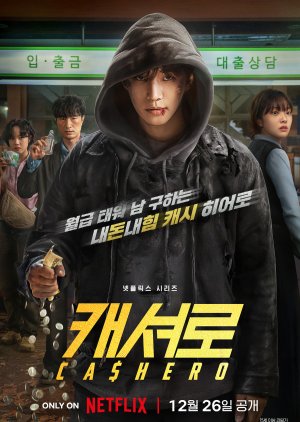
Kang Sang Ung, a public servant with superhuman strength, gains power based on the amount of cash he possesses. He struggles to maintain enough money to use his abilities. His girlfriend, Kim Min Suk, is practical and efficient but supports him despite his power’s inefficiency. Meanwhile, Byeon Ho In, a lawyer and leader of a supernatural organization, and Bang Eun Mi, a telekinetic powered by calories, also have abilities. Together, they aim to protect their normal lives from villains who seek to destabilize the world. (Source: kisskh) ~~ Adapted from the webtoon "Cashero" (캐셔로) by team befar, written by Lee Hoon (이훈) and illustrated by No Hye Ok (노혜옥). Edit Translation
- English
- ภาษาไทย
- Arabic
- Українська
- Native Title: 캐셔로
- Also Known As: Kaesyeoro
- Director: Lee Chang Min
- Screenwriter: Jeon Chan Ho, Lee Je In
- Genres: Action, Comedy, Drama, Fantasy
Where to Watch Cashero
Subscription
Cast & Credits
-
 Lee Jun HoKang Sang UngMain Role
 -
 Kim Hye JunKim Min SukMain Role
 -
 Kim Byung ChulByeon Ho InMain Role
 -
 Kim Hyang GiBang Eun MiMain Role
 -
 Kang Sang JunDirector Ki [Anna's confidant]Support Role
 -
 Kang Han NaCho Anna [Criminal Society's member]Support Role










Reviews

 2
2 2
2 2
2 1
1 1
1 1
1 1
1This review may contain spoilers
The Premise Runs Out of Money
Cashero presents itself as a deft combination of superhero spectacle and social commentary, but the series ultimately falters due to its lack of narrative clarity and discipline. What begins as an intriguing and socially attuned premise deteriorates into a confused and unevenly written drama.The story follows Kang Sang-ung, a timid civil servant whose distant and abrasive father leaves him with an unwanted supernatural ability. Sang-ung can access extraordinary physical strength only when carrying physical cash. The greater the amount of money on his person, the stronger he becomes, yet every use of the power directly consumes that cash. Within the South Korean context, where housing insecurity and financial anxiety shape the lives of many young adults, the metaphor is immediately resonant.
Sang-ung has no desire to become a hero. His ambitions are modest and personal, focused solely on saving enough money to buy an apartment with his girlfriend, Kim Min-suk, an accountant. Acts of altruism are something he actively avoids, and only external pressures force him into reluctant intervention.
In its early episodes, Cashero gestures toward a compelling ethical dilemma. The tension between personal survival and social responsibility is briefly explored through the mechanics of Sang-ung’s power. Because his strength depends entirely on liquid cash rather than credit cards, every sudden influx of money becomes a ticking clock. The question of whether he can secure his savings before being compelled into action initially provides narrative urgency.
This tension is squandered almost immediately. A prolonged early arc centered on an unexpected bag of cash exhausts the concept in one stroke, leaving little room for escalation or variation. What should have been an enduring source of suspense instead becomes a prematurely resolved gimmick.
Despite the conceptual richness of its premise, the series rarely examines its implications beyond surface-level humor. Recurrent jokes about masculinity and financial worth, such as Min-suk secretly adding bills to Sang-ung’s wallet to test his strength, substitute for meaningful character development. Kim Hye-jun, frequently cast in assertive and complex roles, is confined to a reductive portrayal of a nagging, money-obsessed partner. Sang-ung, meanwhile, drifts through the narrative with minimal growth, protected from accountability by the show’s indulgent framing of his reluctance.
The series briefly improves when it introduces a wider ensemble of misfit heroes. Byeon Ho-in can phase through walls only when intoxicated, while Bang Eun-mi’s telekinesis is activated through binge eating. These characters provide moments of tonal relief and comic potential, yet they remain largely underused, functioning as background figures rather than narrative drivers.
As an action drama, Cashero feels generic and underpowered. Its visual effects and fight choreography lack distinction, particularly when compared with more accomplished Korean superhero series that have demonstrated greater ambition and coherence.
The most damaging flaw, however, lies in the writing itself. The series repeatedly undermines its emotional stakes through abrupt tonal shifts and a failure to maintain narrative continuity. In one especially jarring moment, Sang-ung witnesses people die violently at the hands of the villain Jonathan, only for the story to immediately pivot to a warm domestic scene in which his trauma appears to have vanished entirely.
From scene to scene, Cashero struggles to define its identity. It piles up effects-driven set pieces and incompatible emotional beats, then leaves us to reconcile the contradictions on our own.
The opening episode hints at a sharper and more disciplined series. What follows is a steady and disappointing unraveling.
Was this review helpful to you?

Wacky n Cathartic
One of the wackiest concepts I ever seen in a kdrama lol. I was all for it, but lowkey weary about the approach. Will they take it too seriously? Will they beat you over the head with the on the nose financial crisis messaging?Turns out no, it's self aware from the very get, instantly loveable, and actually peppers in the message in a fun way.
I do think this suffers from the typical *not fully thought out* disease that korean stuff falls into more and more lately, stacking up the plot holes and stretching feasibility in exchange for all momentum, but in this case it kinda plays into the concept. Money itself becomes a character equally defined by its complete power and elusiveness.
From the way it wraps up though, I get the sense they wanna push for a second season here. A bunch of stuff is left open and that message is never taken full circle.
Alas. Binged over the course of a day. It's a good quick fix mood booster.
Was this review helpful to you?