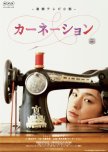
At the beginning of the Showa era, there was a girl running through the town of Kochi at an incredible speed. Her name was Asada Nobu, also known as 'Hachikin Onobu'. Meanwhile, Yanai Takashi, who lost his father to illness at a young age, was taken in by his uncle and met Nobu at the school he transferred to. As the footsteps of war approached, Nobu, who was attending a women's normal school, had become a fanatical militarist girl like the others around her. Soon, the war began, and Takashi was sent to war. Taku lost his younger brother, Chihiro, in the war, and Nobu also lost the person she loved. After graduating from a women's school, Nobu's values had all changed during the war, and she decided that she had to figure out for herself what was right, so she got a job as the first female reporter at a newspaper company in Kochi. After the war, Takashi quit his job as a scrap picker and joined the newspaper company, and the two were in charge of the same magazine. Takashi wanted to become a manga artist in Tokyo but was worried about whether he could make a living. Nobu told him, "You come later. I'll go to Tokyo first and wait for you," and quit the newspaper company and moved to Tokyo. Takashi followed Nobu to Tokyo, and they began living together in a rundown six-tatami apartment where there was no bath, the toilet was shared, and there was a hole in the ceiling, so they had to use an umbrella on rainy days, but on clear nights they could see the stars. Nobu found this lifestyle interesting, and the two got married, saying, "I want to be with someone who can enjoy any kind of environment." (Source: Japanese = NHK || Translation = kisskh) ~~ Based on the true story of Komatsu Nobu (小松暢), the wife of "Anpanman" (アンパンマン) manga and animation series creator Yanase Takashi (やなせたかし). Edit Translation
- English
- Français
- हिन्दी
- Español
- Native Title: あんぱん
- Also Known As:
- Screenwriter: Nakazono Miho
- Director: Yanagawa Tsuyoshi
- Genres: Historical, Romance
Cast & Credits
-
 Imada MioAsada NobuMain Role
 -
 Kitamura TakumiYanai TakashiMain Role
 -
 Kase RyoAsada Yutaro [Nobu's father]Support Role
 -
 Eguchi NorikoAsada Hatako [Nobu's mother]Support Role
 -
 Kawai YuumiAsada Ranko [Nobu's younger sister]Support Role
 -
 Hara NanokaAsada Meiko [Nobu's younger sister]Support Role






Reviews

The life stories of a tomboy and a milksop
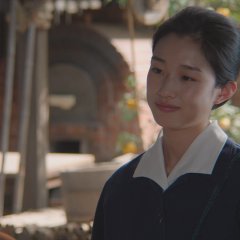
Anpan is the fictionalized biography of Komatsu Nobu and Takashi Yanase the latter of whom was a mangaka and the creator of Anpanman, a character so successful that it overtook the sales of Hello Kitty in 2002. Even from the title it's clear that the draw for this series is Anpanman, but, as the series faithfully documents, Anpanman was not created until Takashi was 50 which happens around week 21 in this series, and, even then, the anime was not created until Takashi was 69. And so the series, appropriately, is more focused on Nobu and her family. To be fair, all the evidence is that she had quite a bit more personality and more interesting jobs than her famous husband (named Yanai in this series).Nobu and Yanai met and grew up together in a small village near to and now a suburb of Kochi City on Shikoku. Young Nobu was a bit of a jock (to the extent that it was possible in the culture at the time) who would always choose to run rather walk. As is common in asadoras, a child actor (Nagase Yuzuna) performs the character in the early episodes and Imada Mio takes over starting in high school. I found Imada's performance throughout to be perfectly fine and professional playing Nobu as upbeat and energetic pretty much throughout though it must be noted that Nobu is the very rare protagonist in an asadora that spans the wars who fully supported the Japanese wars in Asia and the Pacific. She is a grade school teacher during the final years of war, dutifully and enthusiastically drills her students with the war propaganda she is required to teach. And so when Japan finally surrenders, and she sees the cost of what she and others have done, she thoroughly regrets what she had done, quits teaching and sincerely seeks ways to make the world a better place. Indeed, one of the major themes of the series is how the characters respond to their parts in the wars.
Yanai is played by Kitamura Takumi who has the much more difficult role of playing a talented artist who is self-effacing and hesitant to the point of complete and utter inertia at times. The character is unrelentingly uncharismatic, and - absolutely no shade on the actor since that is how the character is written - he effectively portrays Yanai as such throughout.
I must admit that one of the reasons that I watched this series is that Kawai Yuumi plays the oldest of Nobu's two younger sisters, Ranko. As ever, she is an upcoming actress who is one to watch - she has already won the Japanese Film Academy prize for Best Actress (read my review of A Girl Named Ann here on MDL, and then never, ever watch the film). Ranko is a perfectly fine character with her own arc through the series, but there's not all that much for Kawai to do here even as she acquits herself well as usual.
On the other hand, it was Hara Nanoka's performance as Nobu's youngest sister, Meiko, that really caught my eye, and had me searching to see what else she has been in. Her portrayal of Meiko's crush on one of Yanai's friends is both delightful and hilarious. Meiko led the most conventional life of the three sisters, and so there is not that much for character to do in the second half of the series, but her turn in that first half is very fun.
Anpanman itself is a very strange character: a hero who happily offers his head to be eaten by the starving and always nonviolently fights to help people. And so this series is about how that character came to be, and the parts of that character which were drawn from the lives of the people around the real Takashi. I do think the series is successful in telling that story, and I also think it is reasonably fun and entertaining along the way. If you're a fan of Anpanman, then it's probably a must-watch. If you like asadoras as genre then it's well worth the watch: I have this one as above average though not near the greats like Amachan, Tora ni Tsubasa, Oshin and Gochisosan (the latter three of which span roughly the same historical time period). For the general viewer who is unacquainted with the format it's perfectly fine, but there are better ones to introduce you to them.

"Why were you born? How will you live your life?"
"Anpan" is my 38th asadora watched. I want to extend my sincere thanks to Irozukusubs for subbing this asadora. "Anpan" was a fun watch. The first two thirds of it is really solid, but I think it loses its charm/momentum in the third act. Let me explain... P.S. some major spoilers follow!"Anpan" is inspired by the lives of "Anpanman" creator Yanase Takashi (played by Kitamura Takumi) and his wife Komatsu Nobu (Imada Mio). For this retelling, their last names are changed to Yanai and Asada in order for NHK to take liberties with the story. The one major example being that Takashi and Nobu are portrayed as childhood friends, when they actually met as adults in real life. It's a mix of fact and fiction.
The first two thirds of the drama focus more on Nobu and her development as a character. She's very engaging and interesting. Starting off the series as a tomboy and then becoming a hardcore militarist during the War. Asadoras rarely show heroines being on the "wrong side" of history, so I liked this element even if Nobu was somewhat frustrating during this part. Takashi, if we're being honest, isn't given that much character development. He starts as a pure-hearted softie and ends that way. However, for that reason, it's hard to watch him going through his adolescent struggles and then the War.
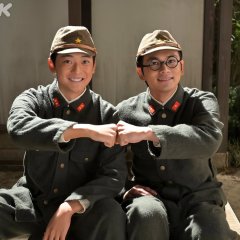
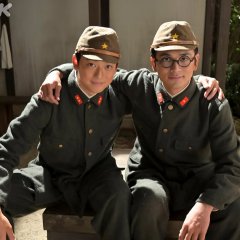
It's strange to call World War II the highlight of this asadora, when it's usually the part I get tired of the most in asadoras. It's when Nobu is at her most interesting and tragic watching her come to terms her complicity as a grade school teacher. Takashi also really shines in this part with several episodes being dedicated solely to him as he goes through army training and then he's shipped off to China. Those episodes showing him starving on the battlefield are incredibly poignant and heartbreaking.
Following the War, Nobu and Takashi are reunited at a newspaper office. She then departs for Tokyo to work with a politician as shes searching for a "justice that can't be overturned." Takashi eventually follows and the pair marry. This is where the asadora falls victim like most "couple asadoras." Less is focused on Nobu's career and she really just becomes his support system as Takashi takes the main stage. This reminded me a bit of "GeGeGe no Nyobo" but it's frustrating since Nobu was such a strong character beforehand. Additionally, because Takashi doesn't actually start "Anpanman" until 1973, it feels like there's a lot of meandering as we watch him struggle to become a manga artist. He also had such a varied career that the focus seems to go everywhere to be honest.
Though the main characters are charming themselves, I had a lot of favorites among the supporting cast. I particularly loved Nanako Matsushima as Tomiko, Takashi's mother who abandons him. She plays the complicated woman so well, making her equally likable and unlikable. A special shout-out to Ninomiya Kazunari for playing Takashi's father for two poignant scenes. Kawai Yuumi is also amazing as Ranko, Nobu's middle sister. She's so good that I hope she gets her own asadora eventually. Hare Nanoka is adorable as the youngest sister Meiko, though the character becomes less interesting in the third act. As there are two many characters to talk about, I mention just a couple more. I also particularly loved Takashi's uncle (Takenouchi Yutaka), the absolute best; Takashi's friend and Army superior Yagi (Tsumabuki Satoshi); and lastly the newspaperman Shoji (TsudaKenjiro). There's lots more.
Rare for an asadora, the heroine is actually married twice which is actually true to life. Nobu marries Wakamatsu Jiro (Nakajima Ayumu) through an arranged marriage. Jiro is quite sweet, and though I wasn't a fan of the age gap, I felt quite sad when he passed away. Surprisingly, I wasn't that annoyed that Nobu and Takashi didn't get together until the last third of the asadora. I felt natural and their cuteness as a couple was worth the wait. I liked the other couples of the asadora, Ranko and Go (Hosoda Kanata), Ranko and Yagi, and Meiko and Kentaro (Takashashi Fumiya).
As a tribute to "Anpanman," it's a tad disappointing that it isn't focused on until the last five weeks or so of the asadora. I suppose it can't be helped, considering the real life circumstances. However, it significantly contributes to the unevenness of the last third of the asadora. At some point, you're just waiting for "Anpanman" to happen and it feels like a long wait. Despite this, "Anpan" is a good asadora with lots to love and enjoy. I waffled a bit between rating it 8.5 or 9, and settled on 9 because the first two thirds are really good. It won't go down as the best asadora, but I'm sure it'll bring many smiles and tears to those who watched it. I'm glad I watched it.
My Asadora Ranking: https://kisskh.at/list/LAlqpp21