This is life
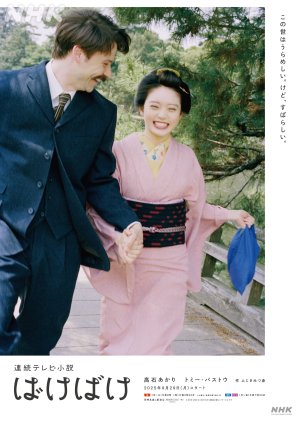
Ordinary scenes like skipping, walking, or even arguing over the gender of a bird aren’t usually the focus of a drama, but that’s exactly what they want to portray: the simple, everyday life the two of them shared. Much like in real life, there are only a few times where we celebrate special days or lament the darkest times; most of our lives are spent in ordinary days, and finding little joys is what makes them meaningful.I also think that this concept wouldn’t work if not for the strong performances and amazing chemistry the actors have shown in the drama. This applies not only to the main couple but also to Toki and Sawa, Heavin and Nishikori, the Matsuno family, and heck, even the innkeeper couple. They’re all perfectly in sync, from the bickering to sensing the slightest shifts in emotion. They are truly what made this drama with a simple concept worth watching.
Also worth mentioning that this is some *WOWOW level of cinematography, scoring, and direction you don’t normally see in a typical asadora. Not a shot missed; every angle has truly captured the best acting moments of each actor.
Bakebake perfectly captured the gentle atmosphere of domestic happiness. And it has been a joy watching as a quiet spectator to the ordinary but subarashii life that Jigoku and Shijimi had.
*JP broadcast company known for delivering quality works.
Was this review helpful to you?

A Slow-burn Love Story Between A Western Writer And A Samurai Daughter
ばけばけ or The Ghost Writer's Wife is the fictionized biography of Lafcadio Hearn (called Lefcada Heavin here) and Koizumi Setsuko (called Matsuno Toki or Otoki here). Hearn was born in Greece and raised in boarding schools in Ireland. He moved to America at 19 and became a successful journalist and reporter in Cincinnati and New Orleans before further roving the world to write travelogues at 37. Setsuko was the daughter of a samurai family who were at bit of a loss at what to do after the feudal structure in Japan was eliminated by the Meiji Restoration. This series begins shortly after Hearn landed in Japan at age 40 and took a job as an English teacher at a middle school in Matsue.Hearn was clearly a bit of an eccentric even by the standards of his time and place. He had damaged his left eye when playing ball at age 16 and completely lost the sight in that eye, and had always been myopic to begin with. Hearn was pretty distant from his immediate family and so was a bit rootless. Heavin is presented as a kind of an ur weeb: he is utterly taken with Japanese culture and fascinated by its traditions, customs and folklore. Heavin is played by Tommy Bastow who had previously appeared in 2024's Shogun.
We get quite a bit more of Otoki's backstory in this series. Her grandfather had been a retainer of the local Daimyo in Matsue, and he is committed to the old ways of the samurai. But the family's income was eliminated after the Meiji restoration, and an important part of the plot of the series is how inept her father is after the transition to the new constitution and economic structure under the Meiji emperor. Otoki is played by Takaishi Akari, and about 5 weeks into the series I was like, "Who is this actor, and what else has she done?" I do recommend her strikingly different but equally great performance as a teenaged assassin in the Baby Assassin franchise (3 movies and a television series to date). Takaishi has a very readable face, IMO, and much of the charm of this series is that it is very easy to guess (or project onto) what Otoki is thinking in her silent reaction shots.
Takaishi won best actress and Bastow won best supporting actor for their performances in ばけばけ at the Television Drama Academy awards in March.
The focus of this series is more on Otoki but we do get a bit of Heavin/Hearn's backstory along the way. I was very happy when the series spent two episodes on Heavin's prior marriage to a previously enslaved woman, Martha (Mattie Foley IRL) from when he had been a reporter in Cincinnati. I had expected the series to completely hide that part of Hearn's past, and I must give the production huge kudos for casting the black American actress Misha Brooks - I am no expert in what Ohio accents would have been in mid-1870s Ohio, but Brooks' modern midwestern accent is perfect for the part, and her performance is notably good in this brief tangent for the series. Notably less good is how the writer chose to end those episodes which I shall rant about as an as a slightly spoilery option at the end of this review.
The writing and the direction in this series are well above the average for asadoras as well. One of the key directorial choices throughout the series is to get a bit closer to natural lighting throughout. Thus, the relatively frequent night scenes are often lit by candle light, and the production sometimes leans a bit hard into the darkness. Everything is pretty much discernable, but you might wish to watch this on a larger screen at night to get the full experience and enjoyment of this series.
By any standards this series is not a quick romance, but it is a delightful and beautiful one. The two do not meet and instantly fall in love, and the process of their getting from here to there is quite lovely. Otoki has an unusual (for her time and place) interest in ghost stories from well before she ever met Heavin, and Heavin discovers a mutual interest in them through her recounting of them to him. As writer Heavin is initially just looking for a source for stories he can incorporate in to his books being printed and sold overseas, but ultimately has his life is changed and unexpectedly fulfilled by this interesting and unique woman from a distant culture. ばけばけ nails that process of bonding, and the series is heartwarming and moving throughout. It is well worth the time investment for the watch.
Beyond here lieth spoilers for two episodes (out of 125) in the middle of the series:
Look. I understand the writer's challenge of trying to present and wrap up Hearn's relationship to his first wife in 30 minutes of television. Hearn did indeed get fired from his newspaper when his editors learned that he was married to a previously enslaved woman. But what the series did not have time to explain was that Hearn then just started working for the competing paper in town and the circulation went up at that other paper because of his writing to the point that the previous paper tried to hire him back. In real life, Hearn and Mattie were married for a few years, and tried to reconcile several times but ultimately drifted apart permanently, and then Hearn moved to New Orleans. Part of what came between them was undoubtedly the racism of the time - mixed-race marriages were not legally acknowledged in Ohio until a few years after Hearn and Mattie parted ways, and one can only imagine the pressures the two experienced while they were together. It is indeed difficult to tell that story in a brief aside in this series.
Nevertheless, choosing to present the reason that Heavin and Martha broke up is because Martha attacked her boss with a razor is shockingly racist. The whole scene is maybe 3 minutes in a 9,375 minute drama, and so I cannot condemn the whole series for that one scene, but there has to have been a way to write a permanent ending for Heavin and Martha's relationship without making Martha a violent, razor wielding criminal.
Was this review helpful to you?

This review may contain spoilers
"Wonderful everyday moments"
"Bakebake" is my 39th asadora watched. I've been highly anticipating this asadora since it was announced due to my love for "Massan" which has a similar cross cultural romance. In my anticipation, I decided to read a biography on Lafcadio Hearn (renamed Lefkada Heavin for this asadora) titled "The Outsider: The Life and Work of Lafcadio Hearn." This way I was able to relive my first asadora experience with "Hanako to Anne," for which I read the biography on which it was based. Of course, "Bakebake" is more based on the life of Lafcadio's wife Koizumi Setsuko (renamed Matsuno Toki) so I consider the biography to be background reading since a majority of it focuses on Lafcadio's life before Japan.As an asadora, "Bakebake" is unique in many aspects. Firstly, it is set roughly from 1875 to 1905. Very few asadoras are set entirely pre-WWII. [The majority of the storyline also takes place in 1890-91.] Secondly, "Bakebake" is able to maintain a light-hearted vibe despite also dealing with heavy topics like poverty, death, and sickness. Sad episodes are often punctuated with a joke or two, causing me to laugh through my tears. Thirdly, the asadora is more of a slice of life story in the same vein as "Hiyokko." Simple day to day life and the residents of Matsue are given the focus instead of a goal/career like in other asadoras.
"Bakebake" is also what I call a "couple asadora," meaning that it focuses on a couple as the leads. Though this isn't unique, it's been since 2014's "Massan" that a non-Japanese person was the co-lead. And really we were truly blessed with Toki (Takaishi Akari) and Heavin-san (Tommy Bastow). Their easygoing chemistry makes for one of the best asadora couples put to screen. Personally I'd put "Bakebake" slightly above the other best couple asadoras, "Massan" and "Yell," while also having the romance on par with my favorite in "Asa ga Kita." Toki and Heavin's romance is the ultimate slow burn romance full of anticipation and sweet, heartwarming moments. Several moments made my heart flutter.
Toki is an endearing heroine because of her loyalty towards her family and her love for ghost stories. Unlike other heroines, she is not pursuing a career instead being motivated to work to pay off her family's debt. Despite her circumstances, Toki finds the joy in little things like eating dinner with her family or sleep paralysis(?). It's truly a joy to just watch Toki smile. As for Heavin, Tommy Bastow plays him wonderfully but I feel the writers do him a disservice. I wish the story had shown more of Heavin before Japan instead of just the brief snippets. His personality and motivations could've been explained and fleshed out more. (Fun fact: Lafcadio's volatile personality is heavily sanitized for this asadora.) I wanted more scenes like the ones with the maid Ume (Nouchi Maru), in which he was insistent on going to the eye doctor since he was self-conscious of his.
A few more grips with the story. I feel like the flashback with his first wife, Martha (Meisha Brooks), could've been handled differently. Something about it didn't set well with me. Also, I was highly disappointed with the character of Eliza Belsland, played by my beloved Charlotte Kate Fox from "Massan." I wasn't a fan of her dialogue most of the time nor that she was in love with Heavin. However, the clincher was her yelling at Toki in the final episodes. It was completely unnecessary. For those curious, Eliza was based on Lafcadio's real-life friend journalist Elizabeth Bisland, whom doesn't appear to have had any romantic feelings towards him.
Now for the section where I praise all of the side characters. My personal favorite was Sawa (Marui Wan), Toki's best friend whom wants to lift her family out of poverty on her own. Her romance with Shoda (Hama Shogo) was sweet. Nami (Sato Honami), a prostitute in the red light district, also had a cute friendship with Toki and Sawa. As for Toki's family, they're all lovable even Toki's father Tsukasanosuke (Okabe Takashi) and grandfather Kaneimon (Kohinata Fumiyo) who cause her troubles while they hold on to a bygone way of life. Kitagawa Keiko plays Toki's aunt/birth mother Ushimizu Tae with an understated gracefulness. Lastly, I can't move on from this section without mentioning Nishikori-san (Yoshizawa Ryo), the unofficial third main character for much of the story. Yoshizawa is truly a great actor because his characters always leave a lasting impact. I still remember him so clearly as Tenyo in "Natsuzora."
Lafcadio's best known book "Kwaidan" was written shortly before he died, a fact I had forgotten as I waited in anticipation for it to be covered. The homage paid to the book was very much worth it. I particularly loved the reference to "Hoichi the Earless." I'd highly recommend watching the 1964 film "Kwaidan" if you're curious about Lafcadio's stories.
In the last episode of the asadora, Toki's mother Fumi (Ikewaki Chizuru) uses this phrase "Simple truly simple, wonderful everyday moments" while talking about Toki and Heavin's life together. For me, this phrase perfectly encapsulates this asadora. It is made up entirely of the simple moments in life that make it worth living. I'll miss "Bakebake" so much though I'll continue to hold it in my heart.
My Asadora Ranking: https://kisskh.at/list/LAlqpp21
Was this review helpful to you?