An Arthouse Slice Of College Life About Grief And Kokuhaku
I'm going to begin this review where I usually end a review by telling you who I think will enjoy this film and who will not. Because, more so than usual, this film is hard to rate even on the three dimensions that MDL provides (I never care about the rewatch value).If you are a film studies major or consider yourself a cinephile, then this film is a must-watch. Similarly, if you are a fan of or are following any of the three main actors Ito Aoi, Kawai Yuumi and Hagiwara Riku, the film is also a must-watch. However, if you're not in any of those groups, it's almost certainly not worth your time.
The film tells the story of Toru (Hagiwara Riku) who has returned to college after a break for personal reasons. We never learn that much about him. He has one friend, Yamane, and works a post-closing shift at a family-run bathhouse where he has a nice convivial relationship to the owners. He has little to no interest in his classes and ignores their existence to the extent he can. (He walks into a couple of ongoing lectures and starts full-voiced conversations with his schoolmates in a way I never experienced in giving a couple hundred lectures at a Cal State University. I know Japan has a reputation for college life outside of the major research institutions being very not focused on academics, but I'm not sure how realistic those scenes are given how polite and aware of other's spaces the rest of Japanese society is.)
The two major themes of the film are grief and love confessions (kokuhaku), and that's a very odd and difficult combination to pull off, and which I presume come from the novel that the film is based on. Nevertheless, that combination is a young actor's wet dream for all three of the principals, and the writer/director, Ohku Akiko, gives the cast amazing opportunities to show what they can do with a long monologue for each of them, and each staged and shot in very interesting ways. Saki's monologue is probably the best, but while it could have been shot in a couple of one-takes of Ito, Ohku cuts in reaction shots, and so we can't be certain. Nevertheless, the film also flashes back to it a few times. Hana's monologue is given in an extreme close-up one-take, and, you know, it's Kawai: of course she nails it.
A secondary theme of the film is supposed to be serendipity which we know because The Three Princes Of Serendip is mentioned a few times. But while there are several unplanned discoveries in the course of the story, by no means are all of them fortunate in any sense. In fact, the story largely tilts its umbrella towards the rains of melodrama while maintaining some distant rays of possible romance.
And so we reach the best and worst thing about the film: Ohku's craft. The blocking, the framing, the camera placement, and the camera movements are frequently amazing throughout the film. But she pushes the techniques to the point that it's sometime hard (at least for me) to understand what she is trying to say by using them. She changes the aspect ratio at one point for a bit, and I have no idea why. She does a sudden zoom in to an extreme close up on Kawai's face in her monologue, but the zoom is done a bit into the monologue for reasons? I have seen other pieces of Okhu's work (please, please seek out her series for NHK, Kazoku Dakara Aishitan Janakute, Aishita no ga Kazoku Datta also starring Kawai- it's currently available on Netflix internationally under the name "My Family"), and so I know that she's a master of the art of film and that these choices are intentional, but this particular work is hard to follow in some moments. And sometimes the techniques can call attention to themselves in ways that pull you out of the film.
As a writer, Ohku also chooses to leave some story points ambiguous in ways that will almost certainly be unsatisfying for some viewers. Was that time lapse of Toru sitting on a pole for a day, his being stood up? I'm not certain. Are the cuts to things Hana is saying to her co-workers about Toru reality or his fantasy? I don't really know for sure. And how does Hana react at the end of the film? It's left to our imagination.
Nevertheless, I thoroughly enjoyed the craft and performances in this film. It's a relatively small story with some very moving moments carried by some fantastic young actors.
Was this review helpful to you?
This review may contain spoilers
Once the dialogue is digested, you get yourself a decent film
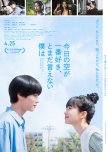
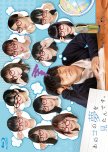
She Taught Me Serendipity, along with it's translated title I Can't Say Today's Sky Is My Favourite are both quite fitting titles for this movie.We have our male lead, Konishi, who is an odd college fellow who uses his umbrella no matter the weather. He was on leave for 6 months and just returned to campus. He instantly is captivated by Sakurada who has a large hair bun and is always by herself. He has a part time job at the public bath where our second female lead, Sacchan (Saki) also works. Sacchan is in a school band and is very cheery, unlike Konishi.
On the surface I think this movie may not resonate too much with some viewers. It is heavy with lines, has some very weird transition shots, and a plot that is good but falls into that usual communication between characters problem. However, the acting, especially from Kawai Yuumi and Ito Aoi really do carry a lot of the memorable weight of the movie. Personally, I was a bit bored on my first watch and had to carve out time to re-watch it to appreciate the movie a bit more.
The deeper layer for this movie is quite well done by the writer and director, Ohku Akiko. She blends humour and every day thoughts into quirky and fun dialogue. The first half of the movie reminds me a lot of Richard Linklater's Before Sunrise in which a man and woman meet and have a long evening together getting to know one another with tons of relatable dialogue. Sakurada as a character is great. She has grown up with a fairly large issue that caused her to have no friends. She doesn't want to be seen by others and treats her large hair bun as a type of armour against those who may look at her. Konishi is similar in which he thinks he can hide from the gazes of others with his umbrella. Sakurada is more written and developed as she has her quirks like listening to the TV at full volume, and reading about The Three Princes of Serendip, to which accounts for the two main characters meeting and getting along well in a serendipitous fashion. She is the lead of the two and brings some interests to Konishi. The two even go into a local restaurant where the owner himself wishes to "hide" a menu item and digs further into the theme of having these pasts that don't wish to be shared.
After the half way mark we have a fairly large turn. Sacchan has a wonderfully long scene with Konishi that is a stand out scene. The lines she delivers is touching and memorable not only for us, but our main characters as well. From then on we get an act that I understand what it is going for, but is really just communication problems among the characters, and even hallucinations that throw us viewers for a loop. The resolution comes with some drama and is it enough of a pay off? Personally for me, it was good, but some scenes just did not fit the environment and takes away from the emotion. Sakurada has a fairly long take filled with lines that is done very well and I feel needs to be pointed out.
My biggest gripe would have to be Konishi. He is written to be a fairly flat and boring character. While there are things written to develop him only in the end, he doesn't really do anything with the supporting characters and it makes me question how some of them can feel the way they do.
Overall though, the little details of dialogue, the way words are said, the two female leads delivering detailed and relatable lines, and a decent plot are great positives for this movie. The odd transitions of slow motion and zooms, the somewhat boring male lead, communication issues, and odd scenes here and there that don't really fit do take some points away from this movie. But I see these points at the deeper level of watching to which the good outweighs the not-so-good, so I can easily recommend this to those who want to pay attention and even learn a bit about young adult life lessons. Obviously Kawai Yuumi fans as well.
Was this review helpful to you?

Un petit coin de parapluie
Les équipes marketing des distributeurs français me laissent parfois pantois. Alors que l'on pourrait traduire le titre original de ce énième film indépendant distribué par Arthouse par le titre « Je ne peux toujours pas dire que le ciel d'aujourd'hui soit mon préféré », empreint de poésie et d'autoréférence, on a plutôt droit à un nom accrocheur pour retraités de la fonction publique ne pouvant plus voyager. Ils rêvent alors de découvrir des lieux emblématiques de l'ancienne capitale, saupoudrés de romance et de geishas en kimono. Ils seront certainement déçus par ce énième triangle amoureux, révélé dès les premières minutes, mais qui s'étire pendant deux heures et comme seuls les Japonais (et les Français) en ont le secret.Nulle contemplation des lieux célèbres de Kyoto ici. Nous suivons plutôt une slice of life dans une université, mettant en scène trois étudiants solitaires, mais qui ont tout de même des amis. Oui, cette information est importante et rappelée durant l'ensemble du film. On peut être ultra-renfermé, beau gosse, jouer dans un groupe de rock, guitare à la main, ou servir des cafés à des clients bien plus âgés avec le sourire, être pleine de vie et pourtant n'avoir ni amourette ni véritable cercle d'amis. Si, pour la centième fois dans une œuvre japonaise, vous passez une nouvelle fois ce cap psychologique, vous apprécierez les moments de contemplation, la parabole du parapluie, omniprésente, ainsi que les conversations parfois lunaires de trois étudiants découvrant leurs premiers émois amoureux.
Bien sûr, c'est plein de tendresse, notamment grâce à un chien beaucoup trop chou, même si tous les dermatologues du monde seront outrés par la quantité de poils dégagée au mètre cube. À priori, les poils humains semblent poser plus de problèmes aux Japonais que ceux des animaux, mais ce sont surtout les sentiments envers les êtres à deux pattes qui ont du mal à s'exprimer, alors que, pour nos amis à quatre pattes, ils débordent littéralement de la pellicule.
Mais c'est surtout, une fois de plus, le talent de Kawai Yuumi qui dégouline de ce trop-plein de kawaii attitude. La blague est toujours trop facile avec son nom, mais il faudrait aussi qu'elle arrête d'être, à chacune de ses apparitions, la petite amie idéale. Elle prend ce petit accent du Kansai que tous les acteurs semblent essayer d'adopter dans le film avec plus ou moins de réussite, et bien sûr, elle fait succomber chaque spectateur. Lunaire mais radieuse, elle étudie peut-être la philosophie ou la psychologie, mais elle aurait tout aussi bien pu être étudiante en art, recouverte de peinture. Le film rappelle au passage que le chignon est le summum de l'extravagance au Japon et la cause apparente de son incapacité à s'intégrer à un groupe d'amis.
Hagiwara Riku est transparent, comme son rôle l'exige, tandis que Ito Aoi incarne l'amoureuse transie, repérable dès les premières minutes. Bien sûr, Riku-kun est le seul dans la salle de cinéma à ne pas s'en rendre compte. Sous ce principe de shōjo qui agace le quinquagénaire que je suis, j'allais finir par écrire une critique acerbe, alors même que les critiques était plutôt bonnes pour ceux qui ont eu la chance de voir le film sur Netflix Japon, où il est disponible depuis un bon moment.
Mais, évidemment, toutes les longueurs, les effets de style, comme le rétrécissement progressif du cadre pour illustrer le rapprochement des personnages, ou encore tous les ralentis sous la pluie ou de la course du clebs, ne sont là que pour poser les bases de la seconde partie. Commencent alors une recherche, une enquête et un questionnement qui emmènent le public bien loin des considérations adolescentes de la première heure, trop ennuyeuse avec ses déclarations d'amour et ses monologues convenus.
Il faudra suivre le questionnement de notre héros, même si le spectateur se doute rapidement de bien des choses, tant la mise en scène et les allusion aux personnes disparues ne laisse guère de place quant au dénouement. Tout juste sera-t-il surpris par les dernières minutes, mais c'est bien peu connaître le rapport à la vie, à la mort et à la famille qu'entretient souvent le cinéma japonais. N'est-ce pas justement le but des distributeurs indépendants que de faire découvrir la sensibilité de ce pays ? Un film à voir et à apprécier, donc, pour ce qu'il est, mais surtout à ne pas résumer, car il perdrait alors tout son intérêt.
Was this review helpful to you?