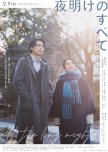
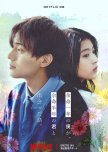
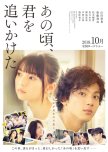
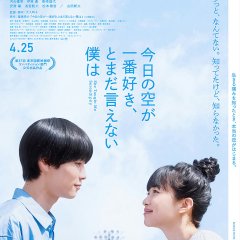
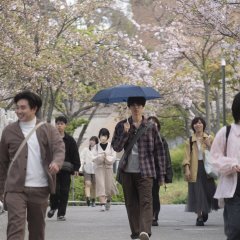
Toru returns to the campus of his Kyoto university after a long hiatus. He’s carrying an open umbrella on a sunny day with not a trace of self-consciousness. He meets his only friend, the goofy loquacious Yamane and in the evening goes to his part-time job cleaning a public bath. His co-worker, the bubbly Sacchan, is a fellow student as well as the talented lead singer and guitarist in an amateur band. But Toru’s attention is drawn to Sakurada Hana, a loner girl with her hair up in a bun who is in one of his lecture classes. He contrives to make her acquaintance and discovers that she more than matches him quirk for quirk – Toru believes he’s found his soulmate and after they part literally jumps for joy, but... (Source: fareastfilm.com/eng) ~~ Adapted from the novel "Kyou no Sora ga Ichiban Suki, to Mada Ienai Boku wa" (今日の空が一番好き、とまだ言えない僕は) by Fukutoku Shusuke (福徳秀介). ~~ Release dates: Oct 29, 2024 (Festival) || Apr 25, 2025 (Cinema) Edit Translation
- English
- Русский
- Français
- हिन्दी
- Native Title: 今日の空が一番好き、とまだ言えない僕は
- Also Known As: Kyo no Sora ga Ichiban Suki, to Mada Ienai Boku wa , Kyou no Sora ga Ichiban Suki, to Mada Ienai Boku wa , きょうのそらがいちばんすきとまだいえないぼくは
- Screenwriter & Director: Ohku Akiko
- Genres: Romance, Life
Cast & Credits
-
 Hagiwara RikuKonishi ToruMain Role
 -
 Kawai YuumiSakurada HanaMain Role
 -
 Ito Aoi"Sacchan"Support Role
 -
 Kurosaki KodaiYamaneSupport Role
 -
 Anzai Hajime[Master]Support Role
 -
 Asaka Kodai[Sacchan's father]Support Role





Reviews

An Arthouse Slice Of College Life About Grief And Kokuhaku
I'm going to begin this review where I usually end a review by telling you who I think will enjoy this film and who will not. Because, more so than usual, this film is hard to rate even on the three dimensions that MDL provides (I never care about the rewatch value).If you are a film studies major or consider yourself a cinephile, then this film is a must-watch. Similarly, if you are a fan of or are following any of the three main actors Ito Aoi, Kawai Yuumi and Hagiwara Riku, the film is also a must-watch. However, if you're not in any of those groups, it's almost certainly not worth your time.
The film tells the story of Toru (Hagiwara Riku) who has returned to college after a break for personal reasons. We never learn that much about him. He has one friend, Yamane, and works a post-closing shift at a family-run bathhouse where he has a nice convivial relationship to the owners. He has little to no interest in his classes and ignores their existence to the extent he can. (He walks into a couple of ongoing lectures and starts full-voiced conversations with his schoolmates in a way I never experienced in giving a couple hundred lectures at a Cal State University. I know Japan has a reputation for college life outside of the major research institutions being very not focused on academics, but I'm not sure how realistic those scenes are given how polite and aware of other's spaces the rest of Japanese society is.)
The two major themes of the film are grief and love confessions (kokuhaku), and that's a very odd and difficult combination to pull off, and which I presume come from the novel that the film is based on. Nevertheless, that combination is a young actor's wet dream for all three of the principals, and the writer/director, Ohku Akiko, gives the cast amazing opportunities to show what they can do with a long monologue for each of them, and each staged and shot in very interesting ways. Saki's monologue is probably the best, but while it could have been shot in a couple of one-takes of Ito, Ohku cuts in reaction shots, and so we can't be certain. Nevertheless, the film also flashes back to it a few times. Hana's monologue is given in an extreme close-up one-take, and, you know, it's Kawai: of course she nails it.
A secondary theme of the film is supposed to be serendipity which we know because The Three Princes Of Serendip is mentioned a few times. But while there are several unplanned discoveries in the course of the story, by no means are all of them fortunate in any sense. In fact, the story largely tilts its umbrella towards the rains of melodrama while maintaining some distant rays of possible romance.
And so we reach the best and worst thing about the film: Ohku's craft. The blocking, the framing, the camera placement, and the camera movements are frequently amazing throughout the film. But she pushes the techniques to the point that it's sometime hard (at least for me) to understand what she is trying to say by using them. She changes the aspect ratio at one point for a bit, and I have no idea why. She does a sudden zoom in to an extreme close up on Kawai's face in her monologue, but the zoom is done a bit into the monologue for reasons? I have seen other pieces of Okhu's work (please, please seek out her series for NHK, Kazoku Dakara Aishitan Janakute, Aishita no ga Kazoku Datta also starring Kawai- it's currently available on Netflix internationally under the name "My Family"), and so I know that she's a master of the art of film and that these choices are intentional, but this particular work is hard to follow in some moments. And sometimes the techniques can call attention to themselves in ways that pull you out of the film.
As a writer, Ohku also chooses to leave some story points ambiguous in ways that will almost certainly be unsatisfying for some viewers. Was that time lapse of Toru sitting on a pole for a day, his being stood up? I'm not certain. Are the cuts to things Hana is saying to her co-workers about Toru reality or his fantasy? I don't really know for sure. And how does Hana react at the end of the film? It's left to our imagination.
Nevertheless, I thoroughly enjoyed the craft and performances in this film. It's a relatively small story with some very moving moments carried by some fantastic young actors.
Once the dialogue is digested, you get yourself a decent film
She Taught Me Serendipity, along with it's translated title I Can't Say Today's Sky Is My Favourite are both quite fitting titles for this movie.We have our male lead, Konishi, who is an odd college fellow who uses his umbrella no matter the weather. He was on leave for 6 months and just returned to campus. He instantly is captivated by Sakurada who has a large hair bun and is always by herself. He has a part time job at the public bath where our second female lead, Sacchan (Saki) also works. Sacchan is in a school band and is very cheery, unlike Konishi.
On the surface I think this movie may not resonate too much with some viewers. It is heavy with lines, has some very weird transition shots, and a plot that is good but falls into that usual communication between characters problem. However, the acting, especially from Kawai Yuumi and Ito Aoi really do carry a lot of the memorable weight of the movie. Personally, I was a bit bored on my first watch and had to carve out time to re-watch it to appreciate the movie a bit more.
The deeper layer for this movie is quite well done by the writer and director, Ohku Akiko. She blends humour and every day thoughts into quirky and fun dialogue. The first half of the movie reminds me a lot of Richard Linklater's Before Sunrise in which a man and woman meet and have a long evening together getting to know one another with tons of relatable dialogue. Sakurada as a character is great. She has grown up with a fairly large issue that caused her to have no friends. She doesn't want to be seen by others and treats her large hair bun as a type of armour against those who may look at her. Konishi is similar in which he thinks he can hide from the gazes of others with his umbrella. Sakurada is more written and developed as she has her quirks like listening to the TV at full volume, and reading about The Three Princes of Serendip, to which accounts for the two main characters meeting and getting along well in a serendipitous fashion. She is the lead of the two and brings some interests to Konishi. The two even go into a local restaurant where the owner himself wishes to "hide" a menu item and digs further into the theme of having these pasts that don't wish to be shared.
After the half way mark we have a fairly large turn. Sacchan has a wonderfully long scene with Konishi that is a stand out scene. The lines she delivers is touching and memorable not only for us, but our main characters as well. From then on we get an act that I understand what it is going for, but is really just communication problems among the characters, and even hallucinations that throw us viewers for a loop. The resolution comes with some drama and is it enough of a pay off? Personally for me, it was good, but some scenes just did not fit the environment and takes away from the emotion. Sakurada has a fairly long take filled with lines that is done very well and I feel needs to be pointed out.
My biggest gripe would have to be Konishi. He is written to be a fairly flat and boring character. While there are things written to develop him only in the end, he doesn't really do anything with the supporting characters and it makes me question how some of them can feel the way they do.
Overall though, the little details of dialogue, the way words are said, the two female leads delivering detailed and relatable lines, and a decent plot are great positives for this movie. The odd transitions of slow motion and zooms, the somewhat boring male lead, communication issues, and odd scenes here and there that don't really fit do take some points away from this movie. But I see these points at the deeper level of watching to which the good outweighs the not-so-good, so I can easily recommend this to those who want to pay attention and even learn a bit about young adult life lessons. Obviously Kawai Yuumi fans as well.