



An Arthouse Slice Of College Life About Grief And Kokuhaku
I'm going to begin this review where I usually end a review by telling you who I think will enjoy this film and who will not. Because, more so than usual, this film is hard to rate even on the three dimensions that MDL provides (I never care about the rewatch value).
If you are a film studies major or consider yourself a cinephile, then this film is a must-watch. Similarly, if you are a fan of or are following any of the three main actors Ito Aoi, Kawai Yuumi and Hagiwara Riku, the film is also a must-watch. However, if you're not in any of those groups, it's almost certainly not worth your time.
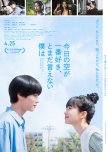
The film tells the story of Toru (Hagiwara Riku) who has returned to college after a break for personal reasons. We never learn that much about him. He has one friend, Yamane, and works a post-closing shift at a family-run bathhouse where he has a nice convivial relationship to the owners. He has little to no interest in his classes and ignores their existence to the extent he can. (He walks into a couple of ongoing lectures and starts full-voiced conversations with his schoolmates in a way I never experienced in giving a couple hundred lectures at a Cal State University. I know Japan has a reputation for college life outside of the major research institutions being very not focused on academics, but I'm not sure how realistic those scenes are given how polite and aware of other's spaces the rest of Japanese society is.)
The two major themes of the film are grief and love confessions (kokuhaku), and that's a very odd and difficult combination to pull off, and which I presume come from the novel that the film is based on. Nevertheless, that combination is a young actor's wet dream for all three of the principals, and the writer/director, Ohku Akiko, gives the cast amazing opportunities to show what they can do with a long monologue for each of them, and each staged and shot in very interesting ways. Saki's monologue is probably the best, but while it could have been shot in a couple of one-takes of Ito, Ohku cuts in reaction shots, and so we can't be certain. Nevertheless, the film also flashes back to it a few times. Hana's monologue is given in an extreme close-up one-take, and, you know, it's Kawai: of course she nails it.
A secondary theme of the film is supposed to be serendipity which we know because The Three Princes Of Serendip is mentioned a few times. But while there are several unplanned discoveries in the course of the story, by no means are all of them fortunate in any sense. In fact, the story largely tilts its umbrella towards the rains of melodrama while maintaining some distant rays of possible romance.
And so we reach the best and worst thing about the film: Ohku's craft. The blocking, the framing, the camera placement, and the camera movements are frequently amazing throughout the film. But she pushes the techniques to the point that it's sometime hard (at least for me) to understand what she is trying to say by using them. She changes the aspect ratio at one point for a bit, and I have no idea why. She does a sudden zoom in to an extreme close up on Kawai's face in her monologue, but the zoom is done a bit into the monologue for reasons? I have seen other pieces of Okhu's work (please, please seek out her series for NHK, Kazoku Dakara Aishitan Janakute, Aishita no ga Kazoku Datta also starring Kawai- it's currently available on Netflix internationally under the name "My Family"), and so I know that she's a master of the art of film and that these choices are intentional, but this particular work is hard to follow in some moments. And sometimes the techniques can call attention to themselves in ways that pull you out of the film.
As a writer, Ohku also chooses to leave some story points ambiguous in ways that will almost certainly be unsatisfying for some viewers. Was that time lapse of Toru sitting on a pole for a day, his being stood up? I'm not certain. Are the cuts to things Hana is saying to her co-workers about Toru reality or his fantasy? I don't really know for sure. And how does Hana react at the end of the film? It's left to our imagination.
Nevertheless, I thoroughly enjoyed the craft and performances in this film. It's a relatively small story with some very moving moments carried by some fantastic young actors.
If you are a film studies major or consider yourself a cinephile, then this film is a must-watch. Similarly, if you are a fan of or are following any of the three main actors Ito Aoi, Kawai Yuumi and Hagiwara Riku, the film is also a must-watch. However, if you're not in any of those groups, it's almost certainly not worth your time.
The film tells the story of Toru (Hagiwara Riku) who has returned to college after a break for personal reasons. We never learn that much about him. He has one friend, Yamane, and works a post-closing shift at a family-run bathhouse where he has a nice convivial relationship to the owners. He has little to no interest in his classes and ignores their existence to the extent he can. (He walks into a couple of ongoing lectures and starts full-voiced conversations with his schoolmates in a way I never experienced in giving a couple hundred lectures at a Cal State University. I know Japan has a reputation for college life outside of the major research institutions being very not focused on academics, but I'm not sure how realistic those scenes are given how polite and aware of other's spaces the rest of Japanese society is.)
The two major themes of the film are grief and love confessions (kokuhaku), and that's a very odd and difficult combination to pull off, and which I presume come from the novel that the film is based on. Nevertheless, that combination is a young actor's wet dream for all three of the principals, and the writer/director, Ohku Akiko, gives the cast amazing opportunities to show what they can do with a long monologue for each of them, and each staged and shot in very interesting ways. Saki's monologue is probably the best, but while it could have been shot in a couple of one-takes of Ito, Ohku cuts in reaction shots, and so we can't be certain. Nevertheless, the film also flashes back to it a few times. Hana's monologue is given in an extreme close-up one-take, and, you know, it's Kawai: of course she nails it.
A secondary theme of the film is supposed to be serendipity which we know because The Three Princes Of Serendip is mentioned a few times. But while there are several unplanned discoveries in the course of the story, by no means are all of them fortunate in any sense. In fact, the story largely tilts its umbrella towards the rains of melodrama while maintaining some distant rays of possible romance.
And so we reach the best and worst thing about the film: Ohku's craft. The blocking, the framing, the camera placement, and the camera movements are frequently amazing throughout the film. But she pushes the techniques to the point that it's sometime hard (at least for me) to understand what she is trying to say by using them. She changes the aspect ratio at one point for a bit, and I have no idea why. She does a sudden zoom in to an extreme close up on Kawai's face in her monologue, but the zoom is done a bit into the monologue for reasons? I have seen other pieces of Okhu's work (please, please seek out her series for NHK, Kazoku Dakara Aishitan Janakute, Aishita no ga Kazoku Datta also starring Kawai- it's currently available on Netflix internationally under the name "My Family"), and so I know that she's a master of the art of film and that these choices are intentional, but this particular work is hard to follow in some moments. And sometimes the techniques can call attention to themselves in ways that pull you out of the film.
As a writer, Ohku also chooses to leave some story points ambiguous in ways that will almost certainly be unsatisfying for some viewers. Was that time lapse of Toru sitting on a pole for a day, his being stood up? I'm not certain. Are the cuts to things Hana is saying to her co-workers about Toru reality or his fantasy? I don't really know for sure. And how does Hana react at the end of the film? It's left to our imagination.
Nevertheless, I thoroughly enjoyed the craft and performances in this film. It's a relatively small story with some very moving moments carried by some fantastic young actors.
Was this review helpful to you?


