I loved it! 9.5
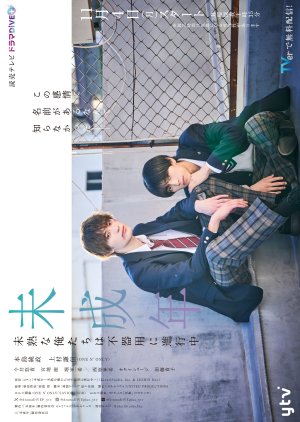
Am I the only one who thinks that flaws in characters make BL even better? A lot of people enjoy BL because of the vulnerability the characters carry. For me, my all-time favourite BL is Our Youth. It’s the kind of BL I always recommend to people who like emotional, character-driven stories.Our Youth follows two students—one a troublemaker, the other a perfect student—played by Minase and Hirukawa. The story unfolds when Hirukawa, the troublemaker, transfers to Minase’s school and ends up living on the same route as him.
Small spoiler: Hirukawa is a victim of domestic abuse. I won’t say more because I don’t want to spoil the experience for you. Now let me talk about the things I loved about this BL.
1. The stillness
This drama carries a beautiful stillness—calmness mixed with inner chaos. I loved how the scenes unfolded slowly and quietly, letting emotions breathe.
2. The acting
The actors truly became their characters. I’m not talking about their handsomeness (though they are handsome). Their performances felt natural and honest.
I especially loved Hirukawa’s duality—fearless on the outside, painfully vulnerable in front of Minase. You can see everything in his eyes. In some scenes he says one thing, but his eyes reveal the truth: he wants to scream, to tell Minase everything, but he’s terrified of losing him.
Minase’s actor was just as good—perfectly portraying annoyance, happiness, and the quiet loneliness shaped by his parents’ divorce. You can feel how much he enjoys Hirukawa’s company even when he won’t admit it. And those final scenes… when he finally meets Hirukawa again, the emotional shift was so perfect and unforced. It didn’t feel like a typical BL—this one stayed with me. I watched it in 2024, and if someone asks about my favourite BL, it’s always Our Youth.
3. The writing and direction
I don’t know the details about the team, but everything looked and felt amazing. It was like I was fully inside their small world, watching their private little universe unfold.
4. The character arcs
Every character was going through something. They felt human—flawed, real, hurting, growing. I loved how each arc slowly revealed itself.
If you’ve watched My Beautiful Man, definitely give Our Youth a try. It has a similar storytelling style, but I’d say Our Youth is even better—deeper, more melodramatic, more bittersweet, and overall more emotionally rewarding.
Was this review helpful to you?
Underrated
Theres only a handful if shows i consider 10/10 and i watched a lot of them.This was one of the most beautiful stories I've seen. Style is a bit indie/ low budget but i love it, it makes it look like real life, a real story.
Bith mains dont have a happy family life, Minase's parents are never around so he's neglected at best. Harukawa has an abusive drunk father so he starts spending nights at Minase's house and they get close.
They're together in high school class so its a young love. The story lasts until their college days so we see characters grow and change as they reconnect with each other.
It made me cry at times because it shows abuse, but also cry happy tears at how pure they love is.
I really loved this show and i dont know why more people dont talk about it!
Was this review helpful to you?

Best JBL out there!
One of the best JBL I've watched so far, everything about it was masterpiece from ost, actors and acting were all great. The story become engaging from interesting plot and way of getting the chemistry so believable and effective was definitely unforgettable. I love how this jbl series become one of the best jbl I repeatedly watch already, such experience I'll never forget in lifetime.Was this review helpful to you?
This review may contain spoilers
this is easily most heartbreakingly beautiful film i have ever seen in my entire life. the cinematography was absolutely gorgeous and i loved how the series was just 2 broken people navigating what love and care means. and although they don’t face the exact challenges when it comes to their familial neglect, it doesn’t change the fact that they both experienced abandonment and standards.
i loved how they open haruki was about getting to know jin but still being careful knowing what type of image that might create for him. i love their mutual sacrifice for one another despite knowing the consequences of being involved with each other. i absolutely loved how haruki found meaning in his life through jin and how he dropped habits for him while Jin ended up picking them up. it really shows how strongly they felt for one another and how distance wasn’t going to change that.
i thoroughly enjoyed how after they met again in the timeskip haruki wasn’t afraid to get straight to the point and continue to keep in contact because he didn’t want to lose jin again.
the line, “your sea and my sea must be connected somewhere,” really spoke to me, and so many lines were so beautifully written it makes me forget that films like this even exist.
haruki’s letter to jin especially broke my heart and really showed me the lengths he’d go to change for him. him leaving behind the cd and his letter inside shows his growth to leaving behind his past and starting a new life, the lines in his letter,“if i hadn’t met you, i think i would have lived hating myself forever. being around you made me think i wanted to become a proper person for the first time. you, who are so extremely different from me, are exceedingly special to me. i think you’re amazing. i began to want to be a person who is worthy of that you.” it really characterizes his growth and his willingness to try harder. even just going to school more often because haruki wanted to see jin was progress. and i feel like the story was slightly realistic when haruki really believed he couldn’t change when he got accused for the shoplifting incident. i think it really shows how jin and haruki can’t fix each other entirely, but they can grow towards new versions of themselves together.
there’s a common theme in these type of films where they will use a time skip to emphasize growth and a lot of them are done poorly. however, i think the time skip in our youth is one of the examples of a time skip done properly and executed well. i loved how neither of them were actively seeking each other out and how haruki had proper time to grow and develop into a “better” person before meeting jin again. the time spent apart taught them a lot about themselves and the people they want to become and i think that aspect of the series was beautifully done.
overall, so beautiful and i will never forget the first time i watched this.
Was this review helpful to you?

.
What I liked about the series:I was unsure about this series because I haven't been hooked on a Japanese series for a long time because I've been disappointed. But I like this one. Watching from start to finish. Watching them grow up.
You can find more of my reviews on Instagram. :D See my homepage about my Instagram account. Some of my reviews are under five hundred words so I can't post them here. (*^▽^)/★*☆♪(*^-゜)vThanks!
.. ... ... .... .... .... .... .. .... .. ... ... .... .... .... .... ..
Was this review helpful to you?

Real meaning of "our youth"
Must recommend to watch this series.This is the best way to show how the youth can be. Because when we are in relationship not everyone but some people might distract from studies. So here we can see even though they've separated from each other for their future but their trust for eachother is amazing. Everything looks great.
Was this review helpful to you?

Masterpiece Beyond the Controversy
Every once in a while, a drama comes along that is so profoundly beautiful it completely captures your soul, forcing you to return to it over and over again. The Japanese BL series Our Youth (2024-2025) is exactly that kind of cinematic triumph. However, it is impossible to talk about this show without acknowledging the painful real-world controversy surrounding one of its main actors, which shook the global fandom in 2025. Yet, as a true fan of storytelling, I firmly believe in separating the art from the artist. Despite the heartbreaking real-life situation, this drama remains a flawless masterpiece that delivers some of the best acting and emotional depth the genre has ever seen.Our Youth stands far above your typical, fluffy high school romances. The plot follows the compelling contrast between Minase Jin (Junsei Motojima), an overachieving, exemplary student bound by societal rules, and Haruki Hirukawa (Kenshin Kamimura), a troubled classmate from a rough neighborhood who bears the heavy scars of domestic abuse. What starts as an accidental crossover of their separate worlds slowly morphes into a deeply emotional coming-of-age journey. The script deals with heavy, mature themes like isolation, family trauma, and the fear of social judgment with immense sensitivity, poetry, and cinematic brilliance.No matter the noise and scandals happening off-camera, nobody can deny the absolute magic that Motojima and Kamimura created together on set. Their on-screen chemistry is nothing short of legendary. The contrast between Minase’s quiet loneliness and Hirukawa’s fierce, defensive vulnerability creates a romantic tension that feels raw, organic, and incredibly heavy with unspoken love. The way they shield, comfort, and gradually heal each other's emotional wounds is breathtaking. Every micro-expression, lingering gaze, and breakdown is acted with elite-tier precision that completely immerses you in their world, making their love story feel immortalUltimately, Our Youth is a definitive 10/10 and easily one of the best Japanese BL series ever produced. It is a poignant, beautifully shot masterpiece that handles the complexities of youth and first love with pure artistic elegance. While the real-world events following the show remain deeply tragic and unfortunate for the cast's future collaborations, they cannot diminish the brilliance of the work they left behind. If you are capable of separating real-world drama from the silver screen, you owe it to yourself to watch this spectacular series—it is a hauntingly beautiful comfort show that you will keep coming back to forever.Was this review helpful to you?
Cute story about two cute characters
Enjoyed it a lot, most likely because the episodes were short and sweet, they did not drag but it also did not feel rushed to me personally. The story was what I expected to happen ( with the exception of 1 moment, did not see that coming from that character and it was a really pleasant surprise ), could have been more creative but the team did a great job with the series, beautiful cinematography.Actors did a great job with the exception of kisses ( they lacked there ) but they still managed to bring the characters to life, good job overall.
Was this review helpful to you?
A must-watch Japanese BL
This is easily hands down the best Japanese BL I have seen. Great acting, amazing story, satisfying ending. Not much could have been done better.The only issue I had was when they suddenly skipped three years. It was too sudden and slightly confusing for a short while. Other than that, I would have loved to see their relationship not being a secret in the end.
Was this review helpful to you?

This review may contain spoilers
What Happens When You Stop Being a Bystander in Your Own Life
I finally finished Our Youth.I actually put this series on hold for quite a while. There were too many new shows, too little time, and from the beginning I had the feeling that this wasn't a series I could casually watch in the background. It asks you to be present.
And I'm glad I eventually came back to it.
Our Youth belongs to the same category of BLs as Let Free the Curse of Taekwondo for me: quiet, heavy, emotional, almost poetic. Watching it sometimes feels less like following a television series and more like reading a novel — something you have to sit with rather than simply consume.
I'm not usually a huge fan of high school dramas. Maybe because my own school days are far enough behind me that I mostly remember them with a mixture of amusement and relief. But I understand the appeal. There is something inherently nostalgic about watching stories set in that particular period of life — that strange space where you're old enough to have very real feelings, but still young enough to have very little control over the world you're living in.
Our Youth uses that coming-of-age framework for something much heavier than first love and queer awakening.
It's about childhood abuse. Neglect. Isolation. And the ways children learn to survive when the adults around them fail them.
On the surface, Jin Minase and Haruki Hirukawa couldn't seem more different.
Jin is the perfect student: disciplined, intelligent, obedient, careful. Haruki is the delinquent everyone has already decided is trouble — skipping school, smoking, getting into fights, constantly covered in bruises.
But the longer you watch them, the more you realise that these two boys aren't actually coming from completely different worlds.
They're both lonely.
They're both being shaped by adults who aren't really seeing them.
They're both learning how to make themselves smaller in order to survive.
Haruki's situation is obviously the more brutal one. His father beats him, and the school keeps failing to see what is happening directly in front of them. The bruises. His behaviour. His absences. The alcohol. The fact that this kid is visibly struggling and everyone has already found an easier explanation for it: he's a delinquent.
And that broke my heart.
Because Haruki isn't simply a rebellious teenager who doesn't care about anything. He's a child who has learned that asking for help doesn't work.
And perhaps the most devastating thing Our Youth does is make Jin witness it.
Jin has this very clear worldview: there are perpetrators, victims and bystanders. Three separate categories. Three separate seas that aren't supposed to mix.
And when he sees Haruki's father beating him, Jin chooses to remain a bystander.
That decision matters.
Because Jin isn't cruel. He isn't indifferent. He simply doesn't know how to cross the line between observing someone's suffering and actually becoming involved in it.
Haruki, meanwhile, has almost the opposite problem. He has learned to expect nothing from people, while simultaneously desperately wanting someone to stay.
And then there is Jin.
The irony is that Jin is also being hurt. Just in a much quieter way.
His mother is physically absent but constantly present through her expectations. His father is there in name more than anything else. Jin is praised for being disciplined, successful and well-behaved, but very little of that seems to come from genuine freedom. He has learned to be exactly what everyone expects him to be.
Haruki initially sees Jin as something almost unattainable — an anomaly, someone who belongs to a completely different world. Something he shouldn't be allowed to have.
And yet he keeps coming back.
Again and again.
Until eventually going back to Jin isn't an option anymore, because Haruki has to break the cycle he's been trapped in.
That's what I found so moving about their relationship. Neither of them really saves the other. They simply become the first person who sees the other clearly enough to make change possible.
There is something wonderfully restrained about the way their relationship develops. The show doesn't need to constantly tell us how important they are to each other. It lets little things carry the weight: sharing food, watching films, remembering details, the way they look at each other, the way physical affection gradually becomes something neither of them has to be afraid of.
And then the series grows up with them.
The time jump is bittersweet because they're both better off — but neither of them has simply escaped the consequences of what happened when they were teenagers.
Haruki has found a future for himself. Jin has changed too, although in ways that aren't entirely healthy. Their relationship has survived.
But being together privately is not the same thing as being able to exist openly.
And that's where the final episode got me.
They're sitting around a table with friends they've known since school. Friends who are getting married. Friends who have grown up within the kind of heterosexual life trajectory that everyone simply assumes is normal.
And only a few hours earlier, Jin and Haruki were in bed together.
"Today we'll tell them."
Then Haruki says that he had a crush on Jin back in high school.
And suddenly the silence is deafening.
The faces around the table.
That split second of confusion.
The desperate hope that this must be a joke.
And then:
"Of course it's just a joke."
That moment hurt me more than I expected it to.
Because Jin's nightmare isn't really about his friends rejecting Haruki. It's about the sudden realisation that even the people closest to him don't necessarily know who he is.
So where exactly is he allowed to be himself?
If he can't even tell the people who have known him for years that he loves another man, what does it actually mean to have a life that is his own?
For a series that spends so much time talking about perpetrators, victims and bystanders, I think that's ultimately what Our Youth is interested in.
What happens when you stop being a bystander in your own life?
Haruki has to learn that surviving isn't the same as living.
Jin has to learn that being good, obedient and invisible isn't the same as being happy.
And somewhere between those two things, they find each other.
Our Youth is not a particularly loud series. It doesn't need to be.
It is melancholic and sometimes painfully quiet, but there is so much feeling underneath that quietness. It's a story about two boys who initially seem to come from completely different worlds, only to discover that their loneliness speaks the same language.
And perhaps that's what stayed with me most.
They don't meet because one of them needs to be saved.
They meet because, for once, someone looks across the water and realises:
"Your sea and my sea might not be so different after all."
Was this review helpful to you?

Beautifully Poignant.
I dropped this drama twice back while it began airing as it made me fall asleep 2 minutes into the story. The overall bleak atmosphere and the inner monologue did not help, as it reminded me of Eternal Yesterday.Setting that aside, I began to watch it after people who follow Japanese LGBTQ+ works kept posting about it.
Minase Jin, a paradigm model student who stays away from trouble and leads a carefully planned monotonous routine, has his life shaken when he accidentally stumbles upon a secret harboured by Hirukawa Haruki, the infamous delinquent of his class.
I think the charm of this drama lies completely in how the emotions are slowly built up and conveyed across the screen in that simplistic fashion that Japan has. The story is not groundbreaking by any means – but as someone said, this drama is not looking for fans, it is an art.
Both the leading actors pulled off their roles beautifully. Especially Motojima Junsei in the last three episodes, where he had to cry a lot. Though, I was a bit surprised that they cast someone who had played the younger counterpart of a character just the previous year. (Tokyo in April.)
Almost everything is from the point of view of Minase, who is a rather unconventional male lead, had he not been the narrator. Eight out of 10 episodes is a series of flashbacks where he recounts his times with Hirukawa Haruki as he pens a poetic letter in which he relates his emotions akin to being lost in the very vast sea.
Hirukawa was a much more easier character to understand.
But, I liked how they portrayed the emotions of both the teenagers – it was not all pretty and polished, but rather gritty and bumpy.
It doesn't just focus on the romance, but how it affected both of them and shaped their lives in some way - the good or the bad. I could relate to moments where characters repeatedly ask Minase to stay away from trouble. Minase himself uses the word "bystander" to describe his part in Hirukawa's life, something that he could not easily control.
I've read the webtoon, but liked the changes made for the live action.
A round of applause for everyone who worked on bringing Miseinen to life, because, honestly, it would've been one of the most boring dramas in existence if anything had gone wrong.
Yes, it's a very simple drama, but the emotions and hard work that went behind it is evident.
I hope that this drama somehow manages to reach somewhere or the right person amongst its journey in the deep ocean.
Was this review helpful to you?

This review may contain spoilers
Good drama, bad actor
Let me first clarify that my positive review of this show in no way means I condone the actions of Kamimura Kenshin. It is of course often very difficult to separate the art from the artist, but since he only represents one part of this whole production, and the rest of the cast and crew are not at fault, I think it is possible to judge the show on its own merits.This show is a lovely look into the difficult lives of two very different teenagers and how they find solace and connection with one another. It's very well written, the performances are all spot-on, and I really enjoy the tight editing and well-thought out pacing. It's also an interesting (if sometimes unfortunately shallow) look into the cycle of abuse and those who perpetuate it.
The highlight for me personally though, is the relationship development between the two main characters. Their intense fascination with one another, the anxiety-inducing see-sawing between open affection and closed-off guardedness, their tentative yet earnest attempts to support one another - it all comes together perfectly into an achingly realistic depiction of the lives of two lonely queer teens which will certainly hit close too home for many queer viewers.
The one thing I wish they had done differently is the fact that none of the abusers in the show ever face real consequences for their actions, nor do we get to see the characters ever directly stand up to them. However I am also aware that that would have left less time for building the characters' relationship, so I can't begrudge the film-makers this choice.
All in all I highly recommend this show to anyone looking for a good romance drama which touches on some deeper, more difficult topics, or to those looking for a touching, yet largely realistic coming of age story.
Was this review helpful to you?