1
1storyline is a 10/10 for me
the storyline caught my attention, for me it's a uniquely well storyline, i like the casting as well and they act very well. i love the tension between the two characters all i can is that the actors who portray the characters is very good with the acting.
Was this review helpful to you?

"Our Youth" - Minase Jin
I honestly have no words. I wish I could do a cool one-liner that puts all my feelings into one, but honestly, I don't know. All I can say is "wow." This is like trying a food and knowing it'll be your favorite from the first bite. That's how I felt when I watched the first 2 episodes. I remember telling my friend, who is now watching, that I had just started this but I knew it'd be in my top 5 jbls. This is just THAT show. I lowkey haven't written a review since "The Trainee" ended (September) but I just have to for these cuties!!In a tiny sum up, the story: Minase Jin is what a parent would call "perfect," with good grades, stays out of trouble, and overall just well-behaved, that is until Hirukawa Haruki steps into his life. This entry led him to find out a pretty personal secret about Hirukawa, which brings them closer, maybe a bit too close.
What did I like? Wow, there's a lot. Shall we make a list?
1. Characters: Honestly just both of their stories alone are great, especially Hirukawas, and them coming together makes a pretty good mix.
2. Chemistry? Well it's definitely there!! I don't care about what others say, there was TENSION.
3. I read other reviews, and with the cinematography portrayed, I felt extremely immersed.
4. As well from a review, the mention of waves and boats. A quote I have from the 10th episode is said from Minase Jin. "And I let the boat carrying the letter go into the sea out of my hands as the wind takes it. That letter sails into the deep sea. " Honestly, I just love the comparison.
5. The loyalty of the two..oh my gosh?? "Even if we can't get married, I will always be by your side." Haruki Hirukawa, can you be MY husband??
Honestly, to name everything I love, I'd have to go back and watch every episode and write down each and every one of my thoughts. But Our Youth has brought out a feeling in me that I didn't think many could reach.
In the later episodes I also realised they called each other by Jin and Haruki, when in the earlier episodes they called each other Minase and Hirukawa, which I found cute. The fact they do that from when their teenagers to adults? I love them. As well as how the "novel" of the letter was Our Youth. That means what we just watched was the letter, right?
Anyways!!!
The only con for me is the special episode. The fact they didn't ACTUALLY tell them they were dating made me sad, but that's okay!! Same with the marriage. Maybe someday we'll get another special episode of their marriage when it becomes legal in Japan. But for now, we can only hope!
To wrap this up, I honestly really wish I didn't have to. I'm gonna miss dreading every time I had to wait for the next episode. When I first started watching, it had 5 episodes out, and I caught up all in one. I started at 10pm (mind you, I have school) and watched every episode to catch up. Then when I found out the 5th had came out that day, I was quite sad to have to wait. But, now I can just rewatch when I'm feeling down. Anyways, I'm really going to miss these two. I know some may disagree, but I loved these two a lot. Would definitely recommend!!
Was this review helpful to you?

This review may contain spoilers
A love so pure, it burns throughout adulthood lasting a lifetime
Definitely not your average fluffy high school drama. It has mature themes and deep story-telling which got me hooked right from EP 1! I went in with zero expectations only to be left wanting more after completing the drama..it was that good and I barely even write reviews..I just couldn't pass on without writing one for this. It deserves a review for me.I watched the drama and just finished reading the manhwa. I liked both versions but I definitely have a soft spot for the drama one. The live adaptation was very well done and the story was executed nicely. I especially liked the fact that in the drama they touched on the letter that seme had left in the DVD and expanded on how uke wrote an entire novel as a response to seme's letter. And how uke's novel was then turned into a movie that seme wanted to make as his final project before graduation..it was heartwarming that they didn't forget to add it in the drama. In the manhwa..the letter was never mentioned again after uke had read it..and it was forgotten just like that..I thought it was quite a pity..
For reference, I am using the term "Uke (Minase/Jinhyuk) & Seme (Hirukawa/Heechan)" here as I'm talking about both versions of the webtoon and drama..so this helps avoid any confusion with the characters' names.
Another change was that the bullying wasn't included in the drama..which I felt was the right choice..instead they shifted the focus on seme's domestic violence issue that happened. The drama depicted real life struggles of DV..that was quite triggering but this also raised awareness about how common this problem is and how there's more to what meets the eyes; you never know when someone is being abused and they never ask for help..its a vicious cycle and hard to get out of unless you have someone you can rely on. The drama showed exactly that..the uke was a light to the seme during his most challenging time. I'm not saying the manhwa didn't show this either but just pointing out that the drama chose to focus on DV instead of the bullying.
We're introduced to the roles of aggressors, victims & bystanders and some might say that the bullying was important to depict this theme. However, omitting the bullying to represent these 3 roles with DV was enough in the drama. I felt that the director knew it didn't really need to have the bullying to portray these and that the domestic abuse was more than enough to show us the 3 roles. Aggressor being seme's father, Victim being the seme and Bystander being Minase; there were 2 scenes were uke was a bystander while witnessing the abuse. One was when he first found out about heechan getting beaten and 2nd was when they were watching the movie at seme's house and the father burst into the house and uke had to run away..he wanted to do something about it but didn't due to fear of all the complications that will arise once he called the police..him being interrogated..his parents having to be called in because what happened etc...So I feel that the director choosing to just have the domestic violence centered in the drama was enough to not only highlight the 3 roles we know of but to also raise awareness of an issue we've don't always see as "common" because bullying is something we always know that happens in school and the audience are more than familiar with it..However, DV is not always touched on.. because it's such a sensitive topic and triggering for others too. And like I mentioned there's more to what meets the eyes..because we don't always know when someone is being abused..it just goes unnoticed until someone discovers it..so I respect the director's decision and understand why he chose to focus on DV for the drama. It was quite a solid choice in my opinion.
Overall..because of how they managed to tie all this up all nicely in the drama..I fell for the live adaptation and it'll have a special place in my heart. They really did an amazing job following the manhwa closely for the drama..I have no complaints whatsoever because the special episode that we got was basically the side stories after the manhwa had ended. They gave us the whole complete package. The casting was perfect. The acting was great, especially Minase's crying scenes and the chemistry between the two of them was just overflowing from my screen..the tension was unreal..everything again just felt natural..not cheesy nor cringe. Also the longing and yearning..it was so much more in depth..its no wonder people said they bawled their eyes out watching the drama..including myself of course. Definitely a great Japanese bl story, and I'm usually very picky with bl but this one definitely deserves all the attention it was getting. I can see why it was worth the hype.
Was this review helpful to you?
Growth in youth is often painful, and while love makes it bearable, sometimes it isn't enough
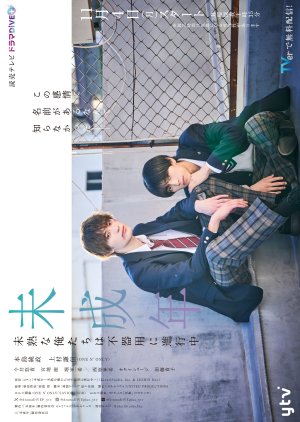
I took one look at the cover photo and synopsis for this show and knew I would love it. I went in pretty much blind and rewatched it twice as it was airing, solely because I couldn't get enough of what I would describe as an immaculately done piece of art. This show carried so much potential and executed it at every point possible.First, I want to emphasize how much of my heart and soul this drama took. From beginning to end, I could not truly predict anything regarding Minase and Hirukawa's relationship, even down to if they were going to be together at the end of the show. On so many different levels this show represented pure craftsmanship to me. From the cinematography to the storyline, everything I would personally say was done with so much intention, detail, and care that I truly hope it is appreciated by others for the beautiful tale it walks its audience through.
Secondly, the only honest criticism I have is that there were a couple of scenes (literally only twice) where I struggled to believe the "sad" vibe due to the acting appearing a little too strong or inauthentic. Please note that it was very minimal and did not change my view of the show at all because, in the grand scheme of the plotline, I still think it was written with great skill and purpose.
Similar to the series "My Beautiful Man", we get to view both the pureness of a first love and the uncertainty that is often felt by those trying to identify if who they love is "right" because it's "different." Yet, in an important difference to the aforementioned show, this series takes the depth of this love and shoves it into a container carrying much more serious trauma, and then proceeds to shake it up with a whole lot of "I have no way to know how to express love because I've never seen a proper example." There are scenes in here that may be triggering for some. It's not dark like "Happy of the End" dark, but any audience member should be aware this series is not here to waltz you through a peaceful and easy-on-the-stomach love story. It's real, imperfect, and at times, depressing to witness.
On a lighter note, if you're into the trope of "He fell first, but he fell harder," you'll get just as much of a sucker punch to the gut as I did, because my God, the yearning will just yank on your heartstrings. Bonus points too if you get to see episode 11 that I had no clue was coming. The tension in that was WILD and some scenes threw me for a serious loop because of how unprepared I was to see grown Haruki and Jin who were fully aware of their feelings now acting on them impulsively and without reservation. It was more spicy than I was expecting lol.
Overall, a show I'd highly recommend, and a series that I think even the more experienced watcher will appreciate.
Was this review helpful to you?

A fine drama but not hitting me with all the feels
A Japanese drama rated 8.9 on MDL is rare, so I have got to check it out. Unfortunately, I might not share the same enthusiasm as many. I don’t dislike “Our Youth” nor do I love it either. I think it’s fine.There are many individual elements that I like. I like the two lost, lonely souls finding each other and healing each other. They are the best kind of soulmates. I have always been a fan of Japanese dramas which are not afraid to use silence to convey emotions. Two good-looking young men play the main roles. All these are great. But for some reason, when these elements are added together, it’s not working for me. Silence only works when there are deep and profound dialogs for the audience to take a breather to think and feel the unspoken emotions. But the conversations in this BL aren't that deep and they actually don’t talk much. Then, silence slows down the pace of the drama and eventually I find the story somewhat….boring?
I do feel the chemistry and I think the acting is quite good. The drama just doesn’t hit me with all the feels as much as I would like. It’s probably a “me” problem.
Completed: 1/22/2025 - Review #537
Was this review helpful to you?

This review may contain spoilers
A story about youth, trauma, growth and the courage to love in a world that often discourages it
Some works seem to know, from their very first frame, that they have no interest in pleasing on a surface level. Our Youth is born from that quiet certainty. The 2024 Japanese BL unfolds with the confidence of a story that understands not only what it wants to say, but how it must be said. This is not simply a romance between two boys; it is an excavation of the emotional debris left behind by a youth shaped by repression, silence, and expectations imposed rather than chosen. Here, affection is treated as something fragile and precious, and at times profoundly risky.The series follows Minase Jin and Hirukawa Haruki, two young men whose paths cross while still in a school setting. At first glance, they resemble familiar archetypes: the sensitive, introspective boy and the one who appears more self-assured, though reserved. Yet Our Youth resists the comfort of these early impressions. As the story unfolds, those surfaces begin to crack, revealing characters molded by deep-seated trauma, inherited fears, and an almost structural inability to believe they are entitled to happiness.
What sets the script apart is the patience with which these truths are allowed to emerge. There is no urgency to define who these characters are. Instead, the series shows and suggests, trusting the viewer to listen closely and fill in what remains unsaid. Each episode stands firmly on its own, yet gains greater meaning when viewed as part of a larger whole. The writing avoids easy explanations, favoring intimate dialogue that can feel unsettling precisely because of its emotional sincerity.
One of the adaptation’s most thoughtful choices is its decision to center the narrative conflict on Haruki’s experience with domestic violence. By shifting the focus away from bullying, a familiar shortcut in school-based narratives, and relocating the trauma to the family space, Our Youth widens its emotional horizon. The home, traditionally framed as a place of safety, becomes a site of fear and constraint, lending the story a heavier and more unsettling weight. This choice grounds the drama in a reality that is harder to name and even harder to escape, reinforcing the idea that some wounds are formed long before the outside world ever has a chance to intervene.
Haruki’s father is not simply an antagonist, but the origin of a fracture that quietly reorganizes how Haruki moves through life. The violence depicted is stripped of spectacle. It repeats itself in gestures, silences, and routines that erode from within. What lingers is not the act itself, but its residue: a body that stays alert, a voice that hesitates, a boy who learns to disappear in order to survive. The series is less interested in shock than in tracing the long shadow of abuse, showing how it distorts intimacy and teaches love to feel conditional, fragile, and perpetually at risk.
Against this backdrop, Jin does not arrive as a romantic rescuer. He offers something far more modest and far more powerful: presence. He watches, hesitates, falters, and still chooses to stay. Their bond is built through small, deliberate gestures such as letters exchanged, films shared, silences given room to breathe, and glances that communicate what words cannot. The symbolic exchange between the letter left behind and the novel written in response becomes one of the narrative’s most resonant moments, not only for its lyricism, but for what it represents: two young people trying to reach each other when language no longer suffices.
Visually, Our Youth is marked by restraint and precision. The cinematography mirrors the characters’ inner lives, shifting between softer and colder tones as emotions deepen. Ordinary settings such as classrooms, streets, and homes are charged with meaning, reflecting confinement, shelter, or the longing to escape. There is an almost handcrafted care in the composition of each scene, a constant reminder that form and content move together; and that how a story is told matters as much as what is told.
The performances elevate the material even further. The cast approaches their roles with evident vulnerability, especially in moments of emotional collapse. Their tears, for instance, never feel performative. They emerge as an accumulation, something that can no longer be contained. The chemistry between the leads is immediate but unforced, allowing desire, fear, tenderness, and pain to coexist in the same space. It is this balance that sustains the show’s emotional tension and keeps the viewer deeply invested.
Romantically, Our Youth avoids comforting illusions. It does not suggest that love alone can heal every wound. Instead, it recognizes that love demands growth, distance, and sometimes painful reckoning. The separation between Jin and Haruki is not a convenient dramatic twist, but a necessary pause. Both must confront their own histories before they can return to each other honestly. Their reunion carries weight not simply because it happens, but because of who they have become along the way.
Also, there is something deeply moving in the way Our Youth portrays a relationship grounded in respect, communication, and attentive listening. There is no romanticized toxicity here, no power struggles disguised as passion. What remains is a love that learns patience, compromise, and care. A love that does not announce itself loudly, but endures quietly. Perhaps that is why the series lingers so powerfully. It reminds us that the extraordinary often resides in the simplest act of being truly seen.
The special episode serves as a quiet yet essential epilogue, shifting the focus from youthful survival to the subtler and no less painful negotiations of adulthood. By portraying Jin and Haruki’s life together years later, the series makes clear that time does not erase obstacles; it reshapes them. Their routine is marked by affection and hard-won stability, but also by constant calculation. Love is present and deeply rooted, yet carefully managed, measured against what can be revealed, what must remain hidden, and who can be trusted with the truth.
The episode’s emphasis on how their relationship remains concealed, even from close friends, is especially telling. This secrecy is not born of shame, but of self-preservation. The series captures the exhausting vigilance of editing one’s own life. Pronouns are avoided, stories are softened, gestures restrained in public spaces. Intimacy here is both profound and constrained, lived fully in private and cautiously fragmented in the outside world.
The legal impossibility of formalizing their relationship deepens this sense of suspension. The series’ understated engagement with same-sex marriage laws in Japan is not treated as an abstract political issue, but as a quiet force shaping everyday life. It seeps into conversations about the future, limits the language available to define their bond, and reinforces the feeling that their love, no matter how real, exists without institutional recognition. What should be ordinary, introducing a partner, making plans openly, claiming a shared life, remains fraught with risk. Fear and caution are not dramatic interruptions, but constant companions.
Yet within these constraints, the episode also reveals a quiet resilience. The desire to live freely does not vanish. It adapts, finding meaning in small acts of care, shared routines, and the mutual understanding that neither is truly alone. In presenting this tension without bitterness or spectacle, Our Youth offers a sobering truth: for some, adulthood does not bring liberation, only a different kind of endurance, sustained by love, patience, and the fragile hope of being seen someday without having to hide.
By the end, Our Youth stands as a work that surpasses the boundaries of the BL label. It is a story about youth and trauma, emotional growth and the courage required to love in a world that so often discourages it. Sensitive, deliberate, and emotionally honest, it leaves a lasting imprint. It does not ask to be celebrated loudly; it asks to be remembered. And it is in that soft afterimage that the series reveals itself as something rare, intimate, and quietly unforgettable.
Was this review helpful to you?

Our Youth: A Symphony of Love and Transformation
Every now and then, a series comes along that doesn’t just entertain but leaves an indelible mark on your heart. This series is one of those rare gems. From its heartfelt storytelling to its impeccable adaptation, it’s a triumph in every sense—a radiant 10/10.The narrative is beautifully crafted, weaving themes of love, growth, and self-discovery into a tapestry that feels both deeply personal and universally relatable. The characters are wonderfully complex, and their relationships—messy, tender, and profound—are brought to life with such authenticity that they leap off the screen and settle into your soul.
What sets this series apart is its warmth. There’s an emotional honesty here that’s hard to come by, a kind of raw yet tender intimacy that wraps around you like a soft blanket on a cold day. It’s not just the romance that shines, but the entire emotional spectrum—from joy to heartbreak, from longing to fulfillment. The series understands that life and love are never simple, and it embraces the imperfections with open arms.
The acting is simply outstanding. Each performance feels effortless, yet brimming with nuance. The chemistry between the leads is electric, their stolen glances and fleeting touches saying more than words ever could. This is acting at its finest, where even silence speaks volumes.
While other countries often hold back due to cultural conservatism, this adaptation feels fearless. Japan's ability to stay true to the source material without diluting its depth is a testament to their storytelling prowess. It’s a rare gift to see a series so unapologetically embrace the beauty of love in all its forms, breaking barriers while staying rooted in authenticity.
For those who have experienced Love in the Big City, this series will strike a similar chord. It has that same magical essence, that same ability to leave you breathless despite its occasional imperfections. But where Love in the Big City warmed hearts, this one ignites them, sending butterflies racing through your stomach as it takes you on a journey you won’t soon forget.
This isn’t just another BL drama; it’s a celebration of love, life, and the courage it takes to be vulnerable. It has firmly placed itself in my top 5 of all time, and honestly? It deserves to be in yours, too. An unforgettable masterpiece that will linger long after the credits roll.
Was this review helpful to you?

JUST FUCKING WATCH IT BABES
masterpiece and I don’t give a fuck what anyone says mehn I loved it and ep11 omg watch it ok make sure you watch it, you’ll love it I promise amazing just amazing the actingggg, the ost omg so beautiful there’s a particular bgm I’ve been stuck on I hope they realesse it because it’s so beautiful!! The fact I stumbled on this show because of a tiktok edit I wasn’t expecting anything but they ended up giving me everything! Minase and hirukawa you will always be number one in my heart I fucking love this showWas this review helpful to you?

Like Waves, I Keep Returning to this Masterpiece Again and Again
EDIT: Lowered my rating due to a lead actor's irl behavior. The show is still good and deserves to be given a chance, but I don't feel like a 10/10 fits anymore for me personally.It’s hard to know where to begin in reviewing this show.
Should I mention the bombastic acting performances, which highlight the characters’ youth and inexperience with feeling quite so much, especially standing in sharp contrast to so many other Japanese shows? Which isn’t to say that they don’t do subtle as well; both mains have a mastery over micro-expressions that feel all the louder in their quiet, precise application.
Sound and silence are both balanced so well that the quiet spaces between words and glances may as well be a supporting character unto itself. The same could be said of water, particularly of the sea, as it is evoked in both words (voice-overs, dialogue, writing, and the main characters’ very names) and images (films, pictures, flashbacks, and day trips both apart and together) again and again, layered into each episode’s framing narration and the very color palette of the show itself.
It’s a visually breathtaking show as a whole. The camerawork is masterful—even when the uncertainty of a situation or scene could benefit from shaky cam, the cinematography team instead allows the camera to smoothly bob and flow as if launched into the sea like some message for help nestled in a bottle. The characters are thus depicted as left adrift in an ocean (a world) far bigger than themselves as they try treading water until their feet find the bottom once more.
Equally impactful are the moments of stillness, just as the moments of silence. Japanese media often utilizes empty space and this show is no different, yet the effect is especially pronounced here as it further leaves the main characters isolated and alone, without the care of anyone tasked to love them, small and vulnerable and lonely whenever they’re apart. They’re made small and thus so, so young in the face of this silence-emptiness combination. Their vulnerability is so pure that you cannot help but empathize and root for them to reach a place of connection—a place back within the embrace of each other.
I should also mention the device of story and storytelling as a meta nod to this story itself. Haruki mythologizes his own situation to give himself strength and hope enough to endure. Jin’s father is a director who is too caught up in his own legend to see the truth—the emptiness—of his son’s life. Again and again we are shown the power of a story to save lives just as this too is itself a story about two young men who ultimately save themselves and each other. It saved me too.
Was this review helpful to you?

This review may contain spoilers
Amazing from start to finished
I have watched over 100 BL series, primarily from Thailand, Korea, and Taiwan. This is my second Japanese BL, and I would highly recommend it.While the production quality—such as the graphics, color, and cinematography—may not be as high as that of Korean dramas, I thoroughly enjoyed this series. I binge-watched all 11 episodes in one sitting. The chemistry between the two male leads was captivating, evolving from friendship to a deeper connection, progressing to their first kiss, and ultimately culminating in them falling in love with each other. I felt a sense of relief when Haruki's father passed away, as he was portrayed as an abusive alcoholic. It was difficult to believe that Japanese law does not provide more protection for children in such situations. Had this been in Australia, Haruki would have received extensive support, including free accommodation, food, and a safe home. I am, however, grateful that Jin was there to support him.
My only criticism is that it seems unrealistic that, after loving each other and being separated for over five years, they could not contact each other through platforms like Instagram or Facebook. While Jin lost his phone in America, in reality, they could easily have reached out to one another if they truly wanted to.
Overall, I would rate this drama 9 out of 10. I appreciated how each episode beautifully developed their relationship, from high school to adulthood, allowing us to see their love grow with each passing moment. My favorite part was the ending, where Haruki mentions that, although Japan does not have legal gay marriage, he will always be there for Jin. This was a deeply realistic and emotional sentiment, and I could see myself in Haruki's position one day.
I look forward to watching more Japanese BL series in the future.
Was this review helpful to you?
one of the best BLs I’ve seen
I haven’t written a review before, but for this one, I have to. This show is a masterpiece. The two leads had so much chemistry and acted so well. The story was captivating, heart-wrenching, and left an impact on me. We were so lucky to get two episodes at the end!I’ve watched so many BLs but this one will be in my top 5. Couldn’t ask for anything better!!
I don’t give 10s out often and my stipulation is that it’s a show I will rewatch. This was an easy 10 and I can’t wait to see these two act in the future! Beautiful.
Was this review helpful to you?
This review may contain spoilers
AMAZING
this show was amazing. everything about it was perfection! if I could give it a 100/10 I would. their acting was great, they had strong chemistry, they made me feel for them. it was so raw and real. It was so emotional, deep, timeless, and beautiful. I will rewatch it again and again for sure. I need a season two like right now the epilogue is great but I need to go deeper I’m not ready to let them go.This has to be the best Japanese BL I’ve watched and one of the best BLs overall for sure. there was not a moment I was disappointed or confused.Was this review helpful to you?