News
News 


It felt as if it was two different dramas -- one that ran for about two thirds of the total and another that started around the end of episode 7 or 8.
The drama starts like quite a few Japanese detective dramas do: An eccentric main character, often a genius, accompagnied by one or two equally eccentric (or very straight-laced) side-kicks solve a "case of the week" , often with a twist or using unusual methods. Their "lair" is appropriately colourful and chaotic, the way the first few cases are laid out follows the pattern of traditional mystery dramas.
And I do love this kind of mystery drama, I liked 99.9 Criminal Lawyer, The Locked Room Murders, and more.
But Inheritance Detective failed to connect me with the team members. It neither develops their quirks well enough for them to really become a running gag (for example Tomonaga is supposed to often speak very quietly, so that nobody can understand him, which is used only occasionally in the earlier episodes, and never in the later ones. Haie himself eats dry coffee beans when he takes on a case, but it's never explained why or at least commented on or, I don't know, *something*, he just does.)
The drama's cases are neither good detective cases, where the audience can either guess along or be astonished at the genius detective's abilities, nor are they connected by a common thread (except by inheritance and wills), unlike the themes of "identity" and "mother-child-relationships" in Don't Call it Mystery.
I could have followed either direction -- comedy, mystery, philosophy -- but this drama failed to evolve any of these possibilities to a depth I could have been satisfied with.
And then the "showdown" with the real villain started, and it felt as if I watched a completely different drama. Any hint of levity was gone, characters suddenly seemed to change (from antagonists to supporters), and it felt like a revenge thriller or court drama, complete with seemingly life-threatening situations.
But this too was never developed deeply enough, even the villain stayed one-dimensional, the speech Haie gives in court near the end felt more contrived than moving -- mainly because I wasn't invested in anything.
Actually, I went through the first five episodes like a breeze, slowed down later, and the last episode took me long enough that I watched both seasons of Minato's Laundromat (which were at least not boring, just frustrating), *and* 8 episodes of Monster Next Door in the meantime.
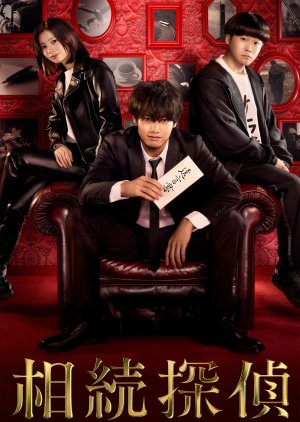
And it's a real shame that the script was so bad, because the main actors were brilliant. I almost didn't recognize Akaso Eiji, he completely disappeared behind his role.
I think, based on the actors' abilities, I could have loved the team -- but not with this script.
However, there *is* one thing in the script I loved: When Haie tries to sideline his female sidekick "for her safety" (not his male sidekick), she doesn't let him, but involves herself again without his consent or even knowledge.
Was it good? -- It had some good ideas, but wasn't consistent in theme or tone. The actors were brilliant.
Did I like it? -- I would have given the first part a 7/10 or the second part a 6/10 -- but put together, no.
Would I recommend it? -- No. Neither to mystery nor to thriller aficionados.
Was this review helpful to you?
This review may contain spoilers
Good law drama on a unique topic - Inheritance, with a good revenge part on the side
It was refreshing to delve into the intricacies of inheritance and see how it was presented in the story. The different narratives—such as the family playing the "butler" against the maid to prevent her from receiving the inheritance, or the complicated business rivalry between half-brothers—were particularly engaging. The latter stood out because of the father’s clever will, which forced the brothers to reconcile and bond over saving their late father’s business.Haie was a delightful character to follow, meticulously handling each case to fulfill the deceased’s wishes. He even went beyond his duty, ensuring the beneficiaries made the best of their inheritances—like helping the brothers mend their relationship.
I also appreciated how Haie prioritized his team’s safety whenever danger arose—often due to Jidori (his biological father). His loyalty to his stepfather, whom he considered his true father, further deepened his admirable character. Despite Jidori’s status, Haie never sought his approval, reinforcing his integrity.
Haie’s revenge against Jidori was executed brilliantly—methodical, patient, and never rushed. The setbacks caused by Jidori added tension, making the payoff more satisfying.
The dynamic with the reporter was another great touch. Their initial rivalry, initiated through a false article resulting in the revoked attorney license from Haie and Haie’s disdain for him evolved into an uneasy alliance against Jidori, adding an interesting twist.
The trial in the final episode was compelling, though I wish it had been longer. A standout moment was Haie’s closing plea, delivered with his signature boldness and flair.
That said, the ending left me wanting more closure. How did the public perceive Jidori afterward? Did he regain his attorney’s license? Was there any reconciliation between him and Haie? Exploring these threads would have been rewarding.
Overall, the story was well-crafted and enjoyable.
Was this review helpful to you?
Started out great and lost direction
The first two episodes were great because the main plot was the resolution of who inherits what. Then after that there are no more inheritance mysteries. Only stupid drama and side stories. It feels like the writers only had good ideas for two episodes and just padded the rest of the 10 episode series with new stories that lead nowhereWas this review helpful to you?

A promising premise's inheritance - you can't have it all
Can you make law interesting, especially laws regarding the dead? I bet someone could, but this drama couldn't.I refused to take this off my list after everyone with similar tastes as mine said it's not worth watching. I just love case-by-case detective dramas and this one was short and had an actor I wanted to see more of as the lead.
Luckily, it was short. Luckily, the acting was good. That's about all the positive I have to say about it.
It was about as bland as the dinner I made while watching this but unlike with my food, nobody remembered to add spices to this drama. It's so standard and cliché, even the negative points are the same as with any other drama that fails at making itself interesting.
Characters are acting out of character - or, should I say, out of their stereotype - , the cases aren't solved by ability but by bending the law first and everybodys' super powers aka super convenient luck later. Whenever it became clear the drama lacked the ability to create true depth we got served misplaced dull comedy that was mostly only funny because of its randomness or its wannabe inside joke character. Supposedly wholesome moments felt cheesy and after everything else already had let me down, I wasn't in the mood for that.
The ending is rushed, we get a grand speech, curtains fall, applause. We see all these strings come together but never find out how or why they do.
I know I am a rare case but I really want to see people doing their job in these dramas. Show me the dull detective work, explain the dull laws, give me bureaucracy, be smart about playing the system with the authority you have. Maybe bend the rules if you must, but stop doing things that go far beyond the scope of what you're meant to do and what the law allows you to just to get the story moving. If your initial setting does not provide the characters with the abilities and authority to solve the problem you hand them, you make them grow until they can. Not make them the heroes bulldozing their way through when in reality it would be them being put to prison. I'm so tired of this trope.
Overall, I think this drama wanted to be a light entertaining crime drama where quirky characters solve weird cases in a quirky way. Then someone remembered "oh, we need a moral of the story" and everything got hugely exaggerated into a fight against a system this drama never was set out for.
TL;DR
The writers kinda wanted to fuse two different tones - one light and quirky, the other serious and meaningful - into one drama and it just didn't work.
There was no time for foreshadowing, for building a decent plot, create interest in the profession or relatability for the characters. If your initial setting does not provide the characters with the abilities and authority to solve the problem you hand them, you make them grow until they can. This drama wanted to do so many different things at once that it forgot it had to do one thing at least decently to make it good.
There is only one reason I would recommend watching - you want to see something light and easy, you don't mind seeing the same three tropes in an inheritance trenchcoat and you somehow relate to inheritance issues.
Was this review helpful to you?

This review may contain spoilers
Gets better as you move along
This starts off kind of goofy, but if you stick it out, it gets much more interesting with several good sub plots.Eiji Akaso is always good, seeing him in several past performances, so he did keep it entertaining. I really think they could have hand picked one or two of the inheritance stories and played that out over the entire drama instead of having so many small stories. Some really good plots were solved within one or two episodes, just too fast. It would have been more enjoyable watching them play out over the entire series.
The last three episodes do redeem the quality of the drama, watching Haie solve his own personal issues from his past. There's a good antagonists we see more of toward the end, that plays well in the story, too.
Overall, a good series, but it could have been so much better.
Was this review helpful to you?
This review may contain spoilers
Great performances and interesting cases until it fell flat on the last one
What really stood up for me in this drama is Eiji Akaso’s charismatic and enigmatic portrayal of detective Haie. His performance was really interesting and brilliant to watch and it made me more invested to catch more of him in action. Other actors were great and really cute with their comedic moments. The only one I couldn’t stand was vulture, he was so off putting.The cases started out really strong and you really have to guess what happens behind those will. But I felt that the writer kind of suffer from writer’s block at the end because it just felt like the detective and solving part is more and more predictable. The final showdown was a total let down because it just felt like Haie and co. was able to defeat the baddie so easily when he supposed to be really powerful. My favourite cases are the forgery, confectionery and the cat one.
As usual, music is not a strong aspect for j drama but I guess the ending song was not terrible, and the tune does stuck in my head.
Was this review helpful to you?

L'héritage des "Grands Reportages"
Dans la grande tradition des "tantei" (détectives), il y a un type d'enquêteur qui avait jusqu'à présent été peu exploité : le détective des successions. Alors qu'en France, TF1 adore nous assommer le samedi après-midi avec ses reportages-enquêtes sur la recherche des ayants droit, aucun producteur français n'a encore eu l'idée d'exploiter ce filon sous forme de série. Peut-être parce que notre rapport à la mort et à l'argent reste fortement imprégné de morale chrétienne, qui nous impose une certaine retenue sur ces sujets.Dans tous les cas, aucune retenue du côté de "Sozoku Tantei", qui prend le parti de l'humour. Car oui, la mort et l'argent, ça peut être fun.
Le casting est prometteur. Akaso Eiji et Sakurada Hiyori, respectivement proclamés gendre et fille idéaux par moi-même, déploient leur charme et leur maladresse, accompagnés du clown de service Yamoto Yuma. Ce dernier n'a plus rien à prouver tant il est l'héritier de 60 ans de comique à la japonaise, aussi bien dans le registre visuel (l'héritage de la coupe champignon) qu'au niveau des dialogues, si toutefois vous réussissez à les entendre. Malgré toute la bonne volonté des deux héros, c'est Yuma-kun qui s'impose et occupe tout l'espace à l'écran.
Hiyori-chan, même si elle tente d'adopter les codes de la génération Z dans son langage et ses postures, se retrouve enfermée dans des postures stéréotypées. Le scénario lui exige les sempiternelles phrases maternalistes et trop directes envers le détective, perdu dans ses pensées. Des passages obligés sans doute imposés par la volonté d'être trop fidèle au manga d'origine, au détriment d'un soupçon de réalisme. On s'attachera donc plutôt aux scènes comiques, empreintes d'humour noir, enterrements obligent. Les runnings gags fonctionnent plutôt bien, souvent sur un registre visuel, même si le trait est parfois forcé.
Quant à Akaso Eiji, bien qu'il fasse partie du vivier des futurs grands acteurs, y compris sur la scène internationale, il n'aura pas ici son grand rôle. Trop contraint par des scénarios convenus : le détective ultra-intelligent, mais fauché, l'assistante qui le remet sur le droit chemin, et le comique de service. Successions d'entreprises offertes au majordome suspicieux, legs à un chat... Du déjà-vu dans l'univers des successions. Même si le travail est fait, les intrigues s'avèrent généralement trop fades pour captiver pleinement.
Reste cet humour et cette légèreté, agrémentés d'une touche de sensibilité bienvenue, qui permettent d'exorciser la crainte d'affronter la mort. En parler, relativiser, soulager peut-être. Qui sait, nous sommes peut-être face à un héritage pour les générations futures, qui, on nous l'annonce, ne connaîtront plus la mort.
Was this review helpful to you?