










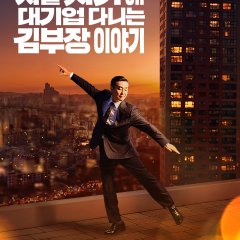
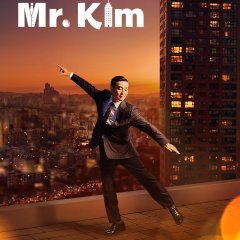






The Dream Life of Mr. Kim

서울 자가에 대기업 다니는 김 부장 이야기 ‧ Drama ‧ 2025
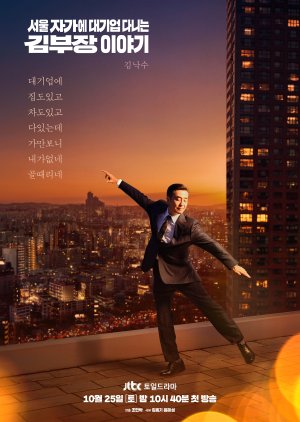
The Dream Life of Mr. Kim poster
7.9
Your Rating: 0/10
Ratings: 7.9/10 from 549 users
# of Watchers: 2,574
Reviews: 14 users
Ranked #2952
Popularity #5854
Watchers 549

Following the story of a middle-aged man who loses everything he once valued. After a long journey, he finds his true self, no longer defined by his job as a manager at a major corporation. Kim Nak Su, a salesman with 25 years of experience. Known for his exceptional skills and sales success, he has never missed a promotion. He owns a prime apartment in Seoul, has a wife and son, and enjoys an enviable life. However, over time, he begins to lose his footing both at work and at home. A heartfelt journey of resilience and survival — one that evokes both tears and laughter in the pursuit of happiness. (Source: Soompi; edited by kisskh) ~~ Adapted from the novel "Seoul Jagae Daegieop Danineun Kim Bujang Iyagi" (서울 자가에 대기업 다니는 김 부장 이야기) by Song Hui Gu (송희구). Edit Translation

  • English
  • Arabic
  • Русский
  • Français
  • Country: South Korea
  • Type: Drama
  • Episodes: 12
  • Aired: Oct 25, 2025 - Nov 30, 2025
  • Aired On: Saturday, Sunday
  • Original Network: jTBC
  • Duration: 1 hr. 10 min.
  • Score: 7.9 (scored by 549 users)
  • Ranked: #2952
  • Popularity: #5854
  • Content Rating: 15+ - Teens 15 or older

Where to Watch The Dream Life of Mr. Kim

Netflix
Subscription (sub)
TVING
Subscription

Cast & Credits

Photos

The Dream Life of Mr. Kim Korean Drama photo

Reviews

Completed
Cora Flower Award1 Emotional Bandage1
52 people found this review helpful
13 days ago
12 of 12 episodes seen
Completed 2
Overall 9.0
Story 9.0
Acting/Cast 10
Music 8.0
Rewatch Value 8.0

Brutally realistic yet unforgettable.

OVERVIEW:

Kim Nak Su, once a perfection-obsessed corporate climber, loses everything and confronts the emptiness of authority without affection. His wife rebuilds their life through real estate, his son forges his own path, and those he once controlled learn resilience, empathy, and self-reliance. Through failure, therapy, and honest work, Nak Su discovers humility, the value of presence over praise, and the quiet dignity of rebuilding. Lives intertwine, mistakes leave scars, but growth emerges: adulthood becomes less about being right and more about showing up, forgiving, and living with the weight of one’s choices.


___________________________

COMMENTARY:

“The Dream Life of Mr. Kim” is a wolf in the clothing of a workplace dramedy. It starts off posturing like a typical corporate satire about an aging middle manager pressured by a soulless system, but by the midpoint it shifts into something far more brutal and intimate: a character study about a man who has spent his entire adult life worshipping the wrong gods.

I went into it expecting light cynicism, a few jokes about hierarchy, maybe some redemption arcs neatly tied with bows. Instead, I got a story obsessed with ego, fear, social masks, and the humiliating price of self-deception. And beneath that is a grim sociological truth Korea has been avoiding for decades: older workers aren’t retiring, they’re being pushed out long before they want to.

This isn’t just one man’s fictional tragedy. Kim Nak-su, the beating disaster-heart of the series, embodies the middle-class checklist so many Koreans strive for: a general manager position at a major conglomerate, an apartment in Seoul, and a son studying at a prestigious university. On paper, it’s the dream life. In reality, it’s a system designed to discard people quietly. Nak-su is abruptly reassigned from the company headquarters to a remote factory, instructed to “keep quiet, kill time,” and even clean up after dogs - a humiliating demotion that reflects what many Korean workers face.

Only 17.3 percent of retirees leave their main job at the official retirement age. The rest are pushed out, with the average Korean leaving their primary job at 52.9, nearly eight years before the legal retirement age of 60. Reasons include recommendations to resign, early retirements, restructuring, reduced workload, and company closures. Those forced out often slip into nonregular, temporary, or daily labor, doing deskilled work far below their qualifications.

Kim’s fictional trajectory mirrors this reality: after resigning, he cycles through precarious jobs, from delivery driver to chauffeur-for-hire, forced to work not by choice, but necessity, because the national pension won’t begin until 65 and pays barely enough for survival. Experts call this decade-long void the “income crevasse,” a period that traps older workers without meaningful support. The public pension system and corporate culture collide in cruel irony: seniors in Korea work at one of the highest rates in the developed world not for fulfillment, but because the alternative is financial collapse.

What makes this show infuriating and compelling in equal measure is that Nak-su is fully responsible for digging the hole he keeps tripping into. His downfall isn’t delivered by some cackling villain in a boardroom. It’s built from thousands of tiny choices: refusing to listen to his wife, ignoring the kindness of others because kindness doesn’t come with a title printed on a business card, pretending his family’s needs are beneath his ambitions. He is constantly choosing the shiny, shortcut version of life, the one that promises power without vulnerability, and that hubris becomes his personal horror story.

Yet the series refuses to flatten him into a caricature. You feel the panic underneath his arrogance. When his job begins slipping through his fingers, you see a man whose identity collapses with it.

When financial disaster strikes and he hides it from his wife, it’s not because he doesn’t trust her, it’s because he can’t stand the mirror she unknowingly holds up, the one that shows him as ordinary, flawed, and scared. The show handles those psychological fault lines with a surprising amount of empathy. It understands that hurt people cling hardest to the illusions that are killing them.

It swings from corporate satire to raw domestic drama to dark comedy that hits so close to the bone you feel uncomfortable laughing. And then there’s the physical comedy of Nak-su’s humiliations - scrubbing floors, dodging barking dogs, trying to play the office hotshot while everyone sees right through him. But that humor never feels like cruelty for entertainment. It’s the sharp edge of realism: life will absolutely kick you when you’re down, but it doesn’t always do it with tragic music swelling in the background. Sometimes it hands you a mop and tells you to get over yourself.

Ha-jin, Nak-su’s wife, is the unsung hero of the story. She grows quietly while he spirals - finding work, rebuilding confidence, facing reality head-on. She isn’t a saint; she’s frustrated, angry, and tired of shrinking herself so her husband’s ego doesn’t bruise. But she is emotionally honest in a world where everyone else is wearing masks. Her journey exposes the truth the show keeps circling: the people we love are the ones most affected by our cowardice. Nak-su’s greatest sin isn’t failure. It’s refusing to let himself be vulnerable with the one person who would catch him.

There is something bold and deeply Korean about the capitalism critique here. The pressure to “look successful” is a monster that eats people alive, and this show doesn’t let anyone escape its jaws unscathed. It’s not glamorizing hustle culture or offering some “work hard and you’ll win” fairy tale. It shows the middle-class dream as a treadmill running on fear: fear of irrelevance, fear of losing face, fear of being left behind. And when Nak-su clings to that treadmill until it throws him off, the series looks at the wreckage and asks: was he ever running toward anything real?

By the time Nak-su hits his lowest point, the show has earned every drop of his despair, and every glimmer of hope that follows. It’s not a series that hands out redemption like a coupon. It demands that Nak-su bleed for it. And in a landscape full of dramas where characters learn lessons in the final ten minutes and live happily ever after, it’s refreshing to see a story that understands real change requires pain, humility, and the courage to admit you’ve been wrong about everything that once defined you.

Watching this show feels like watching a man dismantle the false architecture of his life brick by brick until he finally sees the sky. It’s uncomfortable, tragic, occasionally hilarious, and ultimately deeply human. It’s not the dream life he imagined. But it might just be the first honest life he’s ever lived.

Read More

Was this review helpful to you?

Completed
Dg457
35 people found this review helpful
14 days ago
12 of 12 episodes seen
Completed 2
Overall 9.5
Story 9.5
Acting/Cast 10
Music 9.5
Rewatch Value 9.0

A beautiful story that shows how our dream life has always been before our eyes

Meet Kim Nak Su, a middle-aged salesman with an experience of 25 years. On the surface, Nak Su appears to have the perfect life: a good job, a loving family, an apartment in Seoul. But Nak Su isn't satisfied. He chases bigger achievements. In his pursuit of his dream life, Nak Su makes many questionable choices in order to achieve his dream life. And thus, he embarks on a hectic journey to self-growth.

The Dream Life of Mr Kim is one of the biggest surprises this year. I didn't expect to love it as much as I did and yet here I am gushing over it. I love this type of stories about older people who rediscover themselves and undergo a big development. I understand why they might not appeal to the masses but they can be so beautiful if done well. And The Dream Life of Mr Kim passed this test.

From the get-go, the series makes it plainly clear that Nak Su is not a likeable character. He is arrogant, overconfident, strict, dismissive, he displays conservative ideas. In short, he's the type of character you will not love so easily. Taking into account the fact he's such a controversial person, it makes sense why viewers might not feel connected to him or even choose to give up on this drama. But me, personally, I felt a pull towards this character particularly because he seemed so unlikeable.

Nak Su was a very realistic character. He is the embodiment of many men around his age, not only in South Korea, but in other countries in general. He believed he was faultless, that no matter what his decision was always right and everyone who thought otherwise couldn't be more wrong. He took many things for granted and instead of improving, he insisted on following his old methods. His views reflected his upbringing and the patriarchal nature of South Korean society and he undermined his wife's skills while trying to pressure his son into following a career he didn't like.

Underneath his facade, Kim Nak Su hid many insecurities. He strived to be better and he constantly compared his lifestyle to others. A colleague has an expensive suitcase? He will purchase the next best brand. An "inferior" employee owns an expensive car? Nak Su would need to step up his game. His life was a constant game of comparisons, not only on a professional level but a personal too.

I will not lie, there were times when I got annoyed by Nak Su's attitude. His know-it-all attitude and his refusal to take accountability of his actions puzzled me a lot. How could someone be so ignorant of their actions and their behavior? His inability to communicate properly with his colleagues almost gave me second-hand embarrassment and some of his choices were so infuriating, to the point I wanted to scream at him through my screen.

And yet, even after all that, Nak Su still managed to win my heart, in the most peculiar way. Although I strongly disagreed with his initial attitude, I secretly rooted for him to finally find his dream life. Watching him getting beaten down after every bad decision, made me both satisfied and yet so sad. He needed to fall from grace in order to develop and realise what he had lost but at the same time, my heart bled for him.

Nak Su might had been unlikeable but he wasn't heartless. Clueless yes. Selfish too. But he wasn't incapable of caring for others and their feelings. We saw that with Tae Hwan and the factory workers and as the story progressed, he allowed himself to be more open about his concern and affection. In his own way, Nak Su did everything for his family's case. He didn't express it but he cared for their well-being and he wanted to be the provider of it. So once he started losing his footing, he began to think that his life didn't have a purpose.

And even then, after losing almost everything, he insisted on clinging to the idea of proving everyone wrong. He was desperate to showcase his value and prove his worth as a salesman and a capable man who's the head of his family. He couldn't stand the idea of the company thriving despite his absence. He couldn't allow his wife to earn more than him. He couldn't accept reality in general. And that was his major flaw - and the beginning towards his self-discovery.

I could talk for hours about Nak Su's growth. At first, I was worried about how the writers would depict it because the first four episodes barely had any progress. But as the story went on, Nak Su started changing. Little by little, his old personality began to crumble and he allowed himself to be more vulnerable and open. His shattered life allowed him to open his eyes and reconnect not only with his loved ones but himself to.

As someone who studies psychology, I especially enjoyed and appreciated how the drama handled Nak Su's treatment of his mental health. His scenes with his therapist felt like a breath of fresh air and his initial reluctance in treatment was so realistic and consistent with his character. More kdramas need to address the topic of mental health and I'm glad to see that The Dream Life of Mr Kim did not overlook it.

As expected from a drama like this, The Dream Life of Mr Kim hit me right in the feelings. It caused me a plethora of emotions. Sadness, anger, confusion, cheerfulness, happiness. Just like real life, the drama makes you undergo many different emotional experiences, both positives and negatives. Above all, the drama included some heavy scenes that put tears in my eyes, like the one where Nak Su confessed to his brother how their parents' comparison shaped him up as a person or where he cried after giving up his job.

Of course a big part of my fondness towards Nak Su must be attributed to Ryu Seung Ryong's performance. This man does not disappoint with his roles. It's not easy to play an unlikeable character and make your audience root for him simultaneously but Ryu Seung Ryong did. He never failed to reveal Nak Su's real emotions, even his microexpressions like a twitch on his face or his furrowed eyebrows could convey so much. His acting really shined during the emotional moments and this is when he truly made me sympathize with Nak Su's struggles, as if they were my own. I am not exaggerating when I'm saying that he deserves to receive many nominations and awards for such a compelling performance.

Aside from Nak Su's personal growth and re-birth, The Dream Life of Mr Kim offered some other interesting topics in the story. For starters, it was amusing to see how workplace environments can be and observe the politics behind them. Through Nak Su's employees, we see what it feels like to have a demanding yet incompetent boss and through the background activities, it's revealed that corporations will often turn to shady activities if its profitable for them, without regarding their employees and how they'll be affected.

I was beyond surprised to learn that what the drama depicted is very accurate for South Korea: Korean companies will fire you, without actually firing you. That's the case in The Dream Life of Mr Kim, too. Nak Su doesn't get fired. Instead, he is shipped off as the team leader for Asan Factory Safety Management. It was so interesting to have more insight about companies in Korea and how they treat employees and once again, I couldn't help but still feel sorry for Nak Su (even though it was understandable for him to lose his position).

Another interesting aspect of the story was the development of Nak Su's wife, Ha Jin and their son, Su Gyeom. I was heavily rooting for both Ha Jin and Su Gyeom, especially Ha Jin. Her determination to become a real estate manager and resume her studies made me admire her a lot. I was happy to see that the writers didn't settle with making her a mere background character whose purpose would be to uplift Nak Su's development. She was a person of her own, with her own dreams and feelings and that was very refreshing to see.

I loved how she cared for Nak Su and yet still called him out for his behavior and decisions. Nak Su needed more people to knock some sense into him and hearing this from his own wife had a great impact on him. Similar to how she wasn't afraid to talk some sense into her husband, Ha Jin was not willing to let others step on her. She defended herself and refused to go down without putting a battle, which made her even more exciting to see.

As for Su Gyeom, I found his arc to be realistic and relatable. He was a young adult who wanted to earn his independence and pursue his own career path. It was quickly proven that this wouldn't be an easy road to cross and yet, with the help of his family, he didn't give up. I admit that at first I was bored during his scenes and I found his story to be the least engaging but as the episodes went by, I warmed up to him and I quietly supported his developing career.

Nak Su and Su Gyeom's relationship was complex and yet so beautiful. Both father and son deeply cared about each other. The problem was due to Nak Su's pride and his devotion towards his job, they drifted apart and this, Su Gyeom developed a disliking towards his father's ideas. It was only after Nak Su hitting the rock bottom that they began understanding each other better. Watching them bond and rekindle their relationship made my heart melt. Nak Su supported Su Gyeom and Su Gyeom supported Nak Su in return and their actions could speak louder than words.

The directing and cinematography highlighted the emotional impact and the characters' stories. The camera work and editing were very effective during the dialogues, they added so much tension and accompanied by the delightful yet intense piano notes in the background, they made me bite my nails in distress. Another example of the drama's excellent cinematography were the scenes of Nak Su having a panic attack. The way it was filmed made it feel like I was the one experiencing it. As someone who has experienced panic attacks before, their portrayal in the drama was realistic and grounded. They weren't overused to the point they lost their impact but they were equally effective and set up the ground for Nak Su's anxiety spiral.

If I could voice some minor complaints, they would be about some story points. As I mentioned above, Su Gyeom's arc took a while to make me invested. I got kinda bored with his interactions between Han Na and this whole "will-they-won't-they" situation between them was kinda annoying. Additionally, although I still believe that the writers handled Nak Su's development very well, the writing could have been a little bit tighter in some areas, particularly the first four or five episodes. Had the series been a little longer (say 14 episodes), Nak Su's growth could have been presented in an even more compelling way.

But even these minor flaws didn't ruin my overall impression. Although the first episodes had given me a lukewarm feeling, The Dream Life of Mr Kim actually got better as the story progressed. It's a drama with messages that can resonate with many people, no matter how old they are. Just like Nak Su, many of us are constantly trying to climb the ranks of society, while trying to build "the perfect life". But while trying to survive in a society that wants us to move forward and then stop once we'll reach a limit, we forget one important thing: we forget to LIVE. Life is not about luxurious, superficial things. It's not about owning a big apartment at the capital of your city. It's not about pleasing your higher-ups just to receive a promotion. It's not about buying expensive goods just to feel superior. It's about the memories we build with our loved ones and the small things that bring us joy.

Finding a purpose in this world is difficult. And if we have gotten used to a routine that provided us with some sort of stability and security, losing it might make us crumble. That doesn't mean we should give up. Every ending can lead to a new beginning. Sometimes, instead of clinging to our pride and unreachable dreams, it's okay to settle back and just accept reality.

Spending all our lives chasing after promotions, becoming our companies' erant boy and neglecting the people close to us will become exhausting and soul draining. Maybe all we need to do is sit back, take a break and reflect on everything. And maybe, if we open our eyes, we might realise that what we've looking for has always been right in front of us.

Read More

Was this review helpful to you?
Recommendations

Misaeng: Incomplete Life
I Hate Going to Work
Never Give Up
Desperate Mr. X

Recent Discussions

Be the first to create a discussion for The Dream Life of Mr. Kim

Details

  • Title: The Dream Life of Mr. Kim
  • Type: Drama
  • Format: Standard Series
  • Country: South Korea
  • Episodes: 12
  • Aired: Oct 25, 2025 - Nov 30, 2025
  • Aired On: Saturday, Sunday
  • Original Network: jTBC
  • Duration: 1 hr. 10 min.
  • Content Rating: 15+ - Teens 15 or older

Statistics

  • Score: 7.9 (scored by 549 users)
  • Ranked: #2952
  • Popularity: #5854
  • Watchers: 2,574

Top Contributors

79 edits
21 edits
19 edits
16 edits

News & Articles

Popular Lists

Related lists from users
dramas i've watched so far
486 titles 2 loves
MASTERPIECES.
19 titles 3 loves
List of 2025 dramas
181 titles 1 love

Recently Watched By