Raising a child gives the whole village a headache
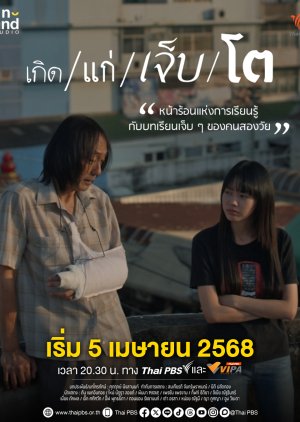
"เลี้ยงเด็กหนึ่งคน ปวดหวัทั้งหมู่บ้าน" -- "Raising a child gives the whole village a headache" ... and raising an adult even more.The Thai title "เกิด / แก่ / เจ็บ / โต" is a very good indicator for this series' themes: "เกิด แก่ เจ็บ ตาย" -- "birth, age, sickness, death" is the fundamental aspect of life in Buddhism. Everybody will experience these four things in life. So, when the Thai title says "birth, age, sickness, growing up" instead, the "death" part and the relation to Buddhist teachings is already implied. The producer tells us: This is a story about life itself.
However, the title goes a step further and inserts "growing up". Both main characters, the man in his sixties and the 17-year-old girl, have a lot of growing up to do, and the only way of doing this is by listening, understanding, mutual respect, and within a community.
For me, "เกิด / แก่ / เจ็บ / โต" was an interesting watch for the cultural lessons it had. How do Thai people speak about dying and death? What changes bring the modern times to family values and intergenerational relationships in a society that is traditionally very clear about roles of family members?
Its intended main theme, I think, was about broken parent-child-relations, about the value of community and family, whether by blood or by choice, and about the importance of listening with respect, regardless of age. And I think that they did a good job with this overall; except in some parts where it got a bit too preachy for my taste, and some of the ending was too feel-good when one secondary character reformed too fast while another gave forgiveness a bit too easily.
That being said, I had feared that *everything* would be resolved neatly, which was not the case, because this too is life: Not everybody will grow up, not every attempt at reconciliation will work out. I just think that it could have been even more realistic without diminishing the feel-good happy ending for our main cast if it had stayed a bit more open-ended.
The story telling was a bit too slow at times and, together with the heavy-handed message, I never felt the urgent need to watch the next episode immediately.
The screenplay was mostly solidly written -- I love the progression of the two main characters, and also how Nok's backstory was revealed slowly. I would have liked it if the supporting characters had been fleshed out more; Pha was a bit too good and too understanding at times, and the trio of our lovely grannies deserved more than to be the background chorus, too. I think the story would have worked as an ensemble cast, maybe even better than it does now.
It's also maybe of note that the screenplay does the usual Thai way of mixing comedic bits and serious messages, which might take a bit of getting used to. There is just enough romance that I can't put the drama in my "No romance!" list -- but both couples make sense within the narrative and the character progression, so it's all fine.
What made this drama was the general production quality, the setting in a lower class environment and the outstanding abilities of the actors. I loved the interactions between Nok and Jan, of course, but also the actors of supporting characters like Omsin and Jojo were excellent in their roles.
Was it good?
I think it was. The production quality was high, the actors were excellent. The message was delivered a bit too heavy-handed at times, and part of the ending felt slightly undeserved.
Did I like it?
I didn't love it so much that I devoured the drama; but I am glad I watched it.
Who would I recommend it to?
To people who an watch a slow, slice-of-life-adjacent drama. And to those who are interested to understand how Thai people view life and death.
Was this review helpful to you?