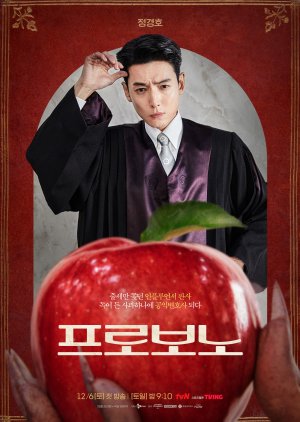
A intriguing courtroom drama with unique perspective
I've seen many courtroom dramas in all sorts of languages but this one definitely gave me a new perspective after watching it.Let's start with the positives:
1. The script- I think this is one of the most well written scripts I've seen in this genre. Sometimes concept dramas often fall into the trap of having dialogues that sound like textbooks. Like the character is speaking directly to the audience to deliver a message. But this drama perfectly balanced the message delivery with hints of realism that it mostly felt natural
2. The characters- I liked that we had an imperfect character. Without his imperfections, I don't think I would've liked him as the lead. Even the background characters had distinct personalities and interesting character arcs.
3. The acting performance- Jung Kyung Ho pulled off such a complicated character with such realism and ease that I felt like he was a real human being. Even the other main characters and supporting characters (special shout out to the minors and extra actors) did such an amazing job is portraying complex emotions.
4. The different legal concepts- This show delt with new and interesting legal issues that is often overlooked like animal abuse, medical autonomy, crime against immigrants, filial crimes etc in a sensistive and bold way. Other shows often focus on sensational topics and major crimes that it felt refreshing to see these topics that are often overlooked.
Now let's move onto the negatives
1. The revenge arc- I was looking forward to Dawit's revenge arc the most and it was interesting but it did feel slow compared to the other episodes. They focused too much on the moral dilema and backstory, whereas I wanted to see more of the legalities surrounding the case
2. The pacing- The first half had amazing pacing. The balance was right for me, nothing felt too fast or too slow but the second half definitely felt slower.
3. The tone shift in the second half- I understand that the cases delt in the second half were more serious but the reason why I was hooked in the first few episodes was because of the humor and lightness irrespective of the case seriousness. It kind of dried up in the second half and even the comedic relief chracters didn't have humorous scenes which was a little disappointing
Overall, I liked this drama and would recommend to anyone who likes this genre or even a beginner who wants to explore courtroom dramas. 8 stars 🌟
Was this review helpful to you?

This review may contain spoilers
Surprisingly great drama.
Saw the ratings and having seen Oh My Ghost Clients (although a good show as well) didn't have insane expectations other than a feel good show similar to Oh My Ghost Clients, however I was pleasantly surprised at how the legal battles and power struggles were represented in this show.Cool concept of a judge being turned into a pro-bono lawyer, done really well with the corruption scandal, leaves you wondering who was behind it and WHY they were behind it. The show sets up the MC as a scummy person vying for power and fame, prioritizing them over achieving justice - however with his backstory it adds an extra layer to his actions and provides further depth on to why he acts this way.
Thought it would just be a case to case show where they look into certain injustices going on, and solve them however he faces numerous obstacles on his path to success. It presents his high level of legal intelligence through the lens of the judge, whilst presenting challenges due to his inexperience as a pro-bono lawyer. It presents him as competent, but still needing room for growth and development, and someone who realizes the worth of his team and role. His character is very funny, someone who is very "arrogant" but fails a lot, however doesn't let it waver them and continues to keep trying to win. His competitiveness truly shines against his opposing defendant lawyer, who truly has no morals and will do anything for money, testing the MC's ability to overcome even the most outrageous of circumstances within a courtroom.
Each case is explored well and presents a new angle and challenge for the MC, and the pro bono team around him challenges him and assists him well to provide a new angle to each and one of them, making them individually stand out. They all have their own motivations, issues and personality, and they mesh well to form a singular team. Nothing is easy for them, and they bond through facing adversity throughout, without mindlessly believing in the MC. They don't rush to conclusions either, and are willing to hear other sides and commit their own research to find the truth, which is very refreshing to see.
The law firm CEO is just kinda an asshole, for no reason too, even to his own daughter. Like I don't really even get his character he's just evil and powerful, but I guess the main focus was how his evilness impacted his daughter growing up. The evil in this show are kind of just evil for the sake of it, for power or money, no real depth towards them. Although the daughter being greedy for power made sense since early on, her character is still kind of dull, alongside the defendant lawyer who simply hates the MC because he stole his love for a bit, which was just kind of a weak explanation for everything. At the very least, the MC didn't submit and left of his own terms, but their arc is kind of disappointing.
The MC achieves revenge and justice whilst developing as a character and enveloping layers with each new case, and the actor is truly one of the better for law related dramas. From Oh My Ghost Clients, Pro Bono and Prison Playbook he has shown his ability and versatility to stand out. The romance between him and the main female of the Pro Bono team is pointless, because it never even is close to developing. Were they trying to tease it, or was it just a simple soulmates situation? It's kinda unclear the intention between the two, why they're the closest of all, and her character is definitely the more disappointing of the Pro Bono team, since it is barely developed or focused on.
Overall a surprisingly great show, typically shows can't balance these aspects very well, however Pro Bono does it well bar a few hiccups near the end surrounding the villains (and how easy it was to take them down).
Was this review helpful to you?

The law drama that I didn t know I needed
Pro Bono turned out to be a really engaging drama. I didn’t expect to get so invested in it, but it completely drew me in from the beginning.I was really expecting every single episode!What I appreciated the most was how the drama balanced legal cases with deeper social issues. Each case wasn’t just about the law—it highlighted real struggles and gave a voice to people who are often overlooked. That made the story feel both important and emotionally impactful.
The character development was also very well done. Watching the main lead grow and gradually change his perspectives!That added a lot of depth to the story. Their journey felt realistic and satisfying.
I also liked that the drama didn’t rely heavily on romance, but instead focused more on justice, morality, and personal growth. It’s definitely one I would recommend to anyone who enjoys character-driven stories with meaningful messages.
I could say this is my favorite drama of Jung Kyung-ho.
P.S. The performances were excellent, and the cast really brought their characters to life.
Was this review helpful to you?
This review may contain spoilers
From the stars to the stables
I love Jung Kyung Ho's character, cunning and intelligent, yet playful.It's a shame that because of a video showing him being corrupt, he's demoted from a prodigy judge to the newest addition to a small, dank "PRO BONO" law firm.
Far below his expectations, he makes a deal to work there for only one year, after which he'll be nominated for chief judge. Since the agreement stipulates a 70% success rate, he'll give it his all.
The cases he'll take on are truly unique, but with his acumen and the cooperation of his team, they'll achieve good results.
Unfortunately, the video circulating about him reaches his colleagues, who begin to doubt his actions.
At that point, the man who wanted to frame him turns to his own team to defend him.
So he finds himself in court having to defend himself against his own subordinates.
From episode 9 onwards, the situation becomes even more interesting. The ending is consistent with his personality, and I could see a future "Pro Bono 2" coming up.
Was this review helpful to you?

Beautiful stories
This was the perfect ending. I don't know what else to say. I had the time of my life watching this show. It was amazing to watch a show that made me laugh, cry and scream. I literally got to watch the characters go through so much growth, and what can I say, man, the main character was so well written. Honestly, all the characters were exceptionally well-written. I loved watching each story unfold, and it's just beautiful to watch people getting their well-deserved justice. There are new characters every episode, and yet the main characters will still always have your heart. Just perfect.Was this review helpful to you?
A mix between Vincenzo and Oh My ghost Client !
Pro Bono, it's the last flower to conclude 2025 on a good note, the story is good well made, we got a mix of interesting client and character and our two main lead are really funny.Without giving a spoiler, the show depict the day of "Pro-bono" lawyer. Which for a mysterious reason, are joined by a former popular judge.
Each episode is 1h, which is quite long since, the format on each episode is totally different from the previous one.
We can have 20 min about an hearing but 40 min painting the consequence or lack of consequence that the case can have. Or we can have 1h episode about an hearing, and a second about the appeal.
My only downside, with the show, is how the time is portrayed, it's a legal show but like Extraordinary Attorney Woo, the pass of time seems unrealistic. Or they don't show what happens during the time where they get the case and have the hearing.
Also what happens for the main character story during this time.
Update :
Honestly, I think the show, needed to have 16 episode. And not 12, because the last 4 episode was sort of a rush.
The acting are still fantastic, but the character development, was the biggest flop on my part.
Was this review helpful to you?

This review may contain spoilers
Lazy and dull
This k drama clearly wants to be some sort of breaking point on social issues in sk, using some type of unfunny comedy to do it. But it doesn't work. The story isn't good, characters are annoying and the cases are so weak and bad that it's hard to not sleep while watching.Of course, I have personal opinions on the point of the show and the content of it itself, but I'm pretty sure you can do a show about social issues and still be good and not lazy and bad like this one.
I remember watching a British tv show called Unforgetten -- that was heavily political and pretty focused on social issues -- and even I, that usually don't like these types of shows, liked it and watched all seasons. Why? Cause it was good and entertaining. That's not the case of Pro Bono, which it's just dull and, well, lazy.
Was this review helpful to you?

xenophobia
Rating: 3/10 (Some solid acting and case-of-the-week drama, but drowned in unchecked xenophobia and superiority complex)Pro Bono tries to sell itself as a heartwarming legal drama about justice for the underdog, with Jung Kyung-ho playing Kang Da-wit—a smug, materialistic ex-judge who's forced into the pro bono team after his perfect career crashes. He starts off as this arrogant "legal influencer" who looks down on everyone below his status, and that absolutely includes foreigners and people from outside Korea living in the country. The way he treats (or ignores) non-Koreans makes it clear: In his eyes—and often in the show's subtle framing—they're not fully part of society, barely even human worthy of real respect or empathy.
Early on, Kang Da-wit embodies that classic Korean elite attitude: Foreigners, especially migrant workers or marriage immigrants from poorer countries (like the foreign wife in one of the cases, enduring domestic violence in rural Korea), are just problems to deal with—or props for his redemption arc. He approaches their cases with cold detachment, like they're inconvenient nuisances invading "pure" Korean space rather than actual people deserving dignity. There's this underlying vibe that outsiders don't belong, aren't "one of us," and their struggles are somehow self-inflicted because they dared to come here. He bullies or dismisses the vulnerable with that superior smirk, puffing himself up by stepping on those he sees as beneath him—migrants, the poor, anyone not born-and-bred Korean. It's all played for "character growth," but it reeks of real societal issues that the drama never fully calls out.
And the hypocrisy? Infuriating. While Kang Da-wit (and the show) has no problem portraying Southeast Asian or other non-white foreigners as pitiful victims at best (or invisible at worst), you just know if an American character showed up—some white expat or "master" type—he'd switch to fawning mode instantly. The narrative bends over backward to avoid critiquing the real power dynamics: Korea's lingering deference to America, the U.S. military bases treated as untouchable, Koreans acting like loyal servants to their "owners" while deriving fake superiority from bullying weaker nations' people. Da-wit feels "superior" by kicking down at migrant wives or workers, but he'd never dare challenge the actual overlords.
If Koreans (or this drama's writers) really have such a problem with foreigners integrating into society and being treated as humans, then have the guts to address the elephant in the room: Tell your American "masters" to leave. Kick out the bases, end the alliances, and see how the ROK army stands alone without that protection. But no—it's easier to dehumanize powerless immigrants than confront the colonial inferiority complex that's still propping up the whole system.
Pro Bono had potential to explore true multiculturalism and human rights in modern Korea, especially with its pro bono focus on the marginalized. Instead, the male lead's arc reinforces the status quo: He "grows" just enough to win cases, but the deep-seated disdain for outsiders lingers. Skip this if you want something that actually challenges xenophobia—it's just glossy entertainment papering over ugly realities.
Was this review helpful to you?
This review may contain spoilers
Mild spoiler
I watched this drama until episode 6, but I couldn't continue.The cases don't even make sense—they were winning only because the plot made them win. Forget about the cases; the female lead is utterly delusional. She always tries to play the hero of justice by taking cases without any proper reasoning.
In one of the cases, she refuses to believe the gossip surrounding the victim, Maya, yet she believes the gossip that the male lead took bribes. That felt very hypocritical to me.
I decided to watch this drama because of the male lead. I already liked him, and I think his role in this drama is perfect. However, I just can't find the chemistry between the male and female leads interesting. I actually prefer the chemistry between the male lead and his ex.
I especially stopped watching because of the female lead. If she had been written a little better, I might have liked the drama.
Of course, other people may have different opinions about this drama, and that's perfectly fine. I'm not going to continue watching it. I'm sorry in advance if my review hurts anyone's feelings.
Was this review helpful to you?

A Boring Slog Carried by One Actor
While Pro Bono started as an easy watch, it quickly lost its spark. With each passing episode, the story became more boring, and I found myself losing interest entirely. By episode 6, I decided to drop it—I didn’t want to force myself to finish it just for the sake of completion.The "Carry" Factor I really liked the lead, Kang, but unfortunately, that was the only positive. He was truly carrying the entire drama on his back. The rest of the team was terrible and lacked any chemistry or charm. While the individual legal cases were somewhat interesting, they weren't strong enough to save the show from its flat characters and slow pace.
Comparison to a Superior Drama If you are looking for a better version of this genre, I highly recommend "Oh My Ghost Client." That drama had everything this one lacked: it was fast-paced, funny, and featured great teamwork and compelling cases.
Final Verdict: Unless you are a massive fan of the lead actor, this one isn't worth the time. It lacks the "drive" and team chemistry that makes a legal drama successful.
Was this review helpful to you?

This review may contain spoilers
Wonderful enjoyment from start to finish
I'm always a fan of Kyung Ho, and once again, he was just fantastic. This part was made for him or maybe he made the part. I definitely saw some resemblance to his character from "Oh My Ghost Clients" ... but totally different as well.The story itself has a perfect blend of drama and comedy .. with just the right touch of sorrow and sadness to balance it out. Besides our lead protagonist, the supporting cast is marvelous. Each one adding something to the story. I must admit, about halfway through, due to the story line, the pro bono team turns on Kang David. I thought it was a bit overdone how they threw him under the bus in such a quick manner. He kept having to prove himself over and over again. BUT, once you get past those events, the story is flawless, as is everyone's acting.
Going toward the ending, it has to be one of the best final episodes I've seen in some time. They managed to take care of all the villain in such a way, it's extremely satisfying to watch it play out.
It's not your typical court room drama by any means, so if you're going into this thinking that's what you're going to watch, you may be disappointed. This is a very unique story with a very unique cast of characters.
Absolutely high marks for a really enjoyable series!!! Way to go Kyung Ho!!!
Was this review helpful to you?
Perfection. No notes.
I thoroughly enjoyed every second of this drama. It’s earned its place as one of my favourite legal dramas. Jung Kyung-ho slayed this role. I like that there was no romance plot line. Is it normal to tear up in most of these episodes? :_( Asking for a friend. Perfection. No notes.Was this review helpful to you?