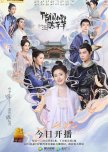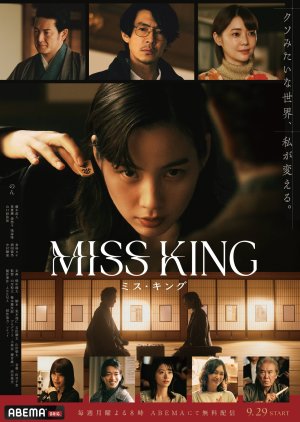
Kunimi Asuka vivait heureuse avec sa famille, jusqu'au jour où son père l'a abandonnée pour poursuivre son rêve dans le monde du Shogi. Peu après, la mère d'Asuka est décédée des suites d'une maladie, et elle s'est retrouvée complètement seule. Témoin du succès de son père en tant que joueur de Shogi, Asuka à nourrit un désir de revanche et est entrée dans ce monde, se fixant pour objectif de devenir la première joueuse professionnelle de Shogi de l'histoire. (Source : Anglais = DramaWiki || Traduction = kisskh) Modifier la traduction
- Français
- Русский
- English
- Español
- Titre original: MISS KING / ミス・キング
- Aussi connu sous le nom de:
- Scénariste et Réalisateur: Yamagishi Santa
- Genres: Thriller, Drame, Famille, Sport


Distribution et équipes
-
") Nounen RenaKunimi AsukaRôle principal
Nounen RenaKunimi AsukaRôle principal -
") Fujiki NaohitoTodo SeigoRôle Secondaire
Fujiki NaohitoTodo SeigoRôle Secondaire -
") Kurashina KanaSakai ReikoRôle Secondaire
Kurashina KanaSakai ReikoRôle Secondaire -
") Nakamura ShidoYuki ShoichiRôle Secondaire
Nakamura ShidoYuki ShoichiRôle Secondaire -
") Okunuki KaoruKunimi KeikoRôle Secondaire
Okunuki KaoruKunimi KeikoRôle Secondaire -
") Mori ShootYuki TatsuyaRôle Secondaire
Mori ShootYuki TatsuyaRôle Secondaire







Critiques

Kishi drama
2025 a été le retour du shogi dans les dramas. Le sport cérébral numéro 1 au Japon s'est fendu de deux dramas le mettant à l'honneur dans des contextes en manque, malheureusement, d'originalité. D'abord Hotei no Dragon remettait sur le devant de la scène Mone Kamishiraishi sans vraiment me convaincre, puisqu'il n'était rien d'autre qu'un énième lawyer drama. Puis Miss King et sa promesse d'épisodes courts (38 minutes), peu nombreux (8), mais efficaces pour renouveler le genre du revenge drama, grâce à des stratégies issues du shogi. Tient-il plus la route ? Il serait de bon ton d'analyser la feuille des déplacements d'après-match pour le savoir.Je suis donc arrivé sans trop de difficultés jusqu'à la finale (des épisodes) et voté pour la promulgation en kishi de ce revenge drama. Mais je dois avouer être encore perplexe. Si voir Non dans un premier rôle enchante par sa fraîcheur, sa simplicité et son franc-parler, l'histoire reste plutôt creuse. Vue mille fois dans d'autres contextes, on est loin de la psychologie et des émotions de March Comes in Like a Lion, le maître étalon du genre, celui du "petit génie du ... ".
Bien sûr, Miss King est une excellente entrée en matière pour découvrir le monde du shogi. J'ai bien dit le monde, et pas les règles, car le néophyte sera tout simplement incapable de suivre un tant soit peu une partie. Heureusement, les scènes courtes consistent surtout en des plans sur les visages des concurrents et un rapide survol du plateau afin d'apprécier les différentes manières de déplacer les pièces. Du glissement hésitant au claquement de celles-ci sur le plateau, toute la subtilité de l'attaque psychologique envers l'adversaire réside dans le simple bruit de la pièce posée sur le bois.
Si la trame principale n'est pas très passionnante, classant la série dans le genre shonen avec des sensei à gogo, fusionnant maître Miyagi avec maître Yoda et transformant la « miss padawan kid » fougueuse en génie du calme et de la réflexion, la production essaye quand même d'envoyer des messages au spectateur. Mais là aussi, sans réelle finesse. Miss King interroge la parentalité, en reprenant de la manière la plus maladroite possible la vieille rengaine du « Papa outé ». Elle dépeint également la condition féminine dans le monde du shogi, parabole de la société japonaise actuelle (ou presque). Ce manuel du féminisme pour les nuls hérite lui aussi de clichés grotesques (mais en cours encore dans ce milieu), femmes méprisées par des hommes se croyant encore à l'ère Edo. Mais qui n'arrivent à convaincre qu'eux-mêmes.
Reste la prestation de Non, qui aurait mérité une réalisation plus ambitieuse, des sidekicks et des histoires parallèles d'opposants détestables devenant des alliés essentiels sur plusieurs épisodes, par exemple. Les personnages secondaires sont aussi transparents que l'a été son père durant son enfance. AbemaTV a clairement décidé de ne pas ennuyer le public avec des longues side story, et le choix est plutôt discutable, sachant la réussite de March Comes in Like a Lion dans ce domaine.
Peu de profondeur de toute part, cette série ne laissera donc que peu de traces dans le monde des shonens sportifs, rendant contre-productif son message. Comme si la première kishi femme n'était pas un événement en soi. Comme si les femmes n'étaient pas capables de tout abandonner pour leur passion comme un homme, esclaves de leurs émotions qu'elles sont. Pour ce monde moderne qui souhaite tant revenir au système patriarcal de l'ère Edo, la part de féminité est un poison à combattre, ramenant la gent masculiniste à sa propre faiblesse. Ce drama révèle toute la bassesse de l'homme avec un petit h et c'est déjà ça !
Cet avis était-il utile?

HomeScreen Alchemist
10 personnes ont trouvé cette critique utile
A carefully-crafted allegory, about courage to face and overcome seemingly impossible challenges
"Miss King" offers us a charming approach to presenting familiar real-world issues and occurrences, assembled into a serial-drama centered on the game of Shogi, a Japanese chess. But this is not a drama about shogi, even many scenes show us the actual games' moves — enough to make Shogi enthusiasts be excited. Shogi is only used as a central theme of the allegory. We don't really need to understand the game to watch and appreciate it. While many may compare this to the movie "The Queen's Gambit", I don't see anything similar between the two in their stories, although "The Queen's Gambit" might have been used as a thematic inspiration to form the initial idea of "Miss King".The first thing that stands out from the first few minutes of watching is the top-notch quality of the cinematography as well as the editing and post-production, including the music. This does not have the typical "cheap & quick" serial drama production we have seen too often on mainstream TV. From the beginning of the episode, they give us very artistic, feature-movie-like visual display and creative camerawork without being too "artsy" and pretentious. The production team really put effort down to very conceptual details, even the "MISS KING" title presentation where the pointed warped texts start with the first letter for episode 1, then 2 letters for episode 2, and so on, up until the final episode when the entire letters are warped.
Despite the dramatizations, the story of "Miss King" doesn't go too deep into unnecessary complications and plot twists. The plot stays as simple and straight-forward as possible here, and many of the conversations are on-point and vital to the story. Just like the actual game of shogi (I'd assume), it does have the attack and retreat moments. Even though there are a few repeated patterns here and there, it is still far from becoming "just another shallow & boring story" plaguing many of the now over-saturated TV dramas. Screenwriter/director Yamagishi Santa delivers the most efficient storytelling condensed within the tight and gripping 8 episodes, with a rather short duration per episode. I wished the duration could be a bit longer, like 45 to 50 minutes each. In most episodes, 30 minutes feel like merely 15 minutes. It passes very quickly because the editing is very tight, and shuffling between two scenes is used quite often for thrilling effect. The cinematography is very good at presenting each scene from multiple different angles, sometimes even using extreme close-ups. Re-watching all the episodes is recommended, because we may miss some small details.
The Shogi whereabouts and its entire intrigues in the drama could very much represent the entire showbiz/entertainment industry (be it sports, film, TV, music, etc.), specifically in Japan but also in many other countries throughout the world, which is tainted by corporate greed and the thirst for power. This is what makes "Miss King" a very likely candidate to be the best J-drama for 2025. It has a multilayered meaning. Simple, but deep at the same time. To those of us film enthusiasts who are curious to interpret the allegorical meaning and symbolism beyond the surface-level plot or story line, this is an absolute must-watch because this drama has plenty of them, just like the 2025 movie "Exit 8" (check out my review of "Exit 8" here on MDL 😉).
What is being presented in "Miss King" is not about "selling the dreams/aspirations", but a carefully-crafted fictional allegory. In particular, I have noticed some cautious re-narration (or RENA-rration 😁) of what happened to the acting career of this drama's main lead female actor: Nounen "Non" Rena. — She is the most suitable person in playing the role of the main character Asuka, because they both share the similar flair, brilliance, and also struggles to overcome obstacles in the world that abhors the natural sparks within a person. It seems that whoever came up with the story already had Non in mind to play the role of Asuka when the character was being developed (the character was built around the actor and not vice versa). I'm not going to give any spoilers but just one clue: in the ending scene of Episode 5, it reveals a similar situation to what had actually happened to Non back in 2015.
Again, without attempting to spoil the scenes, there is one important statement said by Todo Seigo (the main/leading supporting character played by Fujiki Naohito): "I'm going to kill the old era", which may explain the "hidden aim" presented in this drama, thanks to Abema TV. His character is displayed as "hot temper" but, at the same time, also "cool-headed", a unique combination that's essential in strategically guiding and refining any person gifted with raw talent and wild/unfocused energy like Asuka.
When we think about "the old era" within the showbiz industry, that refers to the outdated system of hierarchy, controlled by a very few yet highly influential key people at the very top of the pyramid where most of the important decisions are made, in which the entire industry is being run through exploiting the ones at the "bottom of the food-chain": namely all the young and naive talents with high aspirations. These talents are used merely as "assets" that can be exploited, disposed of and replaced at any time. The entire "agency system" provides these assets to do the work in a "binding agreement" so that entertainment commodities can be produced as money-generating tools. In reality, many of these modern-day "slaves" (not owned by landlords, but talent agencies) are more than willing to sacrifice their authenticity, integrity and freedom just for wealth and fame, and in certain cases, even dignity and moral values for a slight chance to move up in the hierarchy. These people then turn to become "monsters" (the term used often in this drama) , despicable creatures who "have made a deal with the devil." As outlined in the first line of this drama's synopsis, it is a "shitty world" indeed. There are also many talented individuals within the industry who actually understand how this system works, but decide to compromise and let themselves remain in the safe "middle ground" by choosing not to excel further, in order to keep themselves at bay, from being attacked by those monsters. They are represented in this drama by the seemingly "pragmatic" Yuna character (played excellently by Narumi Yui), a character many of us here may relate to at some degree. This drama also presents us with the nature of a "binding agreement" or "contract" and its actual significance in controlling the moves of these talents/assets. There's also a seemingly "random" casual joke about plastic surgery popping up in a conversation.
Of course, a drama is a drama, a play. All the dramatizations of the characters and the "larger-than-life" fictional story line are needed so that it is exciting to watch, be it the background stories, the situations, character development, etc. Some of the characters are displayed as serious and very realistic, like for example the Sakai Reiko character (played by Kurashina Kana), and Asuka's mother. The other characters are a bit "comical" to spice up the story, like Todo Seigo, for example, or the variety of "supposedly villain" characters in the Yuki family clan. We can relate ourselves to any of these characters in the "Miss King" story. Certain personality traits being displayed so often by the characters here are: envy, pride, selfishness, rivalry, victim mentality, and lack of self-worth, while on the positive side, goodwill, compassion and empathy also play a significant role in balancing the story so that it does not fall into a toxic negative vibe, where revenge may turn into absolute nihilism. This is a positive drama about courage to face and overcome seemingly impossible challenges. The description of "revenge" here is more about "taking the power back" or "reclaiming what was once lost", and certainly not the "bring everyone who put me down into the pit of hell" type of revenge.
However, I have to disagree with the official synopsis given by Abema TV, that Asuka's "revenge" was fueled by deep hatred (nikushimi / 憎しみ). I don't see that in her character at all. Maybe "rage" (uncontrollable anger) is the more appropriate word to describe what drove Asuka in the first episode, where she began to act impulsively, as opposed to a premeditated plan. Asuka was indeed angry and in pain, but all her anger was more like a "righteous anger" triggered by the world that is full of manipulations and betrayal where she became a victim. Despite being angry and in pain to begin with, Asuka's authentic love for shogi since she was a child (displayed when she smiles during her shogi matches as if she is actually having fun doing it) is the source of her willingness to fight back, and that alone is beautiful to watch! There is a great amount of love being displayed in this drama, even without any romance. As Asuka began to build her trust in the ones who support her unconditionally, she was able to find a way to convert or transmute the energy of anger into creative expression using the platform that she loves, which is shogi. In the real-world, many authentic artists and musicians do that, including I believe Non herself. Speaking of Non, she still has that adorable sparks of energy/aura that has been unique to her ever since she starred in the classic asadora "Amachan", and that energy is incredibly magnetic! 😍
I give "Miss King" a high rating because it is one of the very few J-dramas that has the ability to transform us, if only we're courageous enough to open our hearts. It does not lecture us about virtues or moral values. It is up to us to extract the story, relate ourselves from the characters, and use the allegory as a mirror reflection.
9/10
Cet avis était-il utile?