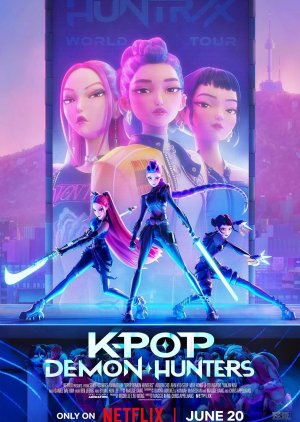









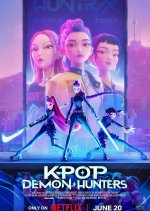
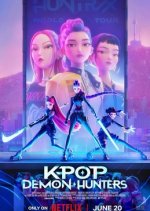
 'KPop Demon Hunters' director: Song Joong Ki, IU, Park Seo Joon referenced for character creation
 - Español
- ภาษาไทย
- Português (Brasil)
- Nederlands
- Título original: KPop Demon Hunters
- También conocida como:
- Director: Maggie Kang
- Géneros: Acción, Música, Comedia
Dónde ver KPop Demon Hunters

Subscription (sub)
Reparto y créditos
-
") Ahn Hyo SubJinuVoice Actor
Ahn Hyo SubJinuVoice Actor -
") Kim Yoon JinCelineVoice Actor
Kim Yoon JinCelineVoice Actor -
") Lee Byung HunGwi MaVoice Actor
Lee Byung HunGwi MaVoice Actor -
") Daniel Dae KimHealer HanVoice Actor
Daniel Dae KimHealer HanVoice Actor -
") Woo KevinMystery [Singing]Voice Actor
Woo KevinMystery [Singing]Voice Actor -
") Lea SalongaCeline [Singing]Voice Actor
Lea SalongaCeline [Singing]Voice Actor
Fotos
Reseñas
Música del alma
Ver esta película nació de una noche de pijamada con una niña de 9 años y una chica de 13 que tienen memorizados hasta diálogos de la peli: son las más fans. La vimos con el audio en español latino, lo cual probablemente restó un poco del encanto que seguramente conserva más en su idioma original. Sin embargo, me resultó divertida y me encantó la animación, además de los buenos temas musicales e intrigante historia.El concepto de la música como algo protector y que cura me pareció absolutamente acertado. Me gustó
Update, 02 feb 2026: La vi en audio original (nuevamente acompañada, esta vez de mis dos hermanos); definitivamente la disfruté muchísimo más
¿Te ha parecido útil esta reseña?

A Standout Animated Film
KPop Demon Hunters is easily one of the most compelling animated films released this year. It manages to blend modern pop culture with supernatural action in a way that feels fresh without trying too hard. The premise—K-pop idols secretly fighting demons—could’ve gone gimmicky fast, but the film handles it with a surprising level of care and style.What really stands out is seeing this film listed on kisskh. Usually, animations—especially ones from non-Asian countries—don’t make the cut there. But in this case, it actually makes sense. Unlike a lot of Western attempts to tap into K-culture, KPop Demon Hunters shows a real understanding of its influences, and it doesn’t just borrow the aesthetics—it respects them. That’s probably why it was given a chance where others weren’t.
The animation is clean, the action is sharp, and the characters are well-designed both visually and emotionally. The music hits the right notes without overshadowing the story. It’s fun, but it also has enough substance to hold your attention beyond the spectacle.
It’s not just good “for a Western animation”—it’s a strong film in its own right, and a smart, entertaining watch for anyone interested in a cross-genre story done right.
¿Te ha parecido útil esta reseña?