"I smell violence on you"
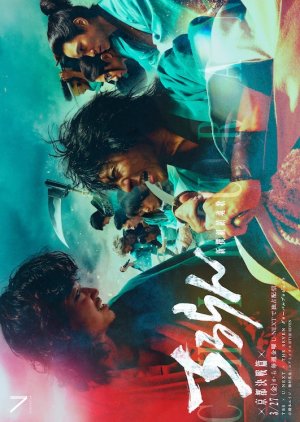
Song of the Samurai: Fateful Showdown in Kyoto was a raucous sword swinging, foot stomping, unhinged samurai drama based on a manga that was based on real world people and events during the waning days of the Shogunate. The names and places were familiar even if the purple hairstyles were not.In 1912, an old man recounts the tales of Hijikata Toshizo to a curious young woman. The viewer is transported back to 1859 when the reckless, "thorny brat" Toshi, joins the poverty stricken Shieikan dojo. Kondo Isami is the leader and protects his disciples like a mother hen. Most of the young men are kind and view each other as family. They hope to find a patron lord or government job during the tumultuous era when the Shogunate was headed for the exit door as the Imperial Court was ascending. The even more reckless and unhinged ronin, Serizawa Kamo, enters the picture with his two minions. With spies and assassins lurking in the shadows or in narrow crawl spaces, life becomes precarious for the Shieikan crew.
Toshi’s main goal was to become the strongest man in Japan. He wasn’t terribly bright and was always ready to fight, inwardly rejoicing when he jumped impulsively in over his head. The only time he truly felt alive was when he was brandishing his sword against a stronger opponent. The flipside of the coin was the flamboyant Serizawa who reveled in women and booze, but his “blood boiled” only when meeting a worthy adversary. Props to Ayano Go for uttering his lines and fighting with a cigarette constantly dangling out of his mouth! Neither Toshi nor Serizawa were concerned with politics or the standard samurai life. Though the apolitical Serizawa could see where the life of the samurai was headed.
The majority of Kondo’s group weren’t highlighted much. The charismatic Saito Hajime had his moments to shine, strategist Yamanami Keisuke played a vital role, and the young Okita Soji had a nice fight. The others came to the forefront as needed for reaction shots or in a crisis. The Grim Reaper didn’t darken the screen until the next to last episode. Kondo was regaled as an uncommonly fierce fighter yet he never really had a chance to prove his metal. The flashiest fights were nearly all Toshi’s. So, if you are a Yamada Yuki fan, you will be in for a real treat.
The challenges were full body, gravity defying fights. Ronin flipped, spun, rolled, kicked, and punched as much as they sliced and diced. Shout out to the amazing stuntmen who sold the action in the battle scenes. Since it was based on a Manga there were ridiculous weapons involved on occasion. And even more ridiculous characters. There was no shortage of “cuckoo for Cocoa Puffs” people on the Shogunate and Imperial sides. This was also a world where women did not exist, except for the geisha Oume. I’m still not completely convinced that the young woman in the intro wasn’t a figment of the old man’s imagination.
Song of the Samurai was bloody, fast paced, and took historical liberties for entertainment purposes. The characters and weapons were campy, often over the top. I couldn’t help but root for Kondo’s Kids as they were brave and loyal to each other (for the most part) and ready to take on any challenge regardless of the odds. “Certainty of death, small chance of success…what are we waiting for?”* My biggest complaint was the ending. After paying for an enormous cast of handsome faces, the finale felt like they ran out of film and just had to stop. Hopefully, there will be another season to wrap things up. Overall, it was a fun romp, never slowing down long enough to get boring.
“To bloom in battle and fall in battle. Samurai are flowers that bloom in full splendor, unafraid to fall. The Shinsengumi were the last flowers to bloom in the dying twilight of the Bakumatsu Era”
18 June 2026
*Gimli, LOTR Return of the King
Trigger Warnings: Dismemberments. Spewing blood. Smoking. Some really dreadful hairstyles
Easter Egg: Watch for the 47 Ronin throwaway comment that was not a great foreshadowing for our motley crew
~~~Slightly spoilery comment below:
**If there was a prequel, maybe there will be another season to wrap up what will be a devastating ending for our spunky group of swordsmen. Was really hoping they would show the clash with Serizawa and just epilogue the rest of it. History is history and was not kind to the feisty group which will be heartbreaking.
Was this review helpful to you?

A Samurai show for anime fans
This series mainly appeals to anime/manga fans. If you are someone who takes samurai warriors and their battles seriously, you might find some of the action sequences overly imaginative and exaggerated. Frankly, there isn't a storyline that shows the development of a samurai warrior, either; those who are skilled are just skilled right from the start. Regardless of all that, the storytelling is really bad. Looking at the positives, the acting is good and the cinematography is beautiful. It's a series that bores you at times, yet glues you to the screen at others.Was this review helpful to you?

This review may contain spoilers
O último florescimento de Kamo Serizawa
Song of the Samurai é mais uma demonstração de como a dramaturgia japonesa pode alcançar um nível extraordinário quando recebe investimento, cuidado artístico e atenção aos detalhes. Tudo parece pensado com zelo, da cenografia aos figurinos, passando pelas coreografias de luta, que são particularmente belas. Há cenas em que a câmera simplesmente permite que acompanhemos os movimentos e as nuances dos combates, sem transformar a ação em uma sucessão confusa de cortes. É uma produção que consegue fazer o espectador sentir que está testemunhando os últimos suspiros de uma era.Mas é Ayano Go quem rouba o drama para si ao interpretar o infame e visceral Kamo Serizawa. O ator constrói um personagem errante, violento e completamente fragmentado, alguém que parece carregar desde a infância o desejo de florescer à sua própria maneira. E o mais interessante é que Kamo chega ao fim justamente como imaginava, completando de forma quase trágica o arco de um homem incapaz de encontrar paz fora da violência. Confesso que estranhei Toshi não ser o responsável por seu fim, mas o episódio final esclarece a escolha: talvez ainda não fosse a hora de o protagonista florescer. Seu verdadeiro adversário parece estar apenas começando a surgir alguém ainda mais forte, mais perigoso e, aparentemente, mais maníaco que Kamo. E isso torna a próxima etapa particularmente promissora.
Was this review helpful to you?