 Q, EXY & more confirmed for new horror K-movie

From the ferries of Gulangyu Island and the kitchen at home to green-screen studios and the world of cinema, Chen Du Ling has gradually learned to be brave and to believe amid new beginnings. Time hasn't changed her; it has simply allowed her to become more and more herself.
Some time ago, Chen Du Ling returned to her hometown of Xiamen.
When she talked about home, her tone became relaxed. The hectic pace and tension of work seem to be washed away, at least by half, by the sea breeze of Xiamen. Much of her adolescence was closely tied to Gulangyu Island. She took a ferry to the island to attend primary and middle school, with the journey taking about 20 minutes. Sunlight would spill across the sea as the boat cut through the waves and eventually reached the shore — day after day, this was her routine.
Gulangyu Island is known as the "Island of Music", and music is the breath of the city. Chen Du Ling studied piano for nine years, taking lessons at school while also having a piano at home. Her parents felt that becoming a piano teacher in the future would be a good path for her. Her grandparents would say to her in the Minnan dialect, "The mountains you rely on will collapse; water you rely on will run dry." In other words, you should have a skill of your own and not depend on others. She said that they told her to use this saying as a reminder whenever she became restless or restless while studying.
During those days back in Xiamen, Chen Du Ling's grandparents told her many stories about their childhood. She imagined the places where they had lived, and also looked through many black-and-white photos of old Xiamen on social media.
She decided to return to the place where her grandparents had grown up and see them for herself. The red-brick traditional houses and low old homes had long since been renovated and transformed beyond recognition. Afraid that this period of time would otherwise become blurred and fade away, she filmed videos as she walked, working with her grandparents to piece together and retrieve memories of the past. She told them: "The street where the old house once stood has now turned like this."
As they were talking, a potted mimosa plant on the table slowly began unfurling its leaves, and Chen Du Ling was the first to notice it. It reminded her of her childhood: "Grandpa really loved growing plants. There were lots of flowers on the balcony. He often had me take the plants and the fish tank outside to bask in the sun. He said the fish should get some [sunlight] too."
In Xiamen, it is also common to see Chinese narcissus bulbs of different varieties such as Jinzhan Yintai and Yulinglong. "You put the narcissus bulbs in water and change the water sometimes." If she ever starts growing plants herself one day, she would like to start with aquatic plants like these.
Her childhood home was situated on a hillside, not particularly close to her grandparents' house. It was an old-style residential community from the 1990s, with its exterior walls painted white and green, and a steep, narrow stairwell.
Not far from the house was a small tunnel entrance. The neighbors all called it the "dongkou". Pedestrians and bicycles would pass through it, and beyond the "dongkou" lay a world of bookstalls, renting little illustrated storybooks, their pages worn and frayed at the edges by countless little hands, carrying a mixed scent of printing ink, dust, and something like the bottom of an old wooden crate.
The food stalls might sell fresh, juicy oyster omelets, tusundong jelly made by simmering sipunculid worms from the tidal flats, milky-white peanut soup, or a bowl of sweet tofu pudding.
Food is tied to memories and nostalgia for home. It is only after leaving home that she realized that not all food in the world tastes the same. Chen Du Ling remembers coming home one day to find her mother making soup in the kitchen. It was not even ready yet, but its aroma had already begun to fill the air.
"Just smelling the aroma of the soup," she said, "naturally makes me feel that it's a taste I can't find anywhere outside." She feels that "food you make yourself [at home] has that guoqi — the warmth and aroma that come from the wok — and the scent of the kitchen. When it's served in the dishes we use at home, it gives you this wonderful feeling."
For a fleeting moment, it feels as though she has returned to the area around the "dongkou" again. Only this time, she is no longer by the hillside but in the kitchen.
Bianshi [wontons], tossed noodles, braised meatballs… She feels that one of the secrets to Xiamen cuisine also lies in its seasonings. "You mix in peanut sauce and Xiamen chili sauce. I haven't come across this way of preparing it anywhere else…"
For the meatballs, "you put minced meat, light soy sauce, and eggs into a dish, mix everything well, and steam them. Making the meat mixture beforehand is a bit laborious [task], but once that's done, you just need to steam it for 10 to 15 minutes."

When talking about Xiamen cuisine, she becomes animated, as if opening the floodgates: "Xiamen's huāgé and wéngé clams are quite famous. Dishes like seafood cooked in soy sauce and seafood soup should be relatively easy to recreate." "For shacha noodles, there are ready-made sauces that you can use to recreate the dish, but the seafood probably won't be exactly the same."
By the seaside in Xiamen, clams are dug fresh from the tidal flats that very morning, and when the boats pull into shore, the fish are still thrashing energetically. The freshness is alive.
The tides rise and fall, and every time she returns, it feels as though life has remained unchanged. In Chen Du Ling's eyes, Xiamen is "a city full of warmth and human connection and very hospitable." The people of Xiamen have always taken life at an unhurried pace. "They're never in much of a rush, following their own feelings and taking care of their own little world first."
"Xiamen is just so comfortable," she said.
Before returning to Xiamen, Chen Du Ling had just wrapped filming for The Doll Game. In the series, she plays Bai You Wei. Bai has spent years confined to a wheelchair in her daily life. Cold and aloof on the outside, she instinctively keeps others' kindness at a distance, unwilling to be pitied or given special treatment because of her physical disability. Though she may appear fragile, she is a highly intelligent survivor in a survival game. Unable to rely on physical strength to break through, she survives by breaking down and analyzing the game rules.
To get a feel for the physical habits and movements of a girl who uses a wheelchair, the production team delivered a specialized wheelchair to Chen Du Ling before filming began. During that time, she moved back and forth along the hotel corridors in the wheelchair, using it as her everyday means of transportation and repeatedly practicing how to adjust her sitting position with one hand and how to exert force when moving her body. She not only had to operate the wheelchair with one hand and maneuver around obstacles precisely but also had to make the movements become muscle memory.
She gave an example: in one scene, she had to sit up from the grass. The movement was similar to a seated forward bend. After the scene was filmed, the director said, "Very good. Throughout the entire long take, your legs never moved at all." By then, she had been on set for about half a month.
More than half of the entire series was filmed in a virtual green-screen studio. Chen Du Ling describes the studio sets as "very dreamlike, with dollhouses that look like something out of a fairy tale, but the rules of the game in the story are very cruel."
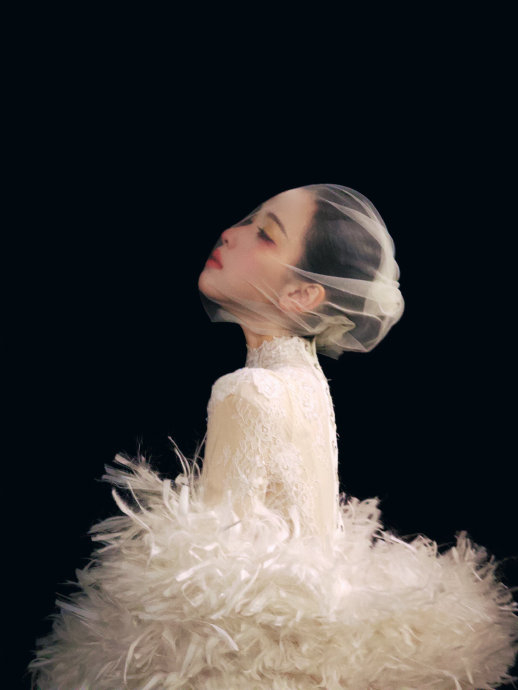
The core of the entire series is a nail-biting battle for survival. The contrast between the sweet, dreamlike visuals and the brutal story creates a sense of conflict, particularly testing the actors' inner sense of conviction.
"Every day when filming began, it felt as though I had entered a game level and was constantly trying to clear it." "So I felt that there was no need to deliberately maintain a certain state for the performance. I would naturally become immersed in it."
Chen Du Ling has always experienced the highs and lows of her characters' lives through scent. To her, Bai You Wei smells of "white musk, ylang-ylang, and iris," with the complexity of the character surging richly like a fragrance.
She expresses, "At first, you might feel that she is in a state of avoiding the world. But then you discover that deep down, she longs for love. She simply does not want to accept love that is given to her as charity. What she needs is an equal exchange. In the end, she learns to coexist peacefully with the world."
"Because I needed to understand the worldbuilding of the script, I watched some animated series," Chen Du Ling says, also talking about some of the new formats she has been paying attention to recently. "There are also some well-made AI films online. Creators can use them to quickly express ideas that would be difficult to film in reality."
She has a keen observation of the relationship between AI and acting: "The emotions of characters expressed through technology are what everyone can imagine, but in reality, everyone experiences [and expresses] emotions differently. And every person is unique."
In terms of her approach to acting, Chen Du Ling has her own unique philosophy: "You have to first stop being afraid and overcome your fear. Only then can you do a good job."
Fear is like a mirror, but once the wall inside her mind came down, her body was truly able to reach a level that Chen Du Ling had never imagined possible. Learning to dive was much the same. "At first, when I knew I would be going into the water, I imagined some of the news reports I had seen and worried that I might choke on water." But once she got into the water, she began imagining herself remaining calm and relaxed. "And then I really did it." The water surrounded her like an embrace.
As time passes and everything changes, she too is becoming more expansive. In the past, she would often become tense over a gesture, a small matter, or even some seemingly insignificant detail, feeling that she had been reckless or careless. "But now I've realized that I don’t need to put myself through that kind of internal struggle. There's no need to overinterpret everything. A lot of things are simply a normal part of life. You can do whatever you want to do and live in whatever way you want."
She is no longer afraid. "I no longer worry about turning out differently from the person I had originally planned to be," she says with a smile. She is no longer fixated on a preconceived notion of perfection.
After this shift in mindset, she has increasingly come to enjoy observing the world and interacting with others.
"It's as if I've unlocked a world that is very different from the one I knew as a child." "Everyone has such different experiences and ways of expressing themselves. This world is really interesting."
There are some films that Chen Du Ling watches again and again. Each time she revisits them, it seems as though she is waving to her past self from afar. She watched Inception when she was in college. "I especially loved watching movies back then, and they would give me so many new ideas."
She said that watching films at that stage of her life felt different from how she feels about them now. "Back then, I didn't care whether I understood what I was watching. When I watch it again today, I see it from a different perspective. It has come to represent an experience and a memory from the past, like a symbol of growth. Yet every time I watch it, I still find myself moved by it."
The emotions surrounding the end of filming are always complicated. Chen Du Ling remembers the day The Doll Game wrapped up filming: "I was really happy, but I was actually quite reluctant to say goodbye to everyone. We had been filming together for such a long time and had formed a deep friendship, yet now we had to part ways."
But Chen Du Ling feels that she can also choose another way to welcome the days ahead. Life is long and full of twists and turns; everything keeps moving forward, and there will be countless reunions to come.
"Because we're one step closer to the day when we reunite in the Doll World."
Source: Cosmopolitan China