
Oda Yuji, Sorimachi Takashi, Kamenashi Kazuya, Sato Koichi, Matsuyuki Yasuko, Mitsushima Shinnosuke, Haru, and other artists bring to life compelling characters in Kitakata Kenzo's multi-volume historical epic Suikoden (Water Margin), which won the prestigious 2006 Shiba Ryotaro literary prize.

The drama begins in the final days of the Northern Song Dynasty. Corruption is rampant. Suffering of the people is as meaningless as proper governance to an insufferable emperor. Incompetent and negligent of his administrative duties, while enjoying a life of decadence, corrupt officials rule in his stead. His extravagance deepens widespread chaos.
Saddened at the scale of corruption while enraged by the plights of his people being ignored, low-ranking government official Soukou pens an important manifesto for reform and justice. Wielding a copy of Taiten Gyodo, Ro Chishin travels the country to find like-minded comrades willing to take up this cause alongside himself and his ally Soukou. Soukou’s words ignite the hearts and chivalry of those who choose to rally around his cause, including Chao Gai. This is a story of rebellion, determination and reform. The powerful and corrupt Song Regime, as well as the secret organisation "Seirenji" led by Li Fu, are the greatest obstacles.
In the original Chinese classic from the Ming Dynasty, "Water Margin" is the tale of Song Jiang aspiring to change the wheel of destiny and stop corruption for the sake of his people. Deciding to go against Emperor Huizong, Song Jiang and 107 companions eventually gather at Liangshan Marsh to rebel against the government. His allies include Chao Gai, Lin Zhong, Yang Zhi, and other outlaws who represent the incarnations of 108 stars, comprising 36 "heavenly spirits" and 72 "earthly demons".
Oda Yuji is the main protagonist Soukou, as Song Jiang. His opinion of ‘Kikakata Kenzo: Suikoden’ includes, “I have been an actor for close to forty years, but I have never filmed anything on this scale or magnitude.” He is also unable to hide his enthusiasm, stating he cannot wait to see final results on-screen, after so much time and effort and resources have been invested in this production.

Filming took place entirely in Japan, despite the drama setting being placed in China. Spanning eight months, the cast and crew covered more than fifty locations in seventeen prefectures, totalling approximately 25,000 kilometres. Covering 25,000 kilometres is equivalent to more than 500 consecutive days walking this distance to exceed more than half of the Earth’s equatorial circumference, or the equivalent of running more than 590 consecutive marathons. Oda Yuji also recounted filming inside a cave, where he could not differentiate between day and night. Veteran lead actors Oda Yuji and Sorimachi Takashi concluded in unison that this drama contains the toughest locations they have experienced throughout their acting careers.
The bond between Soukou and Chao Gai, transforming into allies, is a pivotal relationship in this story, caring for ordinary people while leading their comrades. Two different heroes are portrayed by two actors of contrasting temperaments. Oda Yuji and Sorimachi Takashi have known each other for many years, which includes going fishing together outside of work. Their shared trust and professionalism are unmistakable in this production. Despite different personalities and abilities, Soukou and Chao Gai recognise each other as kindred spirits when they meet.
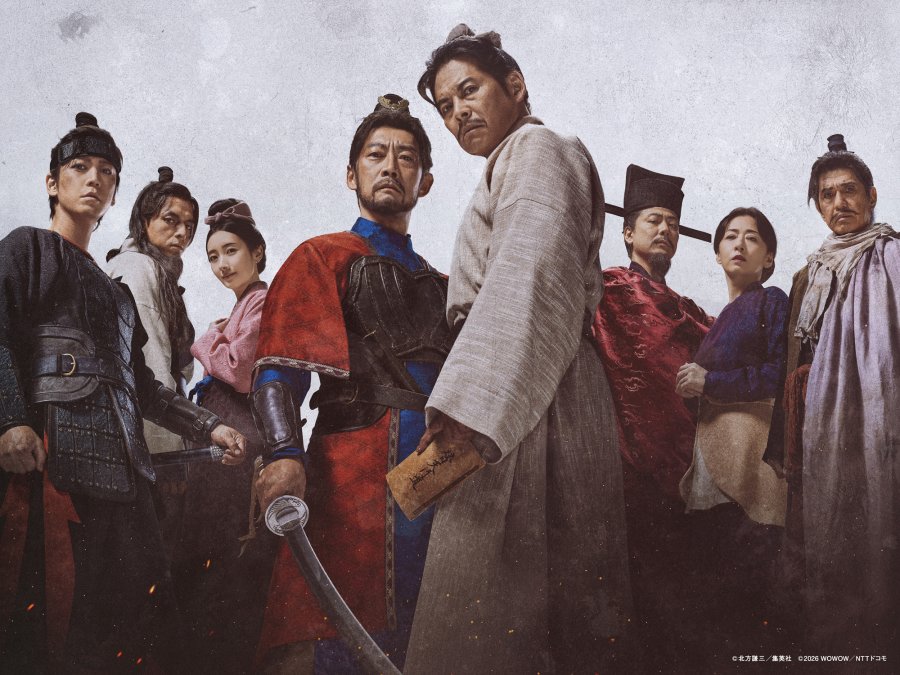
To Oda Yuji, Soukou is an ordinary man you can easily find. He does not possess the fearsome charismatic leadership qualities of Chao Gai, portrayed by Sorimachi Takashi. He does not have the military expertise of Oushin (Wang Jin) expressed in an intimidating manner by Sato Koichi, a martial arts instructor of the Imperial Guards stationed in the Imperial Capital.
He is not an unmatched master of the spear and military warrior, demonstrated by Rinchu (Lin Chong), fleshed out in love and pain and combat by Kamenashi Kazuya. He cannot match the battlefield finesse of a high-ranking military officer Youshi (Yang Zhi), who is a descendant of heroes, skilfully evinced by Mitsushima Shinnosuke.
What makes Soukou the key to a path of victory?

A determined ordinary man who leads with empathy and virtue to foster trust instead of military might, forming the ideological core of the rebellion, Soukou is a rare leader forging a unique path leading to irreversible change. Within their stronghold at Liangshan Marsh, war as "misfits" of society rebelling against corruption and unreasonable authority is inevitable. Embracing justice and responsibility while carrying the world on their shoulders, they are determined to survive and save their nation through righteousness.
Wakamatsu Setsuro is the most prolific of the three directors helming Kitakata Kenzo: Suikoden, alongside Muratani Yoshinori and Sato Sayaka. He has worked closely with actors such as Oda Yuji and Sato Koichi. He has also been recognised with multiple nominated and award-winning dramas and movies, such as Sore Ga Kotae Da! in 1997, Whiteout in 2000, and Shizumanu Taiyo in 2009. He believes a specific vision for the theme song of this historical epic is necessary.
Fully drawing on his expertise honed by decades in this industry to meticulously birth the best results, this ensemble drama combines social justice and reform on a sweeping scale, bolstered by myriad emotional ties tested on a relentless battlefield. Weathering dangerous scheming within shadows while cementing unforgettable friendships in a historically exacting production, Kitakata Kenzo: Suikoden is unprecedented in the history of Japanese drama.
The man responsible for the Japanese literary reinterpretation of "Water Margin" enabling this ambitious drama adaptation is Kitakata Kenzo. A prolific novelist whose works focus on tense atmospheric hardboiled crime fiction and historical realism, a gigantic poster calling the public to “Learn more about Kitakata Kenzo-Sensei!” now adorns the Shueisha Building in Jimbocho which is the headquarters of Japan’s largest publisher.

Gritty intricate plots, morally complex characters and psychological suspense have been skilfully interwoven as enthralling short stories and novels meriting multiple prestigious literary awards, in a literary career spanning more than half a century. As the former 10th President of The Mystery Writers of Japan from 1997 to 2001, his earlier fictional works contain powerful introspective voices. Reformed gangster Takino Kazuya runs a suburban supermarket but cannot escape the consequences of helping fugitives from his yakuza past, as detailed in his 1983 novel translated into English as "The Cage". In the 1996 thriller translated into English as "Winter Sleep" resembling a first-person psychological study, painter Nakagi has been released from prison. Seeking freedom and solitude from his past in the mountains, he is eventually forced to face unavoidable intrusions using ruthless measures.
Kitakata Kenzo has also explored historical fiction since 1989, weaving feudal intrigue with personal ambition. His ambitious adaptations showcasing his incisiveness and ability to convey warfare, betrayal, alliances, and moral complexity within the historical epics of East Asia include reimagining "Romance of The Three Kingdoms", channelling his vision for "Yang Family Generals" and thus earning him the Yoshikawa Eiji prize in 2004, as well as the seventeen-volume efforts known as "Chronicles of Genghis Khan".

One person can change the course of history. Individuals coming together can permanently transform an empire through unity. Every flame of love, hope and determination is important. Kitakata Kenzo also introduces an additional important central theme for this drama, transforming strangers through finding family in his literary epic ‘Suikoden’ via Sai Jinbi.
As the wife of Youshi, Haru is Sai Jinbi, resiliently embodying warmth and love. Sai Jinbin and Youshi adopt an orphan. Where she once felt hopeless, meeting this child gave her joy and happiness. By helping this child not connected by blood, strangers become family. This relationship transforms "strangers into family" and creates a comforting domestic anchor of "compassion and love" amidst relentless warfare. Compassion and love within family should never be taken for granted. Strangers and their shared relationships can be fundamentally transformed because of such bonds.
Theme song of Kitakata Kenzo: Suikoden is Birds Wandering Through The Night sung by MISIA. Her powerful vocals mirror this glorious adventure with promising themes of hope and determination. This song embodies unity between fury and righteousness, flying the flag of heroes preparing for battle while embracing these rebels with love. Themes of unwavering friendship alongside the will to resist unreasonable authority throughout this historical epic are strongly relevant, especially in this day and age.

Composed by singer-songwriter Kato Tokiko, buoyed by lyrics penned by Oikawa Neko, carefully-crafted arrangements are handled and finalised with Sagisu Shiro. These legendary powerhouses representing the Japanese music world come together to forge a remarkable aural anthem rooted in personal aspirations, to capture your imagination and fire the soul.
This is a story about conflicts, beliefs and bonds affecting many people living in a turbulent world. Various characters dream of an ideal country for their families and friends, hoping to bring about a better world, which is echoed dynamically through MISIA's vocals. "I will risk my life to survive" showcases the will of each individual willing to sacrifice for a larger dream of peace and justice, in order to protect what they love. Popular voice actor Junichi Suwabe will narrate the main sections of the drama, his charismatic voice adding depth and colour to an emotionally vivid world of war, stoicism, and quiet moments.
"Believe. Resist. Survive," are Misia’s intentions. While working on this song and quietly reflecting on her feelings of resistance and survival, she wants the values of this song to reach and reside within the hearts of all who hear it. Director Wakamatsu Setsuro has expressed contentment. After first hearing the completed song ‘Birds Wandering Through The Night’, he feels this song truly embraces everyone who has lived through this drama and when evaluating this song paired alongside overall drama footage, he believes the final piece of ‘Kitakata Kenzo: Suikoden' is complete.
Streaming on WOWOW and Lemino, ‘Kitakata Kenzo: Suikoden’ totals seven episodes and will be broadcast every Sunday, premiering on Sunday, 15 February at 10 pm.
Source: Natalie.mu, Yomiuri Shimbun, Official Suikoden Website, Official x.com account for Suikoden


