
 Editorials


This review may contain spoilers
Love may be sparked by feeling but Love is an action word motivated by commitment.
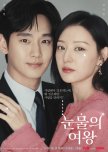
Queen of Tears is being re-released marathon-style this weekend (6/3-5/26) in Korea. This feels like the perfect opportunity to revisit and review one of my favorite dramas and also respond to some of the criticism I’ve seen out there.
To those who have thoughtfully articulated their criticisms on various sites, I respect you for clearly explaining your perspectives. However, to those who gave this drama a low rating after dropping it within the first three episodes, to keep ratings fair, I would respectfully suggest placing those early impressions in the comments section rather than the review section.
—The Acting
I believe the director of Queen of Tears used a restrained acting style between Kim Soo-Hyun and Kim Ji-Won for Baek Hyun-woo’s and Hong Hae-in’s characters. Meaning there was more silence and less dialogue, with much of the communication happening through eyes, facial expressions, delayed reactions, and unspoken emotions. I can see were this approach drew viewers into Baek/Hong's thoughts and feelings, making us experience their emotional journeys alongside them.
For me, much of the drama’s suspense came from these moments rather than from cliffhangers at the end of episodes. IMO, both Kim Ji-won and Kim Soo-hyun portrayed their characters with remarkable refinement and skill. Each displayed the wide acting range necessary to create truly multidimensional characters, the kind that we all love to watch.
Not only can Kim Soo-hyun portray profound sorrow, but he also excels at restraint. He masterfully utilizes subtle gestures and micro-expressions, communicating volumes without words. I’ve seen most of his dramas as well as Secretly Greatly. Never have I seen him display more varied gestures, expressions, or personality traits within a single character than he did with Baek Hyun-woo. As BHW, he convincingly portrayed boyish innocence, explosive anger, intense longing, devastating heartbreak, emotional collapse, and everything in between.
To the critics, how is that not great acting? But Kim Soo-hyun needs no defense from me.
Kim Ji-won has evolved into an exceptionally dynamic actress. I first enjoyed her performance in Descendants of the Sun, but there is a night-and-day difference between her acting range then and what she delivered in Queen of Tears. She gave us a subtly layered Hong Hae-in: a strong, uncompromising Type-A personality who is fiercely defiant but too proud to openly express emotions that might be perceived as weakness. Some of her funniest moments came through her indirect expressions of affection; asking leading questions, offering backhanded compliments, or scolding Hyun-woo before admitting he made her heart flutter. These moments, in my view, highlighted just how difficult it was for her to communicate genuine romantic feelings. As Hae-in’s journey with her illness and her relationship with BHW progressed, Kim Ji-won revealed her character’s deepest vulnerabilities at precisely the right moments and in exactly the right measure, making her both believable and relatable.
Queen of Tears would not have been the same story without both Kim Soo-hyun and Kim Ji-won. They were equals as actors, just as their characters were equals as man and wife. To reviewers or critics who say they had little or no chemistry is, in my opinion, to not have watched it or to have watched it with a heavy bias against one or both actors.
—The Character Development
*Kim Soo-hyun once remarked in an interview that Baek Hyun-woo begins the story as a loser. He was right. Hyun-woo was passive, submissive, and immature in his understanding of love. He believed enduring mistreatment without protest was an expression of devotion. Being constantly wounded by the Hong family—including his wife—became unbearable. He couldn't fight his circumstances so he convinced himself that he hated her as was revealed in the meeting with his psychiatrist (oh, the clever irony seeing Oh Jung Se as the psychiatrist. )
It would be no surprise that with that mindset, divorce was his only escape. Then came the shocking realization of Hae-In's impending death. We are to believe life with HHI and the Hongs was that unbearable. Again with his mindset, this would conveniently solve his problems. I agree with KSH and other critics, he was a loser and a coward.
*Hae-in sounded as though she understood what love was when she spoke to Eun-sung when he asked her about their relationship. In reality, she was every bit as immature as her husband. She seemed to believe that as long as Hyun-woo remained “by her side,” they would be alright. He said he would always be there, didn’t he?
At the beginning of the story, we see how thoroughly she has adopted her family’s arrogant sense of superiority, which justifies mistreating those of lower status for personal gain, even when that person is her husband. In the nursery removal scene, she hid behind that arrogance as a way of coping with the miscarriage.
These Baek-Hong warts are the foundation of QOT.
*While utterly foolish, Yang-gi’s suggestion that Hyun-woo pretend to love Hae-in in order to secure a place in her will became a blessing in disguise. Or…, perhaps it was a calculated move by Yang-gi to help his best friend see the truth beneath all the hurt. I doubt the latter, but it shows how much Yang-gi is in his BFF's court because he has witnessed BHW's life for the last 3+ years,
*Even though Hyun-woo cannot truly pull off hating Hae-in, he remained a coward by resisting the urge to start anything romantically with her. As her condition deteriorates, however, his resolve gradually crumbles and we see that buried love for her begin to reignite because, well, he never hated her to begin with. I loved when his mother scolded him later on when he confessed HHI's terminal condition. She was a strong woman with a gentle, loving spirit. If I had her for a mother, because I knew she loved me so much, that scolding would have been worse than any beating or rant.
*Of course, the pivotal moment for BHW comes in Germany. With both completely defeated, he deliberately provokes a divorce battle from Hae-in, not because he wants to leave her but because he desperately wants her to live. He gives her something to fight for, even if it is not with him. I believe this is where Baek Hyun-woo embraces what love truly is—not merely a feeling, but a choice and a commitment expressed through action.
In helping the Hong family escape to Yongdu-ri, Hyun-woo proves that love by devoting himself completely to protecting Hae-in and her family. We later learn that he contacted hundreds of cancer centers around the world in search of treatment options for her because he is desperate to keep her alive.
*Hae-in’s growth begins when she finally “wins” the divorce (props to Vincenzo / Song Joong Ki). It's at that point she begins to examine herself honestly and see Hyun-woo for who he truly is, the only man she could ever love. She realizes that he gives her a reason to live and that she cannot bear the thought of a future without him, in life or in death. For a fiercely independent and emotionally guarded woman, this was enormous character development.
When she found herself separated from the pressures of her corporate life in Yongdu-ri, Hae-in dropped her guard and, around Hyun Woo, she revealed a softer side she may never have known existed. The ultimate expression of her selfless love for HW came during the press conference, where she exposed Eun-sung's deeds in order to protect him.
Beyond Baek-Hong, the overall family relationships ultimately reinforced one of the drama’s central themes: that love outweighs money, status, and power. When they lost it all, they could finally see and appreciate each other.
*Beom-ja, although initially too eccentric to be taken seriously, became a scene-stealer, who consistently provided much-needed comic relief. She had been right along about Moh Seul-hee.
*Yang-gi also stole nearly every scene he appeared in (loved him). For me, his final scene with Hyun-woo in the car was one of the most memorable moments involving any supporting character in the entire drama. He was the friend to the end and he didn't want to lose him.
*Eun-sung’s, wonderfully portrayed by Park Sung-hoon,character arc never truly evolved beyond his obsession with possessing Hae-in and controlling Queens Group. He was still a juvenile wearing a 5,000,000 KRW suit. Despite the writers’ efforts, I don't believe viewers ever developed meaningful sympathy for him or for his mother, Moh Seul-hee. We were reminded how terrible a mother she was, more times than necessary.
Eun-sung did nothing to weaken the Baek-Hong relationship. If anything, he strengthened it. Despite all their resentment and misunderstandings, neither Hyun-woo nor Hae-in looked elsewhere. Eun-sung was never going to have a chance.
—The Story, the Second Half, HHI's Illness, Plot Extremes, and Valid Criticisms
Queen of Tears was approximately two years in the making, including about a year of filming. Across its roughly 23-hour runtime, Studio Dragon delivered a beautiful story about two people who had forgotten how deeply they loved each other and who rediscovered that buried love after a life-threatening tragedy nearly ended their relationship forever. It’s worth remembering that the drama was reportedly inspired, in part, by the real-life story of a Samsung heiress who married a regular employee.
Stories, fables, and even biblical narratives often use extreme or unrealistic circumstances to communicate deeper truths. I view many K-dramas through a similar lens. Not every detail needs to be realistic or true to life if the emotional truth resonates. This is why I can accept some of the more exaggerated elements of Queen of Tears. Even if one could dismiss parts of the story as unrealistic (real life often proves stranger than fiction, by the way), as someone who loved the drama, I can acknowledge its flaws.
* IMO too much screen time was devoted to the mechanics of the conspiracy against the Hong family. The writer and director likely felt it necessary to illustrate the lengths psychopaths will go to in pursuit of power and wealth, but I was not heavily invested in all of the related side characters and their storylines. Some of that time could have been spent further developing the Baek-Hong relationship.
* The Hong family—excluding Hae-in—sometimes came across as baphoonery in their trust of people who clearly sought to exploit them. Also, I found it difficult to believe, at first, that Hae-in’s mother remained trapped in grief over her son’s death for so many years, but truthfully, some people never fully recover from such losses.
* Grandfather, who trusted every word Baek said, suddenly placed his faith in a complete stranger and eventually removed Hyun-woo from the board. That transition felt uncharacteristic and unrealistically abrupt.
* The collapse of Queens Group and the attempted destruction of Hyun-woo’s legal reputation is where some viewers felt the drama lost focus. With so many moving parts, keeping track of everything started to get challenging. Grace’s role as a double agent often felt like a wrench thrown into the machinery of the plot.
* The exile to Yongdu-ri introduced additional storylines, some of which felt unnecessary.
Yet, the central focus did remain the Baek-Hong relationship. Every major event either contributed to or reflected their gradual surrender to the love they had spent years suppressing, even burying.
* Critics who argue that Hae-in’s illness lacked realism make a very fair point. It did show some of her illness’ effects, but the drama could and should have done more to show more of the effects of her illness. She was in the hospital once, briefly, but recouped amazingly quick. But wait…., she’s dying, isn’t she she? Also, her post-surgery recovery was far more glamorous than reality would allow. Still, those shortcomings were not deal-breakers for me. KDramas tend to lack that medical realism unless it's actually a medical drama.
* The arrest in Germany, the kidnapping, the hit-and-run, Hyun-woo somehow leaving the emergency room in one piece, and the winter gunshot sequence all pushed the boundaries of plausibility. But most of these 2nd half plot twists or narrative devices were designed to intensify the emotional climax between Baek Hyun-woo and Hong Hae-in. They forced the building of a new relationship between two people who thought they knew each other but, in some respects, were strangers.
Alchemy of Souls was pure fantasy (one of my least favorite genres) yet audiences embraced it because they connected emotionally with the characters. The same principle applies here.
—Why I Still Rate It So Highly
Even someone who loves Queen of Tears can acknowledge its flaws and still give it a 9 or 10.
Why?
Because, taken as a whole, the drama speaks to the heart.
I have never been wealthy, nor did I marry into a wealthy family. Yet the relationship between Baek Hyun-woo and Hong Hae-in reminded me of my own marriage. Both our love for each other was immature in the beginning and we definitely experienced our share of dramatic and difficult moments. Then, in our sixth year together, my husband began suffering life-altering medical episodes while still appearing healthy on the outside. A year later, he died. Looking back on our life together, I felt like I could have been a better partner and blamed myself for a long time over mostly trivial things. What I wanted was for him to come back. Anyway, I eventually realized something important: he never held my shortcomings or my mistakes (big and little) against me. He had made plenty of his own. And I never held his mistakes against him either. In retrospect, we always understood that about each other, even during our worst moments.
That realization changed how I viewed Queen of Tears. Forgiveness and acceptance are two of the highest forms of love in action.
—Why is Queen of Tears a treasured story for many?
I am certain I am not the only viewer who found pieces of their own life reflected in this drama.
Queen of Tears may contain over-the-top moments, but many viewers accept them because extraordinary moments exist in ordinary lives. We just don’t read about them every day. In the end, despite its plot holes, detours, and occasional excesses, Queen of Tears succeeds where it matters most:
It reminds us that love is not merely something we feel. Love is a choice. It is an action word. And it is not for the faint of heart.
To those who have thoughtfully articulated their criticisms on various sites, I respect you for clearly explaining your perspectives. However, to those who gave this drama a low rating after dropping it within the first three episodes, to keep ratings fair, I would respectfully suggest placing those early impressions in the comments section rather than the review section.
—The Acting
I believe the director of Queen of Tears used a restrained acting style between Kim Soo-Hyun and Kim Ji-Won for Baek Hyun-woo’s and Hong Hae-in’s characters. Meaning there was more silence and less dialogue, with much of the communication happening through eyes, facial expressions, delayed reactions, and unspoken emotions. I can see were this approach drew viewers into Baek/Hong's thoughts and feelings, making us experience their emotional journeys alongside them.
For me, much of the drama’s suspense came from these moments rather than from cliffhangers at the end of episodes. IMO, both Kim Ji-won and Kim Soo-hyun portrayed their characters with remarkable refinement and skill. Each displayed the wide acting range necessary to create truly multidimensional characters, the kind that we all love to watch.
Not only can Kim Soo-hyun portray profound sorrow, but he also excels at restraint. He masterfully utilizes subtle gestures and micro-expressions, communicating volumes without words. I’ve seen most of his dramas as well as Secretly Greatly. Never have I seen him display more varied gestures, expressions, or personality traits within a single character than he did with Baek Hyun-woo. As BHW, he convincingly portrayed boyish innocence, explosive anger, intense longing, devastating heartbreak, emotional collapse, and everything in between.
To the critics, how is that not great acting? But Kim Soo-hyun needs no defense from me.
Kim Ji-won has evolved into an exceptionally dynamic actress. I first enjoyed her performance in Descendants of the Sun, but there is a night-and-day difference between her acting range then and what she delivered in Queen of Tears. She gave us a subtly layered Hong Hae-in: a strong, uncompromising Type-A personality who is fiercely defiant but too proud to openly express emotions that might be perceived as weakness. Some of her funniest moments came through her indirect expressions of affection; asking leading questions, offering backhanded compliments, or scolding Hyun-woo before admitting he made her heart flutter. These moments, in my view, highlighted just how difficult it was for her to communicate genuine romantic feelings. As Hae-in’s journey with her illness and her relationship with BHW progressed, Kim Ji-won revealed her character’s deepest vulnerabilities at precisely the right moments and in exactly the right measure, making her both believable and relatable.
Queen of Tears would not have been the same story without both Kim Soo-hyun and Kim Ji-won. They were equals as actors, just as their characters were equals as man and wife. To reviewers or critics who say they had little or no chemistry is, in my opinion, to not have watched it or to have watched it with a heavy bias against one or both actors.
—The Character Development
*Kim Soo-hyun once remarked in an interview that Baek Hyun-woo begins the story as a loser. He was right. Hyun-woo was passive, submissive, and immature in his understanding of love. He believed enduring mistreatment without protest was an expression of devotion. Being constantly wounded by the Hong family—including his wife—became unbearable. He couldn't fight his circumstances so he convinced himself that he hated her as was revealed in the meeting with his psychiatrist (oh, the clever irony seeing Oh Jung Se as the psychiatrist. )
It would be no surprise that with that mindset, divorce was his only escape. Then came the shocking realization of Hae-In's impending death. We are to believe life with HHI and the Hongs was that unbearable. Again with his mindset, this would conveniently solve his problems. I agree with KSH and other critics, he was a loser and a coward.
*Hae-in sounded as though she understood what love was when she spoke to Eun-sung when he asked her about their relationship. In reality, she was every bit as immature as her husband. She seemed to believe that as long as Hyun-woo remained “by her side,” they would be alright. He said he would always be there, didn’t he?
At the beginning of the story, we see how thoroughly she has adopted her family’s arrogant sense of superiority, which justifies mistreating those of lower status for personal gain, even when that person is her husband. In the nursery removal scene, she hid behind that arrogance as a way of coping with the miscarriage.
These Baek-Hong warts are the foundation of QOT.
*While utterly foolish, Yang-gi’s suggestion that Hyun-woo pretend to love Hae-in in order to secure a place in her will became a blessing in disguise. Or…, perhaps it was a calculated move by Yang-gi to help his best friend see the truth beneath all the hurt. I doubt the latter, but it shows how much Yang-gi is in his BFF's court because he has witnessed BHW's life for the last 3+ years,
*Even though Hyun-woo cannot truly pull off hating Hae-in, he remained a coward by resisting the urge to start anything romantically with her. As her condition deteriorates, however, his resolve gradually crumbles and we see that buried love for her begin to reignite because, well, he never hated her to begin with. I loved when his mother scolded him later on when he confessed HHI's terminal condition. She was a strong woman with a gentle, loving spirit. If I had her for a mother, because I knew she loved me so much, that scolding would have been worse than any beating or rant.
*Of course, the pivotal moment for BHW comes in Germany. With both completely defeated, he deliberately provokes a divorce battle from Hae-in, not because he wants to leave her but because he desperately wants her to live. He gives her something to fight for, even if it is not with him. I believe this is where Baek Hyun-woo embraces what love truly is—not merely a feeling, but a choice and a commitment expressed through action.
In helping the Hong family escape to Yongdu-ri, Hyun-woo proves that love by devoting himself completely to protecting Hae-in and her family. We later learn that he contacted hundreds of cancer centers around the world in search of treatment options for her because he is desperate to keep her alive.
*Hae-in’s growth begins when she finally “wins” the divorce (props to Vincenzo / Song Joong Ki). It's at that point she begins to examine herself honestly and see Hyun-woo for who he truly is, the only man she could ever love. She realizes that he gives her a reason to live and that she cannot bear the thought of a future without him, in life or in death. For a fiercely independent and emotionally guarded woman, this was enormous character development.
When she found herself separated from the pressures of her corporate life in Yongdu-ri, Hae-in dropped her guard and, around Hyun Woo, she revealed a softer side she may never have known existed. The ultimate expression of her selfless love for HW came during the press conference, where she exposed Eun-sung's deeds in order to protect him.
Beyond Baek-Hong, the overall family relationships ultimately reinforced one of the drama’s central themes: that love outweighs money, status, and power. When they lost it all, they could finally see and appreciate each other.
*Beom-ja, although initially too eccentric to be taken seriously, became a scene-stealer, who consistently provided much-needed comic relief. She had been right along about Moh Seul-hee.
*Yang-gi also stole nearly every scene he appeared in (loved him). For me, his final scene with Hyun-woo in the car was one of the most memorable moments involving any supporting character in the entire drama. He was the friend to the end and he didn't want to lose him.
*Eun-sung’s, wonderfully portrayed by Park Sung-hoon,character arc never truly evolved beyond his obsession with possessing Hae-in and controlling Queens Group. He was still a juvenile wearing a 5,000,000 KRW suit. Despite the writers’ efforts, I don't believe viewers ever developed meaningful sympathy for him or for his mother, Moh Seul-hee. We were reminded how terrible a mother she was, more times than necessary.
Eun-sung did nothing to weaken the Baek-Hong relationship. If anything, he strengthened it. Despite all their resentment and misunderstandings, neither Hyun-woo nor Hae-in looked elsewhere. Eun-sung was never going to have a chance.
—The Story, the Second Half, HHI's Illness, Plot Extremes, and Valid Criticisms
Queen of Tears was approximately two years in the making, including about a year of filming. Across its roughly 23-hour runtime, Studio Dragon delivered a beautiful story about two people who had forgotten how deeply they loved each other and who rediscovered that buried love after a life-threatening tragedy nearly ended their relationship forever. It’s worth remembering that the drama was reportedly inspired, in part, by the real-life story of a Samsung heiress who married a regular employee.
Stories, fables, and even biblical narratives often use extreme or unrealistic circumstances to communicate deeper truths. I view many K-dramas through a similar lens. Not every detail needs to be realistic or true to life if the emotional truth resonates. This is why I can accept some of the more exaggerated elements of Queen of Tears. Even if one could dismiss parts of the story as unrealistic (real life often proves stranger than fiction, by the way), as someone who loved the drama, I can acknowledge its flaws.
* IMO too much screen time was devoted to the mechanics of the conspiracy against the Hong family. The writer and director likely felt it necessary to illustrate the lengths psychopaths will go to in pursuit of power and wealth, but I was not heavily invested in all of the related side characters and their storylines. Some of that time could have been spent further developing the Baek-Hong relationship.
* The Hong family—excluding Hae-in—sometimes came across as baphoonery in their trust of people who clearly sought to exploit them. Also, I found it difficult to believe, at first, that Hae-in’s mother remained trapped in grief over her son’s death for so many years, but truthfully, some people never fully recover from such losses.
* Grandfather, who trusted every word Baek said, suddenly placed his faith in a complete stranger and eventually removed Hyun-woo from the board. That transition felt uncharacteristic and unrealistically abrupt.
* The collapse of Queens Group and the attempted destruction of Hyun-woo’s legal reputation is where some viewers felt the drama lost focus. With so many moving parts, keeping track of everything started to get challenging. Grace’s role as a double agent often felt like a wrench thrown into the machinery of the plot.
* The exile to Yongdu-ri introduced additional storylines, some of which felt unnecessary.
Yet, the central focus did remain the Baek-Hong relationship. Every major event either contributed to or reflected their gradual surrender to the love they had spent years suppressing, even burying.
* Critics who argue that Hae-in’s illness lacked realism make a very fair point. It did show some of her illness’ effects, but the drama could and should have done more to show more of the effects of her illness. She was in the hospital once, briefly, but recouped amazingly quick. But wait…., she’s dying, isn’t she she? Also, her post-surgery recovery was far more glamorous than reality would allow. Still, those shortcomings were not deal-breakers for me. KDramas tend to lack that medical realism unless it's actually a medical drama.
* The arrest in Germany, the kidnapping, the hit-and-run, Hyun-woo somehow leaving the emergency room in one piece, and the winter gunshot sequence all pushed the boundaries of plausibility. But most of these 2nd half plot twists or narrative devices were designed to intensify the emotional climax between Baek Hyun-woo and Hong Hae-in. They forced the building of a new relationship between two people who thought they knew each other but, in some respects, were strangers.
Alchemy of Souls was pure fantasy (one of my least favorite genres) yet audiences embraced it because they connected emotionally with the characters. The same principle applies here.
—Why I Still Rate It So Highly
Even someone who loves Queen of Tears can acknowledge its flaws and still give it a 9 or 10.
Why?
Because, taken as a whole, the drama speaks to the heart.
I have never been wealthy, nor did I marry into a wealthy family. Yet the relationship between Baek Hyun-woo and Hong Hae-in reminded me of my own marriage. Both our love for each other was immature in the beginning and we definitely experienced our share of dramatic and difficult moments. Then, in our sixth year together, my husband began suffering life-altering medical episodes while still appearing healthy on the outside. A year later, he died. Looking back on our life together, I felt like I could have been a better partner and blamed myself for a long time over mostly trivial things. What I wanted was for him to come back. Anyway, I eventually realized something important: he never held my shortcomings or my mistakes (big and little) against me. He had made plenty of his own. And I never held his mistakes against him either. In retrospect, we always understood that about each other, even during our worst moments.
That realization changed how I viewed Queen of Tears. Forgiveness and acceptance are two of the highest forms of love in action.
—Why is Queen of Tears a treasured story for many?
I am certain I am not the only viewer who found pieces of their own life reflected in this drama.
Queen of Tears may contain over-the-top moments, but many viewers accept them because extraordinary moments exist in ordinary lives. We just don’t read about them every day. In the end, despite its plot holes, detours, and occasional excesses, Queen of Tears succeeds where it matters most:
It reminds us that love is not merely something we feel. Love is a choice. It is an action word. And it is not for the faint of heart.
Was this review helpful to you?


