
 News


This review may contain spoilers
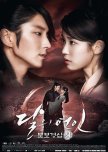
Moon Lovers: Scarlet Heart Ryeo is a 2016 historical-fantasy drama, consisting of 20 episodes, broadcast on SBS and directed by Kim Kyu-tae. Based on the Chinese novel Bu Bu Jing Xin, it tells the story of Go Ha-jin (IU), a 21st-century woman who, during a solar eclipse, is transported back in time and awakens in the body of Hae Soo, a young woman who lived during the Goryeo dynasty, in the midst of the power struggles among the princes of the royal family.
Hae Soo finds herself caught up in court dynamics and meets the numerous princes. Initially she feels attracted to the eighth prince Wang Wook (Kang Ha-neul), kind and caring. However, her fate soon becomes intertwined with that of the fourth prince Wang So (Lee Joon-gi), feared by everyone, forced to hide his face behind a mask because of a scar and nicknamed "wolf dog." A deep bond develops between the two, but the court is a nest of vipers: upon the death of King Taejo, the princes plot and fight fiercely for the throne, and Hae Soo finds herself trapped in a spiral of power, intrigue, and betrayal that will severely test her love and her very survival.
The strength of the drama lies in its emotional intensity and its cast. Lee Joon-gi is extraordinary in the role of Wang So: his ability to shift from the most brutal cruelty to the most disarming vulnerability is what holds the entire production together. Kang Ha-neul builds a Wook who is first gentle and then tragically ambiguous, and his transformation is one of the most interesting in the drama. IU, despite some criticism for a performance that is at times unripe, still manages to give Hae Soo a fragility that works.
The screenplay, however, has obvious flaws. The biggest problem is the lack of logic in the development of the female character: Hae Soo is lively and courageous at the beginning, but in the middle section she makes decisions that seem to "push the plot toward chaos" rather than representing a natural development. The narrative pacing is also problematic: the original Chinese drama has 35 episodes, while the Korean version has only 20, making the development of the second part extremely rushed. The competition for the throne is handled superficially, and the love story becomes excessively dramatic, losing its weight.
The ending is tragic and devastating. Hae Soo dies in the past after giving birth to Wang So's daughter, while Go Ha-jin wakes up from her coma in the present, at the museum, where she sees Wang So's portrait and remembers everything. Wang So remains in the past, alone, with the memory of her and the promise to find her again. The separation between the two worlds and the awareness that their love truly existed make the ending memorable and painful. The political subplots that precede it are confusing, but the ending itself works, and anyone who has followed the story to the end cannot remain indifferent to it.
The connection with Scarlet Heart (2011)
Moon Lovers is an adaptation of the Chinese drama Scarlet Heart (2011), and many dynamics are present in both versions, because the narrative structure is the same: the emperor who kills his brothers after a bloody struggle for succession; the rapid succession of kings; the king who kills the faithful servant of the woman he loves (in Moon Lovers it is Court Lady Oh, and this is one of the moments that mark the rupture between the two); the beloved woman who falls ill and dies from complications related to childbirth; the beloved woman who leaves the palace by marrying the fourteenth prince (Wang Jung here, as Ruoxi does in the Chinese drama); the woman who comes from the future and returns to the future after the coma. The difference between the two dramas is the addition of the detail of the secret daughter entrusted to Wang Jung, which is not present in the Chinese drama.
Trivia: In 2023 it was revealed that an alternative final scene had been filmed (then cut) in which Wang So and Ha-jin meet in the present at the museum, recognize each other, and restart their story.
Moon Lovers is a drama that deserves to be watched, at least once. The cinematography is splendid, the costumes are carefully crafted, the soundtrack is unforgettable, and Lee Joon-gi delivers one of his best performances. It is a drama that makes you angry, makes you cry, makes you shout at the screen, but it does not leave you indifferent. I personally liked it very much, despite some critical issues: the emotional impact and the acting performances more than make up for the flaws in the screenplay and pacing. If you are a fan of Lee Joon-gi or a lover of historical dramas willing to accept a tragic ending, it is worth seeking out. The most accurate description remains that of a classic that commands respect, but that cannot be defined as flawless.
Was this review helpful to you?


