
 News


This review may contain spoilers
The East Palace is a drama I watched on Netflix, and I'll start right away with a consideration that's close to my heart. As a sageuk enthusiast, when I found myself in front of the Italian translation of the subtitles, I felt a mix of annoyance and disappointment. The subtitles were clearly handled by professionals, that must be said, but there's one detail that really didn't sit well with me: the use of the term "archiatra" (archiater).
The archiater is, yes, the chief physician or protomedicus, a court term historically linked to the figure of the personal physician of a sovereign or a pontiff. It derives from the Greek ἀρχίατρος, composed of ἀρχι- (chief) and ἰατρός (physician). However, in a Joseon context, using "archiater" sounds like a foreign body. It's a term that belongs to the classical and pontifical tradition, not to the Korean one.
For a sageuk, the most correct and historically applicable choice would have been Eo-ui (어의), the Korean term for the sovereign's personal physician. He was the senior-ranking physician (dang-sang-gwan) belonging to the Uiwon (내의원, the court medical office), tasked with the exclusive care of the king and the royal family. Alongside him operated the Uigwan (의관), the actual physician-officials, who had passed the medical qualification examination (uigwa) and served as state technicians, handling the health of the court and, in some cases, of the public as well.
Furthermore, it should be noted that the term archiater is an archaic term, very rarely used in Italian, and I presume few people know its meaning. You understand it by logic, based on the scene, but the term contextualizes nothing: it says nothing about the era or Korean culture. Sageuk experts would have used other terms, clearer and more suitable: "royal physician," "protomedicus," "court physician."
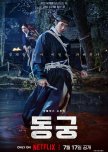
The premise is strong: an imaginary Joseon dynasty, a curse that has been killing heirs to the throne for thirty years, a vengeful spirit living in the pond of the Eastern Palace. The King, played by a Cho Seung-woo who dominates every scene with his grave and tormented presence, is forced to summon Gu-cheon (Nam Joo-hyuk), a cynical and reluctant spirit hunter who can cross the boundary between the living and the Realm of the Gwi. He is joined by Saeng-gang (Roh Yoon-seo), a court lady who hears the voices of the dead and who hides a secret: she is the illegitimate and estranged daughter of the King himself.
The chemistry between the two protagonists works, but don't expect a classic romance. Their relationship is more fraternal than romantic, made up of bickering, misunderstandings, and a trust that is built slowly, mission after mission. Nam Joo-hyuk is convincing in the role of the tired and disillusioned man who finds himself, against his will, fighting for something more than his own survival, and Roh Yoon-seo confirms she is one of the most interesting young actresses on the Korean scene. Their dynamic is the emotional heart of the series, and when the two begin to trust each other, the viewer roots for them.
The action scenes are brutal and well choreographed. Director Choi Jung-kyu infuses an almost animated energy into the fights, with intelligent use of practical effects and CG. The Realm of the Gwi is an eerie and visually successful place, and the creatures that inhabit it are carefully designed. However, the series is not without flaws: halfway through the season, the plot begins to rely excessively on twists, some of which seem more gratuitous than logically constructed. The supernatural mythology becomes confusing at times, with rules that are introduced or bent according to narrative necessity, and this breaks the rhythm.
The supporting cast is solid. Jang Young-nam is impeccable as the Queen Mother, an ambiguous and unsettling figure, and Kwak Dong-yeon, in the role of the Crown Prince, manages to be intimidating and tragic at the same time. Special mention for Ggeomeoksali, Gu-cheon's little spirit companion, who brings a breath of lightness to an otherwise dark drama.
In conclusion: The East Palace is a good supernatural costume drama, visually sumptuous and supported by a cast in form. It's not the most original — the debt to Stranger Things and Kingdom is evident — and the screenplay loses some clarity in the second half. But if you're looking for eight episodes of palace intrigue, ghosts, and well-choreographed duels, with a finale that leaves the door open to a possible sequel, then it's a more than decent watch. A shame, though, about that translation choice that, for someone like me who cares about details, jars quite a bit.
If you watch it, let me know what you think—especially if you also noticed that "archiater" and wondered why.
Was this review helpful to you?


