
 News


This review may contain spoilers
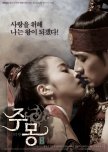
Jumong tells the life of Jumong (Song Il-gook), the legendary founder of the kingdom of Goguryeo. The story begins with General Hae Mosu (Heo Joon-ho) and Princess Yuhwa (Oh Yeon-soo), Jumong's true parents. When Hae Mosu is believed dead, Yuhwa, pregnant, is taken in by King Geumwa (Jeon Kwang-ryul) of Buyeo, who raises Jumong as his son.
Jumong grows up as a weak and despised prince, overshadowed by his half-brothers Daeso (Kim Seung-soo) and Yeongpo. After being expelled from the palace, he meets his blind father Hae Mosu, who secretly trains him. When Hae Mosu is killed, Jumong swears revenge.
Together with Soseono (Han Hye-jin), Jumong flees Buyeo and, after countless hardships, founds the kingdom of Goguryeo in 37 BC. But the return of Yuri, the son he had with his first wife Ye So Ya, creates a succession conflict that drives Soseono to leave Goguryeo with her sons, who will go on to found Baekje.
1. Narrative Licenses: An Intelligent Use of Historical Gaps
The narrative licenses in this drama are well integrated and functional. The scarcity of detailed historical sources on Jumong's life was exploited intelligently: saying that Ye So Ya and Yuri were hostages of Buyeo is very plausible, as is Daeso's coup d'état and his subsequent exile. These elements add a touch of drama that, had they strictly followed history — with Daeso succeeding his father after his death — would not have had the same narrative tension.
The drama proves that historical truth and good storytelling can coexist when the screenwriter knows the material and knows where to intervene. It's not about betraying history, but about filling the gaps with plausible elements that serve the drama.
MBC itself admitted that, given the scarcity of sources, a perfect historical reconstruction was impossible, and that the drama mixes fiction and non-fiction. This awareness allows the authors to take liberties that serve the narrative without betraying its spirit. The result is a tale that, while not a documentary, manages to convey the essence of an era and a character.
2. A Rating I Would Give Ten with Honors
I would give it 10 with honors, but I must limit myself to the maximum allowed by Viki Rakuten. It had been a long time since I had seen a k-drama that kept my eyes glued to the screen, comparable to Empress Ki or Hwarang.
Jumong has that rare quality that distinguishes great historical dramas: every episode counts. Despite its 81 episodes, the narrative never gets lost in filler. The characters grow, alliances change, betrayals follow one after another, and the viewer can't help but want to know what happens next. Song Il-gook builds a Jumong who goes from being a despised prince to an almost mythical figure, and the journey is gripping from beginning to end.
The production is polished, the costumes and sets are well reconstructed, and the soundtrack accompanies every moment effectively. It is a drama that deserves its status as a "national drama" in Korea.
3. The Only Sour Note
The only sour note is the relationship between Hyupbo and Sayong, two of Jumong's companions. Not because of its presence in itself, but because of its evident nature as a 2006 commercial insert disguised as the 1st century BC. The era did not condemn homosexuality; it is the drama that uses it as a decoy. And this forcing of woke concepts at all costs is counterproductive: the more they are imposed, the more people flee.
Was this review helpful to you?


