

 1
1


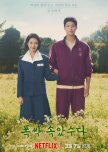
A Tender Tale Told in Seasons
Sometimes a drama doesn’t just entertain you—it lingers. Like the scent of citrus on your hands after peeling a tangerine, When Life Gives You Tangerines stays with you long after the credits roll. It’s tender, nostalgic, and quietly devastating in the best way.
Set against the ever-changing yet timeless backdrop of Jeju Island, the drama follows the story of Ae-sun (IU) and Gwan-sik (Park Bo-gum), two people whose lives become intertwined from a young age through to adulthood. Structured in four seasonal acts—from their sun-drenched youth in the 1960s to the more muted hues of middle age and legacy—the series is a meditation on love, duty, and the little choices that end up shaping entire lives.
What stands out most in when life gives you Tangerines is how unafraid it is to take its time. It resists melodrama and big cliffhangers in favor of smaller, more intimate moments: a shared tangerine under the trees, a silent glance across a schoolyard, an old cassette tape full of promises. It's in these quiet scenes that the drama does its best work.
Lim Sang-choon's writing shines here—lyrical without being overwrought, emotional without leaning into clichés. And director Kim Won-seok knows exactly when to let the camera linger and when to pull back. The cinematography turns Jeju into a living memory: sun filtering through citrus groves, waves crashing against stubborn rocks, the rustle of old hanboks in the breeze.
Before IU and Park Bo-gum even take the stage, it’s the child actors who steal your heart.
Moon Woo-jin as young Gwan-sik is an absolute revelation. He plays the role with so much restraint and quiet intensity, capturing the gentle steadfastness that Park Bo-gum later expands on. You believe from the very first moment that this boy will grow into a man who loves deeply, silently, and for a lifetime. There’s one scene in particular—where young Gwan-sik, dirt under his nails, saves his lunch to share with Ae-sun—that might just be one of the most heart-wrenching and pure moments in the entire series.
Kim Soo-in, as young Ae-sun, is equally phenomenal. She plays Ae-sun with a spark—ambitious, defiant, and a little impulsive. There's a complexity to her performance that goes beyond her years. She makes you feel Ae-sun’s yearning, her frustration with her circumstances, and her dreams of becoming something more. The dynamic between the two young leads is so raw and believable that it sets the emotional tone for the rest of the series. Without them, the weight of the story wouldn’t land nearly as hard.
Truly, their performances are what make the transition to the adult actors feel earned, rather than jarring.
IU delivers a career-best performance as Ae-sun. She plays both Ae-sun and her daughter Geum-myeong with an emotional delicacy that’s hard to put into words. You feel every loss, every compromise, every spark of joy. There’s a weariness in her eyes that tells its own story.
Park Bo-gum, meanwhile, proves why he’s one of the most beloved actors of his generation. His Gwan-sik is a man of few words, but the way he holds space—for Ae-sun, for their shared memories, for his own quiet regrets—is deeply affecting. He doesn’t need grand gestures. He just is. It’s that quiet kind of love that K-dramas don’t always depict well, and here, it feels almost revolutionary.
When Life Gives You Tangerines isn’t for everyone—it’s a slow burn, steeped in nostalgia and weighted with quiet grief. But if you give it the time it deserves, it rewards you with a story that’s both deeply personal and beautifully universal.
It’s about growing up in the shadow of war and poverty, about the dreams we hold onto and the ones we leave behind. It’s about first love, sure—but more than that, it’s about enduring love. The kind that doesn’t always have a happy ending, but leaves you changed all the same.
And above all, it’s a love letter to Jeju, to the haenyeo who dive without fear, to the children who dream beyond their villages, and to the people who love in the quiet spaces of everyday life.
Was this review helpful to you?


