



This review may contain spoilers
Il n'est en art qu'une chose qui vaille, celle qu'on ne peut expliquer...
There comes a point in Seijun Suzuki’s career when one begins to suspect that something has simply broken. Not in a dramatic sense, nor in any ‘artistic’ way that we are accustomed to describing it.
More simply — and perhaps for that very reason more radically — it is as if, after years spent making three or four films a year within the Nikkatsu production machine, Suzuki had looked at the mechanism for what it was: a perfectly functioning structure… and one that was completely exhausted.
At that point, instead of resisting or walking away (at least of his own accord), he seems to do something much simpler. The mechanism… He picks it up. He opens it… And stops putting it back together.
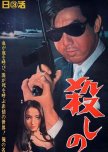
“Branded to Kill” (for the record, the only Suzuki film regularly distributed in Italy at the time) stems precisely from that: not as a dramatic break with convention, but as an internal short circuit, a moment when the genre movie — specifically the yakuza noir — carries on by inertia, even though something, in the meantime, has stopped working.
It’s not that there’s a specific scene or a passage you can pinpoint; it’s just that, as you watch it, at a certain moment you seem to sense it. The film is still there. The story… not quite in the same way.
Suzuki breaks the structure down into fragments, allowing them to coexist without forcing a return to wholeness. A gesture reminiscent of Cubism: not an alternative reality, but the same reality viewed from incompatible, simultaneous angles that cannot be pieced back together. Not a narrative that unfolds but a surface that shatters.
The protagonist, the hitman Hanada, is not a character in the traditional sense; he is a top-tier professional, ranked number 3 in a hierarchy that seems more like a mental obsession than a real system. It is unclear whether he is merely a victim of events, tries to navigate them, or simply reflects them.
It’s almost like a loop. He has these incredible obsessions – the smell of rice in particular, and relationships with the opposite sex – and moves through a world – real!? Imaginary!? Inevitable!? – which, really, resembles a noir film, at least on the surface, perhaps from a distance. Up close, however, it is as if everything had been taken apart and put back together badly, as if a deliberate decision had been made to sabotage the very concept of continuity (logical!? Narrative!?)
It is therefore pointless to try to piece the picture back together: the fragments were never meant to fit together. It is from this acceptance — rather than from any interpretation — that “Branded to Kill” reveals its most elusive nature. It functions like a trance: actions repeat themselves, distorted; situations slip into one another without ever truly meshing. Hanada moves within this flow as if following an automatism he does not control.
It is a kind of strange, almost ‘flawed’ hypnosis that always seems to leave a crack, a tiny gap that prevents one from letting go – and, evidently, from understanding (?). Yet rather than being a dream to be deciphered, it is a reality that has ceased to function.
Despite everything, beneath this unstable surface, the structure is still (more or less) recognisable.
There’s a killer. There are assignments, organisations, hierarchies. There are enigmatic women, betrayals, shoot-outs. Everything needed to build a good noir. Except that here, every element seems to arrive after its own meaning. The tension doesn’t seem to build so much as to dissipate.
Vague dialogue that distracts rather than clarifies, and violence that borders on abstraction in its slavish and, in some respects, illogical repetition. The incredible soundtrack, a blend of jazz and avant-garde (the pink vinyl edition is beautiful!) The noir genre hollowed out from within, leaving only the shell—though far from inert… But this is no parody or cinephile’s mockery playing with arthouse cinema; it is something stranger: a noir that hasn’t realised it’s finished.
And in this friction — between what we recognise and what no longer works — Suzuki finds his greatest freedom. He does not destroy the genre but lets it go. The director takes the noir/yakuza film as his starting point, distorting it until it becomes unrecognisable yet not abstract, moving away from pure avant-garde to arrive at a form of pop (art?) under extreme stress…
If we were to imagine the Nikkatsu executives sitting in the projection room watching "Branded to Kill", we would probably be faced with a scene reminiscent of Jean-Luc Godard’s "Le Mépris", where Jerry Prokosch, the producer played by Jack Palance, literally flings – like a frisbee or discus throw – the film cans of Fritz Lang’s film, for an adaptation of Homer’s “Odyssey” that isn’t exactly “commercial”, in his view…
But Suzuki is not a ‘rebel’, rather, he is an insider saboteur. The romantic narrative of ‘the director versus Nikkatsu’ is true but limiting. Suzuki is more interesting – and complex – if we read him as a craftsman who realised that the system had run out of substance, and that it was better to ‘stuff’ the form until it burst.
If, in "Branded to Kill", sex becomes almost a “fetishistic compulsion inextricably linked to death and violence” (quoted) and if Suzuki “deconstructs genres and conventions”, drawing on a non-conformist spirit and a taste for social satire (already quite evident in his first “personal” works), then, rather than associating him with the American Samuel Fuller, as is often suggested, one is inclined to link him more closely to a director seemingly worlds apart, such as the Italian Marco Ferreri, whose iconoclastic vision is almost identical.
At this point, seeking a conclusion in the traditional sense seems almost out of place.
“Branded to Kill” doesn’t really come to a closure. It doesn’t tie up loose ends or restore order. It simply… fizzles out.
As if, having pushed the mechanism to its limits, Suzuki had decided it was no longer worth fixing. That the meaning, if there was any, had already been exhausted along the way.
And that all that remained was this collection of fragments, images, gestures — still in motion, but now disconnected from any notion of wholeness.
And the viewer, at that point, is not asked to understand, but rather to simply stand before those fragments. To lose himself, if necessary. Or even just to accept that the pieces will never come back together. Because perhaps this is precisely the film’s most radical act: not breaking the rules, not rewriting them, but letting them go — and observing what remains when we stop holding them together.
“Branded To Kill” is unlike anything else, even today when we’re used to everything. It’s short, fast-paced and full of images that stick in your mind. Ultimately, if you like, it’s even entertaining — but in that slightly strange way that leaves you feeling as though you’ve understood something… without knowing exactly what.
And in that moment, between a shot that slips away and a cut that doesn’t quite land, you almost find yourself picturing him once more:
Suzuki. A step back. A quick glance. A half-smile.
As if he were saying to you: “It used to work great, you know?
But in this way it’s much more interesting.”
9 ½ / 10
More simply — and perhaps for that very reason more radically — it is as if, after years spent making three or four films a year within the Nikkatsu production machine, Suzuki had looked at the mechanism for what it was: a perfectly functioning structure… and one that was completely exhausted.
At that point, instead of resisting or walking away (at least of his own accord), he seems to do something much simpler. The mechanism… He picks it up. He opens it… And stops putting it back together.
“Branded to Kill” (for the record, the only Suzuki film regularly distributed in Italy at the time) stems precisely from that: not as a dramatic break with convention, but as an internal short circuit, a moment when the genre movie — specifically the yakuza noir — carries on by inertia, even though something, in the meantime, has stopped working.
It’s not that there’s a specific scene or a passage you can pinpoint; it’s just that, as you watch it, at a certain moment you seem to sense it. The film is still there. The story… not quite in the same way.
Suzuki breaks the structure down into fragments, allowing them to coexist without forcing a return to wholeness. A gesture reminiscent of Cubism: not an alternative reality, but the same reality viewed from incompatible, simultaneous angles that cannot be pieced back together. Not a narrative that unfolds but a surface that shatters.
The protagonist, the hitman Hanada, is not a character in the traditional sense; he is a top-tier professional, ranked number 3 in a hierarchy that seems more like a mental obsession than a real system. It is unclear whether he is merely a victim of events, tries to navigate them, or simply reflects them.
It’s almost like a loop. He has these incredible obsessions – the smell of rice in particular, and relationships with the opposite sex – and moves through a world – real!? Imaginary!? Inevitable!? – which, really, resembles a noir film, at least on the surface, perhaps from a distance. Up close, however, it is as if everything had been taken apart and put back together badly, as if a deliberate decision had been made to sabotage the very concept of continuity (logical!? Narrative!?)
It is therefore pointless to try to piece the picture back together: the fragments were never meant to fit together. It is from this acceptance — rather than from any interpretation — that “Branded to Kill” reveals its most elusive nature. It functions like a trance: actions repeat themselves, distorted; situations slip into one another without ever truly meshing. Hanada moves within this flow as if following an automatism he does not control.
It is a kind of strange, almost ‘flawed’ hypnosis that always seems to leave a crack, a tiny gap that prevents one from letting go – and, evidently, from understanding (?). Yet rather than being a dream to be deciphered, it is a reality that has ceased to function.
Despite everything, beneath this unstable surface, the structure is still (more or less) recognisable.
There’s a killer. There are assignments, organisations, hierarchies. There are enigmatic women, betrayals, shoot-outs. Everything needed to build a good noir. Except that here, every element seems to arrive after its own meaning. The tension doesn’t seem to build so much as to dissipate.
Vague dialogue that distracts rather than clarifies, and violence that borders on abstraction in its slavish and, in some respects, illogical repetition. The incredible soundtrack, a blend of jazz and avant-garde (the pink vinyl edition is beautiful!) The noir genre hollowed out from within, leaving only the shell—though far from inert… But this is no parody or cinephile’s mockery playing with arthouse cinema; it is something stranger: a noir that hasn’t realised it’s finished.
And in this friction — between what we recognise and what no longer works — Suzuki finds his greatest freedom. He does not destroy the genre but lets it go. The director takes the noir/yakuza film as his starting point, distorting it until it becomes unrecognisable yet not abstract, moving away from pure avant-garde to arrive at a form of pop (art?) under extreme stress…
If we were to imagine the Nikkatsu executives sitting in the projection room watching "Branded to Kill", we would probably be faced with a scene reminiscent of Jean-Luc Godard’s "Le Mépris", where Jerry Prokosch, the producer played by Jack Palance, literally flings – like a frisbee or discus throw – the film cans of Fritz Lang’s film, for an adaptation of Homer’s “Odyssey” that isn’t exactly “commercial”, in his view…
But Suzuki is not a ‘rebel’, rather, he is an insider saboteur. The romantic narrative of ‘the director versus Nikkatsu’ is true but limiting. Suzuki is more interesting – and complex – if we read him as a craftsman who realised that the system had run out of substance, and that it was better to ‘stuff’ the form until it burst.
If, in "Branded to Kill", sex becomes almost a “fetishistic compulsion inextricably linked to death and violence” (quoted) and if Suzuki “deconstructs genres and conventions”, drawing on a non-conformist spirit and a taste for social satire (already quite evident in his first “personal” works), then, rather than associating him with the American Samuel Fuller, as is often suggested, one is inclined to link him more closely to a director seemingly worlds apart, such as the Italian Marco Ferreri, whose iconoclastic vision is almost identical.
At this point, seeking a conclusion in the traditional sense seems almost out of place.
“Branded to Kill” doesn’t really come to a closure. It doesn’t tie up loose ends or restore order. It simply… fizzles out.
As if, having pushed the mechanism to its limits, Suzuki had decided it was no longer worth fixing. That the meaning, if there was any, had already been exhausted along the way.
And that all that remained was this collection of fragments, images, gestures — still in motion, but now disconnected from any notion of wholeness.
And the viewer, at that point, is not asked to understand, but rather to simply stand before those fragments. To lose himself, if necessary. Or even just to accept that the pieces will never come back together. Because perhaps this is precisely the film’s most radical act: not breaking the rules, not rewriting them, but letting them go — and observing what remains when we stop holding them together.
“Branded To Kill” is unlike anything else, even today when we’re used to everything. It’s short, fast-paced and full of images that stick in your mind. Ultimately, if you like, it’s even entertaining — but in that slightly strange way that leaves you feeling as though you’ve understood something… without knowing exactly what.
And in that moment, between a shot that slips away and a cut that doesn’t quite land, you almost find yourself picturing him once more:
Suzuki. A step back. A quick glance. A half-smile.
As if he were saying to you: “It used to work great, you know?
But in this way it’s much more interesting.”
9 ½ / 10
Was this review helpful to you?


