


 77
77 334
334 10
10 1
1 5
5 1
1 13
13 1
1 2
2 3
3 1
1 2
2 1
1 1
1 6
6 11
11 2
2 1
1 2
2 1
1 2
2 1
1 1
1 3
3 2
2 1
1 2
2 2
2 1
1 2
2 1
1 8
8


A bot could have done a lot better!
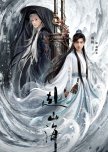
The Journey of Legend (赴山海/Fù Shānhǎi) ambitiously reimagines Wen Ruian’s mid-1970s wuxia classic, The Heroes of China (神州奇侠/Shénzhōu Qí Xiá). Novelist Xiao Mingming, transmigrated into the novel’s world by a vengeful AI for daring to rewrite it with cheat codes, becomes the protagonist Xiao Qiushui. To return home, he must complete the hero’s journey in this sprawling martial world.
Wen Ruian’s novel is a revered masterpiece among wuxia fans, celebrated for its epic scope, literary depth, and genre-defining influence. Layering an AI-driven isekai conspiracy arc over its already rich plot and character-driven narrative is a daunting task. Screenwriter Liu Fang, however, is woefully unequal to it. Her juvenile writing and shallow dialogue clash jarringly with Wen’s sophisticated, poetic prose. The first five or six episodes stumble through Mingming’s integration into the novel’s world, hampered by cringeworthy attempts at humor. The pace improves as the story aligns with the original novel, but periodic AI-driven digressions disrupt the otherwise stellar plot and character arcs. Ironically in terms of screenplay, a bot could have done a lot better! This drama is watchable if you ignore the AI subplots—they’re unworthy of attention.
Set in the fictional kingdom of Daxi, loosely based on the Southern Song Dynasty post-Jingkang humiliation, the story reinterprets the shameful betrayal of patriot Yue Fei through an alternate lens. The Beihuang invaders, likely inspired by the Jurchens, loom large, while a disillusioned jianghu (the martial world) fractures under the rivalry between the ambitious Li Chenzhou’s Power League (权力帮) and the enigmatic King Zhu’s River Sect. As the empire faces a controversial decision, young idealist Xiao Mingming/Qiushui navigates a family conspiracy that spirals into national stakes.
Cheng Yi plays both Xiao Qiushui and Li Chenzhou, narrative parallels designed to look uncannily alike yet embody opposing ideologies. Qiushui champions righteousness and chivalry (义, yì), while the cynical Chenzhou wields power and control (权力, quánlì). Cheng Yi struggles early to settle into these roles, but his portrayal of Chenzhou—a once-idealistic figure hardened by betrayal—outshines the vanilla, righteous Qiushui. Chenzhou’s complexity ultimately steals the spotlight.
The sprawling cast, however, is a mixed bag. Few characters beyond Li Chenzhou are fully developed. Lui Suifeng’s arc starts strong but fizzles, though it’s the best-acted role. Cheung Chi-Lam’s Crazy Yan is another standout, criminally underused. Newbie actors, overshadowed by veterans, expose the uneven casting. The main villain, a dumbed-down Qin Hui—history’s most infamous traitor—reduces a legendary antagonist to a trite middle-child syndrome caricature.
The saving grace? The martial arts. The action sequences are electrifying, ingeniously staged to deliver edge-of-your-seat thrills and imminent peril absent from recent wuxia dramas. Unlike the overly stylized twirling of Mysterious Lotus Casebook, these fights are intense, muscular, and flinch-worthy. If only the budget had stretched to a competent screenwriter! A straight adaptation of Wen’s novel, paired with these action scenes, could’ve been a masterpiece, dated genre or not.
I held off on weighing in on the rating controversy surrounding this production until I’d finished and reflected. Everything I loved—the profound, lingering ending included—stems from the original novel. Despite some clumsy moments, the finale respects Wen’s work. Yet, evaluated holistically, this adaptation desecrates a classic. I’m giving it a generous 8/10, almost entirely for the re-watchable martial arts. The storytelling scrapes by with a 7/10.
Wen Ruian’s novel is a revered masterpiece among wuxia fans, celebrated for its epic scope, literary depth, and genre-defining influence. Layering an AI-driven isekai conspiracy arc over its already rich plot and character-driven narrative is a daunting task. Screenwriter Liu Fang, however, is woefully unequal to it. Her juvenile writing and shallow dialogue clash jarringly with Wen’s sophisticated, poetic prose. The first five or six episodes stumble through Mingming’s integration into the novel’s world, hampered by cringeworthy attempts at humor. The pace improves as the story aligns with the original novel, but periodic AI-driven digressions disrupt the otherwise stellar plot and character arcs. Ironically in terms of screenplay, a bot could have done a lot better! This drama is watchable if you ignore the AI subplots—they’re unworthy of attention.
Set in the fictional kingdom of Daxi, loosely based on the Southern Song Dynasty post-Jingkang humiliation, the story reinterprets the shameful betrayal of patriot Yue Fei through an alternate lens. The Beihuang invaders, likely inspired by the Jurchens, loom large, while a disillusioned jianghu (the martial world) fractures under the rivalry between the ambitious Li Chenzhou’s Power League (权力帮) and the enigmatic King Zhu’s River Sect. As the empire faces a controversial decision, young idealist Xiao Mingming/Qiushui navigates a family conspiracy that spirals into national stakes.
Cheng Yi plays both Xiao Qiushui and Li Chenzhou, narrative parallels designed to look uncannily alike yet embody opposing ideologies. Qiushui champions righteousness and chivalry (义, yì), while the cynical Chenzhou wields power and control (权力, quánlì). Cheng Yi struggles early to settle into these roles, but his portrayal of Chenzhou—a once-idealistic figure hardened by betrayal—outshines the vanilla, righteous Qiushui. Chenzhou’s complexity ultimately steals the spotlight.
The sprawling cast, however, is a mixed bag. Few characters beyond Li Chenzhou are fully developed. Lui Suifeng’s arc starts strong but fizzles, though it’s the best-acted role. Cheung Chi-Lam’s Crazy Yan is another standout, criminally underused. Newbie actors, overshadowed by veterans, expose the uneven casting. The main villain, a dumbed-down Qin Hui—history’s most infamous traitor—reduces a legendary antagonist to a trite middle-child syndrome caricature.
The saving grace? The martial arts. The action sequences are electrifying, ingeniously staged to deliver edge-of-your-seat thrills and imminent peril absent from recent wuxia dramas. Unlike the overly stylized twirling of Mysterious Lotus Casebook, these fights are intense, muscular, and flinch-worthy. If only the budget had stretched to a competent screenwriter! A straight adaptation of Wen’s novel, paired with these action scenes, could’ve been a masterpiece, dated genre or not.
I held off on weighing in on the rating controversy surrounding this production until I’d finished and reflected. Everything I loved—the profound, lingering ending included—stems from the original novel. Despite some clumsy moments, the finale respects Wen’s work. Yet, evaluated holistically, this adaptation desecrates a classic. I’m giving it a generous 8/10, almost entirely for the re-watchable martial arts. The storytelling scrapes by with a 7/10.
Was this review helpful to you?


