


 3
3 4
4 1
1


This review may contain spoilers
Raw, challenging and courageous
The writer, Song Hye Jin’s previous drama “The Smile Has Left Your Eyes” stayed with me for the intensity of the emotions and its stark bleakness, and this one is no different. That was not without fault and neither is this. But it will be another unforgettable drama that haunts rather than lingers. Unlike “The Smile…”, this appears to be an original story, so is doubly impressive. I am not surprised that she only produces work every few years. This level of emotional intensity takes a toll. The effort and depth of understanding needed to create an emotional arc this complex and compelling, and live with it whilst writing is truly astounding and I stand in awe.
My current take on this story having just finished it (and it’s the sort of thing that changes with reflection over time) is that it outlines a co-dependent relationship where however cruel it is, the individuals go back for more to justify to themselves that their self image is true to who they think they are. They both need to fight to keep it intact, whatever the cost.
Although there is a tendency to see Sang Yeon as the villain of the piece, whilst Eun Jung is the victim, this is to ignore the fact that Eun Jung could not walk away from her necessity to think of herself as a good person and accept her limits. As the story progresses Eun Jung is forced to confront the shallowness and fragility of her understanding of what that actually means. She accepts Sang Yeon back every time because she needs to feel that she is big enough and strong enough to cope. That her self respect will not let her down. She accepts the test each time. But the irony is that with each encounter the hate grows bigger inside her, and eats away at the unlimited, balanced personality and open generosity she needs to think she has.
For Sang Yeon, there is an ever present existential threat created by the suicide of her brother and her perceived rejection by her mother, who also ultimately abandons her in death. What is so bad that you would prefer to die rather than live? That you would consider the love and trust of the people around you not enough reason to live. She is constantly testing Eun Jung, trying to push her towards the edge, testing whether her limit will result in an ending and another abandonment. Sang Yeon cannot abandon Eun Jung and returns to her for the connection that will never give up on her. She finally realises that death is a necessary and unavoidable abandonment, but that it does not necessarily imply rejection.
The responsibility for this fractured relationship is in fact equally balanced and it is not until they both realise that fact that they could finally come together.
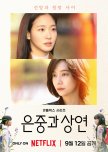
The performances by Kim Go Eun and Park Ji Hyun were exceptional. To be offered a script of this quality must have seemed like a dream come true. Both of them excelled and created compelling characters although personally I was more convinced by Park Ji Hyun than Kim Go Eun. However, I was not immediately drawn to them and it took about 5 or 6 episodes for me to work my way into their characters. (More about that when I come to talk about the cinematography and editing.) But over the course of the drama as a whole, they both convinced, especially in the emotional impacts at the end of each of the four “acts”.
This is essentially a story about two women, the male lead has a fairly inconsequential character arc and is really there to act as a foil between the them. To be honest, I found his character bland and lacking depth and it felt as though Kim Gun Woo accepted that lack in his playing of the part. I was not convinced of the pivotal role he had in the lives of the women, whose characters were strong and fully realised. This is perhaps a necessary compromise in the writing. To have made the character of Sang Hak richer and stronger would have added competition on a field already filled to bursting with it and taken away from the interaction between the women.
I was so glad that at the end of the drama they did not resort to euphemism but had the courage to follow through on the emotional impact. The drama was unafraid to be raw and direct. Not just in the storyline, but in the behaviour of the characters who spoke their truth brutally and used it as a weapon to both intimidate and manipulate.
The faults that I mentioned earlier (and FFS perfection is a ridiculous imposition to put on such a good drama) are mainly to do with the cinematography and editing, although there is a small niggle with the story arc.
Let’s address that first. By the time we reached the 2013 section of the drama I was a little tired of adjusting to new situations and characters and found that much of it felt like a repeat of 2003 in a different setting with slightly different stakes. Although I admit if I rewatch this drama I may see that differently. The other niggle is about how the early part of the story is partly narrated in voice overs by Eun Jung as part of her autobiographical writing of their relationship. This led to awkward storytelling, where scenes Eun Jung was not present in were necessary for the narrative flow. I think that was unnecessary and the story could simply have been told straight.
Now for my main peeve - the cinematography and the editing. Ironic in a story where one of the characters is a cinematographer. I thought a lot about why I was not engaging with the characters for the first third of the drama and came to the conclusion that it was a lot to do with how the story was visually presented. The editing style was to chop and change constantly, with mainly close-ups being used in significant emotional scenes. It was like being at a tennis match. When facing one person you can’t tell what’s happening to the other one so you turn back and bounce between them. What you want to see is the combined picture where they are both in frame so that you can watch the subtle changes in body language and sink into the tension between them. Then, make an impact by showing close ups. They were so busy with capturing the details that they forgot to open up the big picture. The result was that I had to put a lot of work into reading the room. I recently finished “Sounds of Winter” where the superb cinematography was a major part of the emotional impact and this production could well have learned something from it.
There was another choice which drew my attention away from the characters at critical moments, and that was the decision to use hand held camerawork in the climactic scenes in episodes 7 and 13 when everything fell apart. The unavoidable camera shake pulled me away from the intensity unfolding in front of me. It was so noticeable because it had not been used in any other context and was obviously a deliberate decision. Perhaps with the intention of illustrating how their world was shaking. As far as I was concerned it was Um Song Tak’s (the cinematographer) “look at me” moment.
Having said all that, this drama deserves its 9 rating. It didn’t capture my heart, but rather confronted and challenged me and had the courage to deliver on its promises.
My current take on this story having just finished it (and it’s the sort of thing that changes with reflection over time) is that it outlines a co-dependent relationship where however cruel it is, the individuals go back for more to justify to themselves that their self image is true to who they think they are. They both need to fight to keep it intact, whatever the cost.
Although there is a tendency to see Sang Yeon as the villain of the piece, whilst Eun Jung is the victim, this is to ignore the fact that Eun Jung could not walk away from her necessity to think of herself as a good person and accept her limits. As the story progresses Eun Jung is forced to confront the shallowness and fragility of her understanding of what that actually means. She accepts Sang Yeon back every time because she needs to feel that she is big enough and strong enough to cope. That her self respect will not let her down. She accepts the test each time. But the irony is that with each encounter the hate grows bigger inside her, and eats away at the unlimited, balanced personality and open generosity she needs to think she has.
For Sang Yeon, there is an ever present existential threat created by the suicide of her brother and her perceived rejection by her mother, who also ultimately abandons her in death. What is so bad that you would prefer to die rather than live? That you would consider the love and trust of the people around you not enough reason to live. She is constantly testing Eun Jung, trying to push her towards the edge, testing whether her limit will result in an ending and another abandonment. Sang Yeon cannot abandon Eun Jung and returns to her for the connection that will never give up on her. She finally realises that death is a necessary and unavoidable abandonment, but that it does not necessarily imply rejection.
The responsibility for this fractured relationship is in fact equally balanced and it is not until they both realise that fact that they could finally come together.
The performances by Kim Go Eun and Park Ji Hyun were exceptional. To be offered a script of this quality must have seemed like a dream come true. Both of them excelled and created compelling characters although personally I was more convinced by Park Ji Hyun than Kim Go Eun. However, I was not immediately drawn to them and it took about 5 or 6 episodes for me to work my way into their characters. (More about that when I come to talk about the cinematography and editing.) But over the course of the drama as a whole, they both convinced, especially in the emotional impacts at the end of each of the four “acts”.
This is essentially a story about two women, the male lead has a fairly inconsequential character arc and is really there to act as a foil between the them. To be honest, I found his character bland and lacking depth and it felt as though Kim Gun Woo accepted that lack in his playing of the part. I was not convinced of the pivotal role he had in the lives of the women, whose characters were strong and fully realised. This is perhaps a necessary compromise in the writing. To have made the character of Sang Hak richer and stronger would have added competition on a field already filled to bursting with it and taken away from the interaction between the women.
I was so glad that at the end of the drama they did not resort to euphemism but had the courage to follow through on the emotional impact. The drama was unafraid to be raw and direct. Not just in the storyline, but in the behaviour of the characters who spoke their truth brutally and used it as a weapon to both intimidate and manipulate.
The faults that I mentioned earlier (and FFS perfection is a ridiculous imposition to put on such a good drama) are mainly to do with the cinematography and editing, although there is a small niggle with the story arc.
Let’s address that first. By the time we reached the 2013 section of the drama I was a little tired of adjusting to new situations and characters and found that much of it felt like a repeat of 2003 in a different setting with slightly different stakes. Although I admit if I rewatch this drama I may see that differently. The other niggle is about how the early part of the story is partly narrated in voice overs by Eun Jung as part of her autobiographical writing of their relationship. This led to awkward storytelling, where scenes Eun Jung was not present in were necessary for the narrative flow. I think that was unnecessary and the story could simply have been told straight.
Now for my main peeve - the cinematography and the editing. Ironic in a story where one of the characters is a cinematographer. I thought a lot about why I was not engaging with the characters for the first third of the drama and came to the conclusion that it was a lot to do with how the story was visually presented. The editing style was to chop and change constantly, with mainly close-ups being used in significant emotional scenes. It was like being at a tennis match. When facing one person you can’t tell what’s happening to the other one so you turn back and bounce between them. What you want to see is the combined picture where they are both in frame so that you can watch the subtle changes in body language and sink into the tension between them. Then, make an impact by showing close ups. They were so busy with capturing the details that they forgot to open up the big picture. The result was that I had to put a lot of work into reading the room. I recently finished “Sounds of Winter” where the superb cinematography was a major part of the emotional impact and this production could well have learned something from it.
There was another choice which drew my attention away from the characters at critical moments, and that was the decision to use hand held camerawork in the climactic scenes in episodes 7 and 13 when everything fell apart. The unavoidable camera shake pulled me away from the intensity unfolding in front of me. It was so noticeable because it had not been used in any other context and was obviously a deliberate decision. Perhaps with the intention of illustrating how their world was shaking. As far as I was concerned it was Um Song Tak’s (the cinematographer) “look at me” moment.
Having said all that, this drama deserves its 9 rating. It didn’t capture my heart, but rather confronted and challenged me and had the courage to deliver on its promises.
Was this review helpful to you?


