
 News
News 


 1
1


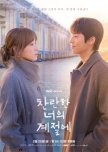
This review may contain spoilers
A Drama About Invisible Pain and the Courage to Try to Be Happy.
This Kdrama came to me as a whisper and ended up being a scream to the heart. The first few chapters completely captivated me, especially due to that so well-constructed emotional weight and that initial entanglement that hooks you: he knows her, but she doesn't seem to remember him. That asymmetry generates a narrative tension that is delicious and painful in equal measure.
As the plot progresses and the male protagonist's backstory develops, one discovers the sadness and emotional burden he carries: the accident, the invisible scars, the loss. But what impacted me most was his conscious decision to "now I will try to live happily". That phrase, so simple on the surface, hides a titanic struggle. And the drama portrays with great sensitivity how sometimes "extremely happy and positive" people are the ones who have fought the most battles in silence. We don't know the story behind a constant smile, and this drama exposes it with a delicacy that both hurts and embraces.
It's important to highlight that both protagonists carry their own pain. She also has her emotional backpack: years of mourning for a person she loved (and who ended up deceiving her), the shock of discovering that the one writing on the other side wasn't her imagined boyfriend, the confusion of having built a love on a lie. However, I did feel that the narrative weight leans more toward him. I would have wished for a little more depth in exploring her grief and disillusionment. It doesn't ruin the experience, but the imbalance is noticeable.
I really liked the parallel stories of the sisters and, above all, the grandmother's. Each showed conflicts of different weights: from a teenage love and the problems typical of that age to issues of health and the right to be cared for, even in old age.
The grandmother's story is especially beautiful: it reminds us that it is never too late to find friendship and love again, to allow oneself to be vulnerable, and to accept that being cared for is not a weakness, even when the years weigh heavy. These secondary plots accompany and enrich the main one without stealing its spotlight.
Another narrative success is the use of the seasons as stages of life. Winter as pain, spring as rebirth, summer as plenitude, autumn as memory. This resource, far from being pretentious, wraps the story in a visual and emotional poetry that elevates the whole.
I must admit that in the final chapters the drama does decline a bit. Perhaps because the great backstory that both characters carry is not handled with the same solidity as in the first episodes. There's a certain sense that the task of closing so many open wounds becomes complex and the rhythm suffers. Additionally, the ending of some stories feels a bit diffuse; I would have appreciated a clearer closure for all the open plotlines. But the decline at the end does not take away all the good that was built before. "In Your Radiant Season" is a very beautiful drama that speaks of forgiveness, pain, guilt, and, above all, how to move on after painful and traumatic experiences. It's a story about resilience, about daring to be happy when life has taught you that happiness hurts, and about learning to let go of what wasn't meant to be in order to embrace what can be.
If you like dramas with intense emotional weight, wounded but fighting characters, and a narrative that uses the emotional landscape as part of the visual landscape, this drama is for you. It's not perfect—the ending feels somewhat blurry and the female protagonist even comes across as cruel at times—but its heart is in the right place. I'm left with its message: sometimes, the bravest act is not surviving, but deciding to try to be happy.
As the plot progresses and the male protagonist's backstory develops, one discovers the sadness and emotional burden he carries: the accident, the invisible scars, the loss. But what impacted me most was his conscious decision to "now I will try to live happily". That phrase, so simple on the surface, hides a titanic struggle. And the drama portrays with great sensitivity how sometimes "extremely happy and positive" people are the ones who have fought the most battles in silence. We don't know the story behind a constant smile, and this drama exposes it with a delicacy that both hurts and embraces.
It's important to highlight that both protagonists carry their own pain. She also has her emotional backpack: years of mourning for a person she loved (and who ended up deceiving her), the shock of discovering that the one writing on the other side wasn't her imagined boyfriend, the confusion of having built a love on a lie. However, I did feel that the narrative weight leans more toward him. I would have wished for a little more depth in exploring her grief and disillusionment. It doesn't ruin the experience, but the imbalance is noticeable.
I really liked the parallel stories of the sisters and, above all, the grandmother's. Each showed conflicts of different weights: from a teenage love and the problems typical of that age to issues of health and the right to be cared for, even in old age.
The grandmother's story is especially beautiful: it reminds us that it is never too late to find friendship and love again, to allow oneself to be vulnerable, and to accept that being cared for is not a weakness, even when the years weigh heavy. These secondary plots accompany and enrich the main one without stealing its spotlight.
Another narrative success is the use of the seasons as stages of life. Winter as pain, spring as rebirth, summer as plenitude, autumn as memory. This resource, far from being pretentious, wraps the story in a visual and emotional poetry that elevates the whole.
I must admit that in the final chapters the drama does decline a bit. Perhaps because the great backstory that both characters carry is not handled with the same solidity as in the first episodes. There's a certain sense that the task of closing so many open wounds becomes complex and the rhythm suffers. Additionally, the ending of some stories feels a bit diffuse; I would have appreciated a clearer closure for all the open plotlines. But the decline at the end does not take away all the good that was built before. "In Your Radiant Season" is a very beautiful drama that speaks of forgiveness, pain, guilt, and, above all, how to move on after painful and traumatic experiences. It's a story about resilience, about daring to be happy when life has taught you that happiness hurts, and about learning to let go of what wasn't meant to be in order to embrace what can be.
If you like dramas with intense emotional weight, wounded but fighting characters, and a narrative that uses the emotional landscape as part of the visual landscape, this drama is for you. It's not perfect—the ending feels somewhat blurry and the female protagonist even comes across as cruel at times—but its heart is in the right place. I'm left with its message: sometimes, the bravest act is not surviving, but deciding to try to be happy.
Was this review helpful to you?


