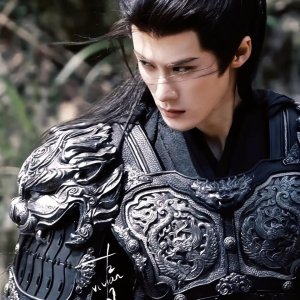
One day left!!!!(≧▽≦)I saved the cutest for last. Behold Feng Long and why he's a hero character? 👇👇👇
Chi Siu Feng Long is the only hero in XY’s life. He embodies a classical idealism of what a hero is. Webster dictionary defines a hero as a person widely admired for their noble qualities and remarkable achievements, often possessing physical or magical strength that sets them apart.
Heroic attributes includes unwavering physical, mental, and emotional resilience, persisting in the face of adversity.
Heroes exhibit immense courage and an unshakable commitment to a strong sense of right and wrong. Whether dedicated to a mission, relationship, or a deeply held value system, heroes inspire through their unwavering dedication to noble causes.
They are exemplars of integrity and virtue, embodying the principles of heroism that often involve standing up for justice and rebelling against oppressive authority figures and societal norms.
FL's unwavering dedication to CX's vision of a united, peaceful world, characterized by brotherhood and filial piety, is a prominent theme throughout the story. He's portrayed as someone willing to sacrifice his own desires, even for the betterment of the world. FL possesses qualities of intelligence, bravery, and courage. He derives joy from bringing happiness to those around him, both loved ones and strangers.
What sets FL apart is his genuine kindness, extended not only to those he loves but also to strangers. He's the kind of man who was more upset at his friend for not revealing his feelings for the same girl, who, despite humiliation at his own wedding, chooses forgiveness, and who grapples with the conflict between his best friend and his filial piety toward his sister, ultimately choosing self-sacrifice to mend their relationship.
Even his reason for marrying XY aligns with the hero's mission, as it transcends mere physical desires. To him, brotherhood and friendship are among life's most cherished possessions. Since he knows he must marry eventually, he decides to marry his friend, especially one who is on the same side of history and is equal in familial and economic status. It's also unique that Feng Long describes his reasons as impure because they are not entirely rooted in romance. "I know women want romance to be pure, but sometimes you can think that all these impure reasons are the invisible threads that bind us together tightly. They might even be stronger and tighter than romance."
However, FL's affection for XY isn't devoid of love or desire, as Tong Hua skillfully portrays, “Feng Long stared at Xiao Yao, and he was so overcome that he couldn't wait for the ceremony to be over as soon as possible, for night to fall as quickly as possible, to return to their honeymoon suite as soon as possible.” Hehe.
XY didn't desire a hero, which is why she couldn't love him; she could only offer friendship.
True love in Lost You Forever is clearly shown...without needing of any voodoo thing...XY and Jing developed themselves…
It is a racist and biased term to use in your negative context! Voodoo is not even the correct translation for the Lover Bugs! Nor is the word witch doctor!
It's shamanism that Juili practices! The correct term for a practitioner is shaman.
Additionally, voodoo, like shamanism, is rooted in healing first! It is a racist and colonialist mindset that paints it in a negative light. Check your privilege!
Two days left! Today, I present my first LYF essay—a character analysis of Cang Xuan.Yes, yes...how can this…
Cang Xuan stands as the central figure in "Lost You Forever," serving as the quintessential archetype of the antihero. His character is defined by the intricate interplay of dual nature—possessing good intentions while employing questionable methods. Despite his actions yielding unselfish results, beneath the surface, selfish motives drive him. This complexity keeps the audience constantly questioning his moral compass, blurring the lines between heroism and antiheroism.
An anti-hero is defined as a protagonist or notable figure conspicuously lacking in heroic qualities. Anti-hero archetypes are incredibly complex due to their dual nature, oscillating between good and bad qualities and often displaying equal proclivities for both good and evil. For further exploration of this character archetype, the article "6 Common Elements You'll Find in an Anti-Hero" on the Storyflint website delves deeper.
Cang Xuan aspires to become emperor, yet he finds contentment in exploring the world, spoiling Ah Nian, and secretly searching for Xiao Yao. Simultaneously, he plots to either use or take down Xiang Liu to further his ambitions.
While Cang Xuan may appear heroic on the surface with his noble cause of uniting the world of Dahuang as emperor, this decision was set into motion only after reuniting with Xiao Yao. It was driven by his survival instincts, facing the choice of either killing or being killed by his uncles, and fueled by a deep desire to create a safer world for Xiao Yao, a mission made possible by Xiao Yao’s status.
He continues to enter into prominent marriages for his cause. Heroes typically uphold values that transcend worldly entanglements or steadfastly reserve their hearts for one person. Yet, despite his genuine love for XY, he persists in pursuing loveless relationships for his noble cause. And don’t get me started on his decision to become a drug addict, ruin his reputation, and become someone useless, just to get to where he needs to be.
Cang Xuan's determination to protect the women in his life is deeply rooted in his trauma from losing Xiao Yao, his mother, his beloved aunt (XY's mother), and his grandmother. Anyone who dares to harm them often finds themselves facing a very dark and wrathful man.
He doesn't hesitate to seek revenge, adhering to the principle of 'an eye for an eye.' We witness this ominous side of him on three occasions: first when Xiao Liu kidnaps Ah Nian for Xiang Liu, then in the aftermath of Xiao Yao’s assassination, and again when he plots to kill Jing. Furthermore, if Jing ever wavers in his oath to protect Xiao Yao again, there is no promise that CX wouldn't hesitate to do what he needs to ensure XY's safety.
To him, the women in his life hold a value higher than life itself, transcending all logic and reason. "Today, if I were to abandon the pursuit of justice against those who have harmed Xiao Yao in exchange for power, I would be betraying the person I once was, the one who stood resolute before Cao Yun Peak. If I betray my own vow, I will never be able to recall the happy and sad moments of our past with a clear conscience."
Even his choice to allow Xiang Liu, the sworn enemy of the Xiyan Empire, to take Xiao Yao for her recovery is, at best, questionable, but the ends justify the means.
Cang Xuan’s ambitions are interconnected with his desire to protect Xiao Yao. However, XY’s loyalty to CX and her love for him stem from sibling bond. This is not only because he sacrificed so much of his dignity for a world XY can exist in, but also because he can no longer be the man XY wants. While sitting atop the world, he could possibly be someone who would put her first, but he no longer meets XY’s second requirement of having no other woman.
CX's tragedy comes in full circle, decidingly to let XY go, losing her forever to the wilderness in his journey to be the one to protect her.
Two days left! Today, I present my first LYF essay—a character analysis of Cang Xuan.
Yes, yes...how can this XL fan end up writing about CX first? Because CX is our ML protagonist with more screen time, so it was easier to see his character unfold. 🤣👇👇👇
Physical cages serve to bind traumatic bonds between XY and XL, XY and TSJ, and XY and CX. However, it is how…
Even the kindness is a double standard. XL going over the moon to keep his men fed isn't seen as kindness...OR XL sparing XY life for intruding on military territory, OR XL saving Jing pathetic arse. 😂🤣😅
Physical cages serve to bind traumatic bonds between XY and XL, XY and TSJ, and XY and CX. However, it is how…
Codependency is not healthy as it positions XY and TSJ as the only emotional crutch for one another, and it should be called out for what it is. XY's journey to find love should have started with herself, finding meaning in life on an intrinsic and spiritual level, and searching for happiness from within.
Here's a wonderful quote from Will Smith that I am reminded of: "I'm in that phase of my life when you realize that no relationship, that no money, that no kids, there's literally nothing that can make you happy. That happy is an internal, full frontal contact with your Dark Knight of the soul. And you reconcile that. You gotta make happy in here."
It is unfair for XY and TSJ to make each other the object of their happiness because such actions dehumanize their individual selves. That is just my view on how love and happiness should be, and the way TH has penned their journey to each other contradicts what I find as a healthy way to love. Some people find the inability to love without each other romantic, to each their own...
Why would you call XL and Hong Jiang's relationship a slave and master dynamic? There is NOTHING in the text or drama that refers to their relationship in this way. It is specific in that XL came back to repay Hong Jiang, and after serving for several years, he could leave at any time, BUT Hong Jiang unexpectedly adopted him as his heir. XL wasn't just serving Hong Jiang by the time we meet XL in LYF; XL was fighting for his family, just as XY and CX were fighting for theirs. The double standard is astounding, but I understand, because some people view XL as the villain in this story, like he is the object in the way of peace and love for the Xiyan family and their empire.
But I just know that the story starts with XY in chapter one and ends with XL in the epilogue, and after several years of writing and editing on TH's part, her decision to keep this juxtaposition is unlikely a coincidence but a beautiful reminder of how much this story is also about XY and XL.
You are correct in that Jing did not choose to stay in a life filled with revenge, but that is not the only thing about Jing. His kindness was always his strength, his weakness, and his weapon. TH's allegorical reference to his cage, in my opinion, imparts on his low self-worth and his need to attach it to something. Even XL called him useless for thinking he needed his status and his money to be worthy of XY. There's plenty in the text and drama that describes Jing in this way and his mediocre outlook on life.
The concept of cages and prisons is a recurring theme that Tong Hua delves into, encompassing both physical and…
Physical cages serve to bind traumatic bonds between XY and XL, XY and TSJ, and XY and CX. However, it is how these characters cope, adapt, and heal that ultimately provides insight into how these experiences affect their outlooks and ways of life. Both XY and XL fought to stay alive, overcoming their captors and building resilience. To XY, they are too similar, whereas to XL, they are soulmates through whom he can enjoy XY's unique culinary expertise. The difference lies in XL's belief that life is worth living, cherishing every scenery and detail, and relishing these moments temporarily—living life a quarter mile at a time. Conversely, XY believes life is only worth living with someone to share it with.
In contrast, TSJ did not escape from his cage. Whether he tried, who knows? Instead, he was left for dead, forced to beg for help, further degrading his emotional and psychological state. TSJ never fully recovered from his diminished state, seemingly waiting for death. His self-worth was strongly tied to worldly status and materialistic possessions. TSJ's substitution of his self-worth onto something tangible—XY's existence—is evident.
These physical cages eventually manifest into strong emotional and psychological confines. Debates often arise regarding when each man fell in love with XY. While XL fell in love with XY gradually through their shared experiences surviving their tumultuous past, I argue that TSJ fell in love with XY due to her reaction to him as a man. TSJ's emotional confinement manifests in his displaced self-worth, a testament to his inability to break free from the physical cage imposed upon him. Meanwhile, XY's perception of TSJ's inability to live without her is flattering, reflecting her adamant requirements (that no man should abandon her and that she should always be put first), indicative of her own failure to break free.
In contrast, XL is the only one of the three who has managed to free himself from the physical cage that once confined him in the slave dens. His acceptance of FFB's oath to care for his mother, his decision to return to Hong Jiang's side, his continuous fight for his soldiers, his determination to push XY away, and his resolution to perish with his army all exemplify his exercise of free will. XL lived life to the fullest, planning his demise on his own terms.
CX, on the other hand, never had to contend with an "invisible" cage. Intelligent enough to recognize that being a hostage prince in the Haoling Empire strategically kept him safe from his vulture uncles, this circumstance did not diminish his self-worth, courage, or outlook on life. The cage/prison allegory TH writes for CX revolves around power—he imprisons XY, where TSJ extracts a 15-year promise (another level of emotional and psychological imprisonment, but a topic for another discussion). CX's emotional turmoil (guilt, love, abandonment issues) manifests in his determination to protect XY like a caged bird. He breaks free from this need by releasing XY and practicing noble magnanimity. To think otherwise would undermine his remarkable antiheroic character arc.
Labeling filial piety as a "shackle" undermines the essence of DaHuang. Such labeling would imprison everyone within their circumstances. TSJ's rationale for not seeking revenge against TSH is often misconstrued as kindness manifesting; however, closer examination reveals this resolution is not unique to him. XY refrained from seeking revenge against CX for his past violence, and CX did not retaliate against his uncles and cousins for assassination attempts. TSJ's decision against revenge does not solely reflect kindness but is deeply rooted in filial piety. To equate filial piety with kindness is simplistic; it carries nuances beyond such a label.
Among the leads in "Lost You Forever," XY and TSJ left parts of themselves in the cages and prisons that once confined them, remaining prisoners to their emotional and psychological needs, enslaved by their codependency. In contrast, XL and CX, despite tragically losing what they loved most, were the only ones whose exercise of free will enabled them to transcend their limitations and embody the antiheroes Tong Hua envisioned.
The concept of cages and prisons is a recurring theme that Tong Hua delves into, encompassing both physical and emotional/psychological dimensions. Let's explore how Tong Hua ACTUALLY uses these metaphors to portray the relationship dynamics in "Lost You Forever." 👇👇👇
As we may all know, Tu Shan Jing, the second male lead and endgame character in the world of 'Lost You Forever,'…
Thank you... It took me roughly five months to write it because I just couldn't comprehend TH's decision to write him like this. I analyzed his character arc and found its changes not significant enough to constitute a well-fleshed-out character. While all the other characters are rooted extremely strongly in Confucian thought, Jing's character is perceived as one, but his actions are the opposite of what it truly entails.
I'm glad you brought up the idea of a failed Junzi or was it Wei Junzi? I was thinking about another discussion…
I've never really thought about Lancelot much, and I think it is because his story is overshadowed by King Arthur.
To me, Lancelot and Guinevere's betrayal stems from the fact that both of them were closer in age, and therefore, the passion was probably more enticing. I believe in some despictions, by the time Guinevere (who was 19) met King Arthur, he was already in his late 20s or early 30s. He was well established as the one true king and had a lot of political power, which would have been quite daunting for a 19-year-old. Not condoning their infidelity, but just putting things in a little perspective.
Believe it or not, as an XL fan, I don't hate XY. Some days, I love her and other days, I am frustrated with her. Everything that XY could be, Tong Hua chose not to pen her, but chose her to be an encompassing manifestation of generational trauma. I was raised by a woman like XY, and I have several sisters like XY. My heart just aches because women like XY never heal. They just find more excuses to not deal with it. They expect other people to be the source of their happiness, but we all know happiness starts from within. Life is long for XY, and I often wonder if she would choose the same if her life were short. As humans, we often say "life's too short" followed by whatever we're afraid to try. Perhaps, if XY's life were shorter, she would have thought the same and let her heart make the decision for her. Here's a poem I penned for her:
My demon heart
Malediction In my last words, thrown and flown.
Yet, I mourned The time and space I last witnessed you.
How did I Miss the sorrow, meek lonely eyes You lied
While I cursed you?
Weighted Like coins that danced in casino,
I dared laugh In the time and space I shared with you.
How did I Miss the faint, fading smile lines We wine
While I assessed you?
I devor you Soaked, seeped crimson viens.
Yet, I deny The need for a time and space for you.
How did I Miss the beatings of demon hearts Impart
When you comsumed me?
Snowflakes frosted Warm and bitter, inside caressed,
This emptied bosom, where time and space stopped with you.
My demon heart, Bleeds invisibly, icicles hardened I bore
How Tushan Jing is nothing but a plot device and failed 君子 (Junzi aka gentleman)?The following character analysis…
As we may all know, Tu Shan Jing, the second male lead and endgame character in the world of 'Lost You Forever,' was crafted by Tong Hua to be praised as the merchant prince, heir to the Tu Shan clan, the most influential and powerful family of the Central Plains. He may be memorable for his contemplative behavior and calm demeanor around Xiao Yao; Jing’s strength, as well as his weakness, to a subset of audiences, is kindness.
When we first meet Jing, he is a beggar, crawling on the ground, waiting for death. As the story progresses, the audience, like XY, develops a sense of pity and care for him. Our initial response is that of a savior. We hope and root for his recovery, but unlike XY, we, as the audience, are awaiting when he becomes someone worth remembering and whose character will change the lives around him for better or worse.
Yet, after reading the novel three times, I cannot pinpoint what kind of character Jing is. I had originally thought of him as a mild antihero, but as the story progresses and definitely after the third read, TSJ as a character becomes anything but an antihero. In the end, he is not a hero, antihero, or villain in any literary sense. He can't even be regarded as an anti-villain. In order to cast TSJ as any of the above categories would require strong character development. The best heroes and antiheroes achieve self-awareness, gain a heightened ability to protect loved ones, and overcome shortcomings--a transformation that proves they are worthy of every word the author has penned. While villains and anti-villains transform into the antithesis of our heroes and antiheroes. Even the poorest written heroes and antiheroes change their circumstances through their decisions. Yet, TH's penning of Jing stays consistent throughout the story, in a continuous cycle of disappointment, incompetence, and pity. Frustratingly, all his actions require the drive and intelligence of others (CX and FL), and the solving of his own personal problems in the hands of more capable characters (XY and XL). For a majority of the story, TSJ’s character functions like a chest piece to be maneuvered by the strongest characters, for favors, bargains, promises and obediences.
Unlike CX and XL, both of whom, as antiheroes, undergo heroic journeys, Jing's character does not experience growth where he overcomes his shortcomings to become a better version of himself. I can only speculate that his character remains throughout the story, perhaps, intentionally to reflect and counterbalance XY’s need for security and stability. Whether TH had intended or not, she had meticulously crafted Jing to a point that one can't even analyze his existence without comparing him to other stronger and more fleshed characters, or independent of XY's emotional and psychological deficiencies. In addition, while CX and XL are more self-reliant and don't constantly need rescuing, Jing's character development is hampered by being a damsel in distress, and how others perceive him--CX views him as unworthy due to his weakness, while XL is simply unafraid of him.
I've encountered several posts that refuted that Jing's character doesn't need to go through character development, heroic arcs or any sort of growth. Others had simply argued, TH wrote him to be the perfect character and therefore didn't need any transformation. How naive to think an author of Tong Hua's calibur would think a character is perfect that they don't require development at all? In fact, in TH's creative journey to craft a story unlike her previous works, her decision to keep Jing a consistent character degrades his value and importance to that of a plot device.
As a character, TSJ exhibits codependency, low self-esteem, and a lack of self-value. “Since I was a child, I have always been the pride of heaven. There was a woman who practiced dancing for ten years just for me to glance at her. There was a famous man who traveled thousands of miles to Qingqiu and stayed there for seven years just to play a game of chess with me. Some people asked for a painting at any cost, and some people called me a master of one word. I once thought that was who I was...I came to truly understand that, without those beautiful coats, I was nothing, but then God made you appeared." He had spent his whole life pampered and tied his self worth to his status and materialistic things. When all those were taken from him, he found new meaning in attaching his manhood, self worth and existence on XY’s random act of kindness and her blushing. Tong Hua writes, “But when I took a shower that day, you saw my body and your face turned red. At that moment, I felt really alive. In your eyes, I was still a man who can make your heart....”
He views his life so worthless that he is willing to die with her and die for her. He literally drank poison on purpose just to prove his loyalty, but can’t find the inner strength to save them both from the cherry blossom orchard, because without her, there’s no meaning left. When he wakes up from his 37 years of slumber, he tells XY he is willing to be her slave.
However, Tu Shan Jing has a pattern of failing to fulfill commitments. He failed to honor his mother’s and grandmother’s promise to marry FFYY because he desired to be with XY. Subsequently, he couldn't keep his promise to XY because he couldn't free himself from his familial obligations. Ultimately, he failed to fulfill his role as a father to Tu Shan Zhen in order to remain with XY. How can someone who consistently fails to follow through be deemed worthy of a lifelong partnership? The answer is simple: Jing has positioned himself to rely on XY to resolve his personal problems and save his life. He has made it clear to XY that she is indispensable and therefore inadvertently manipulates her emotions to his existence.
Tu Shan Jing possesses a narrow and selfish worldview. While he may be perceived as kind, his kindness is limited to his immediate family and does not extend beyond that. Furthermore, due to his narrow perspective, TSJ utilizes kindness as a tool of manipulation, making him an emotional manipulator.
It's no secret that Jing has made questionable decisions in the past, prioritizing his family business over his moral compass. In the ongoing conflict between the Xiyan Empire and the remnants of the Chenrong army, he has engaged in business dealings on both sides. As hinted by Xiang Liu, ‘You underestimate him! Just a palette of medicine, to him, it’s nothing. The Tu Shan Clan engages in all types of business. Back then, he sold far more dangerous items to the [Chengrong] army.' Throughout thier interactions, especially those post meeting Xiao Yao, even Xiang Liu feels obligated to save his life for XY.
Additionally, he has been credited as the financier of gambling dens that host demon slave fights. Li Rong’s family feels indebted to him because he saved their family from downfall with his financial support. In retrospect, it was the slave dens that created Xiang Liu, and the root of suffering for so many demons. Yet, Tu Shan Jing, the compassionate gentleman, has no problems forking over financial support of such an evil, because his family business reeps to profit.
In his narrow and selfish worldview, Jing excels in business but grapples with personal issues. He's willing to bravely face danger for Xiao Yao, yet hesitates when dealing with his own family. Ironically, while he can source rare medical herbs globally, he struggles to comprehend or anticipate the schemes of his own family members, especially when his grandmother and fiancée entrapped him. This perplexing situation leaves him in emotional turmoil until his FL intervenes. Furthermore, he can offer substantial support to CX and FL, while supplying XL with military rations, but struggles to protect himself from his brother and FFYiying.
Another example of Tu Shan Jing’s kindness doesn’t extend outward is seen in securing XL's blood oath to steal Xiao Yao from her wedding with FL. He knowingly purchases her blood oath from XL for 37 years of rations, despite knowing that XL and XY cannot be together. After all, XL, impoverished and desperate to provide for his people, bore the weight of thousands of lives on his shoulders. Jing was well aware of this, yet he contradicts his kind and compassionate persona by using the lives of thousands of men as leverage. In Jing’s mind, his kindness and compassion, in this moment, are directed towards XY, because he doesn't want to see her unhappy. How can I begin to believe this? When this trade-off is acceptable to him because XL, FFB, and the FF family will bear the brunt of the humiliation. He gains everything---his family's reputation intact, XY’s forgiveness and her single-hood.
TSJ channeling his support for CX through Feng Long, using FL as a shield for his family, is another example of TSJ's limited kindness. Partly due to his family rules forbidding him to openly support a political party, TSJ employs FL as his messenger. This strategy ensures that if things turn sour and out of his favor, all blame falls on CX, Feng Long, and the Chuisui clan. This method ensures that the Tu Shan family remains untouched.
However, it is XY who will bear the burden of TSJ’s kindness, as she will end up doing everything for him while he promises only to live for her. To Jing, everything is a matter of gains and losses; familial preservation trumps all else.
Yet, I digress. What should count as character development? How does one conclude that a character has become a better version of themselves? Unfortunately for TSJ, Tong Hua decided to write in a particular way that makes him throw away his opportunities to overcome his shortcomings. He remains steadfastly codependent, with low self-esteem, continuing to attach his self-worth to XY. By the end of the story, TSJ’s worldview reduces to just XY. He continues to use his kindness as leverage for pity, leaving with XY into the world as the same person we met in chapter one.
Astrid Leong-Teo (from 'Crazy Rich Asians') once said, 'It’s not my job to make you feel like a man. I can’t make you something you’re not.' Yet, for XY, TSJ is determined to fail at becoming the man he ought to be. In the end, he finds himself as the man XY wanted: a weak person who would not dare to abandon her. He will also become dependent on her to literally keep him alive, weak and sickly due to in his inability to protect himself.
Four more days til we meet again, here's a character analysis of Lord Xiang Liu.An oldie essay, but one of my…
"You either die a hero, or you live long enough to see yourself become the villain."— Harvey Dent, The Dark Knight
When I think about Xiang Liu, I think about this quote from Christopher Nolan’s "The Dark Knight." Xiang Liu maybe an antihero, but unlike Cang Xuan, all of his decisions and actions appear selfish on the surface, yet they actually stem from a place of heroic unselfishness, filial piety, and true love. Everything he does, has done, or will do results in him gaining nothing—no praise, no victory, no glory, and certainly no love. Somehow, he has portrayed heroic traits as well as antiheroic attitudes, transforming himself into a villain in the eyes of the people of Dahuang, and even to some audiences/readers.
Tong Hua put a lot of thought into Xiang Liu. The stream of maybes, I could imagine, as she sat in her place of comfort, sipping tea (or coffee) and pondering the what if’s.
What if a demon with a heart of gold falls in love? Will he become a hero? If so, to whom does he become a hero? Will he confess, hide his love, or demand her love in return? What if this young demon was greatly misunderstood, just learning to be human? Will love transform his demon heart into a human one?
Whatever was Tong Hua’s intention, in the end, she has written one of literature’s most complex antiheroes I’ve ever encountered. In Xiang Liu, we see a character who embodies Nolan's quote, walking the fine line between heroism and villainy, and challenging our understanding of morality and love.
Approaching Xiang Liu with a black and white understanding of Good and Evil, as well as clinging to Christian ideals of Gods and Demons, would hinder a nuanced understanding of his character, as he defies such simplistic categorizations and invites a more profound exploration of moral ambiguity and the depths of his persona. In the world of Dahuang, gods, demons, and humans are intermixed, characterized by the length of their lives and demons' inclination toward more primal, animalistic instincts. Yet, they all share the capacity for both good and evil, showcasing the complex moral spectrum that defines their existence.
Therefore, depending on the fence, and perhaps which side of history, you are standing on, you may see XL as a hero or a villain. He's regarded as a hero by the remnants of Chenrong and deemed worthy as an heroic rival by his opponents (CX even once tried to convince him to come to his aid), while others see him as a villain to be feared. The only person who truly understood this complicated persona was Xiao Yao.
Xiang Liu's character undergoes a remarkable transformation, evolving from a cold-hearted and aloof general into a symbol of the principle of repaying kindness. His journey is a testament to the profound impact of relationships on his character development. Initially, he is driven by the need to repay the kindness of FFB, his adopted father, Jing and Xiao Yao. His heart, once distant and unyielding, gradually softens as he falls deeply in love with XY, an emotion he never expected to encounter.
As Xiang Liu's love for XY grows, so does his determination to honor his fallen soldiers and ensure her peaceful life. He lays intricate plans, demonstrating the lengths he's willing to go to protect her. His heroic journey isn't just one of physical courage on the battlefield but also a transformation of his inner self, driven by love and the desire to secure a future of peace and happiness for XY.
XL has nine lives: one for himself, one for his adoptive father, and six for Xiao Yao—two to save her life, three to last her a lifetime and one for the man she wants to marry. He is willing to die nine times, while continuously crushing his only heart. In a paradoxical blend of antiheroic self-destruction and heroic self-sacrifice, Xiang Liu's demise ultimately ushers in peace to the world of Dahuang, serving as the catalyst to fulfill Cang Xuan's mission for a world where XY can lead a tranquil life with the one who will never abondon her. As he departs this world, leaving behind nothing but the legacy of a villain, to XY, he becomes the irreplaceable loss she'll carry with her always, a poignant tragedy, as she may never come to know the extent of his sacrifice.
Delving into Xiang Liu's sacrifices will invariably prompt a discussion of XY's own battles with selfishness and her inability to overcome the trauma of loneliness and abandonment. These two intertwined narratives illuminate the profound complexities of their relationship and individual character development.
Time and time again, Xiang Liu has demonstrated an unwavering ability to summon strength from the depths of his being to protect Xiao Yao. Regardless of injuries, diminished spiritual power, or even facing formidable armies, he fearlessly charges into battle for what he holds dear, showcasing his profound commitment to what he believes in and loves.
Xiang Liu has impressively prioritized XY while simultaneously balancing his filial devotion to his adopted father and commanding thousands of soldiers on the battlefield. However, within this intricate web of emotions and unspoken affection, they discover themselves entangled in an intense and uncharted emotional terrain. Yet, their relationship bears the strain of unresolved tensions, stemming from XY's self-centered yearning for love and fear of abandonment, and Xiang Liu's ongoing battle with his multitude of responsibilities, all of which contribute to the friction between them.
Adding to the intricacy of their relationship, they are like star-crossed lovers, trapped in the never-ending conflict between the remnants of Xiyan and Chenrong, a war that further complicates their already intricate bond. In their tumultuous journey, Xiang Liu and Xiao Yao have faced countless challenging encounters. Despite the hardships, XY harbors no blame toward XL; however, she finds it incredibly difficult to overcome the emotional scars left by their turbulent moments. Strangely, she manages to let go of the violence inflicted by Cang Xuan, the scars of which heal more readily than the wounds inflicted by the man she loves.
Her inability to let go of the trauma also serves as a barrier to Xiang Liu's approaches. He has faced rejection multiple times by XY and has been deemed unworthy to enter her dreams, a reflection of the lingering wounds in their relationship that both struggle to mend. XL, using these rejections as fuel, inadvertently pushes XY away, inflicting pain on his own heart, all while secretly laying plans for her to find happiness with Jing, despite the turmoil in his own emotions.
Yet, despite the pain, Xiang Liu served as Xiao Yao's mentor and protector, teaching her archery and life lessons during their dates. He encouraged her growth and offered fresh perspectives on life. As a poignant gesture, he gave her a map of the ocean, symbolizing his preparations for a future without him. These actions showcased his deep care for her well-being and left a lasting impact on her life.
"After decades of teaching you archery, you now have the ability to take care of yourself. You don't need your own body to shield someone you treasure when danger is around. You no longer have to endure solitude as your constant companion; you now have the right man to rely on. The sky is vast, and the oceans are deep. You now have a sanctuary to seek, free from the pursuit of others, and a place to call home. Xiao Yao, from now on, I can no longer stand watch to protect you. You have to take care of yourself. Wishing you a lifetime of worry-free happiness." — Xiang Liu
Four more days til season two airs, here's a character analysis of Lord Xiang Liu.An oldie essay, but one of my…
"You either die a hero, or you live long enough to see yourself become the villain."— Harvey Dent, The Dark Knight
When I think about Xiang Liu, I think about this quote from Christopher Nolan’s "The Dark Knight." Xiang Liu maybe an antihero, but unlike Cang Xuan, all of his decisions and actions appear selfish on the surface, yet they actually stem from a place of heroic unselfishness, filial piety, and true love. Everything he does, has done, or will do results in him gaining nothing—no praise, no victory, no glory, and certainly no love. Somehow, he has portrayed heroic traits as well as antiheroic attitudes, transforming himself into a villain in the eyes of the people of Dahuang, and even to some audiences/readers.
Tong Hua put a lot of thought into Xiang Liu. The stream of maybes, I could imagine, as she sat in her place of comfort, sipping tea (or coffee) and pondering the what if’s.
What if a demon with a heart of gold falls in love? Will he become a hero? If so, to whom does he become a hero? Will he confess, hide his love, or demand her love in return? What if this young demon was greatly misunderstood, just learning to be human? Will love transform his demon heart into a human one?
Whatever was Tong Hua’s intention, in the end, she has written one of literature’s most complex antiheroes I’ve ever encountered. In Xiang Liu, we see a character who embodies Nolan's quote, walking the fine line between heroism and villainy, and challenging our understanding of morality and love.
Approaching Xiang Liu with a black and white understanding of Good and Evil, as well as clinging to Christian ideals of Gods and Demons, would hinder a nuanced understanding of his character, as he defies such simplistic categorizations and invites a more profound exploration of moral ambiguity and the depths of his persona. In the world of Dahuang, gods, demons, and humans are intermixed, characterized by the length of their lives and demons' inclination toward more primal, animalistic instincts. Yet, they all share the capacity for both good and evil, showcasing the complex moral spectrum that defines their existence.
Therefore, depending on the fence, and perhaps which side of history, you are standing on, you may see XL as a hero or a villain. He's regarded as a hero by the remnants of Chenrong and deemed worthy as an heroic rival by his opponents (CX even once tried to convince him to come to his aid), while others see him as a villain to be feared. The only person who truly understood this complicated persona was Xiao Yao.
Xiang Liu's character undergoes a remarkable transformation, evolving from a cold-hearted and aloof general into a symbol of the principle of repaying kindness. His journey is a testament to the profound impact of relationships on his character development. Initially, he is driven by the need to repay the kindness of FFB, his adopted father, Jing and Xiao Yao. His heart, once distant and unyielding, gradually softens as he falls deeply in love with XY, an emotion he never expected to encounter.
As Xiang Liu's love for XY grows, so does his determination to honor his fallen soldiers and ensure her peaceful life. He lays intricate plans, demonstrating the lengths he's willing to go to protect her. His heroic journey isn't just one of physical courage on the battlefield but also a transformation of his inner self, driven by love and the desire to secure a future of peace and happiness for XY.
XL has nine lives: one for himself, one for his adoptive father, and six for Xiao Yao—two to save her life, three to last her a lifetime and one for the man she wants to marry. He is willing to die nine times, while continuously crushing his only heart. In a paradoxical blend of antiheroic self-destruction and heroic self-sacrifice, Xiang Liu's demise ultimately ushers in peace to the world of Dahuang, serving as the catalyst to fulfill Cang Xuan's mission for a world where XY can lead a tranquil life with the one who will never abondon her. As he departs this world, leaving behind nothing but the legacy of a villain, to XY, he becomes the irreplaceable loss she'll carry with her always, a poignant tragedy, as she may never come to know the extent of his sacrifice.
Delving into Xiang Liu's sacrifices will invariably prompt a discussion of XY's own battles with selfishness and her inability to overcome the trauma of loneliness and abandonment. These two intertwined narratives illuminate the profound complexities of their relationship and individual character development.
Time and time again, Xiang Liu has demonstrated an unwavering ability to summon strength from the depths of his being to protect Xiao Yao. Regardless of injuries, diminished spiritual power, or even facing formidable armies, he fearlessly charges into battle for what he holds dear, showcasing his profound commitment to what he believes in and loves.
Xiang Liu has impressively prioritized XY while simultaneously balancing his filial devotion to his adopted father and commanding thousands of soldiers on the battlefield. However, within this intricate web of emotions and unspoken affection, they discover themselves entangled in an intense and uncharted emotional terrain. Yet, their relationship bears the strain of unresolved tensions, stemming from XY's self-centered yearning for love and fear of abandonment, and Xiang Liu's ongoing battle with his multitude of responsibilities, all of which contribute to the friction between them.
Adding to the intricacy of their relationship, they are like star-crossed lovers, trapped in the never-ending conflict between the remnants of Xiyan and Chenrong, a war that further complicates their already intricate bond. In their tumultuous journey, Xiang Liu and Xiao Yao have faced countless challenging encounters. Despite the hardships, XY harbors no blame toward XL; however, she finds it incredibly difficult to overcome the emotional scars left by their turbulent moments. Strangely, she manages to let go of the violence inflicted by Cang Xuan, the scars of which heal more readily than the wounds inflicted by the man she loves.
Her inability to let go of the trauma also serves as a barrier to Xiang Liu's approaches. He has faced rejection multiple times by XY and has been deemed unworthy to enter her dreams, a reflection of the lingering wounds in their relationship that both struggle to mend. XL, using these rejections as fuel, inadvertently pushes XY away, inflicting pain on his own heart, all while secretly laying plans for her to find happiness with Jing, despite the turmoil in his own emotions.
Yet, despite the pain, Xiang Liu served as Xiao Yao's mentor and protector, teaching her archery and life lessons during their dates. He encouraged her growth and offered fresh perspectives on life. As a poignant gesture, he gave her a map of the ocean, symbolizing his preparations for a future without him. These actions showcased his deep care for her well-being and left a lasting impact on her life.
"After decades of teaching you archery, you now have the ability to take care of yourself. You don't need your own body to shield someone you treasure when danger is around. You no longer have to endure solitude as your constant companion; you now have the right man to rely on. The sky is vast, and the oceans are deep. You now have a sanctuary to seek, free from the pursuit of others, and a place to call home. Xiao Yao, from now on, I can no longer stand watch to protect you. You have to take care of yourself. Wishing you a lifetime of worry-free happiness." — Xiang Liu


 2
2  1
1 


Heroic attributes includes unwavering physical, mental, and emotional resilience, persisting in the face of adversity.
Heroes exhibit immense courage and an unshakable commitment to a strong sense of right and wrong. Whether dedicated to a mission, relationship, or a deeply held value system, heroes inspire through their unwavering dedication to noble causes.
They are exemplars of integrity and virtue, embodying the principles of heroism that often involve standing up for justice and rebelling against oppressive authority figures and societal norms.
FL's unwavering dedication to CX's vision of a united, peaceful world, characterized by brotherhood and filial piety, is a prominent theme throughout the story. He's portrayed as someone willing to sacrifice his own desires, even for the betterment of the world. FL possesses qualities of intelligence, bravery, and courage. He derives joy from bringing happiness to those around him, both loved ones and strangers.
What sets FL apart is his genuine kindness, extended not only to those he loves but also to strangers. He's the kind of man who was more upset at his friend for not revealing his feelings for the same girl, who, despite humiliation at his own wedding, chooses forgiveness, and who grapples with the conflict between his best friend and his filial piety toward his sister, ultimately choosing self-sacrifice to mend their relationship.
Even his reason for marrying XY aligns with the hero's mission, as it transcends mere physical desires. To him, brotherhood and friendship are among life's most cherished possessions. Since he knows he must marry eventually, he decides to marry his friend, especially one who is on the same side of history and is equal in familial and economic status. It's also unique that Feng Long describes his reasons as impure because they are not entirely rooted in romance. "I know women want romance to be pure, but sometimes you can think that all these impure reasons are the invisible threads that bind us together tightly. They might even be stronger and tighter than romance."
However, FL's affection for XY isn't devoid of love or desire, as Tong Hua skillfully portrays, “Feng Long stared at Xiao Yao, and he was so overcome that he couldn't wait for the ceremony to be over as soon as possible, for night to fall as quickly as possible, to return to their honeymoon suite as soon as possible.” Hehe.
XY didn't desire a hero, which is why she couldn't love him; she could only offer friendship.
I saved the cutest for last. Behold Feng Long and why he's a hero character? 👇👇👇
It's shamanism that Juili practices! The correct term for a practitioner is shaman.
Additionally, voodoo, like shamanism, is rooted in healing first! It is a racist and colonialist mindset that paints it in a negative light. Check your privilege!
An anti-hero is defined as a protagonist or notable figure conspicuously lacking in heroic qualities. Anti-hero archetypes are incredibly complex due to their dual nature, oscillating between good and bad qualities and often displaying equal proclivities for both good and evil. For further exploration of this character archetype, the article "6 Common Elements You'll Find in an Anti-Hero" on the Storyflint website delves deeper.
Cang Xuan aspires to become emperor, yet he finds contentment in exploring the world, spoiling Ah Nian, and secretly searching for Xiao Yao. Simultaneously, he plots to either use or take down Xiang Liu to further his ambitions.
While Cang Xuan may appear heroic on the surface with his noble cause of uniting the world of Dahuang as emperor, this decision was set into motion only after reuniting with Xiao Yao. It was driven by his survival instincts, facing the choice of either killing or being killed by his uncles, and fueled by a deep desire to create a safer world for Xiao Yao, a mission made possible by Xiao Yao’s status.
He continues to enter into prominent marriages for his cause. Heroes typically uphold values that transcend worldly entanglements or steadfastly reserve their hearts for one person. Yet, despite his genuine love for XY, he persists in pursuing loveless relationships for his noble cause. And don’t get me started on his decision to become a drug addict, ruin his reputation, and become someone useless, just to get to where he needs to be.
Cang Xuan's determination to protect the women in his life is deeply rooted in his trauma from losing Xiao Yao, his mother, his beloved aunt (XY's mother), and his grandmother. Anyone who dares to harm them often finds themselves facing a very dark and wrathful man.
He doesn't hesitate to seek revenge, adhering to the principle of 'an eye for an eye.' We witness this ominous side of him on three occasions: first when Xiao Liu kidnaps Ah Nian for Xiang Liu, then in the aftermath of Xiao Yao’s assassination, and again when he plots to kill Jing. Furthermore, if Jing ever wavers in his oath to protect Xiao Yao again, there is no promise that CX wouldn't hesitate to do what he needs to ensure XY's safety.
To him, the women in his life hold a value higher than life itself, transcending all logic and reason. "Today, if I were to abandon the pursuit of justice against those who have harmed Xiao Yao in exchange for power, I would be betraying the person I once was, the one who stood resolute before Cao Yun Peak. If I betray my own vow, I will never be able to recall the happy and sad moments of our past with a clear conscience."
Even his choice to allow Xiang Liu, the sworn enemy of the Xiyan Empire, to take Xiao Yao for her recovery is, at best, questionable, but the ends justify the means.
Cang Xuan’s ambitions are interconnected with his desire to protect Xiao Yao. However, XY’s loyalty to CX and her love for him stem from sibling bond. This is not only because he sacrificed so much of his dignity for a world XY can exist in, but also because he can no longer be the man XY wants. While sitting atop the world, he could possibly be someone who would put her first, but he no longer meets XY’s second requirement of having no other woman.
CX's tragedy comes in full circle, decidingly to let XY go, losing her forever to the wilderness in his journey to be the one to protect her.
Yes, yes...how can this XL fan end up writing about CX first? Because CX is our ML protagonist with more screen time, so it was easier to see his character unfold. 🤣👇👇👇
Here's a wonderful quote from Will Smith that I am reminded of: "I'm in that phase of my life when you realize that no relationship, that no money, that no kids, there's literally nothing that can make you happy. That happy is an internal, full frontal contact with your Dark Knight of the soul. And you reconcile that. You gotta make happy in here."
It is unfair for XY and TSJ to make each other the object of their happiness because such actions dehumanize their individual selves. That is just my view on how love and happiness should be, and the way TH has penned their journey to each other contradicts what I find as a healthy way to love. Some people find the inability to love without each other romantic, to each their own...
Why would you call XL and Hong Jiang's relationship a slave and master dynamic? There is NOTHING in the text or drama that refers to their relationship in this way. It is specific in that XL came back to repay Hong Jiang, and after serving for several years, he could leave at any time, BUT Hong Jiang unexpectedly adopted him as his heir. XL wasn't just serving Hong Jiang by the time we meet XL in LYF; XL was fighting for his family, just as XY and CX were fighting for theirs. The double standard is astounding, but I understand, because some people view XL as the villain in this story, like he is the object in the way of peace and love for the Xiyan family and their empire.
But I just know that the story starts with XY in chapter one and ends with XL in the epilogue, and after several years of writing and editing on TH's part, her decision to keep this juxtaposition is unlikely a coincidence but a beautiful reminder of how much this story is also about XY and XL.
You are correct in that Jing did not choose to stay in a life filled with revenge, but that is not the only thing about Jing. His kindness was always his strength, his weakness, and his weapon. TH's allegorical reference to his cage, in my opinion, imparts on his low self-worth and his need to attach it to something. Even XL called him useless for thinking he needed his status and his money to be worthy of XY. There's plenty in the text and drama that describes Jing in this way and his mediocre outlook on life.
In contrast, TSJ did not escape from his cage. Whether he tried, who knows? Instead, he was left for dead, forced to beg for help, further degrading his emotional and psychological state. TSJ never fully recovered from his diminished state, seemingly waiting for death. His self-worth was strongly tied to worldly status and materialistic possessions. TSJ's substitution of his self-worth onto something tangible—XY's existence—is evident.
These physical cages eventually manifest into strong emotional and psychological confines. Debates often arise regarding when each man fell in love with XY. While XL fell in love with XY gradually through their shared experiences surviving their tumultuous past, I argue that TSJ fell in love with XY due to her reaction to him as a man. TSJ's emotional confinement manifests in his displaced self-worth, a testament to his inability to break free from the physical cage imposed upon him. Meanwhile, XY's perception of TSJ's inability to live without her is flattering, reflecting her adamant requirements (that no man should abandon her and that she should always be put first), indicative of her own failure to break free.
In contrast, XL is the only one of the three who has managed to free himself from the physical cage that once confined him in the slave dens. His acceptance of FFB's oath to care for his mother, his decision to return to Hong Jiang's side, his continuous fight for his soldiers, his determination to push XY away, and his resolution to perish with his army all exemplify his exercise of free will. XL lived life to the fullest, planning his demise on his own terms.
CX, on the other hand, never had to contend with an "invisible" cage. Intelligent enough to recognize that being a hostage prince in the Haoling Empire strategically kept him safe from his vulture uncles, this circumstance did not diminish his self-worth, courage, or outlook on life. The cage/prison allegory TH writes for CX revolves around power—he imprisons XY, where TSJ extracts a 15-year promise (another level of emotional and psychological imprisonment, but a topic for another discussion). CX's emotional turmoil (guilt, love, abandonment issues) manifests in his determination to protect XY like a caged bird. He breaks free from this need by releasing XY and practicing noble magnanimity. To think otherwise would undermine his remarkable antiheroic character arc.
Labeling filial piety as a "shackle" undermines the essence of DaHuang. Such labeling would imprison everyone within their circumstances. TSJ's rationale for not seeking revenge against TSH is often misconstrued as kindness manifesting; however, closer examination reveals this resolution is not unique to him. XY refrained from seeking revenge against CX for his past violence, and CX did not retaliate against his uncles and cousins for assassination attempts. TSJ's decision against revenge does not solely reflect kindness but is deeply rooted in filial piety. To equate filial piety with kindness is simplistic; it carries nuances beyond such a label.
Among the leads in "Lost You Forever," XY and TSJ left parts of themselves in the cages and prisons that once confined them, remaining prisoners to their emotional and psychological needs, enslaved by their codependency. In contrast, XL and CX, despite tragically losing what they loved most, were the only ones whose exercise of free will enabled them to transcend their limitations and embody the antiheroes Tong Hua envisioned.
To me, Lancelot and Guinevere's betrayal stems from the fact that both of them were closer in age, and therefore, the passion was probably more enticing. I believe in some despictions, by the time Guinevere (who was 19) met King Arthur, he was already in his late 20s or early 30s. He was well established as the one true king and had a lot of political power, which would have been quite daunting for a 19-year-old. Not condoning their infidelity, but just putting things in a little perspective.
Believe it or not, as an XL fan, I don't hate XY. Some days, I love her and other days, I am frustrated with her. Everything that XY could be, Tong Hua chose not to pen her, but chose her to be an encompassing manifestation of generational trauma. I was raised by a woman like XY, and I have several sisters like XY. My heart just aches because women like XY never heal. They just find more excuses to not deal with it. They expect other people to be the source of their happiness, but we all know happiness starts from within. Life is long for XY, and I often wonder if she would choose the same if her life were short. As humans, we often say "life's too short" followed by whatever we're afraid to try. Perhaps, if XY's life were shorter, she would have thought the same and let her heart make the decision for her. Here's a poem I penned for her:
My demon heart
Malediction
In my last words, thrown and flown.
Yet, I mourned
The time and space I last witnessed you.
How did I
Miss the sorrow, meek lonely eyes
You lied
While I cursed you?
Weighted
Like coins that danced in casino,
I dared laugh
In the time and space I shared with you.
How did I
Miss the faint, fading smile lines
We wine
While I assessed you?
I devor you
Soaked, seeped crimson viens.
Yet, I deny
The need for a time and space for you.
How did I
Miss the beatings of demon hearts
Impart
When you comsumed me?
Snowflakes frosted
Warm and bitter, inside caressed,
This emptied bosom,
where time and space stopped with you.
My demon heart,
Bleeds invisibly, icicles hardened
I bore
When I crave you.
The following character analysis will be based on the novel, using Kaola as well as an AI translation. 👇👇👇
When we first meet Jing, he is a beggar, crawling on the ground, waiting for death. As the story progresses, the audience, like XY, develops a sense of pity and care for him. Our initial response is that of a savior. We hope and root for his recovery, but unlike XY, we, as the audience, are awaiting when he becomes someone worth remembering and whose character will change the lives around him for better or worse.
Yet, after reading the novel three times, I cannot pinpoint what kind of character Jing is. I had originally thought of him as a mild antihero, but as the story progresses and definitely after the third read, TSJ as a character becomes anything but an antihero. In the end, he is not a hero, antihero, or villain in any literary sense. He can't even be regarded as an anti-villain.
In order to cast TSJ as any of the above categories would require strong character development. The best heroes and antiheroes achieve self-awareness, gain a heightened ability to protect loved ones, and overcome shortcomings--a transformation that proves they are worthy of every word the author has penned. While villains and anti-villains transform into the antithesis of our heroes and antiheroes. Even the poorest written heroes and antiheroes change their circumstances through their decisions. Yet, TH's penning of Jing stays consistent throughout the story, in a continuous cycle of disappointment, incompetence, and pity. Frustratingly, all his actions require the drive and intelligence of others (CX and FL), and the solving of his own personal problems in the hands of more capable characters (XY and XL). For a majority of the story, TSJ’s character functions like a chest piece to be maneuvered by the strongest characters, for favors, bargains, promises and obediences.
Unlike CX and XL, both of whom, as antiheroes, undergo heroic journeys, Jing's character does not experience growth where he overcomes his shortcomings to become a better version of himself. I can only speculate that his character remains throughout the story, perhaps, intentionally to reflect and counterbalance XY’s need for security and stability. Whether TH had intended or not, she had meticulously crafted Jing to a point that one can't even analyze his existence without comparing him to other stronger and more fleshed characters, or independent of XY's emotional and psychological deficiencies. In addition, while CX and XL are more self-reliant and don't constantly need rescuing, Jing's character development is hampered by being a damsel in distress, and how others perceive him--CX views him as unworthy due to his weakness, while XL is simply unafraid of him.
I've encountered several posts that refuted that Jing's character doesn't need to go through character development, heroic arcs or any sort of growth. Others had simply argued, TH wrote him to be the perfect character and therefore didn't need any transformation. How naive to think an author of Tong Hua's calibur would think a character is perfect that they don't require development at all? In fact, in TH's creative journey to craft a story unlike her previous works, her decision to keep Jing a consistent character degrades his value and importance to that of a plot device.
As a character, TSJ exhibits codependency, low self-esteem, and a lack of self-value. “Since I was a child, I have always been the pride of heaven. There was a woman who practiced dancing for ten years just for me to glance at her. There was a famous man who traveled thousands of miles to Qingqiu and stayed there for seven years just to play a game of chess with me. Some people asked for a painting at any cost, and some people called me a master of one word. I once thought that was who I was...I came to truly understand that, without those beautiful coats, I was nothing, but then God made you appeared." He had spent his whole life pampered and tied his self worth to his status and materialistic things. When all those were taken from him, he found new meaning in attaching his manhood, self worth and existence on XY’s random act of kindness and her blushing. Tong Hua writes, “But when I took a shower that day, you saw my body and your face turned red. At that moment, I felt really alive. In your eyes, I was still a man who can make your heart....”
He views his life so worthless that he is willing to die with her and die for her. He literally drank poison on purpose just to prove his loyalty, but can’t find the inner strength to save them both from the cherry blossom orchard, because without her, there’s no meaning left. When he wakes up from his 37 years of slumber, he tells XY he is willing to be her slave.
However, Tu Shan Jing has a pattern of failing to fulfill commitments. He failed to honor his mother’s and grandmother’s promise to marry FFYY because he desired to be with XY. Subsequently, he couldn't keep his promise to XY because he couldn't free himself from his familial obligations. Ultimately, he failed to fulfill his role as a father to Tu Shan Zhen in order to remain with XY. How can someone who consistently fails to follow through be deemed worthy of a lifelong partnership? The answer is simple: Jing has positioned himself to rely on XY to resolve his personal problems and save his life. He has made it clear to XY that she is indispensable and therefore inadvertently manipulates her emotions to his existence.
Tu Shan Jing possesses a narrow and selfish worldview. While he may be perceived as kind, his kindness is limited to his immediate family and does not extend beyond that. Furthermore, due to his narrow perspective, TSJ utilizes kindness as a tool of manipulation, making him an emotional manipulator.
It's no secret that Jing has made questionable decisions in the past, prioritizing his family business over his moral compass. In the ongoing conflict between the Xiyan Empire and the remnants of the Chenrong army, he has engaged in business dealings on both sides. As hinted by Xiang Liu, ‘You underestimate him! Just a palette of medicine, to him, it’s nothing. The Tu Shan Clan engages in all types of business. Back then, he sold far more dangerous items to the [Chengrong] army.' Throughout thier interactions, especially those post meeting Xiao Yao, even Xiang Liu feels obligated to save his life for XY.
Additionally, he has been credited as the financier of gambling dens that host demon slave fights. Li Rong’s family feels indebted to him because he saved their family from downfall with his financial support. In retrospect, it was the slave dens that created Xiang Liu, and the root of suffering for so many demons. Yet, Tu Shan Jing, the compassionate gentleman, has no problems forking over financial support of such an evil, because his family business reeps to profit.
In his narrow and selfish worldview, Jing excels in business but grapples with personal issues. He's willing to bravely face danger for Xiao Yao, yet hesitates when dealing with his own family. Ironically, while he can source rare medical herbs globally, he struggles to comprehend or anticipate the schemes of his own family members, especially when his grandmother and fiancée entrapped him. This perplexing situation leaves him in emotional turmoil until his FL intervenes. Furthermore, he can offer substantial support to CX and FL, while supplying XL with military rations, but struggles to protect himself from his brother and FFYiying.
Another example of Tu Shan Jing’s kindness doesn’t extend outward is seen in securing XL's blood oath to steal Xiao Yao from her wedding with FL. He knowingly purchases her blood oath from XL for 37 years of rations, despite knowing that XL and XY cannot be together. After all, XL, impoverished and desperate to provide for his people, bore the weight of thousands of lives on his shoulders. Jing was well aware of this, yet he contradicts his kind and compassionate persona by using the lives of thousands of men as leverage. In Jing’s mind, his kindness and compassion, in this moment, are directed towards XY, because he doesn't want to see her unhappy. How can I begin to believe this? When this trade-off is acceptable to him because XL, FFB, and the FF family will bear the brunt of the humiliation. He gains everything---his family's reputation intact, XY’s forgiveness and her single-hood.
TSJ channeling his support for CX through Feng Long, using FL as a shield for his family, is another example of TSJ's limited kindness. Partly due to his family rules forbidding him to openly support a political party, TSJ employs FL as his messenger. This strategy ensures that if things turn sour and out of his favor, all blame falls on CX, Feng Long, and the Chuisui clan. This method ensures that the Tu Shan family remains untouched.
However, it is XY who will bear the burden of TSJ’s kindness, as she will end up doing everything for him while he promises only to live for her. To Jing, everything is a matter of gains and losses; familial preservation trumps all else.
Yet, I digress. What should count as character development? How does one conclude that a character has become a better version of themselves? Unfortunately for TSJ, Tong Hua decided to write in a particular way that makes him throw away his opportunities to overcome his shortcomings. He remains steadfastly codependent, with low self-esteem, continuing to attach his self-worth to XY. By the end of the story, TSJ’s worldview reduces to just XY. He continues to use his kindness as leverage for pity, leaving with XY into the world as the same person we met in chapter one.
Astrid Leong-Teo (from 'Crazy Rich Asians') once said, 'It’s not my job to make you feel like a man. I can’t make you something you’re not.' Yet, for XY, TSJ is determined to fail at becoming the man he ought to be. In the end, he finds himself as the man XY wanted: a weak person who would not dare to abandon her. He will also become dependent on her to literally keep him alive, weak and sickly due to in his inability to protect himself.
such a bittersweet little poem (ಥ﹏ಥ)
When I think about Xiang Liu, I think about this quote from Christopher Nolan’s "The Dark Knight." Xiang Liu maybe an antihero, but unlike Cang Xuan, all of his decisions and actions appear selfish on the surface, yet they actually stem from a place of heroic unselfishness, filial piety, and true love. Everything he does, has done, or will do results in him gaining nothing—no praise, no victory, no glory, and certainly no love. Somehow, he has portrayed heroic traits as well as antiheroic attitudes, transforming himself into a villain in the eyes of the people of Dahuang, and even to some audiences/readers.
Tong Hua put a lot of thought into Xiang Liu. The stream of maybes, I could imagine, as she sat in her place of comfort, sipping tea (or coffee) and pondering the what if’s.
What if a demon with a heart of gold falls in love? Will he become a hero? If so, to whom does he become a hero? Will he confess, hide his love, or demand her love in return? What if this young demon was greatly misunderstood, just learning to be human? Will love transform his demon heart into a human one?
Whatever was Tong Hua’s intention, in the end, she has written one of literature’s most complex antiheroes I’ve ever encountered. In Xiang Liu, we see a character who embodies Nolan's quote, walking the fine line between heroism and villainy, and challenging our understanding of morality and love.
Approaching Xiang Liu with a black and white understanding of Good and Evil, as well as clinging to Christian ideals of Gods and Demons, would hinder a nuanced understanding of his character, as he defies such simplistic categorizations and invites a more profound exploration of moral ambiguity and the depths of his persona. In the world of Dahuang, gods, demons, and humans are intermixed, characterized by the length of their lives and demons' inclination toward more primal, animalistic instincts. Yet, they all share the capacity for both good and evil, showcasing the complex moral spectrum that defines their existence.
Therefore, depending on the fence, and perhaps which side of history, you are standing on, you may see XL as a hero or a villain. He's regarded as a hero by the remnants of Chenrong and deemed worthy as an heroic rival by his opponents (CX even once tried to convince him to come to his aid), while others see him as a villain to be feared. The only person who truly understood this complicated persona was Xiao Yao.
Xiang Liu's character undergoes a remarkable transformation, evolving from a cold-hearted and aloof general into a symbol of the principle of repaying kindness. His journey is a testament to the profound impact of relationships on his character development. Initially, he is driven by the need to repay the kindness of FFB, his adopted father, Jing and Xiao Yao. His heart, once distant and unyielding, gradually softens as he falls deeply in love with XY, an emotion he never expected to encounter.
As Xiang Liu's love for XY grows, so does his determination to honor his fallen soldiers and ensure her peaceful life. He lays intricate plans, demonstrating the lengths he's willing to go to protect her. His heroic journey isn't just one of physical courage on the battlefield but also a transformation of his inner self, driven by love and the desire to secure a future of peace and happiness for XY.
XL has nine lives: one for himself, one for his adoptive father, and six for Xiao Yao—two to save her life, three to last her a lifetime and one for the man she wants to marry. He is willing to die nine times, while continuously crushing his only heart. In a paradoxical blend of antiheroic self-destruction and heroic self-sacrifice, Xiang Liu's demise ultimately ushers in peace to the world of Dahuang, serving as the catalyst to fulfill Cang Xuan's mission for a world where XY can lead a tranquil life with the one who will never abondon her. As he departs this world, leaving behind nothing but the legacy of a villain, to XY, he becomes the irreplaceable loss she'll carry with her always, a poignant tragedy, as she may never come to know the extent of his sacrifice.
Delving into Xiang Liu's sacrifices will invariably prompt a discussion of XY's own battles with selfishness and her inability to overcome the trauma of loneliness and abandonment. These two intertwined narratives illuminate the profound complexities of their relationship and individual character development.
Time and time again, Xiang Liu has demonstrated an unwavering ability to summon strength from the depths of his being to protect Xiao Yao. Regardless of injuries, diminished spiritual power, or even facing formidable armies, he fearlessly charges into battle for what he holds dear, showcasing his profound commitment to what he believes in and loves.
Xiang Liu has impressively prioritized XY while simultaneously balancing his filial devotion to his adopted father and commanding thousands of soldiers on the battlefield. However, within this intricate web of emotions and unspoken affection, they discover themselves entangled in an intense and uncharted emotional terrain. Yet, their relationship bears the strain of unresolved tensions, stemming from XY's self-centered yearning for love and fear of abandonment, and Xiang Liu's ongoing battle with his multitude of responsibilities, all of which contribute to the friction between them.
Adding to the intricacy of their relationship, they are like star-crossed lovers, trapped in the never-ending conflict between the remnants of Xiyan and Chenrong, a war that further complicates their already intricate bond. In their tumultuous journey, Xiang Liu and Xiao Yao have faced countless challenging encounters. Despite the hardships, XY harbors no blame toward XL; however, she finds it incredibly difficult to overcome the emotional scars left by their turbulent moments. Strangely, she manages to let go of the violence inflicted by Cang Xuan, the scars of which heal more readily than the wounds inflicted by the man she loves.
Her inability to let go of the trauma also serves as a barrier to Xiang Liu's approaches. He has faced rejection multiple times by XY and has been deemed unworthy to enter her dreams, a reflection of the lingering wounds in their relationship that both struggle to mend. XL, using these rejections as fuel, inadvertently pushes XY away, inflicting pain on his own heart, all while secretly laying plans for her to find happiness with Jing, despite the turmoil in his own emotions.
Yet, despite the pain, Xiang Liu served as Xiao Yao's mentor and protector, teaching her archery and life lessons during their dates. He encouraged her growth and offered fresh perspectives on life. As a poignant gesture, he gave her a map of the ocean, symbolizing his preparations for a future without him. These actions showcased his deep care for her well-being and left a lasting impact on her life.
"After decades of teaching you archery, you now have the ability to take care of yourself. You don't need your own body to shield someone you treasure when danger is around. You no longer have to endure solitude as your constant companion; you now have the right man to rely on. The sky is vast, and the oceans are deep. You now have a sanctuary to seek, free from the pursuit of others, and a place to call home. Xiao Yao, from now on, I can no longer stand watch to protect you. You have to take care of yourself. Wishing you a lifetime of worry-free happiness." — Xiang Liu
An oldie essay, but one of my favorites. 👇👇👇
When I think about Xiang Liu, I think about this quote from Christopher Nolan’s "The Dark Knight." Xiang Liu maybe an antihero, but unlike Cang Xuan, all of his decisions and actions appear selfish on the surface, yet they actually stem from a place of heroic unselfishness, filial piety, and true love. Everything he does, has done, or will do results in him gaining nothing—no praise, no victory, no glory, and certainly no love. Somehow, he has portrayed heroic traits as well as antiheroic attitudes, transforming himself into a villain in the eyes of the people of Dahuang, and even to some audiences/readers.
Tong Hua put a lot of thought into Xiang Liu. The stream of maybes, I could imagine, as she sat in her place of comfort, sipping tea (or coffee) and pondering the what if’s.
What if a demon with a heart of gold falls in love? Will he become a hero? If so, to whom does he become a hero? Will he confess, hide his love, or demand her love in return? What if this young demon was greatly misunderstood, just learning to be human? Will love transform his demon heart into a human one?
Whatever was Tong Hua’s intention, in the end, she has written one of literature’s most complex antiheroes I’ve ever encountered. In Xiang Liu, we see a character who embodies Nolan's quote, walking the fine line between heroism and villainy, and challenging our understanding of morality and love.
Approaching Xiang Liu with a black and white understanding of Good and Evil, as well as clinging to Christian ideals of Gods and Demons, would hinder a nuanced understanding of his character, as he defies such simplistic categorizations and invites a more profound exploration of moral ambiguity and the depths of his persona. In the world of Dahuang, gods, demons, and humans are intermixed, characterized by the length of their lives and demons' inclination toward more primal, animalistic instincts. Yet, they all share the capacity for both good and evil, showcasing the complex moral spectrum that defines their existence.
Therefore, depending on the fence, and perhaps which side of history, you are standing on, you may see XL as a hero or a villain. He's regarded as a hero by the remnants of Chenrong and deemed worthy as an heroic rival by his opponents (CX even once tried to convince him to come to his aid), while others see him as a villain to be feared. The only person who truly understood this complicated persona was Xiao Yao.
Xiang Liu's character undergoes a remarkable transformation, evolving from a cold-hearted and aloof general into a symbol of the principle of repaying kindness. His journey is a testament to the profound impact of relationships on his character development. Initially, he is driven by the need to repay the kindness of FFB, his adopted father, Jing and Xiao Yao. His heart, once distant and unyielding, gradually softens as he falls deeply in love with XY, an emotion he never expected to encounter.
As Xiang Liu's love for XY grows, so does his determination to honor his fallen soldiers and ensure her peaceful life. He lays intricate plans, demonstrating the lengths he's willing to go to protect her. His heroic journey isn't just one of physical courage on the battlefield but also a transformation of his inner self, driven by love and the desire to secure a future of peace and happiness for XY.
XL has nine lives: one for himself, one for his adoptive father, and six for Xiao Yao—two to save her life, three to last her a lifetime and one for the man she wants to marry. He is willing to die nine times, while continuously crushing his only heart. In a paradoxical blend of antiheroic self-destruction and heroic self-sacrifice, Xiang Liu's demise ultimately ushers in peace to the world of Dahuang, serving as the catalyst to fulfill Cang Xuan's mission for a world where XY can lead a tranquil life with the one who will never abondon her. As he departs this world, leaving behind nothing but the legacy of a villain, to XY, he becomes the irreplaceable loss she'll carry with her always, a poignant tragedy, as she may never come to know the extent of his sacrifice.
Delving into Xiang Liu's sacrifices will invariably prompt a discussion of XY's own battles with selfishness and her inability to overcome the trauma of loneliness and abandonment. These two intertwined narratives illuminate the profound complexities of their relationship and individual character development.
Time and time again, Xiang Liu has demonstrated an unwavering ability to summon strength from the depths of his being to protect Xiao Yao. Regardless of injuries, diminished spiritual power, or even facing formidable armies, he fearlessly charges into battle for what he holds dear, showcasing his profound commitment to what he believes in and loves.
Xiang Liu has impressively prioritized XY while simultaneously balancing his filial devotion to his adopted father and commanding thousands of soldiers on the battlefield. However, within this intricate web of emotions and unspoken affection, they discover themselves entangled in an intense and uncharted emotional terrain. Yet, their relationship bears the strain of unresolved tensions, stemming from XY's self-centered yearning for love and fear of abandonment, and Xiang Liu's ongoing battle with his multitude of responsibilities, all of which contribute to the friction between them.
Adding to the intricacy of their relationship, they are like star-crossed lovers, trapped in the never-ending conflict between the remnants of Xiyan and Chenrong, a war that further complicates their already intricate bond. In their tumultuous journey, Xiang Liu and Xiao Yao have faced countless challenging encounters. Despite the hardships, XY harbors no blame toward XL; however, she finds it incredibly difficult to overcome the emotional scars left by their turbulent moments. Strangely, she manages to let go of the violence inflicted by Cang Xuan, the scars of which heal more readily than the wounds inflicted by the man she loves.
Her inability to let go of the trauma also serves as a barrier to Xiang Liu's approaches. He has faced rejection multiple times by XY and has been deemed unworthy to enter her dreams, a reflection of the lingering wounds in their relationship that both struggle to mend. XL, using these rejections as fuel, inadvertently pushes XY away, inflicting pain on his own heart, all while secretly laying plans for her to find happiness with Jing, despite the turmoil in his own emotions.
Yet, despite the pain, Xiang Liu served as Xiao Yao's mentor and protector, teaching her archery and life lessons during their dates. He encouraged her growth and offered fresh perspectives on life. As a poignant gesture, he gave her a map of the ocean, symbolizing his preparations for a future without him. These actions showcased his deep care for her well-being and left a lasting impact on her life.
"After decades of teaching you archery, you now have the ability to take care of yourself. You don't need your own body to shield someone you treasure when danger is around. You no longer have to endure solitude as your constant companion; you now have the right man to rely on. The sky is vast, and the oceans are deep. You now have a sanctuary to seek, free from the pursuit of others, and a place to call home. Xiao Yao, from now on, I can no longer stand watch to protect you. You have to take care of yourself. Wishing you a lifetime of worry-free happiness." — Xiang Liu