


 5
5 1
1


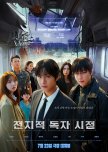
This review may contain spoilers
Omniscient Reader: The Apocalypse Turned Into a Videogame
I didn’t read the webtoon, and I don’t plan to. Because cinema should be judged by coherence, not by faithfulness.
The movie starts with a strong premise: a reader trapped in his favorite novel, forced to survive in a world ruled by the story’s own logic. Sounds great, until the script turns into a nonstop video game — coins, upgrades, items, levels, power rankings. What could’ve been a philosophical apocalypse becomes a Battle Royale with a PlayStation menu.
The first test —“kill a living organism”— sums it all up: a moral dilemma turned into a survival circus. Within seconds, people go from outrage to fighting over an ant, exposing the core message: the end of the world doesn’t destroy us; it reveals who we are. Too bad the film loses that sharpness under forced moral speeches, where even as the subway collapses, there’s still time for life lessons. The script confuses urgency with sermon.
Visually, the chaos of the first act works. The subway sequence has tension and direction. But as the “scenarios” progress, Omniscient Reader turns into a blend of Jumanji and Godzilla, with monsters, portals, and anime-like sword fights straight out of Sword Art Online. What began as social commentary ends up as a cosmic arcade.
Ahn Hyo-seop struggles to carry the film. His Dokja shifts from introspective reader to generic hero without emotional bridge. Surprisingly, Jisoo is not that bad. I used to say she wasn’t an actress at all… but I was wrong. Jisoo should play cynical, morally ambiguous, or emotionally distant roles —modern femme fatales— and forget about angelic or “good girl in the apocalypse” types. That’s her real strength. I actually liked her character this time.
Critics tore her apart, mostly out of prejudice, not real analysis. They attacked her since the casting, as if being an idol automatically disqualified her from acting, without even asking if the role suited her. Ironically, many less-prepared idol actresses get praised just because of their name or fandom. With Jisoo, the scrutiny was triple: if she smiled, “she overacted”; if she stayed still, “she lacked emotion.” But here, her restraint makes sense —this character doesn’t need sweetness, it needs presence. In fact, Genie, Make a Wish might have fit Jisoo better than Suzy. Jisoo’s emotional distance feels natural; Suzy’s looks forced.
And yes, Omniscient Reader: The Prophecy ends up exactly that: a Frankenstein of Ready Player One, Sword Art Online, and every trendy shonen, but with none of their coherence or charm. Visually striking, emotionally hollow —a digital wasteland mistaking spectacle for substance.
The movie starts with a strong premise: a reader trapped in his favorite novel, forced to survive in a world ruled by the story’s own logic. Sounds great, until the script turns into a nonstop video game — coins, upgrades, items, levels, power rankings. What could’ve been a philosophical apocalypse becomes a Battle Royale with a PlayStation menu.
The first test —“kill a living organism”— sums it all up: a moral dilemma turned into a survival circus. Within seconds, people go from outrage to fighting over an ant, exposing the core message: the end of the world doesn’t destroy us; it reveals who we are. Too bad the film loses that sharpness under forced moral speeches, where even as the subway collapses, there’s still time for life lessons. The script confuses urgency with sermon.
Visually, the chaos of the first act works. The subway sequence has tension and direction. But as the “scenarios” progress, Omniscient Reader turns into a blend of Jumanji and Godzilla, with monsters, portals, and anime-like sword fights straight out of Sword Art Online. What began as social commentary ends up as a cosmic arcade.
Ahn Hyo-seop struggles to carry the film. His Dokja shifts from introspective reader to generic hero without emotional bridge. Surprisingly, Jisoo is not that bad. I used to say she wasn’t an actress at all… but I was wrong. Jisoo should play cynical, morally ambiguous, or emotionally distant roles —modern femme fatales— and forget about angelic or “good girl in the apocalypse” types. That’s her real strength. I actually liked her character this time.
Critics tore her apart, mostly out of prejudice, not real analysis. They attacked her since the casting, as if being an idol automatically disqualified her from acting, without even asking if the role suited her. Ironically, many less-prepared idol actresses get praised just because of their name or fandom. With Jisoo, the scrutiny was triple: if she smiled, “she overacted”; if she stayed still, “she lacked emotion.” But here, her restraint makes sense —this character doesn’t need sweetness, it needs presence. In fact, Genie, Make a Wish might have fit Jisoo better than Suzy. Jisoo’s emotional distance feels natural; Suzy’s looks forced.
And yes, Omniscient Reader: The Prophecy ends up exactly that: a Frankenstein of Ready Player One, Sword Art Online, and every trendy shonen, but with none of their coherence or charm. Visually striking, emotionally hollow —a digital wasteland mistaking spectacle for substance.
Was this review helpful to you?


