

 132
132 249
249 23
23 2
2 5
5 6
6 10
10 5
5 7
7 6
6 4
4 10
10 5
5 2
2 7
7 40
40 3
3 5
5 4
4 2
2 1
1 4
4 5
5 5
5 2
2 6
6 30
30 38
38 13
13 23
23


This review may contain spoilers
CHARM CANNOT SAVE A SHOW THAT DOESN'T KNOW WHAT IT WANTS TO BE
Okay so I have been sitting here for the past hour trying to figure out how to even begin writing this review because I genuinely have so many conflicting thoughts and feelings about this drama and I don't even know where to start. I did not hate it, but I absolutely did not love it either. And honestly, that in itself is the biggest problem and the most frustrating outcome I could have walked away with. Because with a premise THIS relevant to the world we are living in right now, you should not be finishing a drama and just feeling… nothing. You should feel something. Anything. Happy, sad, devastated, giddy, obsessed... I don't care. Just SOMETHING. And the fact that I closed out the final episode and essentially just shrugged my shoulders and moved on with my day tells you everything you need to know about where this drama ultimately went wrong.
I want to be fair though because there were aspects of this show that I genuinely enjoyed and I don't want to be one of those people who just trashes something without acknowledging what worked. So let me try and break this down properly.
⸻⸻⸻⸻⸻⸻⸻
GENERAL OVERVIEW:
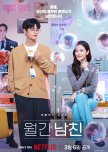
Seo Mi-rae is a webtoon producer whose entire existence has basically been swallowed up by her career. No romance, no social life, no time, no energy, nothing. Just an endless cycle of impossible deadlines, demanding creators, and a workload that would break most people. After going through a painful breakup she has completely checked out of the idea of dating and has zero interest in pursuing another relationship. She is just existing at this point, running on fumes, and pouring everything she has into her job.
Then she gets selected as a beta tester for this revolutionary virtual reality dating platform called *Boyfriend On Demand* and honestly the concept alone had me sold from the jump. The app drops you into this fully immersive digital world where you can interact with hundreds of AI-generated romantic partners and every single one of them is specifically designed to fulfill a different fantasy. You want sweet and supportive? Done. Dramatic and brooding? Right there. Impossibly wealthy and devoted? Say less. Mysterious and protective? Already waiting. The app is essentially a choose-your-own-adventure romantic experience where the risks of real relationships don't exist and every single boyfriend is literally designed to make you feel chosen and special and loved. And as a concept? I mean… come on. You cannot tell me that is not creative and timely premises. In a world where people are lonelier than ever and technology is increasingly filling in the gaps of human connection, this idea had so much to say. SO much. And that is precisely why what they actually did with it hurt as much as it did.
⸻⸻⸻⸻⸻⸻⸻
COMMENTARY:
The virtual dating sequences? Honestly iconic. Genuinely hilarious. Completely unhinged in the most entertaining way imaginable. Every single time Mi-rae entered the simulation I was on the edge of my seat wondering what kind of fantasy scenario was going to unfold and which celebrity was going to pop up as her newest AI love interest. The sheer unpredictability of it kept me watching way longer than the actual quality of the writing deserved and I am not even remotely ashamed to admit that. That is just the truth.
The AI boyfriends themselves were so exaggerated and over the top in the best possible way. They were basically walking parodies of every romantic archetype you have ever seen in a drama and the comedy that came from Mi-rae having to navigate their ridiculous levels of devotion and dramatic declarations of love was genuinely some of the funniest content I have seen in a while. Her reactions alone carried so many scenes. There was a real self-awareness to these sequences that I appreciated because the show clearly knew how absurd the premise was and leaned into it rather than trying to play it completely straight.
And the celebrity cameos... okay listen. I understand that for some people the cameos were maybe a bit of a gimmick but for me? Every single one felt like an event. Like a little gift. You genuinely never knew who was going to show up next and that sense of excitement and surprise genuinely kept the momentum going even when other parts of the story were dragging. In a weird way the cameos became one of the show's most defining and memorable features and I think that says a lot about how well executed they were individually even if they contributed to a larger structural problem that I will get into later.
Seo Kang-joon appeared as one of the AI boyfriends and I am telling you right now, this man had LIMITED screen time. We are talking a handful of episodes at most. And somehow, SOMEHOW, he left a bigger and more lasting impression on me than the actual main love interest of the entire drama. How does that happen? HOW? The chemistry between him and Mi-rae was so immediate and so natural and so effortless that I genuinely sat there with my mouth open thinking "why are you not the lead of this show?" Like their interactions felt lively and easy and genuinely fun in a way that the central romance never quite managed to achieve despite having 10 entire episodes to build itself up. Some of the scenes they shared together were easily among the most memorable of the whole drama and he was barely even there!!!
It genuinely made me a little sad watching it because you could see what the show could have been if that same energy and chemistry had been channeled into the main relationship. I need someone to cast Jisoo and Seo Kang-joon in a proper drama together with a strong script and a fully developed love story because after watching this I am convinced they would be absolutely electric together. Someone please make this happen. I am begging.
And the truly frustrating thing is that his cameo character, a character with almost no backstory, no real development, no space to breathe, somehow felt more emotionally present and engaging than characters we spent the entire drama with. That is not a compliment to the cameo. That is an indictment of how badly the writing failed the main cast.
Park Gyeong-nam, played by Seo In-guk, is supposedly the love of Mi-rae's life. He is reserved and intimidating on the surface but secretly harbors genuine feelings for her and gradually becomes more important to the story as it progresses. In THEORY this relationship should have been the emotional beating heart of the entire series. The thing that grounds all the virtual chaos in something real and meaningful. The anchor. The reason we are watching.
In PRACTICE it felt like an afterthought. A side plot. Something the writers remembered existed between virtual dating sequences and celebrity cameos.
For the majority of the drama Gyeong-nam is essentially sidelined while Mi-rae runs around the simulation falling in and out of fantasy scenarios. He lingers in the background. He shows up occasionally to look meaningful and feel things quietly. And then by the time the show finally decides to actually commit to building their relationship there is genuinely not enough runway left to do it properly. Important moments feel rushed. Character development arrives so late in the game that it cannot possibly land with the emotional weight it should have. And the conclusion of their romance feels hollow as a result because you cannot make an audience invest in something you spent most of the drama not investing in yourself.
This is especially painful because Seo In-guk is genuinely talented. Like properly, undeniably talented. He has this natural screen presence that allows him to communicate entire worlds of emotion through a look or a quiet expression or the way he holds himself in a scene. Some of Gyeong-nam's most effective and moving moments involved no dramatic dialogue at all, just a lingering glance, a subtle shift in expression, a moment of quiet disappointment that he does not allow to show on his face. The performance was there. The actor was fully present and giving everything he had. The script just did not meet him where he was standing and that is the part I genuinely cannot forgive.
Because here is the thing. He tried so hard with so little. And you could feel it. You could feel him reaching for emotional beats that the writing kept failing to set up properly and honestly it just made me respect him more while simultaneously making me angrier at the show for wasting him the way it did. Seo In-guk deserved better material. Full stop. No argument. The character needed more and the actor was more than capable of delivering it if only the drama had bothered to do its part.
Okay let me talk about Jisoo because I think she did a genuinely good job with what she was given and I want to be clear about that before I get into the parts that annoyed me.
Carrying a drama with a premise this unconventional is not easy. It requires a particular kind of energy and presence, someone who can be funny without being cartoonish, emotional without being melodramatic, relatable without being passive. And for the most part Jisoo delivered. Her comedic timing was strong throughout and her expressive reactions became absolutely essential to some of the show's funniest and most entertaining moments. She was watchable in every scene and there is a natural charisma to her that kept the series moving forward even when the writing was letting everyone down. That counts for a lot and I do not want to minimize it.
Mi-rae herself is also a genuinely interesting character on paper. She represents an entire generation of young professionals who are running themselves into the ground trying to build careers while quietly falling apart on the inside. The exhaustion, the loneliness, the uncertainty about where her life is going... those feelings are real and they are relatable and in the right hands they could have been deeply affecting.
The problem is the writing kept undermining her. Her character development was inconsistent throughout the series and there were multiple moments where her decisions felt poorly motivated or just straight up immature in ways that made it difficult to stay fully invested in her journey. Like I understood her on a surface level but the drama never quite gave me enough of her interior world to make me truly feel for her the way I wanted to. And when you have a show that is essentially built around one character's emotional evolution, that is a significant problem.
This is not a Jisoo problem. This is a writing problem. The actress did her job. The script did not always do its job. Those are two separate and distinct issues and they should be treated as such.
At its core *Boyfriend On Demand* is not just a romance. It is a story about loneliness. About emotional fulfillment in an increasingly disconnected world. About what it means when technology becomes better at meeting our emotional needs than other human beings. About the seductive danger of preferring a controlled fantasy to the messy unpredictable reality of actual love. These are themes that matter. These are conversations worth having. And the framework of this drama was the perfect vehicle for having them.
The show even sets up genuinely fascinating territory around this, as Mi-rae grows more attached to the virtual world, reality starts to feel less satisfying by comparison. The idealized perfection of the app creates a standard that no real relationship can match. That tension between fantasy and reality could have been the foundation of something truly thought-provoking. A serious examination of digital dependency, emotional avoidance, and what we lose when we choose simulation over genuine human connection.
But every single time the drama got close to actually exploring one of these ideas, every time it approached a moment of real depth or genuine complexity, it retreated. Pulled back. Cracked a joke. Introduced another cameo. Jumped to another virtual scenario. It was like watching someone sprint toward something important and then stop just before reaching it over and over and over again for sixteen episodes. And eventually you stop believing they are ever actually going to get there.
The tragedy is that the comedy was good! I am not saying the humor was bad or unwelcome. The problem is that it kept coming at the expense of the story's more meaningful ideas. You can have both. Dramas do it all the time. But you have to be willing to let the weight of your themes actually land sometimes and this show consistently refused to do that.
If I had to identify the single biggest structural failure of this drama it is the imbalance between the virtual world and the real one. The show became so utterly fascinated by its own simulation, the rotating cast of fantasy boyfriends, the celebrity appearances, the increasingly elaborate scenarios, that it completely neglected the relationship it was supposedly building toward the whole time.
The virtual world got everything. The real romance got scraps. And no amount of rushing in the final episodes could compensate for 10 episodes of neglect. By the time the show tried to make me care deeply about Mi-rae and Gyeong-nam together it was already too late. The emotional foundation was not there because the drama never bothered to lay it properly. Their connection never gained the depth or the weight it needed to carry the conclusion and as a result the ending felt not just rushed but genuinely unearned.
This is the kind of structural imbalance that no amount of good acting or charming moments can fully fix. It is a foundational problem. A storytelling problem. And it is what ultimately prevented this drama from being what it could have been.
⸻⸻⸻⸻⸻⸻⸻
FINAL THOUGHTS:
If I had to sum this drama up in one phrase it would be "wasted potential," and I want you to understand that this genuinely hurts more than if it had just been a straightforwardly bad drama from episode one. Because bad dramas are easy to dismiss and forget. Dramas that waste genuinely strong premises stay with you in a different and more frustrating way. You find yourself thinking about the version of the show that could have existed. The version that actually committed to its own ideas. The version that gave the real romance the time and care it deserved. The version that was brave enough to sit with its more complicated themes instead of running back to safety every time things got emotionally interesting.
That version of *Boyfriend On Demand* would have been genuinely special. Instead what we got was entertaining enough in the moment but ultimately forgettable once the novelty wore off. The celebrity cameos were fun. Some of the virtual dating scenarios were genuinely hilarious and I laughed out loud more than once. Jisoo worked hard and brought real energy to the role. Seo In-guk was quietly excellent with material that did not deserve his effort. Seo Kang-joon showed up for five minutes and somehow became the most memorable thing in the whole drama. These are not nothing. These things count.
But a collection of entertaining moments is not the same thing as a good drama. And good performances cannot carry a story that the writing never properly built.
Overall I am giving this a 5.5/10.
THE PEOPLE WHO KNOW WHAT THIS COULD HAVE BEEN ARE SUFFERING AND WE DESERVE ACKNOWLEDGMENT!!!
Anyway, thanks for reading! ❤️
I want to be fair though because there were aspects of this show that I genuinely enjoyed and I don't want to be one of those people who just trashes something without acknowledging what worked. So let me try and break this down properly.
⸻⸻⸻⸻⸻⸻⸻
GENERAL OVERVIEW:
Seo Mi-rae is a webtoon producer whose entire existence has basically been swallowed up by her career. No romance, no social life, no time, no energy, nothing. Just an endless cycle of impossible deadlines, demanding creators, and a workload that would break most people. After going through a painful breakup she has completely checked out of the idea of dating and has zero interest in pursuing another relationship. She is just existing at this point, running on fumes, and pouring everything she has into her job.
Then she gets selected as a beta tester for this revolutionary virtual reality dating platform called *Boyfriend On Demand* and honestly the concept alone had me sold from the jump. The app drops you into this fully immersive digital world where you can interact with hundreds of AI-generated romantic partners and every single one of them is specifically designed to fulfill a different fantasy. You want sweet and supportive? Done. Dramatic and brooding? Right there. Impossibly wealthy and devoted? Say less. Mysterious and protective? Already waiting. The app is essentially a choose-your-own-adventure romantic experience where the risks of real relationships don't exist and every single boyfriend is literally designed to make you feel chosen and special and loved. And as a concept? I mean… come on. You cannot tell me that is not creative and timely premises. In a world where people are lonelier than ever and technology is increasingly filling in the gaps of human connection, this idea had so much to say. SO much. And that is precisely why what they actually did with it hurt as much as it did.
⸻⸻⸻⸻⸻⸻⸻
COMMENTARY:
The virtual dating sequences? Honestly iconic. Genuinely hilarious. Completely unhinged in the most entertaining way imaginable. Every single time Mi-rae entered the simulation I was on the edge of my seat wondering what kind of fantasy scenario was going to unfold and which celebrity was going to pop up as her newest AI love interest. The sheer unpredictability of it kept me watching way longer than the actual quality of the writing deserved and I am not even remotely ashamed to admit that. That is just the truth.
The AI boyfriends themselves were so exaggerated and over the top in the best possible way. They were basically walking parodies of every romantic archetype you have ever seen in a drama and the comedy that came from Mi-rae having to navigate their ridiculous levels of devotion and dramatic declarations of love was genuinely some of the funniest content I have seen in a while. Her reactions alone carried so many scenes. There was a real self-awareness to these sequences that I appreciated because the show clearly knew how absurd the premise was and leaned into it rather than trying to play it completely straight.
And the celebrity cameos... okay listen. I understand that for some people the cameos were maybe a bit of a gimmick but for me? Every single one felt like an event. Like a little gift. You genuinely never knew who was going to show up next and that sense of excitement and surprise genuinely kept the momentum going even when other parts of the story were dragging. In a weird way the cameos became one of the show's most defining and memorable features and I think that says a lot about how well executed they were individually even if they contributed to a larger structural problem that I will get into later.
Seo Kang-joon appeared as one of the AI boyfriends and I am telling you right now, this man had LIMITED screen time. We are talking a handful of episodes at most. And somehow, SOMEHOW, he left a bigger and more lasting impression on me than the actual main love interest of the entire drama. How does that happen? HOW? The chemistry between him and Mi-rae was so immediate and so natural and so effortless that I genuinely sat there with my mouth open thinking "why are you not the lead of this show?" Like their interactions felt lively and easy and genuinely fun in a way that the central romance never quite managed to achieve despite having 10 entire episodes to build itself up. Some of the scenes they shared together were easily among the most memorable of the whole drama and he was barely even there!!!
It genuinely made me a little sad watching it because you could see what the show could have been if that same energy and chemistry had been channeled into the main relationship. I need someone to cast Jisoo and Seo Kang-joon in a proper drama together with a strong script and a fully developed love story because after watching this I am convinced they would be absolutely electric together. Someone please make this happen. I am begging.
And the truly frustrating thing is that his cameo character, a character with almost no backstory, no real development, no space to breathe, somehow felt more emotionally present and engaging than characters we spent the entire drama with. That is not a compliment to the cameo. That is an indictment of how badly the writing failed the main cast.
Park Gyeong-nam, played by Seo In-guk, is supposedly the love of Mi-rae's life. He is reserved and intimidating on the surface but secretly harbors genuine feelings for her and gradually becomes more important to the story as it progresses. In THEORY this relationship should have been the emotional beating heart of the entire series. The thing that grounds all the virtual chaos in something real and meaningful. The anchor. The reason we are watching.
In PRACTICE it felt like an afterthought. A side plot. Something the writers remembered existed between virtual dating sequences and celebrity cameos.
For the majority of the drama Gyeong-nam is essentially sidelined while Mi-rae runs around the simulation falling in and out of fantasy scenarios. He lingers in the background. He shows up occasionally to look meaningful and feel things quietly. And then by the time the show finally decides to actually commit to building their relationship there is genuinely not enough runway left to do it properly. Important moments feel rushed. Character development arrives so late in the game that it cannot possibly land with the emotional weight it should have. And the conclusion of their romance feels hollow as a result because you cannot make an audience invest in something you spent most of the drama not investing in yourself.
This is especially painful because Seo In-guk is genuinely talented. Like properly, undeniably talented. He has this natural screen presence that allows him to communicate entire worlds of emotion through a look or a quiet expression or the way he holds himself in a scene. Some of Gyeong-nam's most effective and moving moments involved no dramatic dialogue at all, just a lingering glance, a subtle shift in expression, a moment of quiet disappointment that he does not allow to show on his face. The performance was there. The actor was fully present and giving everything he had. The script just did not meet him where he was standing and that is the part I genuinely cannot forgive.
Because here is the thing. He tried so hard with so little. And you could feel it. You could feel him reaching for emotional beats that the writing kept failing to set up properly and honestly it just made me respect him more while simultaneously making me angrier at the show for wasting him the way it did. Seo In-guk deserved better material. Full stop. No argument. The character needed more and the actor was more than capable of delivering it if only the drama had bothered to do its part.
Okay let me talk about Jisoo because I think she did a genuinely good job with what she was given and I want to be clear about that before I get into the parts that annoyed me.
Carrying a drama with a premise this unconventional is not easy. It requires a particular kind of energy and presence, someone who can be funny without being cartoonish, emotional without being melodramatic, relatable without being passive. And for the most part Jisoo delivered. Her comedic timing was strong throughout and her expressive reactions became absolutely essential to some of the show's funniest and most entertaining moments. She was watchable in every scene and there is a natural charisma to her that kept the series moving forward even when the writing was letting everyone down. That counts for a lot and I do not want to minimize it.
Mi-rae herself is also a genuinely interesting character on paper. She represents an entire generation of young professionals who are running themselves into the ground trying to build careers while quietly falling apart on the inside. The exhaustion, the loneliness, the uncertainty about where her life is going... those feelings are real and they are relatable and in the right hands they could have been deeply affecting.
The problem is the writing kept undermining her. Her character development was inconsistent throughout the series and there were multiple moments where her decisions felt poorly motivated or just straight up immature in ways that made it difficult to stay fully invested in her journey. Like I understood her on a surface level but the drama never quite gave me enough of her interior world to make me truly feel for her the way I wanted to. And when you have a show that is essentially built around one character's emotional evolution, that is a significant problem.
This is not a Jisoo problem. This is a writing problem. The actress did her job. The script did not always do its job. Those are two separate and distinct issues and they should be treated as such.
At its core *Boyfriend On Demand* is not just a romance. It is a story about loneliness. About emotional fulfillment in an increasingly disconnected world. About what it means when technology becomes better at meeting our emotional needs than other human beings. About the seductive danger of preferring a controlled fantasy to the messy unpredictable reality of actual love. These are themes that matter. These are conversations worth having. And the framework of this drama was the perfect vehicle for having them.
The show even sets up genuinely fascinating territory around this, as Mi-rae grows more attached to the virtual world, reality starts to feel less satisfying by comparison. The idealized perfection of the app creates a standard that no real relationship can match. That tension between fantasy and reality could have been the foundation of something truly thought-provoking. A serious examination of digital dependency, emotional avoidance, and what we lose when we choose simulation over genuine human connection.
But every single time the drama got close to actually exploring one of these ideas, every time it approached a moment of real depth or genuine complexity, it retreated. Pulled back. Cracked a joke. Introduced another cameo. Jumped to another virtual scenario. It was like watching someone sprint toward something important and then stop just before reaching it over and over and over again for sixteen episodes. And eventually you stop believing they are ever actually going to get there.
The tragedy is that the comedy was good! I am not saying the humor was bad or unwelcome. The problem is that it kept coming at the expense of the story's more meaningful ideas. You can have both. Dramas do it all the time. But you have to be willing to let the weight of your themes actually land sometimes and this show consistently refused to do that.
If I had to identify the single biggest structural failure of this drama it is the imbalance between the virtual world and the real one. The show became so utterly fascinated by its own simulation, the rotating cast of fantasy boyfriends, the celebrity appearances, the increasingly elaborate scenarios, that it completely neglected the relationship it was supposedly building toward the whole time.
The virtual world got everything. The real romance got scraps. And no amount of rushing in the final episodes could compensate for 10 episodes of neglect. By the time the show tried to make me care deeply about Mi-rae and Gyeong-nam together it was already too late. The emotional foundation was not there because the drama never bothered to lay it properly. Their connection never gained the depth or the weight it needed to carry the conclusion and as a result the ending felt not just rushed but genuinely unearned.
This is the kind of structural imbalance that no amount of good acting or charming moments can fully fix. It is a foundational problem. A storytelling problem. And it is what ultimately prevented this drama from being what it could have been.
⸻⸻⸻⸻⸻⸻⸻
FINAL THOUGHTS:
If I had to sum this drama up in one phrase it would be "wasted potential," and I want you to understand that this genuinely hurts more than if it had just been a straightforwardly bad drama from episode one. Because bad dramas are easy to dismiss and forget. Dramas that waste genuinely strong premises stay with you in a different and more frustrating way. You find yourself thinking about the version of the show that could have existed. The version that actually committed to its own ideas. The version that gave the real romance the time and care it deserved. The version that was brave enough to sit with its more complicated themes instead of running back to safety every time things got emotionally interesting.
That version of *Boyfriend On Demand* would have been genuinely special. Instead what we got was entertaining enough in the moment but ultimately forgettable once the novelty wore off. The celebrity cameos were fun. Some of the virtual dating scenarios were genuinely hilarious and I laughed out loud more than once. Jisoo worked hard and brought real energy to the role. Seo In-guk was quietly excellent with material that did not deserve his effort. Seo Kang-joon showed up for five minutes and somehow became the most memorable thing in the whole drama. These are not nothing. These things count.
But a collection of entertaining moments is not the same thing as a good drama. And good performances cannot carry a story that the writing never properly built.
Overall I am giving this a 5.5/10.
THE PEOPLE WHO KNOW WHAT THIS COULD HAVE BEEN ARE SUFFERING AND WE DESERVE ACKNOWLEDGMENT!!!
Anyway, thanks for reading! ❤️
Was this review helpful to you?


