

 123
123 225
225 20
20 2
2 4
4 5
5 10
10 5
5 7
7 6
6 3
3 10
10 5
5 2
2 7
7 35
35 3
3 4
4 4
4 2
2 1
1 3
3 3
3 5
5 2
2 6
6 30
30 35
35 13
13 21
21


This review may contain spoilers
Muscles doing the acting
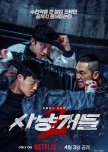
Season two of *Bloodhounds* begins by pretending, briefly, that its characters have earned peace. Gun-woo is no longer just a promising fighter; he’s a world champion. Woo-jin has settled into the role of coach, housemate, brother-in-arms. They live with Gun-woo’s mother in a polished suburban home, splitting time between training and helping out at her café. It’s an image of stability so neatly arranged it almost invites disruption.
It comes, predictably, the moment Gun-woo wins. Victory doesn’t close a chapter here but exposes him. Im Baek-jeong enters not gradually but like a verdict already passed. A former boxer turned operator of a brutal, illegal bare-knuckle league streamed to millions of anonymous gamblers, he represents a more industrialized form of violence than anything the first season explored. His proposition is simple: fight for him, or deal with the consequences.
From there, the structure locks in. Gun-woo, Woo-jin, and their circle (Gun-woo’s mother again placed in the line of fire, the still-recovering police officer Kang Tae-young, and returning allies like Hong Min-beom and Moon Gwang-mu) are pushed into a defensive posture that quickly becomes offensive. The show cycles through escalation: threats, confrontations, retaliation. It’s efficient. Almost too efficient.
What distinguishes this season from the first is not scale but absence. Previously, *Bloodhounds* found its energy in uncertainty. Gun-woo and Woo-jin didn’t just fight opponents; they navigated a world where morality had texture. Their alliance with a benevolent loan shark, their uneasy proximity to figures like Kim Sae-ron’s character...these relationships carried tension because they weren’t fixed. Values were tested in motion. You watched characters arrive at their principles.
Here, those principles are already settled. The narrative dispenses with ambiguity early and never returns to it. Baek-jeong is unambiguously predatory; the protagonists are unambiguously righteous. There is no middle ground to traverse, no shifting terrain. The drama, as a result, relocates almost entirely into physical conflict. The fights are not extensions of emotional stakes so much as substitutes for them.
And to be clear, the fights deliver. Kim Joo-hwan’s direction retains its precision, the clean and forceful choreography that communicates impact without excess ornament. Bodies move with intent; blows land with consequence. Rain’s performance complements this physical language. He is convincing not because the character is deeply written, but because he understands stillness. Baek-jeong doesn’t need to speak much; the threat is in how he occupies space, how quickly stillness converts into violence. There’s a credible sense that when the inevitable clash with Gun-woo arrives, it will be less a showdown than a collision.
But even that anticipation reveals the season’s limitation. Everything bends toward that confrontation, and in doing so, the series narrows itself. Subplots feel less like organic extensions and more like reinforcement, just additional reasons to keep the central conflict in motion. The return of familiar allies provides continuity, but not complication. They orbit the main struggle rather than altering it.
There is also a tonal shift that is harder to ignore. The move into a sleeker, more conspicuously modern setting, complete with visible consumer spaces and product placement, introduces a faint dissonance. The first season’s grit felt lived-in. This one often feels arranged. Not artificial, but curated. The violence remains, yet the world around it is cleaner, brighter, more controlled.
None of this makes the season ineffective. On the contrary, it functions with almost mechanical reliability. It knows how to pace itself, how to escalate, how to stage a fight that satisfies on impact alone. The camaraderie between Gun-woo and Woo-jin still carries warmth, still anchors the series in something recognizably human. That hasn’t been lost.
What has been lost is the sense that anything might shift beneath the surface. It doesn’t ask its characters to discover who they are, but assumes they already know. And without that process of discovery, the drama, for all its movement, feels curiously fixed.
It comes, predictably, the moment Gun-woo wins. Victory doesn’t close a chapter here but exposes him. Im Baek-jeong enters not gradually but like a verdict already passed. A former boxer turned operator of a brutal, illegal bare-knuckle league streamed to millions of anonymous gamblers, he represents a more industrialized form of violence than anything the first season explored. His proposition is simple: fight for him, or deal with the consequences.
From there, the structure locks in. Gun-woo, Woo-jin, and their circle (Gun-woo’s mother again placed in the line of fire, the still-recovering police officer Kang Tae-young, and returning allies like Hong Min-beom and Moon Gwang-mu) are pushed into a defensive posture that quickly becomes offensive. The show cycles through escalation: threats, confrontations, retaliation. It’s efficient. Almost too efficient.
What distinguishes this season from the first is not scale but absence. Previously, *Bloodhounds* found its energy in uncertainty. Gun-woo and Woo-jin didn’t just fight opponents; they navigated a world where morality had texture. Their alliance with a benevolent loan shark, their uneasy proximity to figures like Kim Sae-ron’s character...these relationships carried tension because they weren’t fixed. Values were tested in motion. You watched characters arrive at their principles.
Here, those principles are already settled. The narrative dispenses with ambiguity early and never returns to it. Baek-jeong is unambiguously predatory; the protagonists are unambiguously righteous. There is no middle ground to traverse, no shifting terrain. The drama, as a result, relocates almost entirely into physical conflict. The fights are not extensions of emotional stakes so much as substitutes for them.
And to be clear, the fights deliver. Kim Joo-hwan’s direction retains its precision, the clean and forceful choreography that communicates impact without excess ornament. Bodies move with intent; blows land with consequence. Rain’s performance complements this physical language. He is convincing not because the character is deeply written, but because he understands stillness. Baek-jeong doesn’t need to speak much; the threat is in how he occupies space, how quickly stillness converts into violence. There’s a credible sense that when the inevitable clash with Gun-woo arrives, it will be less a showdown than a collision.
But even that anticipation reveals the season’s limitation. Everything bends toward that confrontation, and in doing so, the series narrows itself. Subplots feel less like organic extensions and more like reinforcement, just additional reasons to keep the central conflict in motion. The return of familiar allies provides continuity, but not complication. They orbit the main struggle rather than altering it.
There is also a tonal shift that is harder to ignore. The move into a sleeker, more conspicuously modern setting, complete with visible consumer spaces and product placement, introduces a faint dissonance. The first season’s grit felt lived-in. This one often feels arranged. Not artificial, but curated. The violence remains, yet the world around it is cleaner, brighter, more controlled.
None of this makes the season ineffective. On the contrary, it functions with almost mechanical reliability. It knows how to pace itself, how to escalate, how to stage a fight that satisfies on impact alone. The camaraderie between Gun-woo and Woo-jin still carries warmth, still anchors the series in something recognizably human. That hasn’t been lost.
What has been lost is the sense that anything might shift beneath the surface. It doesn’t ask its characters to discover who they are, but assumes they already know. And without that process of discovery, the drama, for all its movement, feels curiously fixed.
Was this review helpful to you?


