


 2
2


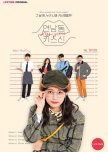
Predictable, pretentious, occasionally charming—like watching a rom-com argue with itself.
The light, quirky premise with just enough emotional seasoning made this drama watchable—but let’s be honest, it also tested my patience with the world’s most oblivious “kiss master.” Yoon Sol spends most of the drama strutting around claiming elite kissing credentials like she’s running a clinic… all while having never actually kissed anyone. Ma’am. That’s not confidence. That’s delusion with a diploma.Still, even though it was painfully obvious who the “mystery kisser” was (spoiler: we all saw it coming from episode one), I genuinely enjoyed the ride. I kept hoping they'd throw in a plot twist we didn’t ask for—maybe a surprise double identity or secret twin—but no, the drama stuck to its script like it was handcuffed to convention. I’m still unsure if that restraint is admirable or a lost opportunity. It’s like ordering spicy ramen and getting mild—but fine, it was edible.
Now, let’s talk about Bae In Hyuk, who got dangled in front of us like a shiny second lead decoy, only to be utterly conned. Yun Woo had every mark of a compelling love interest—chemistry, screen presence, even some emotional backbone. I wouldn’t have complained if he and Yoon Sol ended up together. From the very beginning, he screamed “main lead energy,” but the script clearly had other, less surprising plans.
One thing I did appreciate was the show’s brief nod to inclusivity—the idea that the mystery kisser could be a woman, or just anybody. For a rom-com this fluffy, that kind of openness was refreshing, even if it barely lasted a scene. Sadly, Yoon Sol’s pretentious streak often got in the way. Girl, if you're gonna launch a whole investigative arc, maybe don't pre-disqualify people based on vibes? But hey, without that emotional bias, there’d be no tension—and no runtime.
In the end, this drama is a classic example of drama comfort food—predictable, mildly frustrating, but still enjoyable in the moment. Just don’t think too hard about it… like Yoon Sol does.
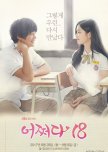
Time travel that won’t make your brain implode or your eyes roll.
This is that rare little drama that doesn’t stumble over its own ambition. In a genre littered with temporal gymnastics and butterfly-effect theatrics, this one looks at the time travel trope and simply says: “Let’s not overthink this.” One man, one regret, one trip back—it’s clean. And in that clarity, it actually manages to say something. Compared to Back to Seventeen (2023), which tried to turn trauma redo into a cinematic therapy session (with mixed results), Somehow 18 feels like the quieter but sharper spiritual sibling of Shining for One Thing. No official remake ties, but the emotional resonance stacks higher with less filler.Choi Min Ho and Lee Yoo Bi slide into their roles with surprising ease. I’ve seen both elsewhere—clearly—but they never made enough of an impression to stick. Here, Min Ho ditches the usual brooding idol blueprint and gives us an awkward, guilt-ridden emerg doctor that actually feels real. Yoo Bi trades the fragile-heroine mold for a more grounded take on a girl whose smile covers more than it reveals. They don’t reinvent performance art, but they work within the frame. No forced chemistry, just a soft tension that holds.
The time-slip device here is refreshingly digestible. No interdimensional flowcharts, no “change one thing and your cat disappears” mechanics. Just a straightforward rewind, emotionally driven, and thankfully free of sci-fi chaos. That simplicity lets the drama breathe, and what surfaces is a quiet but sincere message: that sometimes, the desire to live doesn’t start inside you—it’s lit by someone else.
For a drama this short, the impact is weirdly lasting. It’s not groundbreaking, but it’s earned. Somehow 18 doesn’t razzle and dazzle—it just delivers. And in a landscape of flashy poster betrayals and cluttered timelines, that kind of sincerity almost feels rebellious. Respect.

Come for the charm, stay for the feels—leave before the sequel ruins everything.
I went into this drama expecting the usual: recycled tropes, awkward pacing, maybe some forced cuteness. But this certainly surprised me. What starts out as low-stakes teen fluff slowly builds into an emotional ride with real momentum. It's not dramatic in the heavy sense, but it managed to stir things up just enough to make me care—and feel.The meet-cute setup worked better than it had any right to. A flirty prankster morphs into a genuine love interest, and the transition doesn’t feel forced. There’s something refreshing about watching their chemistry unfold, even if the jealous third wheel shows up right on cue. Obligatory mean-girl archetype included, but she’s less of a threat and more of a checkbox.
Is it groundbreaking? No. But it’s decent. The pacing doesn’t drag, the emotional beats aren’t overplayed, and you get enough character movement to feel satisfied. A reliable comfort watch—nothing profound, but polished enough to avoid cringe. It lands somewhere in the middle between breezy distraction and real connection.
Just don’t follow it into Season 2. That installment showed up with a personality transplant and a warning label. The tone unravels, characters flatten out, and whatever spark Season 1 had quietly fizzles. Watch the first, skip the sequel—unless you’re collecting disappointment for sport.

Wig budget: $12. Emotional tension: priceless
With a title that sounds like a warning and ratings barely keeping the pulse, I expected a snooze-fest. Instead, it turned out better than anticipated—moody atmosphere, layered plot, and just enough mystique to keep me invested. It’s not soaring to greatness, but it’s not bottom-shelf either. We’re talking drama limbo with style.Now let’s address the dual lead dilemma. Su Cheng Xi and Sui Han Bai—same flowing hair, same brooding stare, same aura of tragic backstory. I spent a good chunk of time confused about who was who. Did production run out of wigs or just want to test my observational skills? Anyway, they’re both competent and compelling once you figure out which one’s talking.
And yes, they absolutely need to stop flirting with each other. Or don’t—because I’m all for a good bromantic slow burn. The glances? Intense. The tension? Delicious. They could fight each other or make out—I’d probably still cheer. Whether intentional or not, their chemistry walks the line between rivalry and something suspiciously more... layered.
Overall, this is a solid pick if you can handle a few pacing hiccups and narrative fog. It’s got heart, a compelling premise, and plenty of room for subtext if you squint. Just don’t trust the ratings—they clearly missed the memo.

Self-acceptance message derailed by bad writing and worse men
The central idea, that an unattractive girl desires to be perceived as beautiful, is not an original concept. Beauty’s in the eye of the beholder; we all know this cliché, right?Although the message of self-acceptance was important, the execution fell short due to poor scriptwriting. I thought Ahn Hyo Seop did an adequate job playing the lead, Park Se Gun; however, the character itself was not well-developed, and I did not find him particularly engaging. His redemption arc felt manufactured and lacked authenticity. I think his affection for FL stems not from genuine love, but from a sense of ease and comfort he experiences in her presence, leading him to perceive her as “lovable.”
To Se Gun, who was used to a certain type of girl, Nan Hee was a refreshing change, a novelty like a shiny toy that stood out from his previous dating experiences. In addition, his concern appeared to be keeping Nan Hee’s best friend from getting the FL, and therefore, I am inclined to believe that he was only settling for Nan Hee until someone better comes along.
Speaking of shiny toys, Nan Hee is no different. While her preoccupation with appearances was understandable, given her low self-esteem, it frequently became intensely infuriating. The so-called “best friend” Mi Joo was no better. She just uses Nan Hee as a prop to highlight her own beauty, like how she uses Tae Hyun when it’s convenient. The only redeemable character here is probably Nan Hee’s mother, who is trying to teach her daughter a lesson in a roundabout way.
By the time I finished watching this drama, I couldn't care less about any of the characters and just felt relieved that I can tick this off my list.

Watching this felt like falling down 51 rabbit holes—and none led to Wonderland
Before beginning my review, I must admit that my frustration with finding a translated version of the drama influenced my opinion; so I watched the raw version instead. The problem wasn’t my language comprehension (I grasped about 75%), but the messy video organization—51 links for a mere 18 two-minute episodes! It was incredibly frustrating searching for the episodes, which weren’t in order, and I had to sift through related videos just to find them.What was expected to be a 36-minute watch (if the 18x2 detail is accurate) stretched to 3 hours. Was it worth all the trouble? NO. Absolutely not!! I am sparing you the effort!!! I assigned myself as one of the sacrificial lambs to tell you how this drama isn’t worth it unless you find a source where it can give you everything in one shot.
First of all, the poster is misleading. Nowhere in the show did they dress up remotely like they did in the poster. Shen Hao Nan spent 90% of the show in a pale blue wig that made him like a 17-year-old version of Vic Zhou if Vic Zhou was into cosplay. Second, Tang Xin spent half the drama evading her friend’s weak advances; however, the drama presented Wei Lai’s similar stalker-like behavior, including several uninvited visits to her house, as a romantic pursuit.
Third, the play’s message is that you shouldn’t pursue your passions unless it pays the bills, thus implying that you should work in a “real” job; or better yet, rely on your parent’s wealth if they have some, because that’s all you will be ever be good enough to do.
A better title for this drama would be “Curb Your Ambition” or “Don’t Be Stubborn,” highlighting both my and Wei Lai’s fruitless efforts.
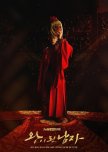
Starts slow, then hits stride—thanks to one actor and 90% character-driven chaos
One of the earliest and most iconic stories of lookalikes switching places is Mark Twain’s The Prince and the Pauper, which inspired the movie Masquerade, which this show is based on. After a sluggish start, this drama picked up steam about 4 episodes in, when the real king Yi Heon disappears mostly from the screen. I almost dropped this drama, and deemed it listless, but Yeo Jin Goo’s performance as both the real and the faux ruler impressed me. While I don’t remember seeing him elsewhere, perhaps in smaller roles, his presence as Ha Seon was truly magnificent.Having watched Lee Se Young in three projects this year, her performance as the queen is exactly what I expected. Not to be outdone is Kim Sang Kyung in his role as the Royal Secretary, a man who has done many questionable things in the name of king and country. He plays the role of Lee Gyu so magnificently that we can’t help but empathise with him, even when he makes decisions that are even against our own moral standards. From Eunuch Jo to the detestable Kwon Hae Hyo as Shin Chi Soo, the rest of the cast delivered exceptional performances; his actions were so loathsome, I wanted to maim him.
In terms of plot, the drama had captivating moments but also some slow parts. The drama progressed as far as it did only because of the character’s actions driving it forward. It’s true that comparing a melodrama to a light rom-com is like comparing apples and oranges; therefore, it’s not surprising I wasn’t in stitches watching it. Though it included some comedic elements, they were infrequent.
Though there was one character that I found extremely irritating. Most would probably guess it’s one of the villains, but they’d be wrong. It is Ha Seon’s sister, Dal Rae, who frustrated me to no end. A naive farm girl’s lack of worldly experience is understandable, yet her actions didn’t suggest a life on the streets with clowns. Let me be clear: I don’t blame her for being assaulted. Yes, that crime was the perpetrator’s sole responsibility. But it was her actions afterward, like how after being traumatized, I would have thought she’d learn her lesson and NOT go off on her own. Despite repeated warnings from her uncle to stay put (or at least stay close to him), morbid curiosity led her to the small hut where the real king was imprisoned. Though unsure of who he is, Dal Rae follows the real Yi Heon throughout the city streets, carries a knife that clearly isn’t hers, resulting in her arrest and risking her brother’s exposure. Why on earth does she continually endanger herself and cause others such worry?
Another thing that bothers me is the way Lee Gyu and Eunuch Jo discuss Ha Seon openly. They say his name so many times, at the risk of being eavesdropped. To avoid confusion, why not use a variation of the real king’s name when referring to him? Have they not learned at all that walls have ears? Can’t they be more covert? I suppose not; otherwise, the villains’ wicked plans would have been revealed sooner. It could just be my own particular issue, but a problem nonetheless.
My rant aside, this show is a decent watch for those who appreciate character-driven shows, a dash of romance, and a heavy dose of political intrigue. It's not the best historical K-drama out there, but it's neither the worst.
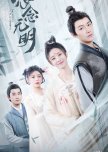
They battle in style, lie with charm, and flirt like it's classified intel.
Touted as the Chinese version of “Mr. & Mrs. Smith,” this drama delivers quite a punch. The characters are sassy and have mad skills at sword play. It was funny to watch Xiao Nian and Wu Ming make up excuses about their whereabouts when asked, and how they attempt to hide their secret identities from each other. Especially enjoyable is Xiao Nian’s antics in hiding her stash of wine jugs! These two together are so sweet!Equally loveable is the second pairing of Wen Fang and Bao Er. I find Wen Fang’s cute, awkward moments with Bao Er, and her way of sniffing him out, very amusing. The production team deserves commendation for their creative and captivating interpretation of the source material, despite limited resources. A great effort for an ambitious task.
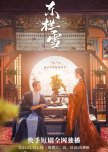
Short, sharp, and surprisingly progressive—plus chemistry you can microwave
This drama would be the story of LI Tong Guang and Ren Ru Yi (from A Journey to Love) if Ruyi returned Tong Guang’s affections. But Chu Ning Yuan is not as obsessive as Li Tong Guang, which is a blessing. The willingness of the Seventh Prince to be subservient to a maid is unexpected in a historical Chinese drama, and this unusual dynamic encourages other maids to challenge traditional roles and speak their minds. Not sure if this is a good or a bad thing. To promote female empowerment, let’s assume that this is an improvement and that social class distinctions are solely based on positions.Plotwise, it’s as straightforward as it gets. Shen Yan wants revenge and helps the Prince along the way. Female badassery at its finest for a short drama. Acting wise, they are both decent, but when paired together, their chemistry is chemistrying. Looking forward to their other works together!

Solid cast, soggy script. This loop needed more polish, less déjà meh
This drama reminded me a lot of “Shining for One Thing,” and therefore, perhaps unjustifiably, I made a lot of comparisons to that show. In contrast to “SFOT”, this drama is mediocre, and it’s no fault of the actors. I’ve seen Zhang Miao Yi in other works, so I know where her capabilities lie. I don’t enjoy time-travel dramas unless they are well-made. Granted, this has a shorter runtime, it’s not surprising that there would be some kinks that still needed to be ironed out. Possibly, a bigger budget or production could allow for a more fully developed story and plot. As it stands, it’s passable.
Leo Yang: carrying the show while dodging plot holes and clingy side characters
This drama is surprisingly decent, and I have to lay the credit on Leo Yang’s shoulders. His performance as an undercover agent who was also a mafia boss was impeccable, a compelling duality of good and evil where he balanced fighting for justice with the sharp mind needed for shady business.However, the same can’t be said for Han Le Yao, and it may not be entirely her fault. I thought her character was poorly developed; she attempted too much with insufficient understanding. Ling Yi only latched on to A Sen hoping to gain information on how her aunt died. Instead, she only became a burden. I’m quite annoyed by Ling Yi’s repeated rescues. I place the blame squarely on her, regardless of her well-meaning interference, which consistently creates difficulties for A Sen. How is an officer supposed to do their job when she puts herself in danger? Instead of helping, Ling Yi has become a liability for A Sen.
The plot, though interesting, has its fair share of loopholes. But if you overlook them, this could be an entertaining watch.

Solid cast, recycled blueprint, emotional spark MIA
When this drama started, it reminded me of “A Walk to Remember.”Both FL’s from the movie and this drama were studious and strait-laced, while both Males are trouble-makers, and because of the numerous similarities between this drama and the movie, I was not expecting this drama to veer off the script. While the movie tugged at my heartstrings, this one did not. It was a lackluster attempt to replicate the story, even though perhaps this is not the drama’s intent. As a standalone, it’s passable, though no fault of the actors. They were great in their performances, if perhaps given a better vehicle.
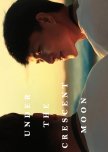
Acting: Nothing to write home about. I can attest that they can ride a motorcycle around the city as they search for answers.
Music: The chanting maybe louder.
Rewatch Value: Not significant to warrant a second look.
Overall Impression: The message is clear, but the execution probably not. With perhaps better resources to support a longer length, this film could have been decent. As it stands, it's mediocre.

Acting: Just some sitting, but mostly standing around, looking unmotivated. If this is the intent, certainly they did the job. I could do that too and pass as acting.
Music: Nothing memorable.
Rewatch Value: Once is more than enough.
Overall Impression: This is like bad porn with clothes on. The black-noir effect is not fooling anyone.
A sad attempt at being profound but ended up being inconsequential.

Acting: It was straightforward and natural.
Music: Nostalgic and poignant, apt for the story.
Rewatch Value: If warranted a second viewing, it's short enough to do so.
Overall Impression: Go in watching this without expectations and you will be mildly surprised.
It's a story about love that transcends genders and ages. A decent effort by the team.


