
 News


This review may contain spoilers
Damn that was spicy
I was the poster looking n i was like cute, this is gonna be something like Jun & Jun (that's why you read the tags) and damn was I wrong. There was NC every episode. Any complaints? No. Despite the NC the plot was good too. I liked cunning, twisted Mr. Kang and Lee who fell for all the tricks🤣🤣Till the ep 4. I absolutely loved it. The one thing, that's not my cup of tea is sleeping with others when you're in a relationship. I was spoiled about this when i was watching ep 1 that baek, kang and lee are gonna sleep together but i didn't believe it🤣🤣. I didn't understand why lee wanted to continue to sleep with baek when kang literally apologized and asked him to go back with him. Worse his 1st top was baek.. so that's the only reason I'm giving this a 9.
Overall it's good. Except for that one thing.
Was this review helpful to you?

This review may contain spoilers
Even Without a Candle, There Is Still the Sun
I finished this drama in a state of mild disbelief. Not because of a shocking twist, but because twelve episodes managed to hold a family tragedy, a corporate corruption case, a coming-of-age story, and a genuinely complicated sibling relationship without any of it feeling rushed or wasted. The fact that it ended so soon is exactly why I am not ready to let go of Chen Shan. I have not seen a drama this narratively full and this disciplined in its pacing in years, and I say that without any fan filter. If anything, I went in skeptical of Chen Zheyuan and came out genuinely impressed.The story builds like a jigsaw puzzle, and that is its greatest structural strength. Nothing is handed to you whole. A fragment of a flange, a journal entry, a gold lock with a character engraved on it, a phone call made at the wrong moment—each piece clicks into place only after you have already seen the picture from another angle. The dual timeline between 1997 and 2001 could easily have become a gimmick, but here it functions as a kind of delayed recognition. You watch the same family in the before and the after, and the gap between those two states is where the real drama lives. The mystery itself is not particularly complicated once the pieces are assembled, but the pleasure comes from watching the characters assemble them while their own relationships are being pulled apart. The reveal that Geng Jian, the godfather who seemed like the one adult the siblings could trust, was the one who killed their mother lands with real weight precisely because the show spent so much time letting him be kind. That is not a cheat. That is the point. The system did not just corrupt strangers. It corrupted the people who ate dinner at your table.
The acting is the other reason this drama stays with me. I did not expect this depth from Chen Zheyuan. His Chen Shan is not a cool, calculating avenger. He is a young man who keeps getting knocked down and keeps getting up because he does not know how to do anything else. The scene where he confronts his mother about the truth of Chen Ying's biological parents is the one that convinced me. He is not performing grief. He is drowning in it, and the question he screams—what am I supposed to do now—is not a plot device. It is the sound of a person realizing that the ground he has been standing on his whole life was never solid. What makes the performance work is the restraint elsewhere. He does not play every scene at that volume. The quieter moments, the way he looks at his sister when he thinks she is not watching, the way he shifts from rage to politeness when he needs something from someone he despises, those are the choices that make Chen Shan feel like a person rather than a protagonist.
And then there is the thing I cannot stop thinking about, which is Chen Shan's feelings for Chen Ying. My reading is that his love for her is not simple. It is not brotherly in the ordinary sense, and it is not romantic in a way that the drama ever allows to become explicit. It exists in the space between those two categories, and that ambiguity is what makes it so affecting. The evidence is everywhere once you start looking. He destroys Qi Mo's bed before Qi Mo has even properly entered the family orbit, a petty territorial move that reads like jealousy even if he would never call it that. He refuses to call Qi Mo "ge" until he has decided to let his sister go. He asks about jobs for her before he asks about jobs for himself when Guangzhou comes calling, and when there is no place for her, he turns the offer down without a second thought. He is ready to mutilate the man who touched her. And when he finally arranges her future with Qi Mo, he calls him "ge" for the first time and then removes himself from the equation. If that is not love in some form, I do not know what to call it. But I also think the drama is smarter than to label it. Chen Shan himself probably does not have a word for it. He grew up with her, she was the person who protected him, and the boundary between dependence and devotion blurred long before either of them could examine it. The show understands that some bonds are too tangled to name, and it lets the ambiguity breathe.
The relationship between Chen Ying and Chen Shan is also where the drama does its most interesting thematic work. The show is not really about whether they can solve the case. It is about whether two people who have been each other's only family can survive the truth about that family. Chen Ying's arc is especially painful because she has to absorb two betrayals at once: the parents who raised her concealed the truth about her biological parents' deaths, and the brother she raised with her own hands participated in exposing that concealment. The drama could have made her simply angry, but instead it makes her tired. The way she keeps working, keeps accounting, keeps gathering evidence even while she is furious at Chen Shan, is a more complicated kind of love than forgiveness. It is love that has been forced to become practical because there is no one else left to be practical for.
What the drama says about the system is not subtle, but it is effective. The petrochemical plant in Wugang is a closed world where everyone is connected and everyone is compromised. Zhang Wenying is not a villain, but she is not innocent either. She let the factory cover up the deaths of Chen Ying's biological parents, and that debt made her useful to Wan Yang for decades. When Chen Fu discovers the substandard flanges and wants to report them, Zhang Wenying's first instinct is to delay him, and that delay is enough. The show does not pretend that the corruption is the work of one evil man. It shows a network: Wan Yang at the top, Sun Jie running the dirty work, Geng Jian as the enforcer who tells himself he is just surviving, and a whole ecosystem of people who look the other way because the alternative is too expensive. The tragedy of the Chen family is not that they were unlucky. It is that they were inside a machine that eats people who ask questions, and the people who fed them to the machine were often the ones who loved them.
Where the drama stumbles, and I say this as someone who loves it, is in the final stretch of the mystery. The reveal that Sun Jie was the one who killed Chen Fu, rather than Qi Mo or someone more structurally central, feels slightly deflated. Sun Jie has been a presence throughout, but he has been a lackey, not a mastermind. His motive, when it arrives, is functional rather than devastating. The show spent so long building Geng Jian as the emotional betrayer that the final villain reveal carries less weight than the confession that came before it. There is a version of this story where the killer is someone whose betrayal would recontextualize every scene they shared with the family, and that version would have hit harder. What we get instead is a resolution that works, but does not quite sing. The gold lock as a clue is also a bit convenient for a show that otherwise prides itself on patient accumulation of evidence. It is not a fatal flaw, but it is the one place where the jigsaw puzzle feels like the piece was shaped to fit rather than found.
Still, the ending left me with something I did not expect: a kind of grief for the version of Chen Shan and Chen Ying that existed before the truth came out. They cannot go back to being the siblings who sat in the dark and told each other that even without a candle, there is still the sun. They know too much now. The people who raised them are not who they thought they were, and the love they had for each other has been permanently altered by what they did to protect it. The drama does not give them a clean reconciliation, and I am grateful for that. It gives them something harder: the choice to keep going anyway, with all the damage visible and all the love still there, tangled up and impossible to separate.
This drama deserved more attention than it got, and I hope the people who skipped it because of the lack of hype or the short episode count will come back to it eventually. It is the kind of show that rewards patience, and it is the kind of story that stays with you longer than you expect.
Was this review helpful to you?
This review may contain spoilers
An immersion to a wonderful world
Things I adored1 The cinematography. Every scene was beautifully shot and it felt like I was there walking with them in a beautiful décor that soothes my soul. It lets you see the struggles and the joy, the beauty and the ugliness, and in the end it transports your soul somewhere beautiful where you can start over. A love letter to the region.
2 The music. That was the highlight of the drama. Every time they sang my heart soared. It brought me joy and tears. It reminded me that music unites us rather then divide us and it can speak a language everyone understands. I'm not a music person, I prefer words, but here it was so gorgeous I couldn't help fall in love with it. Such beautiful melodies and words. It reminded me also of my childhood and my family. They would love that kind of music. It would speak to their soul.
3 The words. Sometimes a phrase, a dialogue would move me to tears. It was clear that much care went to writing and that is great to see. The dedication to those who set off again was my undoing. I felt it to my bones, and I wept for a long moment. You can't get it if you never had to leave and come back and leave again. If you never felt that you had to do what scares you the most: leave behind the comfort of a loving family and friends and try to find yourself, try to chase after your dreams. This drama showcased that in the best way.
4 The journey of the girls as a whole. I had a few issues with their individual stories and I'll be honest I wasn't their best supporter in times, but the whole arc was perfect precisely because their lives weren't perfect. They were in search of their dreams as they should and no matter where they end up, they never avoided what scared them. They soared despite the uneven path before them.
5 The grandmother. She was such a great character, A woman to admire. A woman who spoke to my inner self and made me realize that life shouldn't be still, it should let you see beyond the comfort of your daily life. When my dad felt ill, I asked him what was his best memory. I was expecting to say something about his family, he was such a great father and husband and we were the most important thing for him. But everything he said was about a sunrise in some far away mountain. The new places he saw, the people he met.
My dad who adored our place and never wanted to move, at the end of his life had that far away look. The one it said he was happy with the life he chose, but he was also happy to have seen something else, something more. This is the memory the grandmother stirred in me when she talked about being a pigeon in her next life. We all crave for stability and love, but we all want to be free and fly away. We just need to know we have somewhere to get back.
That was what my dad always said and showed to me. You can fly away, you can fly high, but if you get tired, you know we are here. Always, no matter what. That drama made me realize that again. That I need to fly away until the end of my days, I just need to know someone will be happy to see me when I get back.
Things I liked
1 The women. I want separate them because I had some issues with all of them, but I also loved all of them. I can't say I'm an unconditional fan of them and the FL isn't an actress I truly love. Here though she was at her best. I felt like she was happy to be part of this drama. I've seen in other dramas and she almost ruined them for me, but here she was beautiful and had a different vibe. I also liked her clothes. The other two were good actresses, but I can't say I care to look for other dramas they are in. That said, I'm not sure any other actresses would do better.
Things I disliked
1 Some things like the dancer say her husband loved her just not the way she wanted. I have a problem with statements like that. If you love someone you love them they way they need and want. If that's not the case you don't love them. Sorry there is no love when you can't support the dreams of the person you "love". I hate it when writers make women say things like that. It implies you didn't appreciate his love, that somehow it's your fault. NO. Love is what you give the other person when you are able to see their soul and support their dreams. Everything else is your ego getting in he way.
2 The romance in general. I didn't care about any of them. I watched this drama for the rest. The music, the culture, the craft, the people, the relationship between the girls, but the romance was the weak point.
3 The ML. I think he ruined the romance for because he had no chemistry with the FL and he looked like a high school student and that bothered me a lot. I couldn't believe in their relationship and I couldn't get into it. Not to mention that I though he wasn't a great actor either. That and some things I can't accept, even though they are part of their tradition, has me given it a 8.5.
Was this review helpful to you?

A Journey you shouldn’t miss !!!!
In short , this is the masterpiece drama you won’t like to miss out!!!!✅A drama which talks about two realistic characters who have their own sufferings and are fighting through in their life with utmost courage and passion…
The meeting of two people gives them a ray of sunshine in their life….
They slowly understand and embrace each other without looking on their pitiable self …
Their life is not a easy one and their journey to a sparkling life requires both of them to be understanding and supportive of each other’ life and their sufferings…
The drama is well written with some life changing dialogues and dialogues which will leave you a deep imprint on your life…❤️
The narration doesn’t make you bore or dizzy rather it keeps you hooked up throughout the epsiodes…you don’t want to miss a single moment….💕
The ost -its a top quality and this is one part which makes this drama a masterpiece ..🔥👌
The direction and camera work is done in such a manner that you feel the intense emotions of every scene and moment… 🔥
Hope you don’t miss out this drama!!
Was this review helpful to you?
This review may contain spoilers
More Than Music: A Story About Imperfection, Passion, and the Art of Being Human.
Finished Four Hands, Two Sonatas, and I honestly don't think I'll be forgetting this one anytime soon.The acting was phenomenal. Song Kang and Lee Jun-young were absolute standouts, but truly, everyone brought something extraordinary to this story. The emotions were so beautifully and painfully portrayed that you could feel them through the screen. The storyline kept me hooked from beginning to end. No exaggeration, once I put my phone down, it took me just a day and a half to binge the entire series.
And the music. Absolutely beautiful. As someone with a background in choir, an immense appreciation for an eclectic range of music, and a creative background in filmmaking and photography, this story resonated with me on a deeply personal level. Creatives, musicians, singers, artists of any kind, I think there's something here that will speak to you.
It was a bittersweet, traumatic, tragically beautiful reminder of what should truly drive us to create and pursue the things we love. We live in a world where everyone seems to be racing toward the next achievement, trying to climb higher, get ahead, and prove themselves. But sometimes, it isn't about the climb. It's about the experience, the passion, and the love behind what we do. It's about finding something that allows us to heal, to feel, and to forget the chaos of the world, even if only for a moment.
One quote from Choi Jeong Yo stayed with me:
"I asked whether a flawed artist was still worthy of making art. What he said to me was that, in fact, one must be flawed to create his art."
And perhaps that's the beauty of it all. We're human. We're imperfect. We're flawed. But those very imperfections are what give our art, our stories, and our lives their depth and meaning.
Sometimes, it's not about creating something perfect. It's about creating something honest. Something that makes someone feel something.
And maybe that's what makes both art and life so tragically beautiful.
Was this review helpful to you?

pov: she's kinda feral and he's a little too into that
I think that the first thing I need to mention is how good of a job Tian Xiwei did while playing the characters of A'Chou and Jundai. Both of the characters have such stark differences but there are times where their personalities and actions overlap and I think Tian Xiwei did so well with distinguishing them apart from one another.One downside of the drama is that since it follows the female characters so well the male characters felt kind of bland and underdeveloped in my opinion. Which really did make me sad because Yanan is really good at portraying complex characters. But even if we didn't get to see a lot about Lu Zhou, Yanan did a good job with using his expressions to still give Lu Zhou some character and substance (I do blame the writers for not putting that much thought into the male characters and I can't blame Yanan for just working with what he had and was given).
The drama has it flaws but the plot was intriguing for me, especially with all of the drama and a greater focus being put on the female characters. This was a perfect example for why I love a 'marriage of convenience' drama so much and I would just get so excited waiting for the next episodes to drop. And I had an absolute field day watching the two of fall for each other (especially Lu Zhou)
Was this review helpful to you?

The plot is simple: Our main character Kong Yeun Su is in a loving, fundamentally decent but patriarchal conservative family. The cage has become too small and she's determined to spread her wings. And one way to do so is tip toeing into a modern relationship.
She is the only character with a strong built out character and motivations. This was clearly written to orginally be 16 episodes and then was cutdown to 10. Most of the characters act badly and then quickly reverse to acting ideally. Dokgo Dal was commitment phobic, but now he isn't and is the complete perfect boyfriend without any relationship experience . .. how?
The sex toy storyline used to illustrate what healthy consensual sex can look like, and that disrupting the patriarchy means women taking control of their body and sexuality.
The acting is OK, music and sets, and costumes a bit below average . . . but hey, honestly, good for them for putting this out into the world. It's a theme I can get behind, even if there isn't much else there there.
Was this review helpful to you?

This review may contain spoilers
Lack of Narrative Cohesion - A Critical Assessment
Broker is a series full of interesting ideas, but it never quite manages to bring them together into a coherent story. Its premise – pharmaceutical research, industrial espionage and scientific rivalry – has all the makings of a gripping thriller. Instead, the series repeatedly gets sidetracked by subplots, romantic entanglements and endless office politics.The main problem is its lack of narrative cohesion. Several different genres seem to have been rolled into one: a scientific drama, a spy thriller, a workplace drama and a romantic storyline. Rather than complementing one another, these strands often feel disconnected, with the result that the series repeatedly loses sight of its central theme.
The characterisation is not always convincing either. Qiu Jianing and Zhou Xiaoshan are portrayed as intelligent, capable and complex individuals. While Xiaoshan has genuine emotional depth, Jianing often remains difficult to relate to on a personal level. Many of the supporting characters are primarily driven by self-interest and are not particularly likeable either. The series features several strong female characters, including Su Qian, Jianing and Mo Li. Yet strength is often associated with emotional detachment, ambition or ruthlessness. By comparison, characters such as Professor Wang and some of the more unassuming supporting roles come across as considerably more human and sympathetic.
Su Qian is one of the series' successful characters. She has authority, style and a well-defined sense of who she is. Jianing, by contrast, is repeatedly described as an exceptional scientist, yet remains surprisingly elusive as a character. Her sometimes flamboyant wardrobe also sits rather uneasily with the personality the series otherwise tries to establish.
The finale is the series' greatest weakness. Xiaoshan's final decision is neither convincingly foreshadowed nor a believable outcome of his character development. Instead of bringing the many conflicts surrounding scientific responsibility, personal loyalty and moral choices to a coherent conclusion, the series opts for a melodramatic ending designed primarily for tragic effect. In doing so, it undermines much of the character development that has gone before. A story that devotes so much attention to scientific integrity, responsibility and national loyalty should surely offer a more convincing exploration of guilt and justice. Instead, key conflicts are left unresolved, and dramatic escalation takes the place of a satisfying conclusion. Whether scenes removed from the final cut might have made the ending more convincing remains unknown.
One interesting aspect, however, is the social criticism implicit in the series. Why did an exceptionally intelligent and talented boy like Xiaoshan end up in the hands of a criminal? Why was he never given a scholarship? One of the supporting characters was able to pursue higher education only thanks to Su Qian's financial help and is consequently devoted to her without question. Dr Qin Bin, too, helps patients financially because they cannot otherwise afford the treatment that could save their lives. And why did Mo Li never seem to have a fair chance? In the end, it is Jianing who comes out on top: a privileged young woman from a well-connected family, with financial resources and the opportunity to study abroad. The series touches on important issues of social background, equality of opportunity and access to education and healthcare, but never explores them in any real depth.
Conclusion
Broker is not a bad series, but it is an underdeveloped one. There is enough material here for two separate dramas: a thriller about scientific research and industrial espionage, and a workplace drama centred on relationships. By trying to combine the two, however, the series weakens both. What remains is a production full of interesting ideas and featuring some memorable characters, but one that never quite succeeds in finding its narrative direction. For many viewers, Luo Yunxi's screen presence is likely to be a major reason to keep watching, while the story itself falls well short of its potential.
Was this review helpful to you?

The Good:
• Both leads had life-altering, soul-crushing experiences at the same time in their lives and were finding their way out of their personal darkness. The support they gave each other, even secretly, was heart-warming to watch.
• Both Ahn Hyo Seop and Kim Bum in a drama? I was instantly interested, even though the harsh reviews concerned me and had me delay watching. That was an error on my part, as not every drama is going to be everyone's cup of tea. I'm a bit puzzled by the claims of "unrealistic" when it comes to watching a romcom. They are notoriously unrealistic—it's one of their defining factors! People don't generally turn into dogs when they kiss, enter contract relationships when looking for an apartment, travel back in time, kidnap their love interest in a misguided show of attention, present themselves as the opposite sex and fall in love, show up as a substitute for a blind date, get caught in a whirlwind and end up in enemy territory, mistakenly marry the wrong person, transform into a llama, body swap with their love, date someone about a 1000 years older than themselves, hide a body only to discover he wasn't dead and therefore dateable, pretend to be a robot, date an alien or mermaid or vampire or gumiho or ghost, become a personal human battery charger, mistakenly sleep with someone during a cruise, or rub a magic lamp to find the love of their life.
• Speaking of Kim Bum, is he drinking from the fountain of youth? It's hard to believe it's been 17 years since he was in Boys over Flowers. I loved "Almost Paradise" played when he made his appearance as the 2ML. Kim Bum was also the 2ML in Tale of the Nine-Tailed where he had a romance. I'm curious how he would do as the lead in a romcom. Here, he was the besotted 2ML, but he was mature and decent enough to realize FL didn't feel the same. It was a small role, but he was outstanding in it.
• As an avid drama watcher, I appreciated all the Easter eggs presented to the viewers: the FL recounting the plotline of a favorite romcom, which happened to be Business Proposal; Melomance playing in the background; and Jinu making a cameo appearance.
• I loved that the ML and FL had a relationship where neither backed down from their convictions. They were willing to argue their points, come to an eventual agreement, and still love one another. It was a very realistic view of relationships in that regard.
• I appreciated that people's evil deeds weren't glossed over. Jobs were lost, people went to jail, and, contrary to most romcoms, not all relationships were healed. Conversely, people who had been misunderstood spoke out and mended bridges. Apologies were made and forgiveness was given. Healing happened.
The Bad:
• Ahn Hyo Seop is a beautiful man, but how I itched to take some scissors to his bangs. He looked disheveled at moments, and not in a cute way.
• Slapstick comedy is not my favorite, and it featured prominently.
Sold Out on You didn't break new ground or push boundaries, but it did what a romcom should: provided an enjoyable experience for the viewer, with attractive people and sets, and touched on universal truths. Recommended for those wanting a cozy, healing drama interspersed with slapstick moments.
I added a half star for no evil love triangles, cute leads, and a drama that didn't make me want to drop it halfway in.
Was this review helpful to you?
This one is not in my bucket list Still I Watched it It's really Amazing
Honestly I want to watch the when I meet the moon but that drama disappointed me. Somehow I landed to this drama Honestly This one suprised me It's really good one Very comforting and the also Direction was so aesthetic When Comes to direction I found that this director previous works was wifty It's really good one Acting was really good both main leads done a superb job and I loved the female lead so much very comforting drama If u guys like very comforting genre drama This one is for you I waiting for the upcoming episodes.Was this review helpful to you?
Fluffy rom com
This show is pretty much just a fluffy rom com. At this length, it has to be at least a little serious, but I’d say it’s the least stressful that it can realistically be while still maintaining long-drama standards.The premise is quite fun and sets us up for some good solid shenanigans. A little under half the show is about the leads’ fake domestic bliss, and how the beleaguered ML gradually falls for his fake wife. Comedy of errors is a good description- it’s difficult to pull off such a double life, and the ML has to work hard to keep up his act! Of course, situations, dialogue, etc are arranged to be extra ironic.
It is pretty funny. But... well. I get that him deceiving her is the premise of the show, but his approach is uncomfortably gaslight-y (eg making her doubt her observations until she is the one feeling guilty). And also, the show lays on a bit thick about how “good” she is to him. Would YOU be so devoted to a husband you don’t even remember? (Or one you do, for that matter?) Said husband is both useless and suspicious, which she recognizes but doesn’t seem to mind. I think Miantang is only an exaggeratedly too-good-to-be-true wife so the show can drive home a point and make the ML feel extra guilty; it makes no actual sense for her personality.
On her end... I mean, she is actually a girlboss. You just wouldn’t know from her amnesiac behavior. To be fair, during her dutiful wife phase, she is still weirdly capable at running businesses (and this girl can change careers like she changes clothes!) How does she know so much about porcelain? Who knows! She cheerfully devotes all her efforts to this "family business" and says it's for the ML, who clearly doesn't even care. The situation is so odd, the only way I could make sense of it was to consider it as her building her own career, for her own fulfillment. I happily thought this for awhile until the business is quietly abandoned and forgotten... so maybe not, I guess.
Once Miantang gets her memories back, it’s like a total personality change. Three years of memories shouldn’t change personality or intelligence like that! She was so sweet and easy to trick before, now suddenly badass and deadly. ...also incredibly hard to get, while the ML pulls out all the stops to chase after her. Maybe she’s supposed to be a little conflicted or secretly in love during this phase, but I didn’t really see it. Then he finally succeeds, they get together, and she abruptly transforms again. All hints of hesitancy vanish into thin air, and she is once again sweet, supportive, and all-in in love.
I just feel that Miantang’s characterization and personality are a particularly poorly executed aspect of this show, wildly inconsistent and jumping around to whatever is narratively expedient. And honestly, I didn’t really care that much for either version of her- too extreme- even though both are probably supposed to be admirable.
But still, this is a rom com. It is funny and fluffy, and that’s worth a lot. The humor is best during the amnesiac phase, but it still sticks around afterwards. A lot of the story arcs are devoted to harmless conflicts, like keeping up the act, dealing with bullies, sorting out their relationship, etc. There is a little bit of love triangle, but it is over thankfully quickly. There are also some politics and power struggles which certainly play a role, but the show doesn’t seem to care much for the politics in and of themselves; several big developments aren’t even shown. I frankly could not even tell a lot of the older men apart, so I wasn’t really following the intrigue, but that barely affected my understanding of the story. It is mostly a show about the leads and their relationship.
A few side characters get decent screentime. There is a second couple who is cute-ish but kind of cheesy, and I didn’t care too much for them. Ziyu is quite likeable, and I think a good model for SML as somebody who loses his love triangle early but needs to accept this, move on, and prioritize the bigger picture. My favorite character is probably Shi Xueji, who is sort of Cinderella but without Prince Charming. She has nobody looking out for her, but she doesn’t demand or expect anything from others; she just quietly does what she thinks is right. Actually she’s kind of Mary Sue if you take a step back, but since she’s an unloved side character, I still liked her a lot.
Xueji doesn’t get that many scenes. I was just always looking out for them, especially towards the end. After the leads get together again, a lot of the focus shifts towards showing how amazing the FL is, how much the ML loves her, how well they get along, etc. I simply did not like them enough to want this many scenes of it. But I was still glad that a lot of the conflicts at the end are still on the fluffier feel-good side, and the final villain is pretty easy to hate.
The show also has some girl power undertones. It’s not explicitly about female empowerment, but it does spotlight struggles faced by women, and it also clearly believes in their independence and autonomy. The society is not so constrictive that women can’t forge their own paths with enough willpower, and of course our favorite men are the ones who support them.
The acting is fine. I’ve only seen Zhang Wanyi once before (in Si Jin which I DNF’ed) but he has a distinct mumbly style which I think fits this show quite well and adds flare to his character. Wang Churan’s Miantang fell a little flat for me, but it might just be how she’s written. I think everyone does fine but it didn’t really stand out.
The production is also fine. Costumes, styling, sets, choreography, all look decent. Same for the music, does its job but didn’t stand out to me. There is a little bit of fighting, which is pretty but very performative; looks kind of like a choreographed dance.
Overall I think this is a sweet fluffy rom com that will probably leave you with a smile. But Maintang’s character is problematically inconsistent, some things are too unbelievable, and I didn’t care enough for the main characters to enjoy so much screentime dedicated to puffing them up. I really appreciated the laughs at the beginning but ended up watching the middle to end at 1.25 – 2X speed. Still, this is a nice low-stress watch that didn’t leave me obsessing, and sometimes that's just what you need. I'd give it a 7 ("entertained but not a masterpiece") except it's so feel-good, +0.5. Fans of romance might like it more.
ENDING – READ AHEAD ONLY IF YOU WANT TO KNOW, CONTAINS SPOILERS
The ending is happy. No sacrifices of side characters and nobody left sad. The last few episodes are unusually not-tense; things don’t even get kind of dire until almost the last episode, and even then, I didn’t believe for one minute that the leads had lost control.
We get flashes of three happy couples at the end. I mean, I wouldn’t have minded a little more on how their lives go (especially Xueji!), but I was still very pleased by this ending.
Was this review helpful to you?
hehehe
make me tingle more like make me cry tfML is so so pretty like what the heck
Was this review helpful to you?
This review may contain spoilers
Fiction, Reality, And Everything In Between
This series is approximately 90% "Into The Role" (the drama being acted out within the series) and 10% "Deep In" (the actual drama we came here to watch).I appreciate the concept of a drama within a drama, and I didn't necessarily dislike the idea itself. Usually, when I've watched series where the characters are actors playing actors, the production doesn't dedicate such a significant portion of the actual series to the fictional drama they're working on. However, this series decided to do exactly that. We weren't just watching one story unfold, we were essentially watching two separate stories simultaneously, and unfortunately, I don't think either of them had enough depth or development to justify that decision.
Because the series constantly switches between these two narratives, it sometimes feels as though we're missing important pieces of what's happening in both realities. Even writing this review, I'm struggling to organize my thoughts without making everything sound unnecessarily confusing. Discussing a drama within a drama is already complicated enough, so bear with me as I try to make sense of it all.
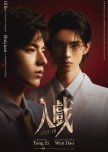
I guess let's start with "Deep In", because this is ultimately the story we came here for. Interestingly enough, if you look at the poster, you'll notice that it resembles the poster for "Into The Role", almost as if the production itself couldn't quite decide which direction it wanted to take. Setting aside the fictional drama being acted out within the series, "Deep In" is actually alright. We get to explore parts of Zhen Xin and Zhang Zhun's relationship and see how their story gradually unfolds. However, because we're constantly jumping between two different narratives, the overall experience feels rather fragmented and, at times, difficult to follow. Perhaps that was intentional. Maybe the production wanted us to experience the same psychological disorientation as the actors themselves, showing how deeply they became immersed in their respective roles to the point where the boundaries between reality and fiction started to disappear. And, honestly, there were moments when even we, as the audience, struggled to distinguish between the two.
Now, let's talk about "Into The Role", the fictional drama starring Zhen Xin and Zhang Zhun as Fang Chi and Gao Zhun, respectively. I have to say that I genuinely did not enjoy this storyline. Not only was it disturbing on several levels, but I also found its overwhelming presence in the overall series rather unnecessary.
First of all, the storyline itself was an absolute mess. We're dealing with a narrative filled with trauma, manipulation, and questionable behavior, including a therapist who desperately needs to have his license revoked. Because what exactly do you mean this man recreated an SA scene with the person he's supposedly in love with under the justification that it would help him heal from his trauma and replace the original memory? Even if Gao Zhun was the one who initially requested it, this was clearly someone who was deeply traumatized, emotionally vulnerable, and in no position to be subjected to something like that. Instead of approaching his trauma with the appropriate care and professional boundaries, Fang Chi repeatedly crossed lines that should never have been crossed. It honestly felt more manipulative than therapeutic, which made it increasingly difficult for me to tolerate this storyline.
And let's not even get started on the questions Fang Chi would ask Gao Zhun regarding his SA. He would ask him incredibly inappropriate and invasive questions about whether he experienced pleasure, if he came during it, if the r@p*st used protection and if he also came, how the perpetrator did certain things, and so on. I genuinely had to pause for a moment because WHAT??? At some point, I audibly said, "WHAT?" because what on earth was this series trying to accomplish? I understand that the storyline was attempting to explore trauma and the psychological complexities surrounding it, but the execution was extremely questionable. There is a difference between portraying uncomfortable subject matter and presenting deeply inappropriate behavior without handling it with the necessary care.
God, I genuinely don't know how to organize all my thoughts about this series. There's quite a bit I want to discuss, but it's difficult to put everything into words when the storytelling itself is so convoluted.
Moving on, I will say that the chemistry was good in both stories, surprisingly enough. The acting was also solid across both narratives, although I found the performances in "Deep In" considerably more natural and convincing than those in "Into The Role". The characters were also much more tolerable in the actual storyline, because why was practically everyone in "Into The Role" a walking black flag??? The music was decent as well, and there were a few moments when I genuinely enjoyed it.
Overall, though, I think the series struggled with its own concept. I understand what the production was attempting to achieve, and I wouldn't necessarily call the execution terrible, but I also wouldn't call it particularly successful. Had I not noticed the visual differences between the two narratives, I probably would've been completely lost. Whenever the characters were playing Fang Chi and Gao Zhun, the screen would become noticeably narrower, and there would occasionally be a beeping sound when transitioning into or out of those scenes. These little details were honestly essential in helping me understand which storyline I was watching.
A few things to keep in mind before watching, because I would've appreciated someone explaining this to me:
- Ollie plays Zhen Xin in "Deep In", while Zhen Xin plays Fang Chi, the therapist, in "Into The Role".
- Shu Yuan plays Zhang Zhun in "Deep In", while Zhang Zhun plays Gao Zhun, the therapist's patient, in "Into The Role".
- Yao Wang plays Wu Rong in "Deep In", while Wu Rong plays Zou Yun, the security/ r@p*st, in "Into The Role".
- Li Mei plays Qin Xun Er in "Deep In", while Qin Xun Er plays Zuo Lin Lin, Gao Zhun's wife, in "Into The Role".
- Pay attention to the screen ratio. Whenever you're watching the therapist-and-patient storyline ("Into The Role"), the screen becomes narrower. When it returns to the actual storyline ("Deep In"), the screen widens again.
- MAKE SURE YOU WATCH AFTER THE ENDING CREDITS OF EACH EPISODE! There are additional scenes, usually around one or two minutes long. They don't necessarily contribute anything groundbreaking to the plot, but they occasionally provide extra context and details that are worth watching, mostly on the last episode it really just tied the bow on this confusing series overall.
Another thing I want to mention is how the whole drama-within-a-drama concept affected my ability to connect with the actual story. Whenever the series returned to the so-called reality of "Deep In", I sometimes found myself becoming more aware of the acting rather than feeling completely immersed in the narrative. I think this is something that can happen with stories centered around actors playing fictional roles, because you're constantly reminded that you're watching people portray characters who are themselves portraying other characters. It creates an additional layer of separation between the audience and the story, and unfortunately, I experienced that quite a bit here. Rather than becoming fully absorbed in "Deep In", I occasionally found myself thinking about the production and the performances themselves. As a result, I felt somewhat disconnected from the overall experience.
But yeah, despite all of that, I wouldn't call this a bad series. It was watchable, enjoyable in certain moments, and certainly had an interesting concept. However, the execution was messy, the constant switching between realities made the storytelling unnecessarily difficult to follow, and dedicating such a substantial portion of the series to an entirely separate fictional drama ultimately took away from the development of the actual story.
Anyway, from a more objective standpoint, I could probably justify giving this series an 8/10. However, speaking strictly from my personal experience and enjoyment, I'd settle on a 7.5/10. I would still recommend it to anyone who enjoys more complex, psychologically driven narratives that require a little extra attention to follow. Just be prepared for a bit of a psychological brain fuck.
PS: I absolutely LOVED the last couple of minutes of the final episode, when Chen Zheng Sen and Qin Yao kissed in front of Qin Xun Er, and she just stood there like, "WHAT IS THIS WORLD?" LMAOOO. That genuinely made me laugh. Easily one of my favorite moments.
Another PS: I actually went back and rewatched the ending of the previous episode after seeing someone's comment, and I can't believe I didn't pick up on the details the first time around. I completely overlooked the names being mentioned and the fact that Zhen Xin/Fang Chi was wearing his glasses, which was an indication that we were actually seeing Fang Chi. Now that I've connected those details, I finally understand what that scene was trying to tell us. And honestly, this makes the whole narrative even more complicated than I initially thought. We're dealing with a story within a story within a story, and this makes me realize this is a story you watch a million times to fully understand.
One thing I genuinely have to give this series credit for is how cleverly it plays with the concept of fiction and reality. For the majority of the story, we're convinced that Zhen Xin and Zhang Zhun are our protagonists, and that we're following two actors who gradually develop feelings for one another while filming a BL movie. But as it turns out, we've been looking at the story from the wrong perspective this entire time.
The actual starting point is Fang Chi and Gao Zhun. Their relationship is the foundation of the movie being filmed by Zhen Xin and Zhang Zhun, an adaptation of their own love story that was brought to life through the involvement of their friends. In other words, what we initially perceive as the main storyline is actually a fictional recreation of someone else's reality.
But the series doesn't stop there. The final scenes take this concept several steps further. The couple appearing during the ending credits are the real Fang Chi and Gao Zhun, and the book Fang Chi is reading is none other than the story of Zhen Xin and Zhang Zhun. Think about the implications of that for a second. A real-life relationship inspires a film, the actors involved in that film develop a genuine relationship of their own, and their experience subsequently becomes a novel that is read by the original couple who inspired the entire chain of events.
It's such an interesting narrative structure because the story essentially circles back to its own beginning. Fang Chi and Gao Zhun become the inspiration for Zhen Xin and Zhang Zhun, but eventually, the latter's story becomes something that exists within Fang Chi and Gao Zhun's world. Each relationship influences the existence of the other, creating this fascinating overlap between two seemingly separate realities.
And just when I thought I had wrapped my head around it, I came across people mentioning that the novel apparently contains four additional chapters where all the characters meet. Which raises approximately a thousand more questions because HOW DOES THAT EVEN WORK??? I might need someone to sit me down and draw a diagram because clearly, I haven't reached the bottom of this rabbit hole.
And to finally wrap up this review (because at this rate, I'm going to keep coming back every five minutes after discovering yet another detail lol), my overall rating and opinion of the series remain unchanged. I don't think the complexity of its narrative necessarily makes it a bad series, in fact, I can appreciate the ambition behind a plot that requires viewers to piece together multiple layers of storytelling and reconsider what they've been watching. However, I also think that level of complexity won't appeal to everyone, particularly those who aren't interested in having to constantly dissect and reinterpret the narrative to fully understand it.
I found the concept much more interesting after discovering all these additional details, and I can certainly appreciate what the series was trying to accomplish. However, that doesn't change the fact that I didn't particularly enjoy the viewing experience for most of its runtime. I felt like I had to do a little too much digging outside of simply watching and following the story, and that ultimately took away from my enjoyment. That's not necessarily a flaw in the series, but rather a matter of personal preference. I can appreciate what it did without necessarily enjoying how it was presented. And sometimes, that's just how it is.
Rating: 7.5/10
Was this review helpful to you?
A rebel who is also a closet conformist
For @Love moviesThe rigid Korean patriarchal system is a drama trope in and of itself. Our FL's clan takes this to the next level. Instead of the usual annual memorial service as seen in many k-dramas, this clan holds two dozen per year! All the men dress in traditional attire, and the clan lines up to offer supplication. Needless to say, the grandfather rules the family with an iron fist. It is like a slice of Joseon planted in suburban Seoul.
I know the writer-nim did this deliberately. One of the key themes is the clash of cultures. This includes the definitions of love, marriage, sex, and woman's roles. I assume this boat is going to be thoroughly rocked! In the end, I was only half right, and I am not unhappy about it.
I know that last sentence is confusing and I do apologise. Please allow me to explain.
To put it simply, this show has two distinct phases. The first half is all about airing the dirty laundry of modern Korea. This includes exam fever, familial obligations, the roles of women and the old crowd favourite: love, sex, and marriage. It is packed to the rafters with issues du jour.
The pot is well and truly stirred as the drama is set in a company specialising in adult toys and marital aids. Many quality products are on display. This is a brave decision when you consider how conservative some segments of the Korean society can be.
If I'm honest, the writer-nim tries a little too hard in the early episodes. There are scenes where characters literally air grievances and debate the pros and cons across a table. It can feels like a government sponsored panel discussion.
While the talkfests don't offer many concrete solutions, our diverse cast provides some insights through their personal experiences.
I still chuckle when I recall the scene where one of the FL's coworkers gave advice regarding condoms to a high schooler only to find out he is her daughter's boyfriend! It was delicious.
The table is turned mid show though. The tone of the drama became a lot more mellow and respectful. Swoonworthy scenes replaced combative ones.
Multiple romances vie for our attention. The FL's and her BFF's are cute. The one centred on the FL's brother is angsty and conventional. The two young actors are the weaker link in the ensemble. The senior actors provide a lot of light comedy which greased the plot wheel. The pacing is good and steady.
Normally, I would rail against such drastic tonal shift. However, the romance of our leads is so sweet and innocent I'm willing to give them a hall pass.
As this is not some indie production aiming to burn the establishment down, the need to toe the line eventually won. In that sense, the show is not about storming the barricades, but rather a polite petition for changes. With respect, of course.
The world is changing, just not all at once. This is a reflection of modern Korea. Millions of people caught between the rock of traditions and the unyielding modernity. Peace.
Was this review helpful to you?
This review may contain spoilers
THIS MOVIE IS A MASTERPIECE!
I love everything about this movie and how it took a dark tragic turn. Imagine you spent your life building your future with your partner just for them to die in an accident. Like that is sooo tragic but I love it. Not only that but he thought to love again but his second partner died again in an accident. It makes him think that will all my future partners die? like this movie is just chef kiss. The acting is super good 😊👍 Engfa's acting gave me chills I felt the character's emotions. Jeff is sooo goood as well as Keng and Toey. I really like how the actors you see here you can see in different series like Khemjira and Nour really good 😭❤️Was this review helpful to you?


