This review may contain spoilers
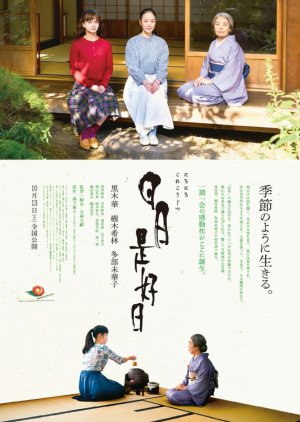
Basically, Every Day A Good Day is about finding the fire which ignites the spark within consequently giving life meaning. Noriko, the main female character, always fondly mentions La Strada, one of Federico Fellini's most celebrated films and it's not difficult to figure out why. Just as the character/s in the aforesaid award-winning Italian film, she likewise sees herself as a drifter searching for a real purpose in life. Attending a Japanese tea ceremony on a singular occasion as a guest is perhaps one of the most wonderful things I've ever experienced. I hope to experience it once more, and I hope you'll get to experience it as well. In the initial scenes, we witness Mrs. Takeda, the tea sensei, admonishing Noriko (and Michiko) for analysing every step in the Way of Tea. This is because analysis runs contrary to the precepts of Zen Buddhism which holds primacy over the path of action in conjunction with meditation in performing a task or learning a skill because only in this way can harmony with nature and innate tranquilitea be achieved.
''In the practice of tea, a sanctuary is created where one can take solace in the tranquility of spirit.''
I highly recommend a book called Chado (The Japanese Way of Tea) most esp. if you're an enthusiast of tea and/or if you're on the path towards serenity.
Was this review helpful to you?

This review may contain spoilers
Beginner’s Guide to Japanese Tea Ceremony (aka The Omotesenke way of tea)
This was not a movie with much of a plot or things happening, except for one major incidence near the end. Still, one did not watch this movie for such mundane things as a storyline.The moments leading up to, and scenes of the practice of preparing a bowl of tea (Matcha, in this context) were the sum and whole of the story.
A story about a young woman adrift in the world, looking for her purpose in life.
This movie was not about her finding her meaning in life, but about how her constant companion, the practice of Sado, gave her important lessons about living life, in the moment, one whisk of tea at a time,
True to its title, it was a visual meditation on some Zen Buddhist philosophy as practiced within the framework of Sado ( 茶道, Way of Tea Ceremony), specifically the practice founded by Sen Rikyu a few hundred years ago. This movie perhaps more accurately depicted the teachings, style and aesthetics of the Omotesenke School (as evidenced by the wooden plaque at the gate of the Sensei’s house).
If one is a tea and pottery - or the Wabi Sabi aesthetic - enthusiast, this movie will be a feast for the eyes, heart and mind. Each frame and scene was beautifully captured to immerse one in the rusticity and simplicity of the Sado and Wabi aesthetics of a tea room. And through the glass bottom half of the sliding door, one was ensured arresting glimpses of an exquisite Japanese garden which emphasized the flow of, and the beauty of the changing seasons.
(I was also gawking at the beauty of the tea utensils throughout).
A comforting, slow and wonderfully calming movie with lovely performances.
If one is in the right frame of mind to be imparted some nuggets of wisdom about how to make “everyday a good day”, this would be a good movie.
Was this review helpful to you?

Some things are quickly understood and some things take time
I was surprised by how much I liked this film. Usually, films like this one, films that get very philosophical and don't have much plot in favour of thinking about life, quickly tip over into "too much" for me. Either they are too preachy (like "The Zen Diary") or pretentious (like "Glasses") or too artificial (like "Bread of Happiness").But for some reason, "Every Day a Good Day" managed to keep to the side of thought-provoking while not getting to obnoxious about it. I can only guess why that is. It might very well be because a large part of the first half takes the time to just show the Tea Ceremony in detail -- the way it is filmed and the way the teacher comments on the details, feels much more like a documentary than a fictional story.
Added to that, the way of the tea ceremony is carefully balanced with Noriko's life -- and what an ordinary life it is! There's nothing special about her, she's struggling to find a job, she's clumsy and very mediocre both in real life and in learning the ceremony, she despairs when a young girl learns much quicker than her. Not only did she stay simply human throughout -- she does it not in the pretentious "Look at how humble I am", but in the much more relatable way of "I am not good at the things I do, but I have to try to find the good things in life, even if it's hard". Her teacher is the same, and I love her last sentence in the film (which is the second-to-last overall):
"By teaching, we are taught."
Noriko's life also echoes much of my own experience through adulthood, and when the film ends, she is about the same age as me now, give or take a few years. And I feel that the both of us look back at our life (so far) in a similar fashion -- only that she is, of course, doing it in a much more concise way, since the author surely refined her own thoughts into the essence of her life when she wrote her book.
One aspect I really loved was how the seasons were an integral part of the narrative. The crew took the time to film throughout the year -- they connected the meditative aspect of tea making with the surrounding sounds and sights of nature, and thus they managed to show us viewers how much we stand to gain from paying attention to what is around us:
"On a rainy day, listen to the rain. Savour the moment with all five senses, with your whole body. On a snowy day, look at the snow. In summer, feel its heat. In the winter, the freezing cold. `Every day a good day` So that's what it means!"
I wonder how much I would have liked the film twenty or even ten years ago? Not much, I guess. Commenters on the JFF website mentioned how much they cried, or that the film was devastating. I did not feel that at all! I felt mildly melancholic, yes, but definitely not devastated. So, I think this is probably one of the films that either speak to the viewer (and everyone would hear something different) or it doesn't speak to them at all.
Was it good?
It was a film with great technical expertise, and marvellous actors. It's obvious how much care went into showing the ceremony and into integrating it with the life of the protagonist.
Did I like it?
Surprisingly, yes.
Would I recommend it?
I have no idea. I think this is one of the films where every viewer gets something else out of it -- or not. Those who need plot and exciting things to happen, or even a neat ending, might want to stay away.
"Some things are quickly understood and some things take time. The things easily understood need only be gone through once. But those other things you come to understand only with time, little by little."
Was this review helpful to you?

I do appreciate it when a film does not rely on emotional manipulation techniques to transmit a heartfelt stimulation. The emotions provoked are more genuine and authentic, rather than forced and assaulting. I do despise it when a film forces a melodrama only for the sake of breaking a heart, without having your soul or innermost being be moved.
This film is like the former for me. It didn't break neither moved my heart, but it really spoke to me: quiet, delicate, but so profound. This was a walking still life: food, nature, almost rugged, yet, so mellow. You might shed a tear or two not because you felt emotional nor understood, but because you can somehow learn a simple thing about life. It is not about being understood, but acquiring some understanding that evokes the greatest humanity inside of us.
Instead of the film displaying a hyperbole of feelings, the rhythm of rain weighed heavier as it climaxed. The wraiths of wisdom wrung by the waterfall—don't read the characters (letters); see them as pictures. The rottenness and fruitfulness of her romances were portrayed rather vaguely. We have never seen the facade of her lovers neither the redness of a relationship, but we have witnessed the unaffected train leaving her in her sombre solitude; the heat of the sun callously flooding her room in the depth of her depression; and the warmth of the sun finally embracing the entirety of her cheek as she walked with her newfound love.
Science says that water possesses negative ions that enhance mental and emotional health. Even spiritual notions hold water as a vital healing matter. As such, we could see from the film how water affected the characters, especially Noriko. She always found herself in the sea, the river stream, or even drinking from a sōzu (water fountain) during the toughest times of her life. As if the flowing waters spoke for her when she could not find the words or exact expression to expound what she thinks or feels.
The epilogue scene was New Year's day. In spite of the numerous times that the winter season was shown or talked about in the film, this is the only time that falling and covered snow was in sight. There was only rain and sunshine before, but now she has snow. As the new year changed, the old seasons withered away and Noriko has changed as well, except for one thing, she still goes to Tea every Saturday.
Noriko was portrayed to be slow and almost overly analytical. Perhaps, inside her mind was where her real world was. Though, learning about tea has changed her as a person; and now each time she could not find life, going to the teahouse gave her renewal and refreshment.
"By teaching, you are taught."
"Perhaps, my real beginning comes now."
Was this review helpful to you?