1
1 1
1This review may contain spoilers
poise & pain
I felt like I was being suffocated right alongside Saori because she is just a walking, open wound for two hours. Satomii just let herself be ugly and it felt so painfully real. She is frantic and aggressive and looks like she hasn't brushed her hair since Miu vanished. I didn't see a single shred of poise left in her. I saw a woman being eaten alive by the fact that she was at a concert when her kid went missing and the internet will not let her forget it for a second. Watching her scroll through comments from trolls who decided she deserves this pain was devastating. I could feel every ounce of her self loathing."If I don't read them, it is like she has already been forgotten. This is the only place people are still talking about her."
I think she feels so dangerously authentic because Satomii doesn't try to make her grief look cinematic or poetic. It is just heavy and exhausted and mean. I felt the weight of her emotions in the way she breathes and the way her voice cracks when she is screaming at people who are just trying to help. She made me feel that desperation as if it was my own life falling apart. The media in this was actually nauseating for me to watch because of how they egg her on when she is at her lowest point. I can't get that scene out of my head where she actually proposes holding a birthday party for Miu and the news crew just leans into it because they know it will make for a pathetic sensational shot. I could see Yutaka absolutely hating the idea but he is so drained that he just stands there while they light the candles.
"I feel like I'm already dead. I'm just moving because I have to find her."
It broke my heart to see her so desperate to keep her daughter's face on TV that she starts performing her own grief for the cameras just to keep the search from dying out. I felt like Yutaka trying to be the stoic anchor just felt like abandonment to her and I watched their house become a pressure cooker where they just end up lashing out at each other in the dark. The brother Keigo is obviously another part that really got to me. He was the last person seen with the girl and because he is socially awkward he becomes a target. Seeing Saori turn her rage on him because she needs someone to blame and I think it shows how a tragedy like this just fractures a family until there is nothing left.
I was completely captivated by the way Satomii inhabits this specific, haunting brand of misery. I saw her standing in that yellow crossing guard vest at the end and it just gutted me. There is no magic resolution. She is just there in the street protecting other people's kids while hers is still gone. It is a quiet and miserable kind of strength. I felt like she was forcing me to sit in the wreckage with her until the very last frame.
Was this review helpful to you?

This review may contain spoilers
This is a miserable movie, and it will make you miserable.
Superior acting from the leads Ishihara Satomi, and Aoki Munetaka. It is no exaggeration that Ishihara spends about half the screen time crying or breaking down in tears. I can't imagine what it took to be that emotionally exhausted for the filming period. I can't imagine what it would be like to have your child go missing, but I imagine it leaves you searching for your sanity in a way that closely resembles what Ishihara portrays in her role as the mother.There is very little, if any, levity to be had in this movie. Despair grows and continues throughout the movie and I found myself being emotionally taxed by the end of it. It's just setback after setback for the couple who are trying desperately to cling to any shred of hope that might come their way. It just always ends in more despair.
There is no happy ending here and the movie wraps up with no conclusion, a reflection of reality when a child goes missing.
(I'd love to just be able to ignore the rewatch value metric here. I don't think this is a movie you would want to watch more than once because it's A LOT, but giving it a low score also feels unfair).
Was this review helpful to you?

This review may contain spoilers
Contains Spoilers
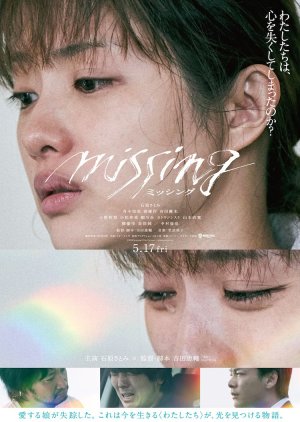
Missing is a Japanese film about a six-year-old girl, Miu, who disappears while walking back home. What makes this movie stand out immediately is where it chooses to begin. Instead of focusing on the kidnapping itself, the story starts three months after Miu has already gone missing. By then, the shock has settled, routines have returned, and the tragedy has become something the family is forced to live with every day.
The film gives us a perspective we don’t often see in kidnapping stories. Rather than dramatizing the moment of loss, it throws us into the quiet aftermathwhen the case is no longer breaking news, when hope and despair coexist, and when grief becomes almost chronic. Life continues for the world, but not for the people directly involved.
We are shown multiple perspectives, and they depict human emotions in an incredibly honest and uncomfortable way.
Miu’s mother, Saori, is portrayed as emotionally unstable and deeply desperate to find her child. She is consumed by guilt for letting Miu walk home alone that day so she could attend a concert by her favorite boy band. That guilt follows her everywhere, amplified by cruel and malicious online comments that constantly remind her of her “mistake.”
Saori is a fascinating and painful character to watch. She moves through layers of emotiondesperation, hope, anger, resentment, guiltand sometimes she appears almost “crazy.” But the film makes it clear that this is not madness; it’s grief in its rawest form. She struggles to understand why others, especially her husband, don’t grieve the way she does. She is willing to do anything, push anyone, endure anything for Miu’s sake, and she can’t accept that others cope differently. At the same time, there’s a part of her that wants someone especially her husband to blame her, because blame might give her something solid to hold onto. She never rests. Every second is torture. Through Saori, the film shows us the overwhelming and conflicting emotions a mother lives with in a situation like this.
Miu's father, Yutaka, is a more passive figure, contrasting with Saori's frantic efforts on behalf of Miu. He struggles to express his desperation, illustrating another aspect of grief that the film aims to convey the internal suffering that can be difficult to articulate, rather than outward expressions like shouting or crying.
Alongside the parents, we follow Sunada, the reporter covering the case. He faces pressure from the TV network to sensationalize the story, to “add spice,” but with no leads and no progress, there is very little he can do. Sunada wants to believe he has integrity, that he is showing reality rather than chasing ratings. Yet he is also fighting an internal battle—watching younger colleagues rise in their careers by bending the truth, while he remains stuck.
What makes his character compelling is that the movie doesn’t paint him as purely right or wrong. While he claims he wants to help the family, we slowly realize that part of him is also trying to help himself. He pushes the parents at times, crossing emotional boundaries, and eventually he is forced to confront the uncomfortable truth that maybe he was lying to himself about his intentions all along.
The story also introduces a possible suspect: Keigo, Miu’s uncle and Saori’s brother, who was the last person to see Miu and allowed her to walk home alone. Everything initially points toward him, making him one of the most intriguing characters in the film. Layer by layer, however, the movie reveals the truth about him, challenging our assumptions and showing how easily suspicion can destroy a person.
Beyond its characters, Missing makes a powerful statement about society. These cases may capture public attention for a while, but eventually they fade away. People move on. The news cycle moves on. But the parents don’t. They remain trapped in a nightmare that never ends. From the outside, it can even start to look unreasonable that they “can’t move on” and if we’re honest, most of us have been guilty of thinking this way when we’re not directly involved. The movie forces us to confront that uncomfortable reality: the gap between public reaction and a parent’s lived experience.
As the film progresses, we see how support slowly disappears. The people who were once actively helping begin to fade away, leaving the parents increasingly alone.
It’s a deeply emotional and heavy movie. The ending wasn’t what I wanted, but maybe it was what we needed. Not all stories end with answers. Not all pain is resolved. Some losses don’t end you simply learn how to live with them. And that lingering feeling is exactly what Missing leaves you with.
Was this review helpful to you?







![[PTW] JAPAN list](https://i.mydramalist.com/MRjRMt.jpg)
![[PTW] JAPAN list](https://i.mydramalist.com/ZbzAW_4t.jpg)
![[PTW] JAPAN list](https://i.mydramalist.com/MB16Gt.jpg)
![[PTW] JAPAN list](https://i.mydramalist.com/Bdlk6t.jpg)
![[PTW] JAPAN list](https://i.mydramalist.com/eeoOp_4t.jpg)