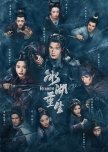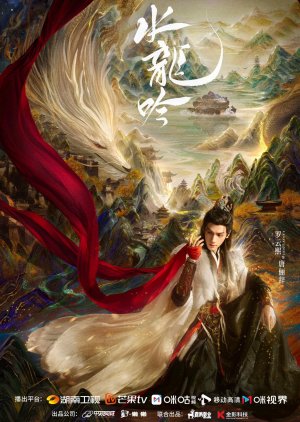
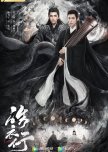
The morally inscrutable Tang Li Ci is framed by a former friend and is forced to enter Jianghu to clear his name. During his journey across the lands, his initial detachment softens as he is gradually influenced by the community's profound code of chivalry and courageous spirit. As this transformation occurs, he uncovers a sinister plot: under the manipulation of the House of Pleasure, the entire martial arts community faces extermination. Tang Li Ci realizes he must not only shoulder the fate of the world but also confront his true identity and purpose, leading him to finally face his destiny. (Source: Wikipedia) ~~ Adapted from the novel "Enduring a Thousand Tribulations" (千劫眉) by Teng Ping (藤萍). Edit Translation
- English
- 中文(简体)
- Русский
- Українська
- Native Title: 水龙吟
- Also Known As: Qian Jie Mei , Shui Long Yin , The Dragon Chant , Water Dragon's Chant , 千劫眉 , 水龍吟
- Director: Chen Zhou Fei, Qian Jing Wu
- Genres: Mystery, Wuxia, Fantasy
Where to Watch Whispers of Fate







Cast & Credits
-
 Luo Yun XiTang Li CiMain Role
 -
 Xiao Shun YaoShen Lang HunMain Role
 -
 Ao Zi YiChi YunMain Role
 -
 Alen FangLiu YanMain Role
 -
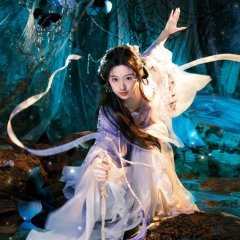
 Bao Shang EnZhong Chun Ji / Princess LangyaMain Role
 -
 Sebrina ChenXi Fang TaoMain Role






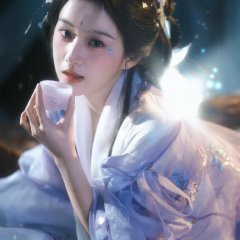
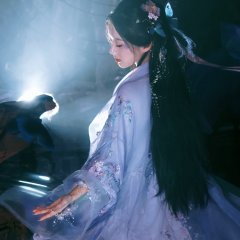
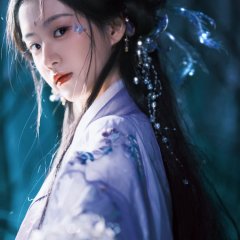
Reviews

 1
1A very Chinese-flavour drama with eastern phylosophical ideas
WARNING: MAJOR SPOILERS -This post is part of a trilogy where I analyse only the cultural and historical artistic aspects, as well as two Eastern philosophical perspectives with strong presence in the drama, without tackling other elements such as wuxia themes, Confucianism, sci-fi inspiration, and so on. The links to the complete three-acts review with images are in the comments.
By accident when adding this part, I erased the previous review :
NOTE: Although the story is remarkable, the execution and direction has flaws that impact the overall result, so the final score is a balance between the outstanding aspects of the drama rarely seen in any kind of drama or serie (that gives the extra points to reach the 8) with its flaws. Luo Yun Xi and Jeremy Tsu - outstanding.acting
-------------
As we enter this THIRD and last ACT about Buddhism, the framework that gives structure to the whole story, it felt fitting to bring the classical theatre resource where a character steps in at the beginning to set the scene and offer context. Honouring that tradition, I’ll quote the answer that Mo’at gives to Jake Sully in the movie Avatar when he asks the Na’vi people to teach him their worldview and wisdom: “It is hard to fill a cup that is already full.”
This phrase didn’t just pop into my mind by chance. Buddhism is a philosophy and religion completely different from Western conceptions and beliefs, and since it sits at the heart of Shui Long Yin’s narrative, I tried my best to do justice to its principles. Although I kept things as concise as I could, this time you’ll need to be extra forgiving with me.
As actor Luo Yun Xi said himself (see ACT 2), Tang Li Ci seeks enlightenment. Let’s embark together on that search and see whether he attained what he was looking for, or if , at the very least, the journey was worthy.
Buddhism, the general framework
“All things are impermanent; they arise and they pass away.”
While Daoism is about finding harmony with the Dao, Buddhism is a path of understanding meant to transcend this world and the suffering inherent in it. It originated in India around the 5th century BC with Siddhartha Gautama who, after attaining enlightenment, became known as Buddha, or “the awakened one.”
The foundation rests on the Four Noble Truths:
1) Life contains suffering
2) Suffering has a cause (craving and attachment)
3) There is an end to suffering (nirvana and enlightment)
4) There is a path to end suffering
(NOTE 1 - Masters Puzhu and Fang Zhou // Although there is one “internal” path to end suffering, there are two “external” ways to walk that path. Puzhu represents the Buddhist archetype of the hermit who isolates himself from humanity and external distractions to walk the path. Fang Zhou represents the Buddhist archetype of the master who actively involves himself in worldly affairs with compassion.)
The ultimate goal is to wake up from the "dream" of cyclic existence, the Samsara, realising the true nature of reality. This is achieved by understanding and internalising several key principles:
Impermanence: All conditioned things are in a constant state of change.
Karma: The law of cause and effect, where intentional actions shape future experiences.
No-Self : The perception of a fixed, independent "I" is an illusion.
Nirvana: The unconditioned state, the cessation of suffering and the end of the cycle of rebirth, achieved by disolving all harmtful states of minds
So, let´s walk this path through Shui Long Yin together.
Impermanence: life as a dream or the stage of a play // “All phenomena are like dreams” - Heart Sutra
Some of the comments regarding the ending of Shui Long Yin revolve around the idea that everything Tang Li Ci did seems meaningless because no one remembers he existed. Even worse, not only are all the bad omens now living good lives, but TLC has never even existed. Was the whole drama, and all the time and emotions invested by viewers, pointless?
In the drama, Tang Li Ci voices a similar distressed question during his dream coma, and Fang Zhou’s answer guides not only him, but us, along the Buddhist path...and might add, the drama.
(NOTE 2 - Zhoudi Tower // In the dream, Tang Li Ci is disheartened and defeated because Yique YingYang is already back after ten years, and he feels that all the deaths and efforts back then were meaningless. Fang Zhou, a Buddhist teacher answers: “Even if YQYY is alive, are all the people who were able to live and enjoy life during those ten years not worthy of that?” … “In this world, not a second of effort is wasted.”)
By this point, we already know there are three stories: the original timeline, where Ye Mo kills Tang Li Ci only to realise that without emotions the Holy Son isn’t perfect and can’t achieve immortality; the second timeline, the one the drama actually follows; and the third one, the new life we glimpse at the end, where Tang Li Ci is no longer explicitly present nor ever existed.
So? Which one is real? The first one we never saw? The second one we grew attached to? The final one we only catch a glimpse of? Buddhism states that just as our dream experiences are mere appearances of the mind, so too are beings, their environments, their pleasures, and all other phenomena. The strong theatre-stage effect of the drama (ACT 1) seems to work like a visual metaphor of this.
(NOTE 3 - Tang Li Ci’s dream in Zhoudi Tower // From a Buddhist perspective, this dream and Tang Li Ci’s confusion about what was real bring up the topic of phenomena as mere appearances of the mind.
This doesn’t mean those phenomena don’t exist; it means they don’t exist on their own, only in relation to the mind. We believe the only “real” timeline in the drama is the one we just experienced because we formed a connection with it. The others feel unreal because we didn’t immerse ourselves in them, even though, at the back of our mind, we understand they existed too - but only from the moment we are introduced to them, not before.
We can see this idea represented in different moments and ways throughout the drama, through both cinematic and narrative resources: the contrast between chaos and fighting versus the calm, quiet tea scene in the Buddhist temple at the beginning; the reality in which Liu Yan lived all those years, where Tang Li Ci is a murderer and the most despicable being, versus Chi Yun believing the marks of Yique YingYang are beautiful and enhance Tang Li Ci’s attractiveness.
(NOTE 4 - All phenomena are like dreams // The quiet calm of a tea ritual and a baby sleeping at a lakeshore versus the chaos and action-packed fighting in the temple’s front yard.)
(NOTE 5 - Matrix (1999) – iconic sci-fi movie directed by the Wachowski sisters // The best way to explain it is this movie
2. Karma, suffering, and samsara: Even things aren´t “real”, we still suffer...Why? How? // “If you know your own mind and develop it, you will become a Buddha; do not seek Buddhahood outside yourself”
Every sentient being wants to be happy and avoid suffering. We tend to think that the causes of happiness or pain are external, but Buddhism states they actually lie within our own mind.
The mind isn’t a material object or a by-product of physical processes; it’s an immaterial and continuous entity, different from the body. Every action we take leaves an imprint or potential on our very subtle mind, and in time, its corresponding effect will arise. Virtuous actions bring happiness; harmful actions bring suffering. This is the law of karma, and it affects all lives, constantly.
At the beginning of Whispers of Fate, Tang Li Ci already has a partial understanding of these ideas taught by his master, Fang Zhou, and he reflects with the monk on intention and karma. When he decides to enter the jianghu, he is, without realising it, following Fang Zhou’s path to end suffering through the worldly-affairs way. At that point, his obsession and his merely intellectual grasp of these concepts and teachings prevent him from truly embracing them, as he still doesn’t fully understand what that way means or how it works.
(NOTE 6 - Tang Li Ci speaking with the Buddhist monk about intention, karma, and suffering. By entering the jianghu, he will come to learn and understand human emotions (hate, fear, love, obsession) and the deeper meaning of things, just as Fang Zhou told him many times.)
So, the world itself is the result of karma — the actions of the sentient beings who live in it. A pure world is the result of pure actions, and an impure world is the result of impure actions. Since all actions are created by the mind, all things, including the world, are created by the mind as well.
(NOTE 7 - Impermanence, karma, samsara // Every relationship and every character is shaped by karma and samsara. Hatred turns someone into an inherently bad person; attachment turns an object into something inherently pleasant and capable of making them truly happy. All mental afflictions work like this: they color reality with their own bias, and we end up responding not to what things truly are, but to the distorted version of them.)
While the body disappears at death, the mind - now called the very subtle mind, and without the memories of that life - continues to exist. Depending on the karma that grows, we reincarnate into a fortunate form (human or god) or an unfortunate one. We can’t choose; karma rules. This uninterrupted cycle of death and rebirth, without any freedom to choose, is called samsara.
3. The Path to Liberation from Suffering, and Enlightenment // “Samsara is like a wheel that turns through the force of contaminated actions performed by mental afflictions”
Mental afflictions such as attachment, hate, malice, jealousy, greed, and delusion are to the mind like clouds to the sky: bad habits that can be eradicated because they are not the sky itself. They are distorted perceptions that cling to things as if they had inherent or independent existence.
In the drama, this idea of clarity as the true nature of the mind is highlighted by Fang Zhou’s teaching: “Every person is born good” — which is also shared by Confucianism, by the way.
The strongest ignorance is the intuitive feeling that we possess a real and objective self that exists independently of other phenomena or things: the ignorance of self-grasping. Because we esteem ourselves so intensely, we feel attracted to objects and people that seem appealing, we desire to separate from those we dislike, and we feel indifference toward the rest. Therefore, attachment, hatred, and indifference arise. I’m sure you’ve already pictured countless examples from the drama while reading this.
Attention should focus on creating mental states that bring real happiness (love, patience, generosity) and also on letting go of mental afflictions completely by addressing their root: the mind’s tendency to cling to a fixed self. By tackling the causes of suffering within, external ones like illness or death lose their power to disturb us. This lasting freedom from mental afflictions and suffering is what Buddhism calls liberation, or nirvana. In other words, this is the path to truly freeing oneself from suffering.
There’s a sequence in Episode 2 that sums up everything above, so I’ll simply replay the dialogue, presented as a voice-over during the scene when Tang Li Ci is leaving the temple:
Tang Li Ci: “Masters and servants can turn on each other for money; brothers can betray and kill each other. In the end, the heart is the hardest to see through. Demons are everywhere.”
Monk: “Amitabha. Right and wrong, good and evil, they are just a thought apart. What you can’t let go is obsession. You’re very wise. You go through the sea of suffering by yourself. I believe you’ll eventually reach the other shore.”
** Some translation don't address the specific term "sea of suffering" but instead go for "salvation lies in your own hands". Although the essential meaning is the same, the second avoid the específico and direct reference to Buddhism - a bad take in my opinion as it's about Buddhist beliefs.
(NOTE 8) The path to liberation from suffering – The journey and the destination // From attachment to life, to the past, and to Fang Zhou, to loving new people and appreciating the human world and its beings, and ultimately managing to let go.
It’s worth noticing that, despite the different levels of wisdom each character had reached before the time reversal, almost all the villains’ endings carry a note of compassion. You might have thought “finally!”, but there certainly wasn’t a sense of “hate” or “I’ll wish you eons of suffering” left floating in the air.
Liberating only oneself from suffering isn’t the highest aim on the Buddhist path. Beyond wisdom, it’s kindness and love for others that form the true foundation for helping all beings reach the same state. Those who seek enlightenment do so guided by the mind of Bodhichitta: a mind that, moved by deep compassion, naturally wants to awaken in order to help all sentient beings directly.
The Buddhas are those beings that, having completely removed all traces of ignorance from their minds, have freed themselves from the dream of samsara and attained omniscient wisdom, along with the limitless ability to help others.
And with this understanding in mind, I hope you can find more meanings to the ones you´ve already found in Whispers of Fate. As for my part, the analysis of this trilogy has now come to an end.
** Epilogue (closing and ending notes) ** - I´ve link the three parts completed with images in the comments to a better review
Whispers of Fate is a drama about loss, grief, and attachments; but at its core, it’s a story that reflects on and questions what it means to be human from a very Chinese perspective, rooted in China’s history while staying in tune with its present. We see that search in every character, although I want to highlight three.
Nothing in this world is perfect, and neither is this drama. It’s a complex and ambitious project with a distinctive Chinese flavour that can look ordinary and simple on the surface, yet be slow and fast-paced, common and uncommon, all at once. And when we bring in our Western viewpoint, shaped by a Judeo-Christian background or even a modern secular mindset, we really do need to empty our cups first.
For me, the beauty of Whispers of Fate lies in its distinctive Chinese aesthetics, but also in the way it blends Eastern philosophies into its storytelling. In a way, the original title “Shui Long Yin” and its literal translation “Water Dragon Chant” is the most fitting, as the whole approach of the drama reminds me of those apparently simple tales and legends through which ancient cultures and societies explained the world, what it means to be human and why we are here.

 1
1 1
1To let go is to embrace
Hello, dear Wispys~ Most of us have finally reached our destination (i.e. the finale of the story), while some are still 'experiencing' the journey together with Tang Li Ci and others. It was a wonderful journey for me, and I hope it was a splendid experience for you as well! (˶ᵔ ᵕ ᵔ˶)💞Loosely adapted from the novel “Enduring a Thousand Tribulations” by Teng Ping, the drama follows its sole main character, named ‘Tang Li Ci’, on his journey to accepting certain truths, letting go of obsessions, and sacrificing for the greater good. The story begins with the lavish wedding of a young woman named A-Shui, who allegedly sold herself to City Lord Hao Wen as his concubine to pay for her father’s funeral. However, the wedding is abruptly halted when a devastating tragedy occurs mid-occasion, at the hands of a single man, as if it were a blessing in disguise for the innocent, young girl. This mysterious assailant reveals himself to be Tang Li Ci, a cruel and cunning cultivator who supposedly gouged out the heart of his saviour, who was essentially family for seven whole years. Being accused of the brutal massacre, the true young master Tang embarks on a journey to clear his name, along with his faithful friend, who is more like a devoted follower, Chi Yun. That is how he meets new people, such as A-Shui, Zhong Chun Ji, and Shen Lang Hun, some of whom later become his newfound family… Our male lead will face several confrontations and betrayals as he steers his life towards an almost impossible goal of resurrecting his deceased senior brother, Fang Zhou, and making things right.
Unlike some historical C-dramas we’ve watched, [Whispers Of Fate] draws on a range of philosophical and religious themes closely connected to Buddhism, such as “letting go of the self” and “embracing emptiness”. Therefore, I would humbly like to interpret my review through the lens of Theravada Buddhism (School of the Elders), exploring certain plot points and identifying how they are interconnected with the concepts of “The Four Noble Truths”, “The Wheel of Life”, and “The Eightfold Path”, which I will provide relevant links below to aid further understanding. (..◜ᴗ◝..)✨
More than ten years before the incident at the Hao residence mentioned above took place, Tang Li Ci (formerly known as Ajibaner Tang Jia) was rescued and taken under the wing of a highly revered martial artist, Fang Zhou, who was the eldest disciple and master of the Zhoudi Tower. Fang Zhou bestowed the name 'Tang Li Ci' upon him with the hope that he would become someone special—someone who doesn’t cling to past grievances. Seven years passed, and the bond of brotherhood between them grew deep—so deep that Tang Li Ci could not accept the fact that Fang Zhou was nearing death due to old injuries sustained during a battle with Yi Que Yin Yang at Tiandu Peak. This obsession led him down a dark path, where he practised an unorthodox technique to transfer his healthy life force to Fang Zhou while absorbing the poison harming his senior brother into his own body. However, this attempt ended in disaster, resulting in Fang Zhou's instant de@th due to Liu Yan’s interruption. Still unable to accept this loss, Tang Li Ci clung to a final desperate hope. He dug out his senior brother’s heart crystal to 'nourish' it within his own body, ensuring that it would continue to beat. As if that weren’t enough, this crafty 'fox' even stole the ice coffin belonging to Wangyu Yuedan’s father, the former leader of 'The Palace of Fallen Jade,' to preserve Fang Zhou’s deceased body inside. (Yes, I know… He’s been a naughty boy, stealing other people’s belongings… (ᵕ—ᴗ—) )
All living beings experience suffering, both physical and mental. Tang Li Ci's situation serves as a perfect example of Gautama Buddha's famous quote, "the root of suffering is attachment." This celestial being felt his world crumbling when confronted with the First Noble Truth: suffering or unsatisfactoriness (known as ‘dukkha’). His intense longing and obsession to be with Fang Zhou, who had already passed away, led him to pursue an impossibly dedicated goal of resurrecting his deceased senior brother—this is a clear example of mental suffering.
The Second Noble Truth (‘samudāya’) addresses the origin of dukkha, which is suffering caused by desire and attachment. This suffering arises from craving permanence in an impermanent world. These desires can manifest in wanting to achieve something—such as Tang Li Ci deluding himself into thinking he could bring the deceased Fang Zhou back to life—or in not wanting something, which reflects Tang Li Ci’s unfortunate fate associated with Yi Que Yin Yang. This latter aspect is a significant source of the misfortunes he has encountered.
In episodes 32 and 33, the male lead finally grasped the importance of letting go of his past obsessions, accepting them, and living in harmony with the present. From a Buddhist perspective, these small steps toward understanding one’s cravings and recognising the illusory nature of permanence represent significant progress toward the Third Noble Truth, or 'nirodha,' which means the cessation of suffering. 'Nirodha' signifies the potential to end our suffering and be liberated from the “Wheel of Life” (Bhavacakra). This concept illustrates the Buddhist belief in the cycle of Shengsi (生死), the Chinese transliteration of life and de@th, emphasising the interconnectedness of birth, death, and rebirth, as well as the teachings of karma.
Our male lead is determined to keep everyone by his side and to alter the tragic outcomes he has witnessed—the deaths of many innocent people, including his close friends and acquaintances. It is only when Tang Li Ci comes to understand his own suffering and its origins that he will truly grasp what it means to let go of these desires and embrace emptiness; this is what ‘liberation’ entails. As another quote states, “No one saves us but ourselves. No one can and no one may. We ourselves must walk the path.”
The fourth and final Noble Truth, known as 'magga', explains how individuals can guide themselves to achieve enlightenment by practising "The Eightfold Path". This path consists of right view, right intention, right speech, right action, right livelihood, right effort, right mindfulness, and right concentration. In simple terms, it is a guide that helps us move away from our cravings and towards ultimate freedom. In his final moments, Tang Li Ci reflected on the sincere wish he had made during the Lantern Festival:
“No matter how the world changes as years pass, I hope the people I care about, those who were with me, and friends who fought side by side…, can live peaceful and happy lives.”
When Tang Li Ci focuses on his desires, he becomes ensnared in the Wheel of Life once more, taking on different forms: first as a little white fox, then as a dragon. In the new timeline, he consistently serves as a guardian deity, protecting Shenzhou (神舟), which means Divine Land or Divine Continent, and its remnants. This role has led to the creation of the Legend of the Fox-Dragon. While it can't be said that he has fully achieved enlightenment—since he remains tied to that world by his attachments to friends and those close to him—it can be inferred that this protective Fox-Dragon may have finally grasped the Four Noble Truths before disappearing into the mortal realm. This occurs after he resets the world to a time before the existence of the Tianren realm and Yi Que Yin Yang.
Although time travel does not exist in Buddhism, ancient texts describe countless physical galaxies, solar systems, and worlds similar to ours (**which would be Shenzhou in the drama), collectively referred to as the “Thousand-Fold World System.” With that context in mind, here is my subjective interpretation: What if the Tang-gongzi we knew were reborn as an entirely different being in a world that resembles our own? At some point, he might have regained his memories due to his abundant spiritual powers, allowing him to ‘change the past’ and create a brand-new world filled with happy inhabitants.
And now… CUT! -ˋˏ✄┈┈┈┈ This is getting far-fetched… (๑´>᎑<)~* Let me finally present my humble insights on the drama...
Although the ending of [Whispers of Fate] may not be considered perfectly happy by all viewers, it is a drama that boasts stunning visuals, enchanting music, and a thought-provoking storyline. The production team paid close attention not only to the attractiveness of the main and important supporting characters but also to several minor characters who have only a few minutes of screen time. For instance, this includes the lesser-known members of Feng Liu Dian (House of Pleasures), the two goddesses guarding Ajibaner Tang Jia’s celestial mother during her pregnancy, along with other celestial beings.
One of the most charming aspects that captivated me was the music and the traditional instruments used. I was especially taken by Hong Gu’s arched harp, known as the Zonggaoji (originally called the "Saung-gauk" in Myanmar). This instrument is unique and rare, as it is not commonly seen in historical Chinese dramas. Among all the original soundtracks, my favourite is "春声碎 (Shattered Sounds of Spring)," followed closely by "临风吟 (Ballad to the Breeze)." "Shattered Sounds of Spring" feels like a soulful ode to Tang Li Ci’s longing and false hopes, as well as Liu Yan’s resentment towards him after Fang Zhou’s passing. In contrast, "Ballad to the Breeze" seems to convey that Tang Li Ci has finally come to terms with the truth and has moved past his earlier struggles. Additionally, the wardrobe designs for each character have been thoughtfully chosen not only for their visual impact but also to reflect the rich history of ancient China. Personally, I found Zhong Chun Ji's wardrobe choices less appealing. Unfortunately, her styling came across as somewhat over the top. For instance, her initial hairstyle at her introduction and the purple princess outfit paired with ocean-themed head accessories were particularly striking. (づ˶˃⤙˂˶)
[Whispers of Fate] can be a slow watch, and some viewers might feel that the story drags before reaching certain climactic plotlines. However, as you continue watching, you will find yourself hooked. The drama is undeniably complex, and it would have benefited from more thorough explanations of key events, such as how Ajibaner Tang Jia(Tang Li Ci) was injured and subsequently saved by Fang Zhou, as well as Tang Li Ci’s connections to Yemo and Yi Que Yin Yang. Additionally, the character arcs can be confusing, particularly with A-Shui.
A-Shui had great potential to drive the story forward with her intriguing, mysterious background. She was depicted as a pure-hearted woman who heals those around her with unconditional love and care, without any ulterior motives. However, she came across as a plain, blank sheet of paper left unused on a desk—without intention or purpose. A-Shui was one of the biggest enigmas for both Tang Li Ci and the audience. Unfortunately, her characterisation felt unsatisfactory. It would have been more effective if her relevance and importance had been hinted at in the earlier episodes, rather than being crammed into the later ones.
Despite a few downsides, [Whispers of Fate] is definitely one of the best dramas worth watching. By paying closer attention to the details and themes, we can learn a lot from these characters about their choices and their consequences. The drama offers not only entertainment but also a rich narrative filled with knowledge about ancient Chinese culture, infused with artistic heritage, philosophy, and religious viewpoints.
┈┈┈┈┈┈┈┈┈┈┈┈┈┈┈┈┈┈ . ݁₊ ⊹ . ݁ ⟡ ݁ . ⊹ ₊ ݁. ┈┈┈┈┈┈┈┈┈┈┈┈┈┈┈┈┈┈┈
The following links may help clarify the concepts I used for my review:
The Four Noble Truths-related:
https://www.ebsco.com/research-starters/religion-and-philosophy/four-noble-truths
https://buddhasartofhealing.com/blogs/thangka/dharmachakra-the-wheel-of-law?srsltid=AfmBOorLcTPTx228ED37pwiRx-P8kp8WFuUEg0Ip4NDq-Lu0NHYxWHbu
https://buddho.org/buddhism/#the-truth-of-the-way-that-lead-to-cessation
https://www.worldhistory.org/Four_Noble_Truths/
The Wheel of Life:
https://www.oxfordbibliographies.com/display/document/obo-9780195393521/obo-9780195393521-0072.xml#:~:text=bhava%2Dcakra)%E2%80%94or%2C,concrete%20form%20abstract%20metaphysical%20concepts.
https://www.lionsroar.com/buddhism/wheel-of-life-bhavacakra/
Many-worlds system concept:
https://www.quora.com/Does-Buddhism-support-the-theory-of-parallel-universes
https://www.themindingcentre.org/dharmafarer/wp-content/uploads/2009/12/R450-160524-Parallel-universes-RB150.pdf
Famous Gautam Buddha Quotes:
https://www.vedantu.com/general-knowledge/gautam-buddha-quotes
Recent Discussions
| Title | Replies | Views | Latest Post | |
|---|---|---|---|---|
 | Group Collective Contributions: Details, trivia, insights across 40 episodes of "Whispers of Fate" by Xiang83 | 15 | 0 | Xiang83 Jun 6, 2026 |
 | Zhong Chunji is the Female lead in 'Whispers of Fate' by Azure | 1 | 0 | Azure May 31, 2026 |
| Whispers Of Fate— Worldview/Timelines and other details by Azure | 12 | 0 | Azure May 31, 2026 |
 | Shui Long Yin/Whispers of Fate 3weeks post SVIP FINALE achievements: by kwanto | 11 | 0 | Azure May 3, 2026 |
| Whispers Of Fate— what is the meaning of life? by Azure | 6 | 0 | Xiang83 Mar 15, 2026 |
 | SLY art poster analysis (slight spoilers) by RBF | 8 | 0 |  suzuko Mar 12, 2026 |