










 1
1 4
4







 Reasons To Enjoy Watching Melo Movie
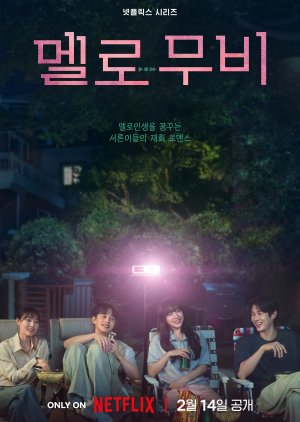
 Kim Mu Bi, an aspiring film director and assistant director, quietly works to follow in her father's footsteps in the film industry. Ko Gyeom, a passionate film critic, aims to watch every movie ever made and becomes intrigued by Mu Bi after meeting her on set. Meanwhile, Hong Si Jun, a self-proclaimed genius but unknown songwriter, still grapples with his past, including his ex-girlfriend, screenwriter Son Ju A. (Source: kisskh) Edit Translation
- English
- 한국어
- ภาษาไทย
- Arabic
- Native Title: 멜로 무비
- Also Known As: Mello Mubi , Melro Mubi
- Director: Oh Choong Hwan
- Screenwriter: Lee Na Eun
- Genres: Romance, Youth, Drama
Where to Watch Melo Movie

Subscription (sub)
Cast & Credits
-
 Choi Woo ShikKo GyeomMain Role
 -
 Park Bo YoungKim Mu BiMain Role
 -
 Lee Jun YoungHong Si JunMain Role
 -
 Jeon So NeeSon Ju AMain Role
 -
 Kim Jae UckKo Jun [Ko Gyeom's older brother]Support Role
 -
 Cha Woo MinWoo Jeong Hu [Mu Bi's childhood friend]Support Role
Reviews

This review may contain spoilers
A HEARTWARMING ODE TO HOPE, LOVE & FILM
TROPES: enemies to lovers, second chance romance, childhood friends to lovers, film industry / behind the scenes, grief and healing, slow burn.Overview:
Melo-Movie follows Ko-gyeom, a man who grew up escaping into film after his older brother would leave him home alone to man their landlord's video rental store, and Kim Moo-bi, a woman who resents cinema and her own name because her director father loved movies more than he loved her. Ko-gyeom becomes a struggling actor turned film critic; Moo-bi becomes a director determined to prove to her late father just how "pathetic" it was to stake his life on his craft. Their paths cross on set, they fall for each other, he mysteriously vanishes without explanation, and five years later fate (and some very convenient next-door neighbor real estate) throws them back together. Around them orbits the tragic, cyclical love story of Ko-gyeom's childhood friends Si-jun and Ju-a, two people who loved each other so completely they lost themselves in the process.
_____________________________________________
In More Detail:
I went into this not expecting to be as moved as I was. I was expecting a cute, low-stakes rom-com and came out having been through an emotional wringer. On paper, "enemies to lovers, film critic x director" sounds like it could easily lean twee or gimmicky, but Melo-Movie earns its sentimentality because it never rushes anything. This is a slow, meandering, character-driven show more than a plot-driven one, and for the most part that patience really pays off.
Likes:
Ko-gyeom and Moo-bi's chemistry felt lived-in rather than performative. I liked that the show didn't manufacture artificial obstacles between them once they actually got together. No cheap love triangle, no third party stirring the pot, no miscommunication trope dragged out for 6 episodes. Their conflict came from something real, which is Ko-gyeom's fear of abandonment (rooted in losing his parents young and being left alone with only movies for company) and Moo-bi's fear of attachment (rooted in her father's emotional absence and eventual death). Watching them slowly "unlock" each other, to use the show's own language, felt earned rather than convenient.
The reveal of why Ko-gyeom disappeared for five years (his brother Ko Jun's accident) was such a gut punch, especially because the show plays the long game with it. Episode 7 in particular wrecked me. The structural choice to show us Ko-gyeom's POV first (piecing together that his brother's "accident" was actually a suicide attempt) before flipping to Ko Jun's own perspective and the letter he left behind was devastating in the best way. The tragic irony of Ko Jun finally finding his will to live, because of Ko-gyeom, right before he dies is the kind of gut-wrenching writing that actually earns its tears instead of manipulating you into them. I was NOT ok after that episode.
I also have to commend how the show handles grief afterward. Episode 8, with Ko-gyeom sleeping in his car because he can't bring himself to walk into an empty house, and Moo-bi quietly showing up to sit with him without demanding he explain himself... that's some of the most mature, understated writing about loss. No sobbing monologues, no dramatic breakdowns necessary. Grief just sits there in the background of everyday scenes, which honestly felt more real than most "big cry" scenes ever could.
Si-jun and Ju-a's storyline might actually be my favorite part of the show. I am so tired of second-lead couples being reduced to filler or comic relief, and Melo-Movie refused to do that. Their history of Ju-a suppressing her own identity and desires because she thought loving Si-jun meant becoming whatever he needed, Si-jun staying frozen in the past while she moved forward, was genuinely one of the more mature examinations of why a relationship can be full of love and still not survive. Their eventual decision to part ways for good instead of getting back together was such a bold and honestly satisfying choice. Not every love story needs a reunion to be meaningful, and I appreciated that the writers trusted us enough to sit with that.
I liked Moo-bi's arc with her father a lot too. The reveal that she used to lie about him being dead to get his attention, only for him to actually die in a car accident right after she told him to come home "if he could," is such a specific and painful kind of guilt to carry, and I thought the show handled her slow unraveling of that guilt (and her realization that she'd been undervaluing her mother's love this entire time) with a lot of care.
Dislikes:
My main gripe is pacing. This show is deliberately slow, and I mostly loved that, but episodes 3 and parts of 6 did feel like they were treading water a bit with lots of "almost" moments and manufactured coincidences before Ko-gyeom and Moo-bi actually got together. I get that it's meant to mirror the ebb and flow of real relationships, but there were a couple stretches where I found myself going "ok, we GET it, move it along."
I also wish we'd gotten a little more closure on the Ko Jun storyline beyond the funeral and Ko-gyeom slowly packing away his belongings. It's such a heavy, important arc that I felt like it deserved maybe one more scene of Ko-gyeom actually processing it with Moo-bi rather than just cutting to him giving away his brother's cigarettes and asking Jun to visit his dreams. It hit hard, don't get me wrong, but it also felt slightly rushed for how much weight the show had put on it earlier.
Also, minor thing, but Ko-gyeom's whole "orchestrated coincidences" phase in episode 6 bordered on mildly stalker-ish before it read as charming, and I know the show is aware of this because it even jokes about him actually getting arrested for following Moo-bi home. I got the intended cuteness, but it did make me raise an eyebrow more than once.
Lastly, I would've liked slightly more closure on Director Ma's arc. His shift from existential crisis about his career to becoming a producer / investor for Moo-bi's film happens somewhat abruptly in the finale, and given how much of a mentor figure he was throughout, it felt like a slight shortchange.
_____________________________________________
Final Thoughts:
Melo-Movie is ultimately a story about people using something else, like film, another person, a persona, to avoid confronting their own grief and fear, and slowly learning that healing comes from finally putting those things down and letting someone else in. Ko-gyeom's arc of literally deciding to stop watching movies because he'd rather live real moments with real people was such a lovely, quiet way to close his character journey. Moo-bi finally making the film she wanted to make, not out of spite toward her father, but because she wanted to, was the perfect way to close hers.
If you need a lot of plot to stay engaged, the slower episodes might test your patience. But if you're the kind of viewer who enjoys sitting with characters and watching them heal in increments rather than leaps, this is such a rewarding watch. It's soft, melancholic, hopeful, and doesn't oversell its emotional beats.
Would I rewatch it? Yes, honestly. This feels like a comfort rewatch for a rainy day type of show.
With all that said, I give Melo-Movie a 8.5/10.
_____________________________________________
Fun Facts:
Since the episode titles of Melo Movie seemed a bit too familiar to me, I decided to do some digging. After some sleuthing, I've figured the episode titles in Melo Movie are quotes from different movies.
Episode 1: "It Will Become Scenic When Dawn Comes" | The Secret Life of Walter Mitty (2013)
Episode 2: "Why So Serious" | The Dark Knight (2008)
Episode 3: "Keep Your Friends Close, But Your Enemies Closer" | The Godfather Part II (1974)
Episode 4: "It’s Not Your Fault" | Good Will Hunting (1997)
Episode 5: "No One Can Prepare You for the Love and the Fear" | About Time (2013)
Episode 6: "Happy Ending is Mine!" | The Princess Bride (1987)
Episode 7: "Thanks For the Adventure, Now Go Have a New One" | Up (2009)
Episode 8: "All You Need Is Love" | Love Actually (2003)
Episode 9: "We Were Like Strangers Who Knew Each Other Very Well" | Big Fish (2003)
Episode 10: "Life is a Beautiful, Magnificent Thing, Even to a Jellyfish" | Limelight (1952)
Thanks for reading! ♡
Was this review helpful to you?

This review may contain spoilers
A Drama So Beautiful.. I Would Rewatch For The Visuals Alone..
Melo Movie might fall under the Rom-Com genre.. But its more than just a romantic story.. The depth it carries evokes strong emotions.. The drama had so many beautiful bonds and I loved how seamlessly they wrapped up the story in just 10 episodes.. Loved the main couple and their dynamic.. They each carried their own baggage and yet they gave each other the space to figure things out on their own.. Choi Woo Shik, Park Bo Young, and Kim Jae Wook all in one drama?? There was no shortage of memorable performances.. They were just too good.. Whenever a drama with Kim Jae Wook comes out I am always dumbfounded by how underappreciated he is.. With the talent he has, he should be far more sought after and have had way more dramas in his career.. He is nothing short of a brilliant actor and Melo Movie just proves that.."Life seems to have a fixed amount of happiness..
In another sense, there is also a set amount of misfortunes.. "
"Its simple.. If someone suffers a string of hardships, they should believe that good things will come soon.. "
First kiss in the very first episode?? In the snow?? And then the male lead disappears right after?? What a way to end the first episode..
"Just like that the dark night passed.. And dawn arrived.. And Ko Gyeom disappeared just like that.. "
Without any context his disappearance was such an interesting plot twist.. But the car drowning scene hinted at a backstory.. One that obviously had to exist.. Otherwise there is no coming back for him from this..
" I know I sound crazy.. But that day Ko Gyeom looked like someone returning home from a long trip.. I thought I saw a sense of relief and inexplicable exhaustion in him.. "
I didnt like Son Ju A and I hated how she coincidentally met Mubee at a bar and they just became friends.. That was such a cliche.. I didnt like her character overall.. She was honestly annoying.. The way she treated Hong Si Jun after becoming successful was just not what I expected.. And cutting off even the ML who was her friend was just too heartless.. What I hated even more was how she had the audacity to barge back into his life after her success.. I felt sorry for Hong Si Jun.. He had a family who never even tried to understand him and a girlfriend who did everything in the name of love without ever truly opening up to him.. Only to leave him suffering in the end.. She never tried to change him.. Never tried to guide him.. Just kept praising him.. The moment she realized she would drown with him she just left.. He himself didn’t know how to navigate life or how to fulfill his passion.. He lacked a guide.. He lacked any real sense of meaning..
Episode 7 was hands down the best of the entire drama.. In that one single episode the whole story found its meaning..
"Are you busy right now?"
"I have never been busy in my life."
Choi Woo Shik and his comedy were on point.. He is easily one of the best in the Rom-Com genre..
Two of my favorite scenes in the drama were when they finally accepted their feelings for each other and kissed near the sunflower field.. And the hug scene at the park.. Perfectly synced with the scene playing on the screen in the background.. I loved the framing of the park scene so much that I rewatched it several times.. It was just that impressive..
"There’s no one at home.. No one’s home, Mubee."
They portrayed the grief of losing someone so realistically.. The way he tries to act okay.. Yet even the smallest things like returning to a house without his brother bring a wave of sadness.. And the fact that Mubee could resonate with his emotions made it even more heartbreaking.. Its true that Mubee finds Gyeom at his lowest points.. She truly was the luck that followed his misfortune..
'' Visit me in my dreams from time to time.. ''
Special shoutout to Ko Jun.. This has to be KJW’s most tragic character to date.. After losing their parents and becoming an orphan, he took on the role of the provider and guardian to his younger brother when he himself was still young.. Dedicated his entire life to him.. Only to pass away tragically just when he finally realized he wanted to live..
Overall Melo Movie was an emotional rollercoaster.. Heartwarming yet heartbreaking.. It reflects how life itself carries multiple genres.. Its never just suffering and misfortune.. Happiness finds its way too..
The cinematography in Melo Movie was beautiful.. I would rewatch the drama just to take in those visuals again..
Was this review helpful to you?
Recent Discussions
| Title | Replies | Views | Latest Post | |
|---|---|---|---|---|
 | “Melo Movie” Articles and Reviews by dcinmb | 3 | 0 | dcinmb Mar 23, 2025 |
| Most unlikable female lead ever? by UnLo | 0 | 0 | No discussions yet | |
| When Choi Woo-shik sketched portraits of Kim Jae-uck, Gong Yoo, Suzy, and other Soop artists . . . by dcinmb | 1 | 0 |  1259 Feb 21, 2025 |
 | I just wanna know if they second couple gets back together again or I'm dropping by Annette | 1 | 0 |  jstkd Feb 17, 2025 |
 | Melo Movie? by Shafkat | 0 | 0 | No discussions yet |