News
News 


This review may contain spoilers
How Would You Rate Me Out Of 10?
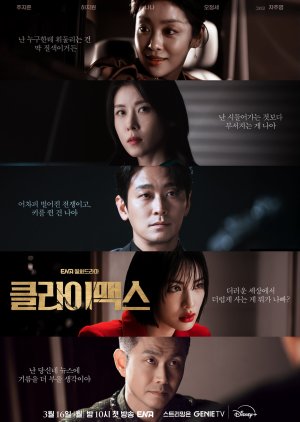
The Actors:Ha Ji Won's tears: 10/10
Ju Ji Hoon's angry eyes: 9/10
Nana's beauty: 10/10
Nana's underacting: 3/10
Cha Joo Young's beauty: 20/10
Cha Joo Young's overacting: -5/10
The Plot:
ML not having a military backstory (unexpected): 6/10
Using revenge porn not once, but twice as a plot point (without legal consequences ever brought up): -99/10
Killing off through murder the three (I'm counting the movie) WLW relationships (is this some kind of subliminal): -100/10
Pretending sexual assault emotionally only affects women (because apparently men are fine being subject to it if it can advance their career): -50/10
Not ever uttering the word gay or lesbian as if that wasn't a whole dimension of the drama and pretending a full on lesbian movie featuring one of the most prominent actresses as lead in a NSFW sex scene would even see the light of day in SK: 7/10 (added points for the positive wishful thinking)
Encouraging sympathy for the ML when he: sexually assaulted his wife, created and used revenge porn for personal gain, manipulated a poor woman into doing his dirty work and knowgingly let TWO innocent men go to prison: 1/10 (male mediocrity forgiveness in kdrama is getting tiring)
The Music:
Playing the OST everytime anything dramatic ever happens (every 10 minutes): 3/10
The Re-Watch Value:
I'm not even sure there is a watch value there: 0/10
TLDR; If the endless twists and turns of human evil scheming, the unprobable lack of legal consequences for public criminal activity and the tears of pretty women are for you, then watch any thriller kdrama. No, you are not special, Climax.
Was this review helpful to you?

This review may contain spoilers
Nothing Sugar-coating: A Noir Masterpiece
For me, the KDrama "Climax" stands as one of the most courageous and socially critical works of recent times.Forget the wave of "sugar-coated" productions that have flooded the recently. Climax is a drama that isn't afraid to play to its strengths. You could describe it as a high-end social thriller that, over the course of 10 hours, reveals the dark underbelly of South Korea’s entertainment industry without any filter.
The cast is phenomenal. Beyond the top-tier performances of Ju Ji-hoon and Ha Ji-won, the supporting cast – Nana, Cha Joo-young, and Oh Jung-se – are equally haunting. In particular, Cha Joo-young as Lee Yang-mi pulls out all the stops, delivering a masterclass as a high-end schemer par excellence.
The storytelling is uncompromising and intelligent, actively challenging the viewer through the sophisticated use of flashbacks and shifts in perspective. We find ourselves empathizing (not necessarily sympathizing) with different sides, only to gradually grasp the full scale of the corruption. Here, the "heroes" are simply traumatized humans with their own darkness, and the "villains" are, strictly speaking, no different.
Greed, trauma, and personal vendettas are consistently wrapped in a "Noir" atmosphere. The story builds tension relentlessly, escalating from one crisis to the next. The central theme revolves around systemic abuse of power in the media—specifically the sexual exploitation of rising stars and the tyranny of agency CEOs. The depiction of the "shadow connections" between politics, jaebols, and the media serves as a painfully realistic and necessary commentary on the industry. While 2025’s My Troublesome Star touched on similar themes, it softened the blow with slapstick and a touch of magic. Climax is far more ruthless, keeping its finger firmly in the wound.
Respect is also due for a genuine milestone in the KDrama world, especially with a cast of this caliber. This is perhaps the greatest progress Climax represents: while same-sex relationships have appeared as subtext in recent years, here it is the driving force of a central plot motif. It’s not just thematic; it’s explicit and authentic. That this was possible in 2026 is truly progressive for the South Korean media landscape. While conservative circles continue to debate it, this story was told—and it never flinches. Major respect to these celebrated actresses for taking on such roles and paving the way for LGBTQ+ visibility in the mainstream.
Finally, this drama returns to its "core competency": soul-saving. Here, "saving the soul" is interpreted as the moment of total revelation and reckoning – a cathartic moment for the audience that goes far beyond your typical revenge epic.
Happy ending? No. We aren’t in a fairytale; we are in the real world. The ending remains true to itself: consistent until the very last frame. I find it "reconciling," even if it isn't in the traditional sense. It’s honest. First: in the fight for the top, you might have to sell a piece of your soul – but not necessarily the whole thing. Second: breaking established structures is nearly impossible. It’s David vs. Goliath without superpowers or magic. It demands everything and more, and yet, they don’t give up. They keep getting back up and rolling up their sleeves.
Was this review helpful to you?

Anticlimatic
The show started with a gripping hook, but by the middle episodes, the momentum vanished. It fell into the classic trap of "filler" episodes—protracted scenes of characters staring into the distance or repetitive flashbacks that didn't add new information. What could have been a tight, 12-episode thriller felt overextended and lethargic.The biggest frustration was the protagonist's decision-making. In an attempt to create "tension," the writers forced the characters to make bafflingly illogical choices that ignored their supposed expertise or established personalities. It’s hard to stay invested in a high-stakes "climax" when the characters are essentially walking into traps that a toddler could see coming.
If you’re looking for something to have on in the background while, some visuals are "nice" to look at. But the "screaming acting" is not doing it for me.
I
f you want a story that respects your time and intelligence, Climax unfortunately falls flat.
Was this review helpful to you?

 1
1 2
2 1
1When exactly did we turn into monsters?
Moral depravity, villainy, greed and filthy politics - this drama is a cesspool of damaged people destroying themselves and others in the name of ugly survival.Manipulative, cunning, ruthless and power hungry Bang Tae Seop would stop at nothing and no one to be one of the top dogs in the political sphere. With his moral compass in the ground, he is not afraid to use and discard people, and eradicate his own pride to get what he wants. Ju Ji Hoon plays him with extreme nuance; bringing about a maelstrom of emotions in his portrayal.
Chu Sang A, played by Ha Ji Won, equal parts victim and devil, is a complicated female lead. All she’s taught is that her femininity and vulnerability will be used against her so she wields that as a weapon when it serves her. Innocent on the surface, she is a real serpent underneath, not hesitating to throw people under the bus when it serves her.
Ha Ji Won played this role beautifully and I couldn’t help but wonder how many parallels were there with her real life. The life of a celebrity is shown to be brutal, 50% in the hands of the media and 50% on the casting couch.
Looking frail, with her bones protruding out, as she throws up her meals and looks sadly in the mirror, constantly under a vicious microscope; she is the picture of an imprisoned show pony. I couldn’t help but feel for her despite everything she’s done.
The truth is regardless of being terrible people however, the two come out to be quite pathetic and pitiful most of the time. They are like wild animals backed into the corner, suppressed by those at the top and no matter how much they try to claw out on the surface, they still have one more boogey man willing to stomp them.
Of course the biggest boogey man is our comical, OTT, petty antagonist Lee Yang Mi who is as hateful as she is entertaining. Ten steps ahead of everyone, and morally black she is a constant thorn in our main couple’s side, never to be defeated.
The whole storyline with Nana was quite interesting for me. While not the best actress, I think she delivered quite well. The sapphic plot line was done quite well too in my opinion, even though it vastly diluted my main ship.
Cause quite frankly, the highlight of the show for me is the chemistry and subtle understanding between the main couple. They are two sides of the same desperate coin, each trying to drag themselves to power in their own way. While there is no love lost between them, there is a sense of camaraderie. Especially on Bang Tae Seop’s side- because even though he uses and sacrifices her for his own ambition, in the end, he still loves his wife enough to never completely throw her away.
Their fight for greed is endless and hard to watch as they constantly have to debase themselves and push themselves to the extreme. Unfortunately, for them, even coming out on top gives them no peace.
The drama could be a social commentary on how people are in an endless rat race for power, only to realise it is all hollow when you reach the top. Because by then, the damage to the soul is too much to bear.
Ofcourse, this drama is an acquired taste. There are no good people here. No idealistic happy endings. Sex is often used as a weapon of suppression and exploitation.
I won’t say everything is perfect here. Because in its quest to be as ugly as possible, the writing does take a hit at times. The pace messes up. There is a repetition of some plot devices.
That said, it’s still one hell of a ride with some seriously brilliant acting.
Mature, raw, emotional and quite honest, this is a slow burn noir thriller that is to be enjoyed slowly, one episode a week, with your moral scruples out the door.
Was this review helpful to you?

Highly Underrated- no sugercoating....the real story
I really don't understand the low rating because this drama is so good.I love the acting – everyone did a great job. Joo Young was the star of the drama for me – she totally nailed the character. Also, Ji Hoon shines in every scene.
I completely get why Tae and Sang started chasing power. They want to become people that others can't touch, use, or throw away. To the rich, regular people are just pawns. I love that Tae and Sang know what they want and will do anything to get it – even putting up with each other's shady methods. It's not an easy journey, as you can see from the ending, which was just perfect.
The storytelling worked for me. Corruption, abuse of power, sex trafficking – nothing new, and sadly, it will never go away. Money and power run everything. What I love most is that this drama doesn't sugarcoat anything. It shows the real world exactly as it is – people doing awful things to get rich, famous, or powerful.
I was hooked from the beginning and excited to watch every next episode. I don't get the low rating, but I'm not surprised – this kind of drama isn't really appreciated on this site.
Overall, I really enjoyed it. I loved watching Tae – life kept knocking him down, but he never stayed down. He always fought back.
Verdict: A powerful, underrated drama that deserves more love.
Was this review helpful to you?
This review may contain spoilers
Psychological/political thrilled with significant "film noir" overtones.
UPDATE after Ep. 10: Final Rating is 9⭐ By the end it was no longer a "thriller" but rather a psychotic roller-coaster - but definitely still "film noir" overtones.If you are a fan of classic Hollywood movies, then (1) see my comments at the bottom about the film posters for the movies "Sunset Boulevard" and "Vertigo". They both deal with obsessive people driven to near-madness. (2) For a long time, I was afraid that the drama would end in the same manner of the obsessive/psychotic couples in "War of the Roses" or "Double Indemnity" [Spoiler: they all died] Thankfully, the Climax writer didn't choose the easy out. Although pathological ambition drove every decision and choice they made, both survived to the end. I should note, that Bang Tae-seop and Chu Sang-ah were not a "romantic" couple, but I found the end satisfactory as they both acknowledged they need each other for support.
Overall Positives: Actors: were raw and mesmerizing. I had never watched anything with Ju Ji-hoon or Ha Ji-won before and I was blown away with how they communicated with their body language just as much as the words. If you binge through without noticing all of the subtleties of their performance, you will miss the highlight (for me) of the drama. The Script: A series of plots/counter-plots and then plots-that-went-nowhere. Although we understood the characters' motivations, it was hard to keep track of the impact of certain choices and blackmail items raised in the first few episodes seemed to be forgotten in the later episodes.
The Cons: There were many - too many - scenes of debasing/humiliating activity that were included for their shock value as much as anything else. Supposedly they demonstrated the desperate lengths people go to in their obsessive drive but IMHO, an A+ writer would be more creative in crafting ethical decisions/tension rather than ick factor. Second negative is that the drama lacked continuity. Just one example: Jeong-won lived in an apartment with multiple fish tanks and they were always there. . . . until they weren't as she was preparing to leave. I didn't really listen to what she said - I wondered what happened to the fish! There were a lot of "what happened to. . . " and "WTF" instances that detracted from the overall tension.
I really enjoyed the drama - the characters, interesting location filming, the roller-coaster of plot/counter-plot. I was very happy with the last episode and how the main couple was able to survive. If not for those ick factor scenes, I would have given this 10⭐
*********************************
[Original interim review after Ep. 6]
Psychological/political thriller is not my usual genre but lately I’ve become tired of rom-coms that follow the same rather unimaginative formula. Climax is anything but unimaginative or formulaic. I’m writing this review after watching Episode 6 (out of 10) and will update each week if anything significantly impacts my overall attitude about the drama.
First, let’s make something clear: the plot involves “The fierce survival drama of prosecutor Bang Tae-seop, who jumped into the cartel of power to stand at the top of South Korea, and those around him." Bang Tae-seop, the choices he makes and the consequences drive the plot.
Like any good mystery, Climax unpeels the onion, episode by episode. And yet, as of Ep. 6, I feel that there are still critical facts that the writer/director has kept hidden from the viewer until the end. That doesn’t bother me IF – Big IF – the viewer learns that they were not outright lied to. I don’t mind if the viewer sees 50% of an event and jumps to conclusions about who actually murdered someone. But failure to include vital information will never be forgiven.
UPDATE after Episode 8: Unfortunately, the drama has descended into one "shock" scene after another with no real character development. Sometimes characters seem to do introspection and then Surprise! it was fake. Climax is still a roller coaster and I am looking forward to watching to the end (at which point I will update again) but except for the "everyone is desperately greedy for power, money, control and will do anything to obtain it", there really isn't much to this drama. I'm still crossing fingers that the end will be satisfactory (as in, the really, really bad, evil people get destroyed) but at this point, those really bad, evil people are mere props with little or no explanation of HOW they became this irredeemable.
One of the things I love most about the drama is the inclusion of two very prominent movie posters from classic Hollywood movies. First, “Sunset Boulevard”, the story of an aging silent film star who is desperate for a comeback – similar to Bang Tae-seop's wife Chu Sang-ah’s desperation to claim her top star status. And second, Alfred Hitchcock’s brilliant “Vertigo” – a movie about a man obsessed with a woman he was unable to protect – Bang Tae-seop’s story as he tries to protect a wife who does not love him. Do the movie posters foreshadow the end of “Climax”?? I don't think so - but they explain the psychological undertones of this “film noir” drama. Whether the writer is able to stick the landing remains to be seen, but thus far, I’m on board.
Was this review helpful to you?

This review may contain spoilers
A Rollercoaster of emotions
OVERVIEW:Climax presents itself as a psychological drama but quickly evolves into something far more intense. The story revolves around a group of individuals whose lives become entangled through power struggles, hidden pasts, and emotional manipulation.
At the heart of it all is the female lead, a woman who has spent years suppressing her true self to survive in an environment that constantly tries to control her. Opposite her is the male lead, a man shaped by pressure, expectations, and a deeply rooted need for control—whether over his life or the people in it.
As their paths intertwine, what begins as a tense, almost transactional relationship slowly spirals into something much more complicated, ultimately leading to a breaking point where everything unravels.
MORE DETAILS (SPOILERS):
Climax doesn’t rely on immediate shock value to pull you in. Instead, it builds its tension quietly, letting the characters carry the weight of the story. By episode 2 or 3, I found myself completely invested—not because of big twists, but because of the growing emotional intensity.
The female lead is honestly a very interesting character. At the beginning, she comes across as reserved, almost passive—but as the story progresses, you realise that her silence isn’t weakness, it’s survival. Watching her slowly reclaim her voice (both literally and emotionally) was incredibly satisfying.
The male lead, on the other hand, is much harder to read. He’s cold, calculated, and at times frustratingly detached. But the more we learn about his past, the more his behavior starts to make sense. He isn’t just controlling—he’s someone who has never been given the space to be anything else. His desire to reach the top and on the other hand to protect the one thing what really is something worth in his life.
What really stood out to me was their dynamic. It’s not a typical romance. There’s tension, resentment, and even moments where their relationship feels almost toxic. But that’s what makes it interesting. Their connection isn’t built on idealised love—it’s built on confrontation, truth, and eventually understanding.
There were moments where I struggled with how certain characters were written, especially when it came to their sudden emotional shifts. One character in particular goes from being almost irredeemable to somewhat sympathetic, and while I understand the intention, it felt slightly rushed.
Also, some of the more dramatic plot twists felt like they were pushing the boundaries a bit too far. Not enough to ruin the experience, but enough to make you question the realism.
The side characters had strong setups, but not all of them were explored as deeply as they could have been. A few arcs felt cut short just as they were getting interesting.
I DIDN‘T LIKE:
The middle portion of the drama drags slightly. There are episodes that feel more like transitions rather than meaningful progress.
This is also not an easy watch. The emotional weight of the story can be intense, especially when it comes to the characters’ trauma and relationships. Some scenes are intentionally uncomfortable, which might not appeal to everyone.
I also found some of the male lead’s decisions frustrating, especially early on. While they make sense in hindsight, they can be difficult to watch in the moment.
I LIKED:
The acting is genuinely impressive. Both leads deliver performances that feel raw and authentic, especially in emotionally charged scenes.
The cinematography deserves a mention as well. The use of lighting and framing adds a lot to the storytelling, often reflecting the characters’ internal struggles without needing explicit dialogue.
I also appreciated how the drama doesn’t simplify its characters. Everyone is flawed, and the story doesn’t try to excuse their actions—it just shows them as they are.
The tension is consistently present, even in quieter scenes, which keeps you engaged throughout.
THINGS I LOVED:
The character development is where Climax truly shines.
Watching the female lead evolve from someone who suppresses everything to someone who finally confronts her reality was incredibly powerful. Her growth felt earned, not rushed.
The male lead’s journey was equally compelling, though in a different way. Seeing him slowly reach what he yearned for - and realising the damage he caused until a certain point - added a lot of emotional depth to the story.
And their relationship? Messy, complicated, sometimes frustrating—but ultimately very real. It’s not about perfect love, it’s about two broken people trying (and often failing) to understand each other.
The final episodes deliver exactly what the buildup promises. Everything comes to a head in a way that feels intense, chaotic, and fitting for the story.
LAST BUT NOT LEAST:
Climax is not a light or easy drama—but it’s not trying to be.
It’s intense, emotionally heavy, and at times uncomfortable, but that’s exactly what makes it stand out.
Is it perfect? No.
Is it gripping and emotionally impactful? Absolutely.
If you enjoy character-driven stories with complex relationships and darker themes, this is definitely worth watching.
THE END:
This is the kind of drama that will definitely divide opinions. Some will find it too slow or too heavy, while others will appreciate its depth and character focus.
If you’re unsure, give it a few episodes—you’ll know pretty quickly if it’s for you.
HAPPY WATCH!
Was this review helpful to you?

 1
1This review may contain spoilers
Always Rising, Never Ending: Heading to the Climax
Climax felt like a road trip. You're eagerly awaiting the final destination, but there's some stops along the way that you need to go through first. That is the most concise way I can describe it. There were some highs and lows, but we (at least, I did) made to the final destination: the climax.The Highs:
The acting - The strongest part of the series to me. Especially with the 2 protagonists, Bang Tae-Seop (Ju Ji-Hoon) and Chu Sang-Ah (Ha Ji-Won.) This drama actually made me a Ha Ji-Won fan! And it also changed my perspective of Ju Ji-Hoon (then again, Five Fingers isn't the best example of his acting in the first place.) Cha Ju-Young was good but she overacted often. Nana was great- understated, distant, but observant. Definitely checking out more of her dramas! Oh Jung-Se did well with what he was given. The supporting cast was good enough, too.
The directing - BEAUTIFUL. Some of the best directing I've seen in a k-drama. The camera work, angles, lighting, and symbolism (like the stairs scenes in the final episode, plus the recurring motifs of things like hotel rooms and toilets, representing characters at their lowest points) worked incredible together. All to create the mood and atmosphere of a neo-noir political thriller.
The music - I liked the soundtrack. The BGM is very good too. Not too repetitive, and again, there's not much to use within a 10-episode series.
The sheer audacity - Yes. Lee Ji-Won's audacity to write a political thriller exploring the dark side of humanity and how far people will go to achieve their own desires, and her audacity to do it with a lesbian female protagonist, AND actually showing her sexuality on live television. Kudos to her and kudos to Ha Ji-Won for portraying Chu Sang-Ah so well.
The ending - As I said in my comment, I liked the ending. It changed my perspective on the drama a little bit. Despite its clear flaws, it was thematically brilliant. Even after Sang-Ah and Tae-Seop get those ambitions they crave so badly, the fight never stops. They've both reached their respective climaxes and the only way to go now is further up. A very unconventional, but truly realistic ending. It's not happy. It's not sad either. It just... is.
The themes - There are several major ones. The biggest one that stood out to me was greed vs. morality, and this one worked VERY well. All of the main characters were greedy for something: Sang-Ah - Status. Tae-Seop - Political Power. Jung-Won - Fame. Yang-Mi - Control. Jong-Wook - Recognition. And they all went about their own ways of getting these things. We saw Sang-Ah and Tae-Seop go to the depths of ABSOLUTE hell to get what they wanted. It was almost sadistic, in a way. But they did win. And it was a pyrrhic victory... because even at the end, they were in hell: trapped in the cycle of power. It'll never end for them now they've reached their climax. Another major theme that stood out was the patriarchy and its hold on power. There's something about femininity/masculinity (in terms of power and its portrayal) that was used in this drama that I genuinely loved. Yang-Mi pursues power and runs WR Group like how she thinks a man would. Jong-Wook was flashy and sought to prove himself worthy of owning WR Group, just like an entitled man would. Tae-Seop was methodical and cunning, but still intimidating, Jung-Won was cold and distant, and lived a quiet life away from the political & business machinations. Only used like an attack dog when Tae-Seop needed her. Sang-Ah, in contrast, was femininity. Desirable, beautiful, famous. Perfection. Everyone wanted a piece of her and what she *represented.* And this was what everyone saw on the surface. Sang-Ah masterfully used her femininity and beauty as a weapon: to manipulate others and to use them. Brilliant writing decision. Again, I wish we'd seen this villainous side of her more. There wasn't enough of it for me!
The Lows:
Character development - My BIGGEST problem. I'm not expecting character studies in a 10-episode mini-series, but some of the character decisions and arcs were weird. Jung-Won's arc in the last 2 episodes fell apart, especially with how things ended for her. I understand that she was a pawn trapped in the game of power, but... I just feel like she was done so dirty. 💀 Sang-Ah, too. I wish they'd leaned into her villainy more. I don't need her to be over-the-top (like Lee Yang-Mi was), but she mostly just got dragged through hell a LOT. It was only in the last parts of the drama that we really saw her fight back (and not by very much.) So, to me, the female characters could've used better character development. They could've also gotten rid of Kwon Jong-Wook... he ended up playing no major role in the series. Lol what a waste of Oh Jung-Se. I hope he got paid well for doing nothing.
Writing - In several areas, there was a lot that could've been improved. The overreliance on shock value was disappointing to me. Seeing the 2 protagonists humiliated almost constantly brought down the quality of an otherwise nicely written series. I blame this on network restrictions, but partially the writer as well. Sang-Ah and Jung-Won's relationship (while I wasn't expecting a perfectly happy ending for them) could've been handled much better. Tae-Seop's ending? I guess I could say that he got what he wanted, but gaining power cost him his soul. That does not excuse some of his actions, however. Sang-Ah's ending, did I like it? No. Did it make sense? Debatable. Also, the last episode mostly left me with questions- and quite a few plotholes. 🤨
Lee Yang-Mi - Yeah, I included her in a separate section. She was so 1-dimensional and over-the-top that it ended up feeling extremely out of place. Sometimes it was funny (like her villainous breakdown at the end), but most of the time it made me roll my eyes and skip her scenes (occasionally.) Also, her "big motive" SUCKED. Lousy writing. For a drama with such an unconventional, villainous, and complex female lead, you'd think the antagonist would match that energy. But she did not. Yang-Mi was a fucking clown at best. Cha Ju-Young's overacting didn't help, but I think she did her best with what she was given.
Should You Watch It? - If you like thriller dramas with morally complex to flat-out villainous central characters who are willing to do ANYTHING to achieve their ambitions, watch it. If you like political thrillers centering on a morally grey/villainous ML, watch it. If you like morally grey characters, watch it. If you're looking for something refreshing, watch this (or at least give it a try.) If you like slow-burn thrillers, watch this drama. But if you're looking for a nice romance drama? Skip it. And if you're looking for a makjang, skip it. THIS IS NOT A MAKJANG DRAMA!!!!
As for whether I'd rewatch it? Maybe. I don't usually rewatch shows, but it might get a 2nd chance from me in the future. Oh, and a bonus 0.5 points for the outfits and styling (for the protagonists & Jung-Won.)
My overall rating: 9/10. Not perfect, but a great drama. Glad I went on this weird road trip with other lovely passengers (and a few mean ones along the way. Haha!) Still loved it!
Was this review helpful to you?

This review may contain spoilers
offensively bad
there's good dramas with sophisticated plots, there's good dramas with simple plots, and then there's bad dramas that try so hard to be sophisticated that it makes them 10x worse. this is one of them.this drama is a disgrace against all women, lesbians, and queer people. the women of this drama are put through perpetual abuse, sexual assault, etc., for the sole purpose of dramatisation and/or character development for the male lead. this is a well studied phenomenon known as the 'women in refrigerators' trope, i highly recommend reading up on it.
as for the queer aspect, just because they included a lesbian character doesn't mean we should be applauding the writers for representation. this drama exploits the hardships of sexual minorities for nothing more than shock value. throughout the entire story, sangah is mentally and physically pushed to the limit, but no attempt is made to send any meaningful message with any of this.
towards the end i began to wonder, who are we even supposed to be rooting for here? taeseob is just as manipulative and power hungry as the elites he strived to take down.
they try to frame taeseob and sangah as equally evil and equally sympathetic, which is NOT the case. sangah wasn't responsible for the murder, and even if she was, it would've been justified. she can't be blamed for cheating either as she was coerced with drugs. taeseob on the other hand, as admitted by himself in the first episode, only saw sangah as a means to climb up the social ladder. sure, you could argue he fell in love with her later, and he did try to 'protect' her overall, but he wouldn't have gone to such lengths to protect her image if it wasn't crucial to his own reputation. not to mention him forcing himself onto her after their big fight which is completely irredeemable. mind you he was already irredeemable to me when he did nothing to help jisoo.
the last episode is its own disaster:
- slow motion montages were excessive and anticlimactic, whole episode could've been 40 minutes if they cut those out
- everything played out way too smoothly all of a sudden
- the focus suddenly shifts onto politics and we're expected to keep up with all these names and lore that were only mentioned in passing in previous episodes
- the "cliffhanger" they left to tease a second season felt sooo forced and rushed
overall, a low quality drama that takes itself too seriously, much to its own detriment.
Was this review helpful to you?

This review may contain spoilers
While Promising Plot become Bogus
I was expected to get Ju Jihoon and Ha Jiwon on one drama and ends up being disappointed. The acting were quite good i have no complaint but the sole problem is execution of the story. The plot was quite promising about political figure married actress only to ends up hiding actress past about sexuality preference and cover the dark side of politic worldI quite like chemistry between the girl, Nana always gorgeous but they quite messing with the pace and it completely make me lose the way of watching this drama only forced my self since i love both of the leads and Nana.
Was this review helpful to you?
This review may contain spoilers
Most definitely NOT a political thriller
From the plot synopsis, you may think that that this is the standard run of the mill political thriller that gets shown every year. A man with ambitions to become President gets tangled up in the corrupt machinations of the elite yada yada... Alas, if you have come in expecting that, you would be sorely disappointed. What this show is, rather, is a convoluted mess of lackluster revenge plots, half-baked social commentary and a somewhat weak(debatable??) attempt at LGBT representation in a conservative Asian society.Writing/Plot - The politics plotline of this show is really thin. And when I mean thin, I mean that if you combined every politics-related scene from the whole show it probably wouldn't be enough to fill the runtime of ONE episode. The show spent way too long setting the scene in the first few eps, resulting in a mad rush to close things up towards the end. The whole "I'm gonna try to get elected plot" basically kicks in after ep6?or 7? which is not enough time to fully develop this plot considering that this is only a 10 ep drama. I actually liked that the show was leaning into the whole "show, don't tell" method a lot, but the whole mad rush resulted in the political angle veering to the "TELL, DON"T SHOW" extreme towards the end to make up for time which was jarring.
Characters - I really really liked that almost EVERYONE in the show is morally grey and basically pieces of shit to varying degrees. Too often we get Mary Sue FLs who can do no wrong but in this show, the FL (Chu Sang Ah) is basically an expert liar and manipulator, who instigated 2 separate murders (both of which failed lol). She went through hell of course, but wow am I amazed at how manipulative she is. To me, she is probably the most complex character in this show. Her motivations were never clear to me - fame? wealth? popularity? Does she love anybody? The only genuine relationship she seems to have is with her (girl?? more on that later)friend Jisoo, and it is ambiguous if she even likes the ML (Bang Tae Seop), who she married. Which honestly, I never understood why she married him of all people. Surely she has had richer and more powerful suitors than a low ranking (at that time) prosecutor. I don't feel like she truly likes Jeong Won either, and was just making use of her right till the end. Others seem to interpret her last conversation with Jeong Won as sort of a confession of feelings; rather I interpreted it as more like an attempt to manipulate Jeong Won to come clean about her leaked sex tape. She knew from the start that Jeong won likes/is enamored by her and would do anything (even murder!) for her. And through that "confession" she was hoping that Jeong Won would help restore her reputation. I'm pretty sure Jeong Won would have agreed to (she was shown wavering after the confession) if she weren't murdered so unceremoniously. Even the scene where Sang Ah wails over Jeong Won's dead body comes across as contrived - they had literally acted out that scene previously (foreshadowing?) in that Four Seasons movie which Lee Yang Mi bankrolled! It was almost like for like with Jeong Won lying bleeding in Sang ah's arms.
Bang Tae Seop on the other hand, is more of the standard "guy from a humble background with political ambitions" character. His motivations from the start were quite clear - to get into the Blue House no matter what. Even getting married to Sang Ah was part of the plan, though he seems to have caught feelings for her. He goes to great lengths to save her and her career, and literally all of the revenge plotting/scheming are masterminded by him. Sang ah is merely a pawn in his game (something I didn't like - wish she was written to be more of his equal intellectually instead of relying on him to strategize).
To be honest, I felt like Jeong Won was the most badly written character in the whole show. Her character development completely turns on itself with the whole leaked sex tape plotline which made no sense at all. Like firstly, why would she even allow herself to be blackmailed for Park Jae Sang's murder when she didn't actually murder him?? She literally entered and exited the room almost immediately upon seeing him already dead? And secondly, WHY would she even agree to set up Sang Ah when it is shown that she seems to be enamored/obsessed with her? If you liked someone enough to want to KILL for them, would you even agree to effectively DRUG AND RAPE them later?? Geez. And the way she was just killed off ... I just... not sure if the writer/director chose to do so because they want to "close" the LGBT plotline.. which brings me to my next point - LGBT representation(?)
I was debating if this show would be considered queer-baiting but I'm honestly not sure as this show was never marketed as a GL. None of the characters explicitly call themselves "gay" and there is some degree of plausible deniability with Sang Ah being married to a man. Sang Ah and Jisoo were never confirmed to be anything more than "friends" and some of the kiss scenes were effectively censored. The revenge porn plot is essentially Sang Ah being drugged and raped against her will. The only other consensual intimate scenes between Sang Ah and Jeong Won are due to "show within a show" plotline with them filming the movie together, and not because the characters themselves are in a relationship with each other. I must say that Jeong Won seems to feel something for Sang Ah - just that it is unrequited. To me, Sang Ah probably feels some guilt (she is not without a conscience...) towards Jeong Won and that was why she imagined Jeong Won in the audience clapping for her at the end. And then the ending with Sang-Ah and Bang Tae Seop holding hands and walking out like a political power couple... a heteronormative closure for the conservative crowd? I guess this is still an improvement for LGBT representation...?
Acting wise this show really is a masterpiece in acting. There are MANY MANY closeup shots of the characters and both the ML and FL really had the acting chops to pull it off. The micro expressions, the eyes, the smallest tremble in the lips, it was just perfection acting wise. I love Nana, but her acting was the weakest among the cast. She wasn't as expressive and her over filled lips were distracting lol. Cha Joo Young's acting here was a bit exaggerated but I'm not sure if it was due to the bad writing. Her character was a very one dimensional, cliche mistress character that had absolutely no character development so I don't blame her for that. The cinematography was beautiful and some of the scene transitions were just brilliant. I was getting arthouse movie vibes lmao. There was some attempt at social commentary about celebrity culture and elites looking down on the commoners but never properly expanded on. The writing was really the weakest link. I liked that the ending was sort of bittersweet - showing the leads sort of succeeding but at what cost? And how the cycle of political struggle would never end. HOWEVER, this type of ending also hints at a potential season 2 which this show does not need. Unless the writer is able to think of more sophisticated strategies that do not include constant blackmails and online video leaks, there is NO NEED for a season 2!!!!!
TLDR: WOW this turned into a whole ramble. Watch for the phenomenal acting, or if you're a Ha Ji Won fan who wants to view her return to dramas. DO NOT watch if you dislike unrealistic/shock value plots or if you dislike potentially gay characters. I treated this drama like some absurdist makjang comedy(!) and actually enjoyed it.
Was this review helpful to you?

This review may contain spoilers
“The times are changing — just enough to stay the same.”
A profoundly revealing series within the contemporary Dramaverse, “Climax” stands out not so much for its undeniable intrinsic value, but for its inherently ambiguous and elusive nature — one that, precisely because of these qualities, seems destined to generate interpretations that are not always aligned.Within an increasingly congested landscape, ever more oriented toward recognizable, reassuring, and easily consumable formulas, works like this move in the opposite direction: they slow down, they layer, they refuse simplification, and above all, they deny the viewer a comfortable position from which to observe events. This is not a flaw — but a deliberate, almost programmatic choice.
It is perhaps along these lines that one can anticipate a reception that may not be entirely uniform, as a narrative so unwilling to provide immediate coordinates demands a different kind of attention — less oriented toward consumption and more toward engagement.
In this sense, some of the reservations that often emerge in response to works of this nature — related to perceived slowness, lack of immediacy, or difficulty of interpretation — seem to reflect more a different mode of viewing than actual limitations of the work itself.
This points to a deeper shift, one that concerns not so much taste as the ability to place a work within the evolving trajectory of cinematic language. Without a clearly defined memory — even a recent one — of forms and their transformations, any narrative risks being perceived only through its immediate impact, losing the very stratification that gives it lasting value.
Within this framework, “Climax “reveals a striking coherence, rejecting any form of simplification and choosing, from the very beginning, to construct a narrative universe that offers neither moral footholds nor stable points of reference. Its characters are not defined through reassuring categories — heroes, victims, antagonists — but instead move along a far more unstable axis, where ambition, survival, and compromise inevitably overlap.
Bang Tae-seop, an ambitious prosecutor reinventing himself as a political figure, embodies perhaps the most evident trajectory of this transformation: a path that does not distance him from the system, but gradually leads him to become an integral part of it. Alongside him, Chu Sang-ah, an actress marked by trauma and a career constantly exposed to manipulation and coercion, represents the most elusive and contradictory face of the narrative, suspended between fragility and calculation, between survival instinct and awareness of her own “role.”
Around them, figures such as Lee Yang-mi — a true nexus of power — and Hwang Jeong-won, only apparently more marginal yet emotionally pivotal, contribute to shaping a system in which every relationship, even the most intimate, is inevitably contaminated by dynamics of control, dominance, and adaptation.
It is precisely through the evolving trajectories of these two protagonists that the deeper nature of the series becomes fully apparent. Tae-seop, initially driven by an ambition still tied to a notion of personal redemption, gradually abandons any residual form of opposition, adapting with increasing lucidity to the logic of power until he becomes a fully conscious agent within it. His transformation is not abrupt, but gradual and almost inevitable, replacing conflict with control, and ethics with effectiveness.
Sang-ah, by contrast, operates on a more elusive and less linear plane — and for that very reason, a more destabilizing one. Her evolution does not follow a recognizable trajectory, but unfolds through successive layers, alternating moments of apparent vulnerability with sudden shifts toward a colder, more calculated awareness. She is a character that resists definition, and it is precisely in this constant oscillation that her strength lies: victim and strategist, emotional presence and constructed persona, never fully one or the other.
Within their relationship, these tensions do not cancel each other out, but rather recognize and integrate one another. What emerges is not a bond grounded in traditional emotional dynamics, but a form of balance built on mutual adaptation, shared risk, and an implicit understanding of the rules of the game. Rather than moving closer, the two protagonists ultimately align, becoming expressions of the same system — one that leaves no room for alternatives.
It is within this convergence that the systemic nature of “Climax” becomes most evident. Politics, show business, justice, and media are never treated as separate domains, but as interconnected parts of a single organism, capable of absorbing, reshaping, and redefining power dynamics from within. There is no real “outside,” no genuine possibility of escape: every attempt at resistance is ultimately absorbed, transformed, neutralized.
In this context, corruption does not appear as an exception or deviation, but as a structural condition — almost inevitable. Characters are not corrupted over time; they either already are, or become so insofar as they learn to survive. It is a process of adaptation rather than downfall, where the distinction between choice and necessity becomes increasingly blurred.
Within this framework, even morality loses clear definition. “Climax” rejects any manichean approach, carefully avoiding rigid distinctions between guilt and innocence, victim and perpetrator. Every character inhabits a grey zone, where actions appear both necessary and questionable, and survival often prevails over any notion of integrity.
In this sense, Sang-ah’s characterization proves particularly significant, revealing — especially in the private and more concealed dimension of her “true self” — a fragility that partially escapes the dominant logic of the system. It is precisely in these more intimate, less exposed moments that a more sincere emotional core emerges, one not entirely reducible to calculation and strategy.
This is not redemption, nor an attempt at moral rehabilitation, but rather an internal fracture that makes the character even more complex and resistant to rigid judgment.
If “Climax” sustains its structure with such coherence, it is also — and perhaps above all — thanks to a cast that deliberately avoids any form of self-indulgence. These are not performances designed to please, nor characters meant to be liked, but figures that exist within the system that shapes them, embodying all its contradictions.
Ju Ji-hoon once again confirms a rare versatility, moving across vastly different registers with remarkable ease, here translating into a progressive restraint that renders ambition almost inevitable, stripped of any overt emphasis.
Ha Ji-won delivers one of the most complex and layered performances of her career, crafting a character that constantly eludes definition. Her performance unfolds through shifts and sudden tonal changes, balancing fragility and control with disarming naturalness, never slipping into mannerism — at times approaching a form of meta-performance.
Nana embraces a deliberately deglamorized image and works through subtraction, building a presence that initially appears cryptic and distant, only to gradually reveal a deeply emotional and tragic dimension.
Cha Joo-young, on the other hand, embodies the structural core of power itself: she does not simply portray it, but makes it visible, giving shape to a figure that encapsulates the distortions of a system with no apparent alternative.
Together, they do not merely support the narrative — they make it believable, giving form to a system that, through their performances, becomes the true protagonist of the story.
It is precisely in light of this construction that “Climax’s ending reveals its full coherence. Far from any need for catharsis or moral resolution, the conclusion does not aim to resolve, but to stabilize. Tensions are not released, but absorbed; conflicts do not reach synthesis, but find a new placement within the same system that generated them.
There is no true fall, nor a real ascent: what changes is the position of the elements within a structure that continues to function according to the same logic. Power is neither challenged nor dismantled — it reorganizes, adapts, evolves. And the characters, far from being judged or redeemed, find a form of equilibrium precisely insofar as they accept being part of it.
It is a conclusion that may feel disorienting, precisely because it refuses simplification and offers no comforting resolution — yet it is likely the only possible one for a narrative that, from the beginning, has chosen to inhabit a space of constant ambiguity, never yielding to the temptation of clear moral distinctions.
“Climax” does not provide answers, nor does it attempt to indicate a direction. Rather, it invites the viewer to question their own position within dynamics that, however extreme they may seem, retain a striking sense of familiarity. It is not a conciliatory vision, nor a reassuring one.
But it is, precisely for that reason, remarkably lucid — and perhaps, unavoidably necessary.
8½
Was this review helpful to you?