
 Editorials


SPOILER ALERT!!!
Honey Part-Time:
Honey Part-Time is a horror series that tells the story of Hyuk-jun, who performs bizarre part-time jobs in exchange for high pay. The way strange creatures are woven into everyday workplaces is entertaining, and the protagonist's struggle to survive in spaces governed by different rules is intriguing.
After watching the first four episodes, what lingered even longer than the strangeness was the theme of labor. Honey Part-Time does not use labor merely as a device to trigger events. Rather, it presents labor itself as the force that sustains the world humans live in, repeatedly showing how easily the world that depends on that power consumes workers.
Looking only at episodes 1–4, there seems to be one contradiction at the heart of this work. Labor is the force that keeps people alive and sustains the world, but the system that requires that labor does not necessarily respect workers' lives.
1. A World Where Labor Is the Source of Vitality
In the world of Honey Part-Time, there are two worlds: the world of yang, where we live, and the opposite world of yin. Normally, the two worlds cannot see each other. However, in places where the boundary between them becomes blurred, beings from the other side cross over, and events occur that are difficult to explain using the rules of reality alone.
The CEO of Spider Manpower explains this structure by adapting Othello's words. Just as the front and back sides have different colors but ultimately form a single piece, the two worlds are separate yet connected. When the boundary between them becomes blurred, what is needed is yang energy. Here, the series introduces a rather unusual idea: the work people do to earn money is what generates that energy.
Why labor, of all things? The idea that working to earn money, rather than human vitality, emotions, or will, creates the power needed to stabilize the world begins to seem less like a simple fantasy rule and more like a metaphor for the entire series as the story progresses through episodes 1–4.
In reality, our daily lives, which we often take for granted, are ultimately maintained by someone's labor. Convenience stores stay open all night, events proceed as scheduled, milk arrives at our doors in the morning, and movie theaters begin screenings at set times. Behind all these ordinary routines, there is always someone's labor. Honey Part-Time turns this familiar fact into a physical law of its fictional world. The world of the living is sustained because someone is working.
In that sense, the convenience store at the end of episode 1 is symbolic. The place where Hyuk-jun was chased by monsters throughout the night and nearly died returns to being an ordinary convenience store at 6 a.m. The spider girl from the refrigerator and Heedong's traces have disappeared. When Hyuk-jun visits again during the day, the place appears perfectly normal, as if nothing happened.
What we usually see is this daytime convenience store. The space is well-lit, neatly arranged, and operating without any obvious problems. What we cannot see is what someone endured during the night to maintain that ordinary appearance.
That is why the other world in Honey Part-Time feels less like a fantasy world completely separated from reality and more like the hidden side of reality. Just as Othello's comparison suggests, the front and back are different sides of the same thing. In this series, the strange does not exist outside reality; it is attached directly to its other side.
2. Spider Manpower: A System That Selects and Manages Desperate People
So, how are the workers needed to sustain the world recruited?
The recruitment method used by Spider Manpower is suspicious from the beginning. Byun Hyuk-jun loses 100 million won in a rental fraud. He then tries to recover his losses using the 40 million won his mother gave him to buy a house, but it appears that he loses that money in the stock market as well. Eventually, he borrows money from a loan company, and the interest he owes quickly reaches several million won. Driven to desperation, Hyuk-jun attempts to end his life at a bridge over the Han River.
The moment Hyuk-jun discovers the Spider Manpower recruitment advertisement is significant. Ordinary passersby cannot see the advertisement on the bridge. It is positioned where someone who has climbed over the railing and is barely holding on can notice it.
Spider Manpower is therefore not simply a place that recruits people who need money. It seems to be waiting for people who have already been pushed out of ordinary choices and brought to the edge of their lives.
Ironically, Spider Manpower does not force Hyuk-jun to go anywhere. Details about the part-time job, including its type, working hours, and hourly wage, arrive by text message. Hyuk-jun must personally reply that he accepts the offer before the contract is finalized. In terms of formality, it appears to be a completely voluntary agreement.
The problem is that the series shows the circumstances leading up to his acceptance in considerable detail. Hyuk-jun is in debt, must pay interest immediately, and receives threats that his family will be contacted to recover the money even if he dies. Loan company employees even suggest that he could make money by appearing on gay websites and advise him to build up his body.
For someone in this situation, a part-time job offering fifty times the usual hourly wage suddenly appears. Under these circumstances, can Hyuk-jun's acceptance genuinely be called a free choice?
The first convenience store job reveals this problem even more clearly. When Hyuk-jun notices something strange at the workplace and calls the head of Spider Manpower, the boss asks, "Would you pay fifty times the hourly wage for a typical part-timer?"
The statement implies that the job is dangerous, but it is difficult to consider it a proper warning about the risks involved. Hyuk-jun accepted a night-shift convenience store job, not a job in which he might lose his life while being chased by monsters.
Spider Manpower does not provide all the necessary information, yet it strictly enforces the terms of the contract. Workers must accept the job themselves, face penalties if they fail to show up, and risk further penalties if they talk about what happened at the workplace.
The choice and responsibility remain with the individual, but the contract does not concern itself with why that person had no real choice except to accept the job.
The name Spider Manpower seems connected to this idea. Hyuk-jun and Ji-yoon directly ask whether it should not normally be called Ant Manpower. Throughout the series, the words ant and spider appear to overlap visually. Sometimes, a single stroke on a sign seems to change one word into the other, while signs on corridor walls intersect depending on the arrangement of pipes and other objects.
Ants are naturally associated with labor. They move diligently, carry things, and work together as a group. Spiders, on the other hand, spin webs and wait for prey to become trapped.
In this sense, the change from Ant Manpower to Spider Manpower can be interpreted as the transformation of a space that connects workers into a space that captures them. What makes this especially interesting is that the difference between the two images is not dramatic. It is only a small stroke that separates them.
The fact that Spider Manpower does not specifically target Hyuk-jun becomes even clearer in episode 3, when the CEO opens a ledger. After Hyuk-jun crosses into the other world, the CEO opens the ledger and says something along the lines of, "That's as far as it goes," before drawing a red line through Hyuk-jun's record.
Hyuk-jun is not the only person listed in the ledger. It is densely filled with the names and ages of countless people, along with records of the jobs they have performed across numerous sessions. Although we still do not know exactly what the red lines and various markings mean, it seems clear that many people have worked for Spider Manpower before Hyuk-jun.
For Hyuk-jun, the experience overturns his entire existence. Within the ledger, however, one person's labor and survival are reduced to a few lines of information. Workers are brought in, their results are recorded after each assignment, and eventually, a line is drawn through their records.
While monsters directly attack people, Spider Manpower creates another kind of realistic horror by managing human beings as resources.
However, based on the information currently available, it is difficult to define Spider Manpower or its CEO as simply evil. If the boss's explanation is true, someone really must perform labor in places where the boundary between the worlds has weakened in order to generate yang energy.
In episode 4, when Ji-yoon begins disrupting the order of the movie theater, the CEO urgently tells him not to interfere any further. This suggests that he may be maintaining and managing a balance rather than actively trying to destroy the world.
If that is the case, the problem becomes even more complicated. If labor is genuinely necessary to sustain the world, someone must perform it.
So why are workers not properly informed about the risks involved? Why does society transfer risks that should be shared collectively onto desperate individuals by offering them high wages? Above all, why must those individuals always be people who have already been pushed to the edge of their lives?
3. Who Makes the Rules, and Who Follows Them?
One of the most interesting features of the convenience store job in episode 1 is the notebook containing the store's operating rules.
In an ordinary notebook with several torn pages, rules are written down: "Part-timers must work in pairs," "Do not enter when there is noise in the warehouse," and "Treat non-human people as the warehouse's cross."
At first glance, these rules resemble those found in a typical internet ghost story. Even if a rule is difficult to understand, it seems that following it is necessary for survival. Hyuk-jun accepts the rules in the same way.
The problem is that these rules do not actually protect him.
Believing the instruction that two people must work together, Hyuk-jun naturally accepts Heedong, who appears later, as the second part-timer. After witnessing the spider girl in the warehouse and returning, he discovers a new statement on the next page: "The second part-timer is not human."
Heedong, whom Hyuk-jun had considered a colleague only moments earlier, suddenly becomes a suspect. Following the notebook's instructions, Hyuk-jun takes the cross from the warehouse and attacks him. When the cross has no effect, Heedong laughs and reveals that he wrote the operating rules himself.
It is still unclear whether the notebook was originally used at convenience stores or how much Heedong has altered it. Considering that the director mentioned during the second group viewing event that Heedong must have done this sort of thing several times, it does not seem to have been a spontaneous prank played on someone he had just met.
Episode 1 therefore overturns the familiar logic of internet ghost stories: if you follow unfamiliar rules, you will survive. What puts Hyuk-jun in danger is not breaking the rules but believing and following rules whose source he cannot verify.
Later, when Hyuk-jun asks Heedong why he is doing this, Heedong replies, "Who would hire two part-timers in a convenience store like this?"
He explains that since two people are present in a place where only one should be, one of them must disappear.
It is unclear whether this is an actual law governing convenience stores or simply Heedong's personal logic. Nevertheless, the idea that only one person can remain in a particular place strangely overlaps with the series' broader treatment of labor.
While episode 1 presents rules whose origins are unclear, episode 2 introduces a much more familiar hierarchy.
Manager Cho, who works for a pharmaceutical company, explains that medical school professors are at the top of the hierarchy, he occupies the second position, and Hyuk-jun is at the bottom.
Manager Cho treats Hyuk-jun rudely whenever he wants. However, when a professor calls him, he immediately accepts the blame and bows his head. After hanging up, he turns around and takes his anger out on Hyuk-jun again.
The insults and pressure he receives from above are passed down to someone below him.
The scene in which Hyuk-jun, facing death at the hands of the clown, declares, "I'm just an illness," is particularly memorable. Hyuk-jun already understands exactly where he stands within this structure. Without anyone needing to explain it, he adopts the attitude expected of someone in his position and uses it as a means of survival.
The situations in episodes 1 and 2 are completely different. One involves suspicious operating rules created by Heedong, while the other involves a hierarchy of superiors and subordinates that is all too familiar in real life.
Nevertheless, in both situations, Hyuk-jun must enter an order he did not create, quickly understand how it works, and behave accordingly if he wants to survive.
4. Strange Labor and Real Labor
In episode 3, Hyuk-jun witnesses people actually dying at a pharmaceutical company event and declares that he will stop working for Spider Manpower.
He decides that working alongside monsters and witnessing human deaths have crossed the line of what he can endure.
However, what makes this episode interesting is what happens after Hyuk-jun leaves Spider Manpower. It initially seems that doing ordinary work might at least protect him from the danger of dying. Yet the labor he encounters in the real world is not safe either.
Along the roadside, he finds a memorial dedicated to delivery workers who died in accidents. At a logistics center in the early morning, he hears about someone who recently collapsed from a heart attack.
There, he also meets a friend he has not seen for a long time. The friend has been hospitalized with rhabdomyolysis caused by excessive physical labor, but the company refuses to recognize the injury as a workplace accident.
After finally obtaining a contact for an interview, Hyuk-jun discovers that the place he visits is not even a legitimate company but a multilevel marketing agency.
Episode 3 rapidly narrows the distance between Hyuk-jun and the world of real labor by making him experience one troubling situation after another immediately after leaving supernatural labor behind.
At least at Spider Manpower, the reason workers receive enormous sums of money is connected to the risks they face. In reality, even when workers collapse and suffer physical injuries, they may receive no compensation for those risks. Sometimes, the connection between their work and their injuries is denied altogether.
This makes it difficult to determine which form of labor is more normal or acceptable.
The supernatural world is not the opposite of real labor. Instead, it exaggerates contradictions already present in reality by turning them into visible monsters.
The reason Hyuk-jun eventually returns to Spider Manpower is his friend's hospital bill.
When he first joins Spider Manpower, Hyuk-jun desperately needs money to repay his debts. As he continues working, however, the purpose of earning money gradually expands to include other people.
After his first assignment, he visits his mother and gives her Korean beef and one million won. After his second job, he buys clothes and shoes for Ji-yoon to wear to an interview.
He leaves 50,000 won at the memorial for a delivery worker who died in an accident. When a friend he meets at the logistics center is hospitalized, Hyuk-jun once again risks his life by accepting a dangerous, high-paying job.
For Hyuk-jun, money is less an object of desire than a means of reconnecting his own life with the lives of others.
He continues earning money not simply because he wants more of it, but because he feels responsible for people he cares about.
In this sense, the idea that labor performed to earn money generates yang energy carries more significance than simple social satire. For Hyuk-jun, labor genuinely becomes a process through which he reconnects with life.
Hyuk-jun, who once tried to end his life at the Han River, fights to survive during his first convenience store shift. Paradoxically, the reason he continues accepting dangerous jobs is his connection to the people who are still alive.
Honey Part-Time does not portray labor as something that merely exhausts people. Labor can drive people toward death, but it can also become an act of survival: earning money to support someone, care for another person, and maintain relationships.
Therefore, the more important question in this series is not whether labor itself is good or bad, but what a person is willing to endure, and at what cost, in order to keep living.
5. Ji-yoon Running in the Opposite Direction
If Hyuk-jun is a character who is frightened by monsters and ghosts themselves, Ji-yoon is his complete opposite.
When someone disappears before her eyes and only their clothes remain, she thinks of a pervert before considering a ghost. When she encounters a man carrying a bloodstained awl and asking questions about movies, she sees him not as a supernatural being but as a madman.
Ji-yoon dismisses most of the strange things happening in the movie theater. What truly frightens her is not the monster itself but the moment her memories are played back on the screen.
At the beginning of episode 4, Ji-yoon dreams about her days as a track-and-field athlete.
The broadcast narration explains that although she had a good start, she lacked the momentum to finish strongly. It also suggests that her performance would suffer if she remained in lane eight. Nevertheless, Ji-yoon continues running.
When she looks back, she realizes that all the other athletes are running in the opposite direction. Discovering that she is the only one running the wrong way, she tries to change direction but falls. She wakes up clutching her ankle, which hurts as though she has injured it in the dream.
The movie theater uses these memories to attack Ji-yoon.
On the screen in Hall 7, the nightmare she experienced that morning plays out exactly as she remembers it. Before she knows it, the audience is filled with people watching and laughing.
What Ji-yoon fears is not simply failure. It is the possibility of having her failures exposed to others and becoming the subject of their judgment.
The setting of the movie theater quickly transforms her personal fear into a public spectacle. The numerous eyes covering the face of the saboteur who appears at the end further reinforce this image of being watched and judged.
The ending of episode 4 changes the meaning of the opposite direction that frightened Ji-yoon at the beginning.
It is easy to focus on the stage containing a door that leads to the other world. However, in one corner of the same frame, there is also a sign pointing toward the exit.
The electronic sign reads, "<- The Way Home." To its right, Ji-yoon opens a door leading to the other world.
Within a single frame, two possible directions are presented. On the left is a safe route home. On the right is another world where she cannot know what awaits her.
This time, Ji-yoon does not check whether she is moving in the same direction as everyone else. Instead, she chooses the opposite direction, despite the clearly marked path home.
In her nightmare at the beginning, running in the opposite direction represents the fear that she alone is doing something wrong.
By the end, however, the opposite direction becomes the path she chooses to reach Hyuk-jun.
The same image changes from a symbol of failure into an expression of personal will.
If Ji-yoon's story continues in this direction, the scene could also mark the beginning of her breaking free from the pressure to move in the same direction as everyone else.
6. What Honey Part-Time Asks: Who Protects the Workers?
Labor can kill people. At the same time, it is also an act through which people struggle to stay alive.
Hyuk-jun risks his life to earn money, but through that money, he reconnects with other people. Within the fictional world of the series, labor even generates the yang energy that sustains the world.
The power of labor in this story is remarkably strong. It keeps people alive, connects relationships, and even maintains the boundaries between worlds.
The problem is not the power itself, but who uses it, who transfers the risks to others, and how the costs are distributed.
In this sense, one of the most memorable images in the series is the difference between ant labor and spider labor.
Ants represent workers, while spiders wait for their prey to become trapped. At first glance, the two names carry completely different meanings, yet the series presents the distance between them as surprisingly small.
The strangeness of Honey Part-Time may ultimately be a way of showing real labor from a different perspective. It takes something so familiar that we rarely question it and makes us see it as strange.
The world continues to function because people work, yet those who maintain that world are too easily exhausted, reduced to entries in a record, and replaced by the next person.
The series slightly distorts this familiar reality, allowing us to see the strangeness that was already hidden within it.
So, ultimately, only one question remains.
Who should protect the workers who sustain the world?
@copied.
[Spoiler Alert] A Deep Dive into <Honey Part-Time Job>: How to Freeze Butter
edited

Details
- Title: Dead-End Job
- Type: Drama
- Format: Standard Series
- Country: South Korea
- Episodes: 8
- Aired: Oct 30, 2026
- Aired On: Friday
- Original Network: Netflix
- Genres: Mystery, Horror, Sci-Fi, Fantasy
- Tags: Part-time Worker Male Lead, Supernatural, Suspense, Debt, Survival, Supernatural Being, Investigator Female Lead, Brother-Sister Relationship, Detective Fiction, Age Gap [Real Life]
- Content Rating: 18+ Restricted (violence & profanity)
Statistics
- Score: 8.0 (scored by 2,842 users)
- Ranked: #2443
- Popularity: #1811
- Watchers: 15,360
- Favorites: 0


Popular Lists
Related lists from users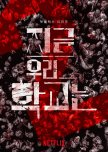




Upcoming Korean Dramas & Movies
140 titles 616 loves 13


Upcoming Korean Dramas
317 titles 253 loves 4


My Most Anticipated
1080 titles 223 loves 8
Recently Watched By


