News
News 


My Therapist Says I’m Not Allowed to Talk About the Gold Anymore
Let me start with a confession: I went into Remnants of Gold expecting a stylish sand-and-swords romp. What I got was a three-day existential crisis, a sudden urge to distrust all dunes, and a profound fear of loose change.Director Xu Bing doesn’t just adapt Gu Long—he dissects him. The 300,000 taels of gold aren’t treasure; they’re a Rorschach test. Everyone who chases them doesn’t go mad—they go true. And that’s the horror. The desert isn’t a setting; it’s a character, and it hates you personally. The cinematography is so achingly beautiful that you’ll forget people are screaming until you realize you’re the one screaming.
The Serious Part (because I have to):
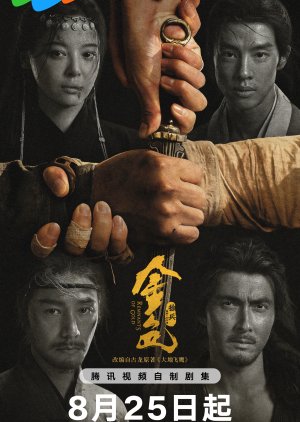
This is a Wuxia drama about the death of idealism. Pu Ying (Yin Fang) is the law’s last gasp, and watching him wrestle with duty while the sand eats his morals is like watching a candle burn in a hurricane—heroic, futile, and hypnotic. Xin Zhilei’s Zhang Luyao is a revelation: a vengeance engine wrapped in poison-proof skin, yet somehow more fragile than glass. She doesn’t want the gold; she wants the lie that gold represents. Chen Kun’s Yu Hou is the political animal we all fear becoming—calculating, charismatic, and utterly hollow. And Vengo Gao’s Ban Zha? The chaotic neutral trickster who made me laugh, cry, and question if freedom is just another cage.
The Funny Part (because I’ll cry otherwise):
· The gold has a higher body count than the plague. At this point, I’d trust a timeshare salesman more than a treasure map.
· Ban Zha walks into every scene like he’s at a desert rave, and I respect that energy.
· If I had a coin for every time someone whispered “the gold” with dramatic gravitas, I’d have 300,000 taels and promptly lose my mind.
The Thought-Provoking Part (because I can’t stop):
Is the gold a metaphor for ambition? Greed? Hope? Or is it just a MacGuffin that exposes how we’re all willing to become ghosts for something that doesn’t exist? The show asks: What do you chase when you know the chase will destroy you? And then it gives no answers—just more sand, more masks, and more broken oaths. The finale doesn’t resolve; it echoes. I sat through the credits in silence, feeling like I’d just watched a funeral for every character I loved, including the parts of myself that believed in happy endings.
Final Verdict:
It’s a masterpiece. It’s also emotional vandalism. I’d rewatch it endlessly—not because I enjoy the pain, but because each viewing reveals a new lie, a new truth, or a new shadow on the dune. Bring water, bring patience, and bring a therapist. You’ll need all three.
10/10. Would lose my sanity again. Next time, I’m chasing the gold with Ban Zha. At least he’ll make me laugh before we both die.
Was this review helpful to you?

 1
1 1
1Heaven Is a Place on Earth
Remnants of Gold is a heavily reimagined adaptation of Da Di Fei Ying (大地飞鹰), one of Gu Long's later and lesser-known wuxias. Beyond the broad outline of a treasure hunt for 300,000 taels of mythical gold stashed somewhere in the middle of a desert, the drama bears limited resemblance to Gu Long's novel. Main characters have been rearranged into supporting roles around new characters, anchored by industry heavyweights Xin Zhilei (Zhang Luyao) and Chen Kun (Yu Hou). Despite the extensive changes, the scorchingly hot noir desert setting unerringly captures Gu Long's signature cold, cynical, and morally ambiguous world.Perhaps director Xu Bing's most audacious innovation is that the protagonist, Zhang Luyao, is a woman. And what a woman! Only an actor of Xin Zhilei's caliber could bring this character to life so compellingly. Unlike Jin Yong, Gu Long never created any iconic female characters; his women were always merely plot devices for his men. So Zhang Luyao is the heroine Gu Long never dared to imagine, much less write. At first, it seems she is set to avenge her family, but later it seems as if she simply wants freedom. She doesn't have grand ambitions to save the world—just herself and one or two lost souls that are, or once were, righteous. Her quietly spoken truths and simple, pointed questions ring with the same clarity as her bell that has the ability to recall a lost soul. This kind of slow, profound, and deep soul-searching is ultimately fatalistic and nihilistic, and explains why Gu Long never enjoyed the same broad, popular appeal as Jin Yong did.
But it is Yu Hou—the Liangzhou Deputy Envoy with a penchant for fine Jiangnan silk pajamas—and Luyao's chance affinity and mutual understanding with him that moved me most. It is the quintessential Gu Long: profound connections formed during transitory encounters that can reshape a person's understanding of themselves and their destiny. Once again, Chen Kun delivers a memorable portrayal of a wretched character yielding to his worst instincts. The pitiless candor in his eyes when he unhesitatingly admits to Luyao—"I was always like this"—and the flash of surprised understanding and acceptance in Luyao's expression. I also liked the gentle giant Ban Cha; I feel this is Gao Weiguang's best role to date.
Neither Xiao Fang nor Pu Ying, who are the main protagonists in the original novel, made a lasting impression on me. In fact, I found Pu Ying to be an annoying version of Cervantes' Don Quixote. Xu Bing has a tendency to irritate the viewer with a super annoying lead character that is hard to root for. It is the main reason why I don't run around telling everyone to go watch Fearless Blood, which is otherwise a fantastic Republican-era wuxia.
For a wuxia, the action scenes here are good enough, but I have seen better. This is forgivable because it is more of a character-driven wuxia. I won't lie—I didn't like the penultimate episode, where the story largely ends. Luyao, who entered with such a quiet force, seems to fade away; even her intelligence seems to dim along with her reason for existence. The morally ambiguous characters and that overarching sense of impermanence and the meaninglessness and suddenness of fate make it difficult to care for anyone in this story. Long before George R.R. Martin, Gu Long was killing off characters suddenly and before their story arcs seemed complete. GOT just took it to another level of gore that Gu Long didn't indulge in. That actually makes the abruptness and finality of it even more stark. What saves the drama is the finale, which seems to unfold on another plane of existence. It wrapped with a sense of humor, and some tears of happiness and sadness. It can be taken literally or metaphorically, depending on whether you think Wusuhai—or heaven—is a place on earth.
This kind of profound, reflective and heavily fatalistic story will not appeal to everyone, but I really enjoyed it. I rate it 8.5/10 overall.
ENDING SPOILER COMMENTS
The final episode can be taken literally or metaphorically. The final battle unfolds next to Minghai (冥海/Nether Sea)—in Chinese fantasy, a nebulous realm between the living and the dead. Wusuhai, described by Ban Cha as close to heaven, lies across Minghai. Even Tang Zheng hesitated to cross Minghai, and after he dies, both he and the Qin Demoness don't get to cross over; they travel toward an opposite, possibly hotter destination. This leaves open the possibility that the Luyao who woke up to go on to Wusuhai has crossed over to another realm. After Pu Ying slides down the sand, we see the gold bars are a mirage, and all that lies ahead is the desert stretching on endlessly. The oasis that is Wusuhai disappears. It was all a mirage. This kind of ending—one that can be interpreted both ways—is very hard to do well. But Xu Bing pulled it off.
X
Was this review helpful to you?
 1
1 1
1This review may contain spoilers
What is worth preserving in yourself when everything around you has a price?
Introspective and transcendental, with a subtle supernatural touch. A story that looks for something far more valuable than the gold at its centre: what remains of us when desire, survival, and circumstance put our values to the test.“In this life, is it better to die with wealth enough to rival a nation, or to die respected by others?” At the end of your life, what has greater value: what you possessed, or what kind of human being you were?
10/10 for the dialogue, directing, and performances.
The dialogue can be strangely dry and almost absurd at times. Conversations have a very mundane, human rhythm. The characters sound like a collection of peculiar individuals who happen to have ended up in the same desert rather than generic wuxia archetypes. I loved the conversational quality: exchanges feel like two people reacting to one another rather than actors waiting to deliver polished lines. You are expected to catch the tone, pause, facial expression or contradiction yourself. The dialogue and behaviour feel like real everyday life rather than something written for a drama. People hesitate, ramble a little, make ordinary comments or leave things unsaid. Small gestures and people not explaining themselves make the drama feel lived rather than performed. You get the impression that the camera has happened upon these people rather than that they’ve positioned themselves for a scene. Each one appears suspicious, and by the end of the drama, you finally understand who they truly are.
The location, voices, yellowish grading and even the very dark, naturally lit night scenes make the production feel very tangible. The real desert reinforces all of it. The wind, sand, sun and emptiness feel almost like another character rather than merely a picturesque background. The gold itself feels almost metaphorically like a seductive trap, while the endless desert becomes the grave of those consumed by greed.
The ending is beautifully open to interpretation. Whether the gold is literally there almost becomes secondary. Zhang Lu Yao sees it and can still ride away, unlike so many who were destroyed by their desire for it. Even more striking is Pu Ying. One of the purest characters, he has consistently refused the gold. In the final scene, he rolls down the dune and accidentally uncovers the ingots without even noticing them. The irony is beautiful: the man who never wanted the gold is the one who finally reveals it. He doesn't even need to reject it anymore; it has simply ceased to hold value in his inner world.
Throughout the story, people desperately search for gold and destroy themselves trying to find it. In the end, when nobody is searching, it quietly reveals itself to the person who wants it least.
Those who desperately sought the gold could not possess it. The man who never wanted it finds it without even knowing he has.
Was this review helpful to you?

 1
1What Do You Carry Across a Desert?
Three hundred thousand taels of missing gold, a massacred family and far too many people who seem to know something about both.That is more or less where Remnants of Gold begins. Zhang Luyao is looking for the truth about what happened to her family, Pu Ying is following an investigation of his own, and somewhere between them sits a much older story involving soldiers, old loyalties and a fortune nobody seems to have actually enjoyed.
It sounds like a mystery about missing gold. For a while, it is.
But the further the story goes, the less interesting the gold becomes.
Part of that is because of the people gathering around it. Zhang Luyao is intelligent, guarded and formidable, but thankfully not written as someone whose intelligence prevents her from making bad decisions. Xin Zhilei gives her a wonderful stillness; she can look exhausted by the world and still be the most dangerous person in the room.
Yu Hou is much messier. Chen Kun makes him selfish, charming, cowardly, lost and loyal without making any of it feel contradictory. He wants money because money means freedom, or at least he thinks it does. The problem is that he keeps forming attachments that make walking away considerably harder than he planned.
Pu Ying is quieter. Yin Fang gives him an appealing steadiness, although the writing never opens him up quite as much. And then there is Ban Cha, who appears with his wine and salt and the general air of a man who has wandered into everyone else's emergency by accident.
By then, the gold has collected an increasingly strange jianghu around it. Ha Bingzhong, Tie Futu, Xiaofang, Pingping, Seventeen, Tang Zheng, the Qin Demons... almost everyone arrives with an old debt, a private motive or some piece of history nobody thought worth mentioning earlier.
I liked that. A strange habit, an old grievance, a few lines of dialogue, and someone who appeared ten minutes ago can feel as though they have been wandering around this world for years.
Sometimes, though, there really isn't much more than the suggestion.
Thirteen episodes keep the story lean, but they also leave several characters somewhere between memorable minor figure and plot mechanism. Xiaofang and Pingping matter, yet their fates very conveniently push other characters where the story needs them to go. Tang Zheng arrives carrying enough history for another drama, while the Qin Demons are wonderfully strange and also suspiciously useful when needed.
Despite finding these people interesting, I never became deeply attached to most of them. The drama keeps us at a certain distance, letting people reveal themselves through what they do, what they remember and what they refuse to explain. I suspect some of that is intentional. Sometimes it works. At other times, especially when characters start dying, I understood why something mattered before I necessarily felt that it mattered.
Xu Bing's direction can be similarly uneven. He likes taking his time, and often I liked taking it with him. People sit and drink, conversations circle around what nobody wants to say, and silences are allowed to last.
But sometimes a scene continues after it has already made its point, while something much more important is treated so elliptically that I wondered whether I had missed a scene somewhere. This becomes particularly noticeable toward the end, when thirty years of grudges, loyalties and unfinished business suddenly have to come together in very little time. Some deaths feel inevitable. Others feel rather more like somebody needed to die so somebody else could finally make a decision.
The desert location work is one of the drama's strengths. It looks dry, empty and unpleasant to cross. The fights have weight, people get dirty and exhausted, and there is a roughness to the whole thing that suits this world. Some of the sets are much less convincing, especially beside those landscapes.
I liked the sense that these people had lives before we met them. They are selfish, loyal, petty, stubborn, occasionally foolish and not always easy to place neatly on one side of anything. Even when the writing didn't give me quite enough of them, it usually left me wanting to know more.
And somewhere along the way, I stopped wondering who would end up with the 300,000 taels of gold, or whether there was ever any gold to find. After enough time in this desert, even the gold begins to feel like a story someone once told.
I wanted to know what would happen to the people still looking for it.
There is quite a bit here that bothered me, but I can already see myself watching it again someday. So despite all my complaints, I'm giving it an 8.5.
Was this review helpful to you?

No Good Deed Goes Unpunished
Nobody in Remnants of Gold seems particularly interested in being a hero.Useful start.
Pu Ying probably comes closest. He gets beaten up.
Zhang Luyao is considerably more formidable. It doesn't make her happier.
Yu Hou would very much like to survive.
Unfortunately, he knows people.
This is the sort of wuxia where character tends to reveal itself at inconvenient moments.
Someone keeps a promise when breaking it would be smarter.
Someone betrays one for reasons that almost make sense.
An enemy behaves decently.
A decent man does something stupid.
Nobody stops to explain the moral.
Much appreciated.
The performances understand this.
Chen Kun never asks for Yu Hou to be forgiven. That makes him much easier to enjoy.
Xin Zhilei keeps Zhang Luyao's grief somewhere behind the machinery. You see the cost before she tells you about it.
Yin Fang is allowed to look thoroughly unheroic while doing heroic things.
And Gao Weiguang's Ban Cha is wonderfully difficult to pin down. Relaxed without being foolish. Principled without becoming righteous. The kind of man who seems to have made peace with the world mostly because he understands exactly how unpleasant it can be.
That one stays with you.
The whole drama is a little odd like that.
People say less than expected.
Appear later than expected.
Die earlier than expected.
Occasionally the plot explains less than expected too.
Not always charming.
Xu Bing can mistake patience for unlimited credit, and thirteen episodes eventually send someone to collect.
But there is very little desperation here to make wuxia look impressive.
No immaculate heroes required.
No grand speeches every time someone chooses correctly.
No guarantee that choosing correctly will help.
Just a collection of strange people trying to decide what they're willing to live with.
Thirteen episodes isn't very long. These people have a way of making it feel much too short.
Some do better than others.
Naturally, those are not necessarily the ones who live.
Was this review helpful to you?

An atmospheric wuxia in the unforgiving desert of China's far northwest
Remnants of Gold revolves around 300,000 taels of gold suddenly appearing in the desert of Northwest China during the early years of the Ming Dynasty, with rumours saying that those seeking it become vengeful ghosts, killing each other. When the Zhang family's escort agency was wiped out overnight, the daughter ventured alone into the desert to seek revenge while an imperial investigator was sent to solve the crime, marking the starting point of a tale of revenge, greed, loyalty, brotherhood, friendship and justice in this far, desolate part of the jianghu.Gu Long (the novelist) and Xu Bing (the screenwriter and director) set the distinctive tone
This 13-episode drama is an adaptation of Gu Long's novel “Flying Eagle over the Great Land” (大地飞鹰 - Dàdì Fēiyīng.) by Xu Bing, who is also the director. These two aspects are important when it comes to Remnants of Gold, as both the style of the novelist and Xu Bing's strong signature in his dual role, impact the type of wuxia you see on screen.
Let's start with Gu Long. I haven’t read anything from him, but secondary sources in English, such as Wuxia Society, describe his style in its mature period as having a distinctive minimalist prose, with extensive dialogue like a script in a play, complex character psychology and Western literary influences, highlighting aspects of human life, intelligence, poetic philosophy and mysterious plots.
You can trace all the above in Remnants of Gold, where fight scenes are there but scattered and used more as a device to tell us something than as mere inevitable confrontations to showcase martial arts skills: unleashing the plot, revealing characters' positions and agendas, marking the climax both for the characters and the main story arcs.
But even when a fight isn’t narratively important, it still needs to be well filmed visually. Whether it’s a single punch or just one thrust, it has to look real and remain coherent with the atmosphere it’s inserted into. And the fight scenes in the drama were in general lacklustre, with few exceptions. I wasn’t expecting highly choreographed fights such as in Side Story of Fox Volant or Blades of the Guardians, but considering Xu Bing’s previous Eastern Heretic and Western Venom wuxia (2025) or Fearless Blood republican road trip (2023), they felt bland for his standards. As there were two adittional directors working with Xu Bing this time, it must be the case of the uneven result on the screen.
Xu Bing's style is also evident. This is the fourth drama I saw by him as screenwriter and director – the only one who managed to reach this achievement – and loved all of them. They're not for everyone's taste as they're full of personality, but they align with my sensibility.
Since the first episode of Remnants of Gold, a lot of things happen while apparently nothing is happening; the drama might feel slow sometimes but a lot is conveyed under this apparent pace. The story builds in arcs that increase the tension slowly until it explodes, then starts again from a slow pace to repeat the cycle but now with an evolved context and new characters, while the ending always leaves a bittersweet taste.
You could say that his usual big trademarks fit perfectly with Gu Long’s soul — those traits described earlier — , while also bringing his own flavour through subtle touches of dry humour, random characters showing up to distort plans, absurd situations that test your patience, simultaneously contrasting dynamic scenes in a sequence. All characters, even the smaller ones, are well fleshed out too, and all are entertaining and interesting in their own right.
The result is an atmospheric, moody drama which focuses on the characters' inner world and their interactions with each other, where the pursuit of gold is more of a test to reveal the real essence of those searching for it than a classic action-packed wuxia with heroes. If you like this combination, you’re in for a ride.
Production with Xu Bing is always very solid, although this time the other aspect that was underwhelming besides the fight sequences was the cinematography. To clarify, the drama has texture, but the combination of studio settings and real locations (Dunhuang’s Mingsha Mountain, Guazhou, and Aksai) downgrades the final result somehow in my opinion. I wrote about it already in other place, so I won't elaborate further now. I'll just say it wasn't a dealbreaker for me, as I was enthralled by the general mood, and after an initial adjustment, it became secondary to the whole experience.
The Gold and the Desert will test who you really are
Friendship, loyalty, justice, corruption, what's right and what is wrong are the underlying topics, as expected in all wuxias, but in this jianghu there's no hero, or at least the classic ones you could call such. The far desert land with its infinite sand, constant wind, desolate conditions, scorching sun and unbearable heat forgives nobody and pushes everybody to their limits: the decisions they make along the way will show who they've become and who they truly are, whether they like it or not. Some characters have more arc development than others, but they always remain coherent within their logic.
Every character can be defined by their relationship with gold: a tool for freedom and a life of pleasure, a tool to gain and have power, simple greed, those who don't care about it at all for several reasons, those who are bound to it due to loyalty and brotherhood, an excuse to accomplish revenge. But they're also defined by their relationships with others: the most important things are those that sometimes are kept unsaid, while other times are said directly; on other occasions, what is said opposes what is done,, and for others, both words and actions match.
The desert is the omnipresent character that determines everyone's fate, and from whom they can't escape: For some, it's a trap; for others, a choice; in other cases, it's part of who they are and what they value; it can even be freedom for a few.
I had fun with all the characters without exception, including endearing or remarkable smaller ones. Among the main ones, my favourite is the complex and conflicted Yu Hou. It's been a while since I liked a character so much, and it's definitely because of the writing and the excellent performance by Chen Kun, really fleshed out but restrained. And I also ended up liking Yu Ping quite a bit, played by my hit-and-miss Yin Fang - this time on the bright side. As for the secondary ones, I was particularly entertained by the coroner and the bandit Tie Futu – whose actor happened to be the director of Side Story of Fox Volant!.
For me, Remnants of Gold is a very engaging human study disguised as a gold treasure hunt in a far and harsh jianghu, with a very distinctive personality, well written, well executed, well acted. I was thrilled to have a wuxia with his flavour and this mood set in these desolate locations, a breath of fresh air I truly appreciate. Without doubt, it has cemented Xu Bing as one of my favourite cdrama screenwriter-directors for his latest projects.
-------
I´m leaving here for those interested, a paper translation of Gu Long’s own words about how he understood what wuxia should be (coinciding with my own reading of what I saw in this Xu Bing’s audiovisual adaptation). Author: Yan Wang Title: My translation of Prologue of Gu Long’s martial arts novel “End of the World, Bright Moon and The Blade (1974)” — Platform: Academia.edu
-----
This piece is about style and spirit — the traits non mandarin sources associate with Gu Long, and how I see them reflected in Xu Bing's writing and directing, not about how faithfully the drama follows the plot or the changes made from the source novel, which I don't discuss here. "Fits perfectly with Gu Long's soul" is shorthand, and a literary use of language, for those traits described earlier in the paragraph.
Was this review helpful to you?

This review may contain spoilers
s wealth important
Remnant of Gold is a beautifully written drama with a story that really makes you think. It shows how greed can slowly strip away people’s humanity, making them cruel, selfish, and willing to hurt others for their own gain.The acting was outstanding. Xin Zhi Lei as Zhang Lu Yao was wonderful. Her character is simple and warm — someone who has suffered but still manages to smile and, more importantly, continues to have compassion for others. I really loved that quality in her.
Yin Fang as Pu Ying also stood out for me. He is not the strongest person physically and cannot always fight his way out of difficult situations, but he is always ready to protect others and stand on the side of truth and justice. His character had a quiet strength that I really appreciated.
And then there is Chen Kun as Yu Hou. I kept hoping until the very end that he would choose truth and justice and become the person I believed he could be. His character left me with mixed feelings, and I honestly felt sad about the choices he made.
I was particularly unhappy about Bacha's death. He was not greedy, and I felt that someone like him deserved a better fate. I felt the same about Xiao Feng and Ping — both characters deserved to live. Their deaths were difficult to accept.
The dialogues were very good, and the story did an excellent job of showing how greed, ambition and the desire for power can change people. What makes the drama even more interesting is that not every character is simply good or bad; many of them are shaped by their circumstances and choices.
And I have to say, I loved the ending! It gave the story a satisfying conclusion and left me thinking about its themes even after I finished watching.
Overall, an engaging drama with a strong story, excellent performances, meaningful dialogues and characters who stay with you. Definitely worth watching.
Was this review helpful to you?

This review may contain spoilers
In love with desert landscapes!
The first thing to stat here is… Where are more chinese doramas like this!!!! I want to know how to find some other works like Remnants of Gold, so different, so original, so hard, so wonderful!I discover this beautiful jewel by chance, looking the poster of one of the characters, performed by Bu Guanjin. WTF!, only seeing the looks and the outfit of the character I thought “this is something that has to be seen”. And I wasn’t wrong. I have to admit that my view is “distorted” because I fall in love at first sight with her. Her looks are absolutely different at any other look seen in a chinese dorama for a girl. That sunburned skin looks amazing on her (tired of seeing always “whiter shade of pale” skins, yeah, bored with it). The same applies to Gao Weiguang, my God, that man appears insanely handsome in this alternative look highly unusual in China. The characterization of everybody searchs to fit in the landscapes of the harsh lands of the Gobi desert. I’m impressed by the excelent work made by the wardrobe staff, thumbs up for all of them…
I’m from very far away from China and I not sure if I get all the context, here, for stat some opinions, hahaha; but I think this work displays supperb quality in many levels, for sure. The direction, the settings, the landscapes, the attires, the plot, the demeanor of the characters… all seem very different to the standard format of the chinese dramas, I dont think I’m mistaken. All of this it is wonderfully made, in a supperb level of higher quality, with an especial effort to differentiate from the rest of the productions. Why I think this? (spoiler alert, beware…)
-The plot. Here, there are no effort in nothing resembling romance, hahaha, and it’s really refreshing. Sometimes, I end up bored with ridiculous plots with ridiculous lovers making ridiculous things about love. Here, thankfully, it does not happen. Here, there are survival struggles, greed for gold or for power, and all is much harder and more difficult.
-Violence and death. My God, there are some doramas where death are something that seems not to exist. The people get beaten, pierced by arrows or swords, fall from heights… and nobody dies!!! Sometimes reaching ridiculous extremes, wtf. Here, there are violence and well represented, harshly and cruelly, sometimes bloody, and I like it a lot, call me weird, hahaha. And here is the spoiler; there are a lot of characters who find death, how sad I was in some of them.
-The landscapes and settings. I think I have never seen a similar quality at this level, for sure. The work is made with accuracy, everything suits magnificently and every single image of the show is an spectacle in itself. I fall in love with the harsh sand landscapes, the dirty places, the windy storms, the “desert balls” rolling on ramshackle towns, hahahaha. Believe me, this is a masterpiece.
-The attires and characters. As I was saying, all the performers here had that dishelved look, with outfits with headscarves, sunburned skin and desert-like appearance. I can only praise the full cast for daring to appear so “wiped out”, so shattered, actually realistic and, by that, wonderful.
-The performers. I think the cast was done on purpose searching really good performers, my God. It’s really amazing, all the people here are wonderfull, threre are no flaws, really. But I especially want to praise the actress Bu Guanjin with her support role, a really warrior girl and, why not say it? She appears stunningly beautiful here, way more than any of those ice faced usual “divas”. I’m fully in love. Gao Weiguang is a really really good performer, yeah, and here the man is at it’s best. Xin Zhilei and Ken Wu are stunning too, i like all of them, and all the support roles and the various weird characters are wonderfully performed. High quality in all levels, oh yes. Maybe the character of Pu Ying (Yin Fang) is the weakest, but is not serious problem.
Long story short; I can only recommend this drama effusively, is a really complete show in all levels, top notch quality, I can swear it. Thumbs up!!!
Was this review helpful to you?