News


 1
"It's to put our fears at rest"
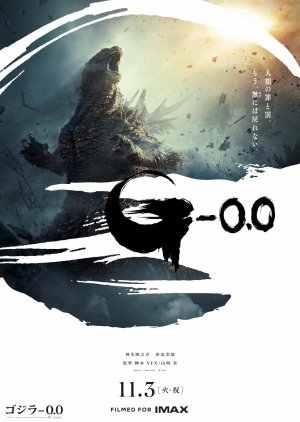
If Japan was at Minus One after WWII, another round with destructive kaiju would put them at Minus Zero this time. Two years after Koichi helped destroy Godzilla, a meteorite delivers a new terrifying nemesis!It’s 1949 and Dr. Noda and his team are back with new member, meteorologist Aoyama Makoto. A new dragon-like kaiju has wrecked a town with biologist Murakami Kanji surviving. He joins Noda’s team in a search for a weapon to kill the newly dubbed Ghidorah. Pilot Shikishima Koichi is once again called into action, but Ghidorah proves as difficult to eliminate, or more so than Godzilla. Even a regenerated Godzilla might not be bad enough to take the ever-evolving alien kaiju down.
First off, I saw this in the theater and highly recommend seeing it this way if you have the opportunity. Wearing my Godzilla and Mothra pins I settled into a seat that would shake and shiver as Godzilla and King Ghidorah rumbled through towns and fought. A nice interactive experience. As a popcorn monster flick this film delivered. Godzilla didn’t show for an hour but that was okay because Ghidorah exploded onto the scene early! Ghidorah is my favorite kaiju villain and this version was excellent and terrifying. Certainly, a match for Big G. The kaiju were designed well and their scale to each other and their surroundings was believable as the tiny humans ran for their lives and buildings crumbled. I thoroughly enjoyed the new horrifying innovations for Ghidorah. I still miss OG Ghidorah’s sound effects that I only glimpsed once.
I was happy to see Koichi and Noriko have significant parts again as well as Dr. Noda. This time around there was a call back to Hiroshima with a vengeful Murakami looking for payback after his family was killed by the atomic bomb. Aoyama attempted to use weather to take out Ghidorah and then to track it. The Americans played a role on the periphery allowing the Japanese to take their shot at the giant foes while they observed from a safe distance. When a method was discovered to attract Godzilla, they of course, could see the potential for a weapon.
Minus Zero didn’t have the same quality of narrative cohesiveness that the first film displayed. This film had a tendency to lean into the melodrama with too long of scenes in an orphanage or Murakami slipping a cog. Koichi’s daughter was given every opportunity to wail at the top of her lungs which began to wear on me.
Overall, I enjoyed Godzilla Minus Zero and if it hadn’t cost a small fortune for movie tickets would have experienced it a second time. Not as thoughtful as the first one but as a monster flick they succeeded. The human stories were compelling if overly long. When the giant talent was on the screen it was something to behold. And the fact it was made for $20 million is astonishing. If you enjoy Godzilla films, this is one to try.
10 November 2026
Where are my notes?!: When the film streams, I’ll come back to this review. I wasn’t able to take notes in the theater and just immersed myself in the film.
Was this review helpful to you?

This review may contain spoilers
Fantastic
Godzilla Minus Zero is absolutely fantastic. It's a solid sequel and the special FX are once again top notch. I almost lost it at the end when I thought something was going to happen that didn't. Takashi is great at pulling those emotional punches and making people question what they would do in a situation.The musical score was phenomenal as well. The Godzilla theme music reminded me of the Darth Vader Imperial March.
Something, I found ridiculous and funny was that when they were trying to trap Ghidorah and they were all on top of that raggedy building and I just kept thinking no way they all staying on top of that building.
11/8/26
Was this review helpful to you?

Too Much Planning, Not Enough Godzilla
Godzilla Minus Zero:*Godzilla Minus One* reminded us why Godzilla is one of cinema's greatest icons. It combined spectacular destruction with a genuinely moving human story. *Godzilla Minus Zero*, unfortunately, seems to have forgotten much of what made its predecessor so extraordinary.
The film suffers from a sluggish pace, overloaded with strategic meetings, scientific explanations, and elaborate plans. Instead of building anticipation, all this preparation gradually drains the story of its energy.
And that's the problem: **Godzilla doesn't need to be complicated to be spectacular.** A gigantic monster, humanity desperately trying to stop it, and a confrontation capable of leaving audiences breathless. Sometimes the simplicity of that premise is precisely its greatest strength.
The subplot involving a scientist traumatized by Hiroshima is particularly unnecessary. His imagined revenge against the United States introduces an ideological detour that contributes very little to the central conflict. It feels inserted to deliver a political message rather than develop the story. Worse still, the logistics of his proposed revenge are so absurd that the entire sequence becomes difficult to take seriously.
Meanwhile, the film devotes considerable attention to meteorological predictions, electrical storms, and increasingly elaborate strategies for bringing Godzilla and King Ghidorah together. The characters spend so much time discussing what they intend to do that the film occasionally feels more interested in planning a monster battle than actually delivering one.
And when the confrontation finally arrives, the payoff is disappointingly modest. There are impressive images and moments of genuine spectacle, but the battle itself never reaches the monumental intensity that such an encounter promises.
This is ultimately a question of narrative balance. **The longer a film makes us wait for its central spectacle, the more extraordinary that spectacle must be to justify the wait.**
*Godzilla Minus Zero* has the monsters, the visual resources, and the cinematic legacy to deliver something unforgettable. What it lacks is the narrative discipline to make the most of them.
Too much preparation, too many explanations, and not nearly enough payoff.
**Sometimes, the best plan for a Godzilla movie is simply to let Godzilla be Godzilla.**
Was this review helpful to you?

-1 + 0 = - 1
C'est finalement trois ans après l'inattendu (pas pour moi) succès planétaire de Godzilla Minus One que nous arrive, en sortie mondiale simultanée et en IMAX, cette suite, cette fois-ci simplement attendue. Ceux qui avaient enterré la bête un peu vite, en présentant le succès comme un coup de chance d'une industrie cinématographique japonaise incapable de s'exporter, notamment en Occident, vont devoir encore une fois revoir leur opinion, et cela dès les premières minutes.Si Minus One était phénoménal à tout point de vue, avec ses effets spéciaux en tête, Minus Zero ne se contente pas de remixer la formule antimilitariste et anti-impérialiste sous des tonnes d'effets visuels : il la sublime par des couches supplémentaires d'émotions et de sentiments déjà bien présents. Si vous craignez une trop grande facilité scénaristique, à grands coups de pouvoirs extravagants de la part de notre survivante nourrie au rayon gamma, soyez rassurés. Le réalisateur Yamazaki Takashi réussit l'exploit de mettre de la retenue là où semblait pourtant s'imposer l'évidence fantastique de la fin de Minus One.
La sobriété se dégage également du jeu des premiers rôles, même si les seconds rôles, scientifiques en tête, en font toujours un peu trop, rendant ainsi hommage aux films de science-fiction de l'après-guerre, avec leurs savants fous et leurs militaires aveugles. Les hommages aux grands classiques de la guerre froide ne se limitent d'ailleurs pas aux personnages, aux costumes ou aux décors : vous reconnaîtrez certaines scènes empruntées à des chefs-d'œuvre d'Hitchcock comme à des réalisateurs plus obscurs.
Mais cette pluie de références, ces scènes monumentales de destruction avec une esthétique vintage volontaire des effets numériques, des éclairs ou du rayon nucléaire rappelant tellement les premiers Godzilla, cette musique et cette ambiance sonore des années 50 ne doivent pas faire oublier la véritable force de cet épisode : sa puissance émotionnelle. Celle-ci atteint son point d'orgue dans la toute dernière scène qui, grâce à un jeu d'acteur sans faille, toutes générations confondues, vous arrachera les dernières larmes qu'il vous restera.
Si le spectateur prend souvent parti pour Godzilla dans la saga, ici, il reste éloigné des sentiments humains et reprend son rôle cathartique de catastrophe naturelle ou nucléaire, face à laquelle les faibles humains ne peuvent s'en sortir que par leur union. Le sens du sacrifice est à nouveau mis en avant, mais avec la nuance d'un après-guerre où tout le monde ne rêve que de jours meilleurs pour ses enfants. Ceux-ci sont d'ailleurs au cœur de cet opus, représentant l'avenir d'un pays saigné jusqu'à la moelle par une Amérique triomphante. Certaines scènes choqueront peut-être le spectateur occidental par leur propos clairement anti-yankee, même si les temps sont aussi à regarder l'Histoire en face.
Minami Manabe prend une place bien plus importante dans cette nouvelle itération, et cela pour notre plus grand plaisir. Mais elle n'est pas le seul personnage féminin fort. Nagasawa Masami nous transporte dans son univers météorologique et prend un rôle de leader pour conduire son pays, 70 ans plus tôt que Sanae Takaichi, vers un avenir bien meilleur que celui qui lui est promis aujourd'hui. Même si les doutes, les remords et les regrets rongent son personnage, tout comme l'ensemble du casting.
Car la véritable force des Godzilla Minus, c'est de montrer à quel point des personnages ordinaires peuvent se transcender sans super-pouvoirs ni gadgets en tout genre. Alors oui, certaines scènes sont complètement what the fuck. Prévoir où la foudre va tomber en premier ou réintroduire les mêmes personnages secondaires du premier opus à tous les niveaux relève parfois de la facilité scénaristique.
Mais ne boudons pas notre plaisir ! Peu de blockbusters peuvent se targuer de réunir autant de qualités diamétralement opposées. De l'action, des effets spéciaux et une émotion qui servent tous à transmettre des messages forts : l'importance de la famille, des liens parfois plus forts que ceux du sang, la nécessité de préserver les générations futures de l'horreur de la guerre, le combat contre l'avidité impérialiste et même l'urgence climatique, cause du retour des fléaux antiques.
Was this review helpful to you?