







 'KPop Demon Hunters' director: Song Joong Ki, IU, Park Seo Joon referenced for character creation
 - Português (Portugal)
- ภาษาไทย
- Português (Brasil)
- Nederlands
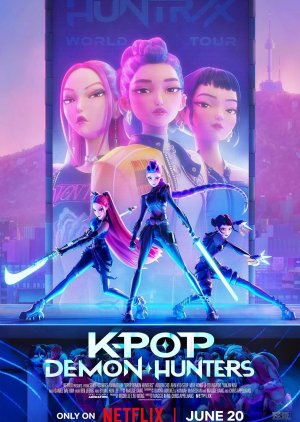
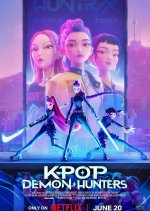
- Título original: KPop Demon Hunters
- Também conhecido como:
- Diretor: Maggie Kang
- Gêneros: Ação, Musical, Comédia
Onde assistir KPop Demon Hunters
Subscription (sub)
Elenco e Créditos
-
") Ahn Hyo SeopJinuVoice Actor
Ahn Hyo SeopJinuVoice Actor -
") Kim Yoon JinCelineVoice Actor
Kim Yoon JinCelineVoice Actor -
") Lee Byung HunGwi MaVoice Actor
Lee Byung HunGwi MaVoice Actor -
") Daniel Dae KimHealer HanVoice Actor
Daniel Dae KimHealer HanVoice Actor -
") Kevin WooMystery [Singing]Voice Actor
Kevin WooMystery [Singing]Voice Actor -
") Lea SalongaCeline [Singing]Voice Actor
Lea SalongaCeline [Singing]Voice Actor
Fotos
Resenhas

A Standout Animated Film
KPop Demon Hunters is easily one of the most compelling animated films released this year. It manages to blend modern pop culture with supernatural action in a way that feels fresh without trying too hard. The premise—K-pop idols secretly fighting demons—could’ve gone gimmicky fast, but the film handles it with a surprising level of care and style.What really stands out is seeing this film listed on kisskh. Usually, animations—especially ones from non-Asian countries—don’t make the cut there. But in this case, it actually makes sense. Unlike a lot of Western attempts to tap into K-culture, KPop Demon Hunters shows a real understanding of its influences, and it doesn’t just borrow the aesthetics—it respects them. That’s probably why it was given a chance where others weren’t.
The animation is clean, the action is sharp, and the characters are well-designed both visually and emotionally. The music hits the right notes without overshadowing the story. It’s fun, but it also has enough substance to hold your attention beyond the spectacle.
It’s not just good “for a Western animation”—it’s a strong film in its own right, and a smart, entertaining watch for anyone interested in a cross-genre story done right.
Esta resenha foi útil para você?

Esta resenha pode conter spoilers
A critical look at "Kpop Demon Hunters"
Narratively fractured and creatively barren, "Kpop Demon Hunters" reassembles genre conventions into a spectacle of commodified affect, where the promise of cosmic struggle is subsumed by performative decadence. Consider the hunters who, paralyzed by lust, pervert the moral architecture of their sacred duty and salivate over the demons they are sworn to vanquishThe movie incriminates itself through the imposition of non-platonic paradigms on male-female idol dynamics and the transfiguration of malevolent entities into archetypes of desire or victims of circumstance. Among the demons, Jinu being a salient example, many owe their damnation to a consistent disregard for the welfare of others. They have forsaken their familial bonds in pursuit of self-preservation and manipulated the truth to cultivate a favorable self-image
Rumi: "I know your story. You were a good person, and you still are"
Jinu: "I lied to you. I made a deal with Gwi-Ma to get myself out of that miserable life. I left my family alone while I slept on silk sheets in the palace with my belly full every night. I left them" (1:9:50)
Having condemned his family to destitution and starvation so that he might live in safety, Jinu endures punishment in the afterlife. Why would we mourn his suffering? No amount of retrospective remorse can rewrite history or nullify the ethical transgressions he committed
To forgive, or not to forgive? This is not a question posed to courts or the public, but a war waged behind closed doors and in the chambers of the wounded heart. Should Jinu's family, the aggrieved parties, extend forgiveness, it would be an act of courage and a near-divine suspension of justified anger. Should they withhold forgiveness, it would be a dignified reclamation of agency, a solemn tribute to what was lost, and a refusal to be coerced into premature reconciliation by societal or doctrinal demands. However, they could very well have departed to heaven. We are left with no clarity on where they stand in the matter
The story still performs a psychological sleight of hand. It acknowledges the demons' past atrocities only to repress their significance. The audience is conditioned to internalize a distorted moral hierarchy that valorizes temporary catharsis over justice, and conditional empathy over accountability. "They didn't deserve it," they would insist. The truth is, the demons in question are not misunderstood or fallen angels whose small errors brought about their condemnation
Rumi: "If this is the Honmoon I'm supposed to protect, I'm glad to see it destroyed" (1:14:42)
Rumi, who seconds ago endorsed the destruction of Honmoon, appears at the Saja Boys' concert with a newfound determination to protect it. Her abrupt shift in sentiment and subsequent behavior remain unexamined, to the detriment of character believability and emotional payoff
"Kpop Demon Hunters" suffers from a systemic breakdown across all creative domains. The characters, the dialogues, the songs. They dissipate into mediocrity
A critical divergence in reception has emerged regarding the songs, with fans asserting their qualitative superiority over the works of established Kpop groups. This position is one I do not share. Established Kpop groups, BTS, Stray Kids, ATEEZ, MAMAMOO, ITZY, FIFTY FIFTY, etc, have released songs characterized by melodic sophistication and lyrical depth. They are amenable to repeated, ritualistic listening. On the contrary, the songs from "Kpop Demon Hunters" are intolerable and unbearable to listen to beyond a single auditory exposure
Measured against the refined standards set by established Kpop groups, I believe the widespread popularity of "Kpop Demon Hunters" is disproportionate to its merits
TL;DR On a scale of 1 to 10, I would rate the movie a 2
Esta resenha foi útil para você?