"People can change completely depending upon the circumstances"
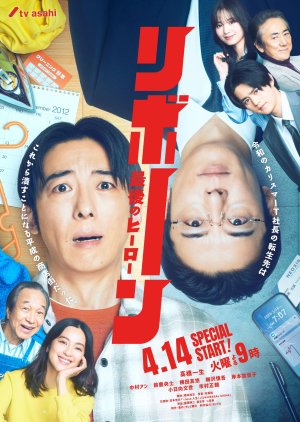
Takahashi Issei playing a dual role was all the motivation I needed to watch Reborn. The drama had an interesting premise but failed to capitalize on it for most of the episodes. While Issei was fascinating to watch as two different characters, much of the story failed to engage me.Neo Kosei began working in relief organizations gaining a good reputation. He propelled that quickly into a corporation that capitalized on others' misfortunes. He comforted himself by saying that the sacrifice of a few gave greater gains to the many. (I kept hearing a quote regarding Ebenezer Scrooge going through my head during this drama. "I have seen your nobler aspirations fall off one by one, until the master passion, Gain, engrosses you," Belle from A Christmas Carol.) When Neo takes a tumble down a temple staircase, he awakens in the body of Nomoto Eito in 2012, who coincidentally looks just like Neo. Eito was supposed to have died in an accident and yet now Neo is walking around in his body and part of the Akari Shopping Street that Neo had destroyed in 2026. Eito/Neo finds himself competing against himself as he tries to save the Akari shopkeepers and gain his old life back. Despite Eito/Neo’s attempts to change the future, the alley and his own life seem on a collision course with the known future and terrible price to pay.
As I said, the premise is worthy of a drama. The problem was the implementation. Chiefly, the shopkeepers weren’t well written. There were three that were often in the shot but rarely called by name. Most came across as amiable but financially incompetent and worse kept electing Eito’s dad, the financially inept Eiji, as chairperson or president. He was maddeningly bad with money and relied on himself instead of Eito/Neo which repeatedly made the situations go from bad to worse. There was a reason the street was failing. Eito’s love interest was kept hanging for 14 years which stretched the bounds of credulity. To top it off, the ending was unsatisfying and left numerous questions unanswered. If not for Takahashi Issei I would have rated this lower but gave it a .5 bump for him. Watchable, but frustrating.
16 June 2026
Was this review helpful to you?

People Can Change!!!, sometimes for the better, sometimes for the worse ...
This series was a little difficult for me throughout the first episode. It was just a bit slow moving and kind of difficult to see where it was heading ... BUT, give it a chance. By the end of the first hour or so, a great story plot emerges. You'll really be pulled into it with great anticipation for future episodes. Episode 5 takes the series to a higher level, the story goes into a direction you don't see coming and goes from good to great.It's not a new story, one person landing in another person's body after an accident, but this story has a bit of a twist to it. The person goes back to the past and is trying to save and change the future with the knowledge he knows from living through it already. ... but like I said, there are several twists and turns that cause positive and negative results.
Without giving away the final episode, that last 30 minutes you will not figure out what's coming. Several major story plots revealed, sending everything into a shocking conclusion.
Issei Takahashi is absolutely fantastic playing a dual role. Two totally different characters and he truly gives them such opposite personalities. It really is great entertainment to watch him perform. He uses a line at the very end that really puts this series into a nutshell ... "Maybe God likes to keep things balanced, good and bad things always seem to take turns"
It's so true in this series. Definitely a must watch!!!
Was this review helpful to you?

Perfect from Beginning to End
This series was very enjoyable and had a very refreshing take on the reborn storylines. It did a great job grabbed my attention. The script did an interestingly good job at setting up the key points of the storyline. It also did an incredible job connecting the events and characters from the two alternative timelines. All the storylines, including the romantic ones, had a nice even pace. I normally hate this type of story element, but this is a good example how and why you should use a time jump. It was also done in a very creative way. I have a minor beef with the very end of the series, but it made sense with all things considered. The whole cast did a phenomenal job bringing their characters to life. Kudos to Takahashi Issei for playing two different versions of one character. I would imagine it’s not easy play a character that was reborn as someone else and then pretend to be that person but still have to portray the other person’s personality. Another incredible element was the perfect editing, cinematography, and music.Was this review helpful to you?
This review may contain spoilers
Takahashi is great
The reason I watched this was because I needed more from this actor after binging on Kishibe Rohan. This series is very addicting- I watched 6 episodes in one day. And the rest of the episodes started coming in like a slow drip.Takahashi has this quality where he can be overly confident and borderline narcissistic while having a big heart of gold underneath. His performance soars above the others, and my ratings here reflect primarily on his performance, (the others were entirely forgettable even though many are familiar faces from other dramas I’ve seen). I think this is innate to the actor’s personality and so he can portray a broad depth of characters. Neo and Eito seem like opposites but are really two sides of the same coin. Even as Neo who is supposed to be overly driven and narcissistic and selfish, you can see the kindness in him underneath all of it. There is a vulnerability in him even in that role, and how underneath the bravado there is sadness and loneliness underneath. To see how that mind or soul adjusts to life as Eito is really interesting because out of necessity he builds compassion within himself, which was already there in him in seed form. Leave it to Takahashi to make you feel empathy for his character, seeing a deeper dimension in it, even when he’s playing a supposed a-hole. I noticed this even in Nagi’s Long Vacation and thought, “Wow this guy is brilliant.”
The story reminds me of The Family Man, where the first version of the main character is a high flying executive businessman who puts his relationship with some chick on the back burner, and he gets transported by a magical moment to have a glimpse into a different life where he had chosen the female over his career. He wakes up in a brood of kids and his wife- they’re poor, but happy and have hearts of gold. The businessman is painted as a arse, while the poor man with the wife and kids is painted as a saint where “real happiness” lives. To me the second life surrounded by buffoons looked like hell- and endless loop of the same old boring family characters crowding the scene with their needs and wants, and behaving in foolish, ignorant, and trashy ways, calling it happiness. This is the same virtue signaling I see in Reborn- the idea that poor people have hearts of gold and the rich like Neo are scum. But Neo has a good heart. If you look closely, the poor ones in Eito’s life are just as sinful, selfish, egotistical, money hungry, and greedy as the rich folk, sometimes even more so. The only thing is it is all mixed in with foolishness, sentimentality, and ignorance in business so they look even more ridiculous. And Sarasa making her ridiculous comments to her money hungry dad Kinpei San who lost their shopping street’s entire savings with bad stock investments, like “Maybe it’s good that you lost all that money, because I like seeing you working hard!” What? What kind of ridiculous nonsense is that? But when Neo offers a very fair deal to by up their shopping street and secure their futures with a lucrative relocation package in the name of “For the People” which he offered to pay 5 times the original amount, but the shopping street people are in an uproar because they “Don’t want to leave their home” and some sentimental nonsense even though they blew all their savings in some stock market fraud and have no customers left- but they have to blame everything on the rich CEO guy because “He must be bad and we need someone to blame for our problems even though we blew all of our savings which came from Eito who is really the mastermind of Neo so we should actually be doubly thankful to Neo.”
The fools of Akari shopping street are painted in a kind of saintly idealistic light as if they have hearts of gold when they are just ignorant, pompous, arrogant, greedy, and prideful for no good reason. They freely take Eito’s help, but constantly sabotage their success and go off drinking or harming themselves (ie Kinpei) whenever they have problems without regard to their families that they claim to care about. Kinpei starts getting drunk everyday in the name of bonding and sentimentality and eventually causes himself and the family the ultimate harm which is just an ego image of “We’re good people unlike that horrible Neo!” Again virtue signaling. Kinpei getting drunk shamelessly in front of his daughter while telling Eito useless old stories about Sarasa in diapers while she smiles on is not bonding or love, but dysfunction, coping, and addiction wrapped in sentimentality. Sentimentality is NOT true love or honorable or virtuous. Kinpei commits suicide and the whole family blames it on Neo, instead of understanding that every person is accountable and must take responsibility for their own actions. Neo didn’t kill Kinpei- Kinpei drank himself to madness and killed himself. He must be held responsible instead of blaming it on Neo and attempting to murder him. Taking their anger out not on Kinpei’s foolishness, but on Neo and other people who have nothing to do with Kinpei’s self destruction (he was known to drink too much even when Sarasa was a child and this fate was inevitable for him regardless of the situation). None of the fools on Akari shopping street understand the mind of Neo/Eito and even though he grows to love them or whatever, he remains set apart from them and an outsider. He is the only kind soul in that Akari Shopping street group that has any integrity. The shopping street fools never properly thank him or understand the gravity of how much he has constantly helped them.
Eiji (Eito’s father) tries to keep all the fools chained to his failing ridiculous shopping district for the sake of “memories” or sentimentality, which is nothing but stupidity and senseless attachment to material things and has no honor in it. Clutching to a dying shopping street business for what?
The croquette lady says this dialogue to Eiji following Kinpei’s second round of suicide: “Maybe it’s time to stop forcing your feelings on others. Everyone wants to stay. But if we stay, we’ll all die in the gutter. Face reality, Eiji. To survive, sometimes, you have to let something go…. (These younger guys).. they still have a future! How long will you keep them tied to this place? They’ll go along with you because they’re good, foolish people. Can you take responsibility for their lives? Our memories will live on in our hearts. We can dream of the day we come together again. Isn’t it time we let go?” This is probably the most sensible line of dialogue that came out of Akari shopping street. Finally someone had sense knocked into them. Though they pat themselves on the back for being “good foolish people,” there is nothing good or inherently righteous about being foolish and sentimentally attached to a dying business.
Eito’s father is truly a piece of work. Speaking of zero integrity, he blows all of Eito’s psychic prediction money that was supposed to be used to pay off their debts and instead bought himself a flashy suit and a watch and plunged them deeper into debt. How is that an heart of gold? “Oh but they’re just lovable family people!” No they’re not! And this father has no remorse except for an ugly sad expression as if he deserves pity for his own greed. And they somehow declare themselves saintly and virtuous compared to the rich guys. It’s abominable. The “low income” characters in the story are just as flawed and sinful or even more so than the rich ones, but the rich are blamed even when they do good. The poor just haven’t had the chance to play out their dysfunctional tendencies on a grander scale like the rich- just give them a lottery win and see what happens. They’ll blow it all in a few months. We all know how that turns out. People simply act according to their roles, and are mostly sinful creatures. It’s only the one that has true self awareness and conscious presence (aka Neo & Eito) who are the outsiders and can see the whole situation from a bird’s eye view beyond their role
So in the end, it was just as I had expected, Neo and Eito had switched places, and each was living and playing the role of the other. In Neo’s position, the soul is lonely and tries to do good from a distance while maintaining his position and ambition, and in Eito’s position the soul is kind and surrounded by ignorant buffoons but is apparently not lonely. My favorite scene of the entire series was the conversation between Eito and Neo in switched bodies (I increased my rating just for that scene)- it was truly a sight to see- but they had so much more to talk about! Like how they came from the same mother and are actually brothers or twins (?). But the new Neo just left it like that and Eito dies.. But that was Eito’s script- he fulfilled that role and exited the stage. For people saying it was an unsatisfying ending, each character on the stage has a role, events, etc and an exit time. Once that role is done, it’s done. I’d say it made sense- it’s not like any of the characters would live forever- and according to that Eito script and role, he was meant to die soon. So he played it out and bowed out of the stage. Interestingly enough, the original Neo (in Eito’s body) had intended to die/fall down the stairs to his death, and it ended up happening except in Eito’s body. Anyways, I like the open mysterious ending. I don’t need to figure everything out. A little mystery is nice. I don’t know who the baby is and I don’t care that much, although there are some interesting suggestions that it is Old Neo/Old Eito coming back into the baby’s body lol.. will it use its memories to ace its way through life? Who knows? Reborn the sequel! With that said, perhaps Old Neo/New Eito that died actually attained enlightenment (ego death) and doesn’t need to be reborn back into the cycle of samsara due to his high integrity and compassion he had developed in his Eito life, that basically surrendered the ego. That would be the best outcome of all.
Speaking of body swap dramas, Takahashi’s own drama Heaven and Hell: Soul Exchange is an awesome one!
ULTIMATE SPOILER QUESTION: If the original Neo intended to commit suicide by falling down the stairs himself with no murderer (as was suggested by the Neo vs Eito conversation), then why when he goes into Eito’s body does he spend the entire series trying to answer the question “Yo who pushed me?!” He keeps making it into a murder from the beginning, but if he had meant to fall down the stairs on his own, wouldn’t he remember that he was on a suicide mission? What’s going on there?
Was this review helpful to you?

Liked only for Takahashi Issei
As fan. Of Takahashi Issei I liked this. It would be great if work on story. Overall good to watch for one time.It not like normal time travel drama but with time travel plus swapping. Episode 5 was very plain.
Let's wait til final episode to make worth it or not.
Dislike: avarage story- story feel very common like other time travel drama so no excitement. You can predict next what happens some time.
Male lead Character: actor has more potential but lead Character feel limited not growing.
Likes: only male lead actor.
Was this review helpful to you?

This review may contain spoilers
Creo que vale verla
La vi mientras estaba emisión, o sea que tuve que esperar cada semana por 2 episodios (viernes y martes). Eso le da un efecto diferente a tener en cuenta. La historia es la de intercambio de almas típica para la redención del personaje principal que se había desviado del camino: sin embargo, da un paso extra donde la historia nos muestra que en realidad, todos podríamos cometer el mismo error si nos rodea cierta gente, entorno y circunstancias, ¡y por eso fue entretenida!Was this review helpful to you?

Boire ou descendre les escaliers, il faut choisir.
Il est plus que temps de sécuriser les escaliers au Japon. Si ma mémoire est bonne, Issei Takahashi s’était déjà pris les pieds dans une marche en 2021 dans Heaven and Hell: Soul Exchange. Et voilà que la perte d’équilibre entraîne une nouvelle fois son esprit dans le corps d’un autre. Après avoir vécu dans la peau d’une femme, le voilà contraint de refaire sa vie dans celle d’un « pauvre ». Car passer de la pourriture la plus riche du monde (mettez ici le nom que vous voulez) au cafard qu’il méprise ne sera pas simple. Un drama à destination des patrons des GAFAM et du « plus grand pays du monde », mais qui n’est pas dénué de défauts.Mis à part son scénario bancal qui mélange échange de corps vu mille fois et time slip vu dix mille fois, on est déjà fasciné par la médiocrité de ce premier épisode rempli de bons sentiments et de caricatures de pourritures humaines. Comment un aussi bon acteur qu’Issei Takahashi peut-il aussi mal jouer le Elon Musk de service ? Être obsédé par le pouvoir et l’argent ne veut pas dire être dénué de sentiments. À force de vouloir rendre son personnage froid, il en devient irréel. Après tout, même Donald a lâché Elon, ou vice versa. Comme quoi, l’argent de l'Oncle Picsou n’a pas suffi à vouloir écraser l’ensemble des pauvres fonctionnaires des États-Unis.
En plus de sonner faux tout au long du premier épisode, son personnage est entouré d’une galerie de mièvreries incarnées parfaitement par le gendre idéal Ouji Suzuka. S’ensuit alors toute une série d’épisodes où, tout en cherchant à rencontrer son ancien moi pour le détourner de la route de l’enfer, mais également celui qui l’y a poussé, il applique à la petite rue marchande ses anciens réflexes capitalistes pour la faire prospérer. Des situations plus ou moins « what the fuck » parsèment la série : l’invention des gilets et des tours de cou réfrigérants des années avant le Covid, des conseils d’investissement au doigt mouillé pris au sérieux par de grands groupes, des occasions de picoler en plein milieu de la journée qu’on n’avait pas vues depuis Juliette je t'aime, et surtout cette petite sœur qu’il n’avait pas remarquée dans son ancienne vie et qui aurait dû jouer un rôle majeur.
Gardons à l’esprit que Reborn tient davantage de la comédie familiale que du drama mystérieux à la Heaven and Hell: Soul Exchange, et c’est peut-être dommage. Mal à l’aise dans les deux rôles qu’il joue ici, Issei Takahashi transmet davantage un malaise qu’une joie de vivre. Reste à découvrir qui lui veut du mal (à priori l’ensemble de la planète) et comment tout cela va finir. Cela vaut peut-être le coup rien que pour voir la classe prolétaire japonaise descendre des litres de saké chaque fin d’après-midi.
Si vous avez ri devant « The Ch’ti, the North-South Exchange » (les Ch’tis, quoi), nul doute que vous apprécierez l’humour. Les autres, il vous faudra sans doute boire plus… mais avec modération.
Was this review helpful to you?