K-Drama


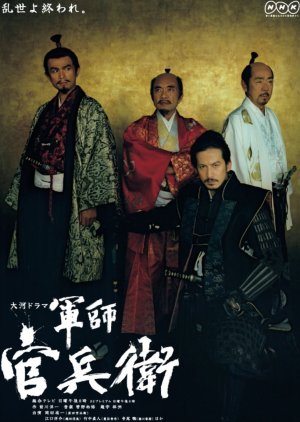
Kurode Kanbe is an acknowledged figure of the Sengoku period –the most chaotic era of Japanese history. He came from a humble clan in Himeji Castle but he distinguished himself through his impressing battle tactics. I will stop here to not spoil those who are unfamiliar with the history of the main character.
This taiga drama illustrated the life of the historically-famous strategist. It wasn’t only a numeric retell of his life story. On the contrary, Gunshi Kanbei was more focused on the emotional side more than anything. Which implores that you will get to know the story without the clinical heavy/slow pacing.
Sengoku Jidai is known for its numerous battles, renowned generals, political clashes, lots of betrayals and utter turmoil. This drama didn’t only illustrate Kanbe’s personal battles but it also included all of the major events that occurred during his lifetime. And since he was close to several main figures of the era, Kuroda Kanbei found himself entangled in all of those continued wars. He was forced to make critical decisions and became a key character in the unification of Japan.
That aside, Kanbe’s familial life was also put in the spotlight. His relationship with his vassals, his wife and his offspring was vastly explored and beautifully dramatized. But the over-idolizing was probably a bummer. Kuroda Kanbei wasn’t exactly a selfless man like the screenwriting pictured him to be. He was known to be quite ambitious. They didn’t focus much on that side except near the end. But again this isn’t a documentary and the main historical points were left untouched.
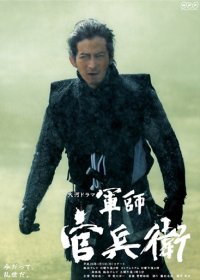
As usual in Taiga dramas, the cast was relatively loaded. Okada Juichi was marvelous as Kanbe. He’s definitely a rare Johnny’s –an idol of high caliber. I am so glad I got to first meet him through this. Other cast members were pretty fitting. But the ones who stood out the most were Egushi Yosuke’s Oda Nobunaga (one of the best portrayals of the legendary character), the penetrating performance of Takenaka Naoto as Toyotomi Hideyoshi, Nakatani as Kanbe’s wife, Tanihara Shosuke short yet amazing portrayal of Takenaka Hanbe and other remarkable talents like Tanaka, Kuroki, Uchida, Ikuta, Matsuzaka, Hamada, Tsurumi and Takahashi.
The directing was noticeably improved from previous taigas but it’s nowhere near perfect. The cinematography was catching. The sceneries and outfits were as usual historically accurate despite some insignificant flaws.
The smooth flowing of events in Gunshi Kanbei proves that this is an impeccable example of how taiga dramas are supposed to be.
Was this review helpful to you?

This drama is the dramatization of the life of Kuroda Kanbei (Okada Junichi), a daimyo during the Sengoku period, known to be the chief strategist and an adviser to Toyotomi Hideyoshi. As a history drama, many of the events were described accurately and at the right timeline. As for the characterization of those historical personalities, it most definitely is bias. Except for the last 3 episodes, Kanbei was always shows as this angel with saint-like qualities. The same can be said about some personalities who were know to be on his side. You can conclude that the drama was made based on Kanbei's point of you on those people. However this doesn't come in the way of learning about history and appreciating those personalities.
As I said, don't let the number of episodes scare you. The episodes are short enough and the events that are being covered can cover four times this amount of time. I found the drama well paced, and keeps you hooked throughout the whole time of his running. Every couple of intense episodes, we get a breather that is both relaxing to watch, and fun to experience the way of life of that era. The graphics and effects were alright, the drama overall is nothing fancy, but good enough to convince you of it's timing and era. Some places I loved most are the tea places. If I were to compare it to another taiga I started recently, Tenchijin, I'd say this one looks much better, but that is only because Tenchijin looks 10 years older than it really is (but once I gave it a chance I still fell in love with it XP). As for the music, that is one soundtrack I really enjoy. It has a very calming side to it that is used during the travelogue.
Despite being a political drama, what makes this drama shine most is the human relationship seen here, mainly between lord and retainer, but also between husband and wife, parent and child, and those are what bring out the emotions out of you. The performances that emphasize on those relationship is what makes me want to keep watcing. Starting with Okada Junichi, don't let his background as a JE idol fool you, he did an excellent job portraying Kanbei throughout his life, from 16 years or to the end of his life. Then there's the lovely Nakatani Miki playing his wife Teru. I just love seeing those two together, even when they got to old age. They definitely had the chemistry, and the looks they give to each other makes it feel like they're looking into each other's souls not selves. Matsuzaka Tori playing his son Nagamasa also did a great job. I did feel he needed a little time to get used to his character, but that may be because he was playing a young inexperience teenager. We later see his growth and the different phases of his relationship with his father.
Then there is the retainers. This drama has succeeded in finally making me understand the relationship between the lord and his retainers. It definitely is not an equal relationship, but it is more of an equivalent exchange, and the basis of that exchange is loyalty, and that goes both ways. Seeing Kanbei's retainer's growth was one of the highlights of this drama. Takahashi Issei, playing Inoue Kuroemon, was by far my favourite. He was a natural. Seeing his reaction always told me if I need to worry about what is going on. Hamada Gaku and Hayami Mokomichi playing Zensuke and Tahe, took a little while to get into character, but when they finally did, they became perfect for their roles.
Other than the Kuroda household, there were many great personalities of the era in this drama. Oda Nobunaga ovliously tops the list, where Eguchi Yosuke's performance was unbeatable. Period. I had a hard time digesting Takenaka Naoto but later I grew fond of it. The character is pretty unconventional which is weird considering the era and people, however it seemed true to his character, and his background as a farmer. The taiga was as much about kanbei as it was Tomoyomi's rise to power. Anothers really interesting personality is Tanaka Tetsushi as Araki Murashige. His character went through the most phases, and at each phase, he shows a different face. Seeing him going from a man with ambitions to a person who has lost his mind. There are many others, many interesting women of the era, but this taiga concentrate mostly what these men go through with each battle they fight and what motivates them to go to war.
To conclude, it is a very well paced drama, with many interesting events, during a very interesting time in Japan's history, that honours many historical figures with excellent performances, and heartwarming interaction. I think it is a drama that can be appreciated by anyone if given the chance. Once you're done with it, I'm pretty sure it'll wake up the history lover in you.
Was this review helpful to you?

 1
1 1
1"It's all for the sake of survival"
At 50 episodes, to say I was trepidatious about Strategist Kanbe would be an understatement. 50 episodes of strategizing, political intrigue, and civil war sounded exhausting. I kept waiting for the lull, the deadly repetitions, but they didn’t come for the most part. Turns out I ate it up with a spoon, becoming deeply invested in Team Kanbe.Here is where I usually give a brief synopsis of the drama. I have over 100 pages of notes, so that’s not really possible for a wordy person like me. Suffice to say, this drama began with Kuroda Kanbe as a child and showed his evolution into one of the best strategists in Japan until his death. His service was both highly desired and feared. The action took place during the Sengoku Era of civil wars and political unrest. Kanbe’s family served the most fickle, sniveling lord in the land, Lord Kodera Masamoto, making life difficult for Kanbe and his father before him. Kanbe would have to learn his skills quickly as two rival powers vied for supremacy with every clan having to pick a side. Family and friends would find themselves on opposite sides, fighting to the death.
What I liked:
“Kanbe knows the future too well.”
I enjoyed Okada Junichi’s performance, even when the director leaned too heavily into the same close-ups. Kanbe was a fascinating character who valued life and always sought solutions that minimized casualties. He learned when to move quickly and when to patiently wait. His strongest desire was to unify the country and end the warring era and making of monsters. Whenever he could, he turned enemies into if not friends, allies. He tried to maximize not only his life but everyone around him. There were also terrible situations where he had to make difficult decisions for the survival of the Kuroda. My only complaint about this portrayal was that there were times he was too angelic, forgiving too easily and felt like historical white washing.
Team Kanbe: Papa Kuroda, Uncle Kuroda, Zensuke, Kuroemon, and Tahei. The latter three, and the actors who portrayed them were delightful as the loyal and competent vassals. I could have used more of them. Every scene with Kuroda Mototaka (Shibata Kyohei) was a gold star moment. I wish Papa Kuroda could have lived forever.
It was interesting to see how Oda, played by the charismatic Eguchi Yosuke, turned the samurai hierarchy on its head by promoting a sandal warmer and later an unemployed ronin causing the status quo to bristle. And when said sandal warmer made his way to the top with help from Strategist Kanbe, like those before him, he stopped listening to criticism, eradicating anyone who could be a threat-real or imagined. As peace was within their grasps, the rulers widened their targets and sought to conquer other countries instead of investing in peace and prosperity for their citizens. It’s difficult to have the powerful echelon built on being a war machine and then not have a war to fight. The attention could once again stray inwards. The drama didn’t give short shrift to the two disastrous Korean (Joseon) wars.
Ibu Masato as the cagey tea master, Rikyu, ever ready with a cracked bowl of tea and pithy remonstration or bit of advice.
Competent and influential women: Teru, Kanbe’s loyal wife armed with supportive words, a shove forward, or a weapon to defend her keep. The other wives who helped their men succeed-Ohne (Oda’s wife), One (Hideyoshi’s wife), Dashi (Araki’s wife), and Okon (sniveling Lord Kodera’s too good for him wife). Lady Yodo was a schemer, but her portrayal was lacking.
The things that made me go hmmm…
The drama did the best it could at the time with the budget they had of portraying grand armies and battles in small contained spaces to make them appear bigger. But I could almost hear the fight choreographer yelling at the extras who died at the front to run around to the back to be killed again.
I know it was historically accurate but some characters had up to four name changes, many at least two. That was hard to track with a huge cast. Characters were added throughout the drama for further confusion. If they could have stuck with consistently using either a character’s given name or family name it would have helped.
There wasn’t enough Vaseline in Japan to spread on the camera lens to make the mid-thirties actors look 16. Though they did try at times with the addition of gauzy light.
What didn’t work as well:
There were several actors who overacted leaving bite marks all over the scenery. There was so much shouting that gobs of spit pooled in their beards and mustaches or collided with dust motes hanging in the air. And I thought English was the spittingest language. There were a few of the younger actors who weren’t as strong as the veterans.
The wigs were awful. Camera angles above the partially bald heads revealing the crumpled fabric and wig glue/tape didn’t help.
I admit to having battle and death bed scene fatigue by episode 49. Not everyone deserved a long death scene. Just let them die already.
Even with a few reservations, this drama flew by. I found it deeply compelling and couldn’t wait to queue up the next episode. It’s not a drama for everyone. You have to enjoy political intrigue, jockeying for power, protracted methodical strategizing, and yes, some repetitious behavior due to the historical situations. Understandably, that’s not everyone’s jam.
Strategist Kanbe lived in a dangerous time where words, failures, inopportune political alliances, even successes, could mean death. Kanbe reveled in the adrenaline and the game willing to take great risks to be a king/shogun maker. The only problem being, kings don’t like having someone around who can see the future too well and carry the sin of being ungreedy. Staying alive could be the most harrowing strategy of all. If you enjoy historical dramas, this might be one to try.
“Nothing is scarier than an ungreedy man.”
7 September 2026
Traditional historical disclaimer: This is not a history I am overly familiar with so I have no idea if everything was properly told. It seemed to hit the main marks of the times. Oftentimes in dramatizations, characters are excluded or combined, some areas are glossed over or enhanced. I only review for entertainment purposes.
Spelling Note: I chose to spell Kanbe’s name as it is written in the title though the subtitles used Kanbei and another spelling shows Kanbee.
Trigger: bug eating
Was this review helpful to you?
Taiga turned Makjang
It's actually one of the more exciting Taiga. Too bad the second half turned into a makjang and the reason I like Taiga is exactly that they aren't makjang! I feel that they took some notes from Korean drama, which is why it was addicting, but they also included the makjang part! Older taigas tend to not have real bad guy which is the opposite of makjang and I like it that way. It’s not as addicting, but more nuance in handling good and evil.The thing that made it very offensive is that this drama was the blatant historical falsification. Kanbei in this drama is literally Ishida Mitsunari (the main villain) during the Korean war! The drama portrayed Mitsunari as a warmonger while Kanbei tried to stop the war. In the drama, Kanbei conspired with Konishi Yukinaga to fake diplomatic letter to stop the war. Historically, that's literally Mitsunari's role! The reason why Yukinaga sided with Mitsunari during Sekigahara was that both of them were the main opposition to the war. So much they technically self-sabotaged to the point they made enough enemies to kill them.
The portrayal of Konishi Yukinaga was another missed opportunity to explore Japanese Christian history and the Imjin War. Historically speaking, he was the one who introduced Kanbei to Christianity, not Takayama Ukon, although Ukon was the one who convinced Kanbei to be baptized. What I found to be interesting was their relationship with Hideyoshi's missionary ban. While Ukon decided to abandon everything to keep his faith, Yukinaga went in the opposite direction and became even more eager to prove his loyalty to Hideyoshi to the point he was awarded larger fief than Kanbei. This was truly an injustice because Yukinaga used to be Kanbei's protege. However, Yukinaga himself was wary of the arrangement because it signaled that Hideyoshi intended to send him to Korea. If you noticed the arrangement of the Japanese army vanguards during the Imjin war, more than half of them were Christians, led by Yukinaga and Nagamasa. There was the feeling that Hideyoshi was treating them as disposable troops, which was why Yukinaga was not happy with the war.
Speaking of Japanese Christians, it's actually quite funny. If you remember, O-ne had a christian maid called Magdalena who warned her about Mitsunari. The drama neglected to tell the audience that this Magdalena was Konishi Yukinaga's mother and her son literally conspired with Mitsunari. lol.
I think it would be interesting to explore how Japanese christians tried to survive as religious minorities, But the writer was like, "Nope! Let's falsified history and have a makjang for the second half!" I think it was truly lazy writing...
Was this review helpful to you?

I've never watched some drama where the side characters were so interesting too, all of them, where villains are amazingly written, where the whole cast is beyond superb. Kanbee is such drama.
I met one man who was worth every praise, whose mind was so ahead of time, who was loyal, brave, with pure heart filled with love and courage. Yes he was ambitious but never to the point where he'd become sleazy backstabber. In time of war you had to be ambitious and prepared for anything from everyone.
Okada has won me forever, with his portrayal and acting Kanbe really came to life, with all of his expressions, gestures and thoughts, I was glued to the screen 100 % all the time. His three vassals were something the best in drama, they carried the whole show constantly. Relationship between four of them I'll remember whole life and strongly believe that such friendship does exist, with such unquestionable loyalty and care. Yes maybe there was over idolizing Kanbe in this drama but still those men were loyal to him till the end. Zensuke, Tahe and Kuroemon are people whom we all need in our lives. Kuroemon became my all time fav. side character in drama, I like his coldness and emotionless in tough and difficult situations, his intelligent moves, his funny and sometimes sarcastic sayings, he was indeed the sweetest and most caring guy. Like Kanbe said, those three really were his rare treasures and without them he wouldn't succeed anything.
I don't know which actor to choose as the most outstanding one cause it's just impossible. Every one of them was brilliant, all of them gave their maximum without flaw to portray their characters. I love some of them, some I like, some I hate, some I respect and admire so much and for some my heart broke. They all brought all these emotions to me.
Takenaka Naoto, Eguchi Yosuke, Tanihara Shosuke, Tanaka Kei, Shibata Kyohei, Takahashi Issei, Hamada Gaku, Hayami Mokomichi, Nakatani Miki, Kiritani Mirei, Uchida Yuki- just WOW. So many incredible folks in one drama, I still can't believe. They gave penetrating performances, they made all their characters alive in front of me, they manage to pull very difficult performances and to be excellent without flaw.
But one thing is sure- Eguchi-san is the best goddamn Oda Nobunaga ever. EVER. I expected that from him, grand and marvelous performance as usual and he did it, the guy is a genius.
I love women in this drama too, they weren't maybe main characters and they weren't in fights but for sure they carried so much heaviness and difficulties in their lives, standing proudly beside their husbands and sons, always ready for battle and protect their loved ones. Teru, Dashi, One, Nou- amazing women indeed and very smart. ?
Battle scenes were definitely the most realistic ones, pace was very slow and then after some time and certain episode, the next period is after 3,5 or 10 years. But it was nicely done.
There were some things that bothered me but they definitely didn't spoil my excitement and overjoy from watching this astonishing drama.
One thing I specially appreciated here is relationship between Kanbe and his dad, I think this is the most wonderful relationship between father and son I've seen so far. How he always consulted his dad, how he always asked for advice from him, their endless conversations full of wise and caring moments, it got me teared up so many times.
I could write so much and talk about Kanbee all day but I want to leave that for you guys, you just need to watch this drama. Especially if you're into realistic historical dramas with amazing cast and characters. If you give a chance to this drama, I guarantee you'll want more of Japanese history to see and watch and suddenly history will sound cool. ;)
Was this review helpful to you?