



This review may contain spoilers
If I leave you, it doesn't mean I love you any less / Keep me in your heart for a while
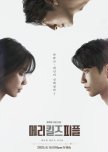
Within the diverse landscape of Korean dramas, it is not uncommon to come across stories that raise profound questions about choices, responsibility, and the limits of human action. "Mary Kills People" fits within this tradition with a particularly delicate approach, asking the viewer not only to understand what is being told, but first and foremost to accept its premise.Addressing a subject like euthanasia — and doing so within a complex cultural context inevitably shaped by personal, ethical, and religious sensibilities — means moving across fragile ground, where a neutral perspective is difficult to sustain. Every viewer brings their own experiences and beliefs, and the show seems aware of this, creating a narrative space where judgment is not imposed, but rather suspended.
Its premise is as solid as it is unsettling: a team that organizes the deaths of terminally ill patients according to precise, almost clinical criteria, attempting to give them a sense of control over their own fate. For this mechanism to work, however, the narrative requires a preliminary step from the audience: to accept — or at least consider — the legitimacy of this premise. This is far from a given, and it is precisely here that one of the central tensions of the story emerges. "Mary Kills People" constantly oscillates between the desire to observe this choice with clarity and the need to justify it, contain it, and at times even protect it.
When the focus shifts to people rather than cases, the drama finds its most authentic voice. So-jeong’s past, Dae-hyun’s journey, the bond between Ye-na and Gun-soo, as well as the quiet suffering of patients and their families, are moments where the narrative stops trying to prove something and simply observes. It is in these passages that the most powerful questions arise — what it truly means to suffer beyond endurance, what it means to accompany someone to the end, whether a choice can ever be truly free under extreme conditions — without the need to provide definitive answers. In these moments, the show feels more sincere, more engaging, and at times deeply moving.
At the same time, however, the drama does not seem to fully trust this dimension. As the episodes progress, the narrative expands and becomes increasingly layered: ethical reflection is joined by investigative threads, criminal elements, blackmail, and shifting alliances, along with subplots that, while interesting on their own, contribute to shifting the story’s center of gravity. The transition is subtle but noticeable: from “why” to “how,” from moral dilemma to narrative mechanics, from reflection to tension. The result is not so much a loss of interest as a dispersion of identity.
And yet, within this movement lies one of the most interesting paradoxes of the show: the higher the stakes become, the further it seems to drift from what makes it distinctive. The most effective moments are not those built on spectacle, but those grounded in simplicity — a conversation, a farewell, a shared moment. It is there that the drama moves beyond its narrative structure and becomes something more intimate, almost experiential.
So-jeong’s journey (brought to life by an intense and consistently excellent Lee Bo-young) fits perfectly within this ambiguity. She is never entirely readable, nor easily defined. Her choices seem to move between conviction, guilt, and a need for control, and the story suggests — without ever stating it outright — that her perspective is deeply rooted in an unresolved personal trauma. This makes each decision more human, but also more fragile, calling into question the very idea of a neutral or universal moral stance.
The final episodes make this dual nature particularly clear. Episode eleven builds toward a possible resolution, bringing many narrative threads to a close and restoring a sense of balance, while still leaving room for doubt. Episode twelve, on the other hand, reopens the discourse, introducing new elements and directions that look beyond the conclusion itself. It is less a cliffhanger than a deliberate choice — a refusal to truly end. Yet this decision ultimately softens the impact of what had just been achieved, as if the drama preferred to preserve the possibility of continuation rather than pause for reflection.
In the end, "Mary Kills People" proves to be an engaging and often compelling work, capable at times of striking deeply emotional chords. At the same time, it feels like a story that never fully trusts its own central idea. In trying to broaden its scope, it enriches and complicates the narrative, but in doing so, it disperses part of its strength. And yet, when it slows down — when it truly listens to its characters — it manages to offer something rare.
More than providing answers, the drama places the viewer before a choice: not so much what to think, but from which perspective to look. And perhaps it is precisely in this suspension, rather than in any definitive stance, that its most authentic value lies.
7/10
Was this review helpful to you?
This review may contain spoilers
“You’re weighing the gold, I’m watching you sink... Fool’s gold.”
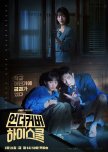
"Undercover High School" fits into the landscape of Korean dramas as a cross-over production, blending thriller, mystery, and school dynamics within a narrative structure that, at times, resembles a full-fledged “treasure hunt.” From the very beginning, the series establishes an intriguing framework, built on a suggestive setting and an immediately engaging premise: an undercover agent navigating the corridors of an elite high school, surrounded by social hierarchies, hidden secrets, and clues scattered like pieces of a game, in search of a legendary hoard of gold bars.One of the drama’s strongest elements lies in the construction of its narrative architecture, which cleverly transforms the school environment into a quasi-labyrinthine space. Classrooms, corridors, abandoned buildings, and hidden rooms become integral parts of a path shaped by riddles, symbols, and ghost-like stories, all intertwined with the search for a hidden treasure. This almost playful dimension—reminiscent of a gamified narrative—helps create a distinctive and immersive atmosphere, sustaining the viewer’s curiosity and giving the story a dynamic rhythm suspended between mystery, tension, and discovery.
The strength of "Undercover High School" also lies in its genre contamination, skillfully alternating moments of tension with lighter interludes without losing, at least in its best moments, its sense of entertainment. Thriller, mystery, hints of teen drama, and comedic elements coexist within a structure that prioritizes pacing and accessibility, making it enjoyable for a wide audience.
Within this framework, the school setting is not merely a backdrop, but also introduces a subtle reading of the social dynamics at play: the divide between privileged students and those from more vulnerable backgrounds, internal power structures, and tensions related to recognition and belonging all find their place in the narrative. The theme of bullying is also present, handled with a degree of attention that, while not deeply analytical, remains effective in highlighting some of the environment’s underlying issues.
However, it is precisely this constant oscillation between tones that reveals some of the series’ main weaknesses. While the variety keeps the narrative lively and never static, the uneven balance between genres occasionally leads to tonal dissonance, with comedic moments sometimes undermining the impact of more tense or dramatic sequences.
A key factor supporting the entire structure is a solid and well-balanced cast, capable of lending credibility even to the more conventional turns of the script. Seo Kang-joon, as protagonist Jeong Hae-seong, stands at the center of the story and manages, with surprising ease, to make believable a character caught between two identities, playing self-consciously with genre clichés. Despite portraying an adult agent posing as a student, he skillfully adjusts his physicality, tone, and presence with a touch of self-irony, making the transition between adult and teenage dimensions convincing—at least within the logic of the narrative.
Alongside him, Jin Ki-joo delivers a grounded and progressively more central performance, accompanying the story with a believable and organic emotional growth. Her character begins on lighter notes before gradually gaining depth and awareness, helping to stabilize the tone in the more mature phases of the drama.
Standing out most, however, is Kim Shin-rok as Seo Myeong-ju, a charismatic antagonist initially defined by a cold and calculated control that makes her a commanding presence. Although her characterization tends to lose some consistency in the latter part of the series, she remains one of the most compelling figures in the drama. Similarly, Lee Ye-na (Kim Min-ju) offers one of the most effective character arcs, evolving beyond a potentially stereotypical role into a more nuanced and emotionally credible presence.
Overall, while the characters often operate within familiar boundaries and recognizable tropes, the cast succeeds in elevating the material, aided by a natural sense of charm and chemistry that significantly contributes to the show’s appeal and its ability to maintain viewer engagement.
Alongside its strengths, "Undercover High School" presents several flaws that partially limit its overall effectiveness. The episode length and uneven pacing result in an imbalanced distribution of content, alternating dense segments with more diluted ones. Additionally, tonal inconsistency remains an issue: while the comedic component works in certain moments, it can feel excessive or poorly integrated in others, diminishing the impact of more serious scenes.
In this regard, some secondary characterizations—particularly those related to the NIS team—while intended to provide levity, occasionally come across as redundant and not entirely aligned with the tone of the scenes they inhabit. Furthermore, certain narrative shortcuts and underdeveloped passages suggest a script that is not always attentive to detail or to the weight of its consequences. These elements do not significantly hinder the viewing experience, but they prevent the series from achieving greater cohesion and sharpness.
For its finale, Undercover High School opts for the safest route: it ties together all narrative threads, resolves conflicts, and delivers a conclusion that is orderly and satisfying, yet lacking in boldness. Consistent with a story that has always oscillated between genres, the series avoids taking risks, favoring a reassuring ending that rewards its characters without truly pushing them to their limits.
The result is a solid and enjoyable drama, capable of entertaining and engaging thanks to a strong cast and an effective concept, but one that rarely manages to fully realize its potential into something more impactful and memorable. A series that is easy to watch and appreciate, but unlikely to leave a lasting impression.
7 ½
Was this review helpful to you?

This review may contain spoilers
Bikini Girl with Fairway Woods
When 'A Tale of Sorrow and Sadness' was released in 1977, Seijun Suzuki returned to feature filmmaking after nearly a decade of forced absence, following his infamous dismissal from Nikkatsu in the wake of 'Branded to Kill'. Officially, the reason given was the alleged “incomprehensibility” of his work; in reality, it marked the breaking point between an increasingly radical auteur and an industrial system no longer able (or willing) to contain him.At first glance, the film appears to move within a controlled and almost conventional framework — the world of golf, advertising, and media construction — where even the language itself seems borrowed from slogans and performance coaching. “Chance for a birdie,” we are told: a promise of precision, control, and success. Yet, as the film unfolds, that promise gradually reveals its darker implications.
The story of Reiko Sakuraba — a promising golfer turned into a carefully engineered media personality — unfolds as a precise study of manufactured identity. She is not simply an athlete, but a constructed image: shaped, refined, and deployed within a system that regulates not only her public presence, but increasingly her private existence as well.
At first, the narrative seems to follow a familiar trajectory — discovery, promotion, consolidation — but Suzuki gradually undermines this structure by introducing a destabilizing force that does not originate within the system itself, but from its most unsettling byproduct: the audience.
Kayo Semba, the obsessive fan, is not merely an antagonist. She is, in fact, the logical outcome of the very process that created Reiko. If an image is designed to be desired, internalized, and reproduced, then it becomes almost inevitable that someone will attempt to inhabit it — to replace, rather than simply admire, the figure it represents.
From this point onward, the film undergoes a decisive shift. Narrative progression gives way to a more ambiguous, disquieting flow, where the boundaries between public and private, performance and authenticity, begin to collapse. The intrusion into domestic space, the escalation of psychological pressure, and the gradual erosion of Reiko’s autonomy do not lead to a dramatic breakdown in the conventional sense, but to something far more insidious: a slow dissolution.
Reiko does not explode, nor does she openly resist. Instead, she empties out. She becomes a surface upon which external forces act — an image that no longer belongs to her. In this sense, the movie feels strikingly modern, anticipating dynamics that today appear almost commonplace: the commodification of the body, the fabrication of identity, and the invasive nature of public attention.
At the same time, the system that produced all this remains fundamentally intact. Even as events spiral into increasingly disturbing territory, the machinery of promotion, contracts, and media exposure continues to operate, ready to adapt, replace, and move forward. Within this framework, the figure of Miyake — manipulative, pragmatic, yet never overtly monstrous — functions less as a villain than as an integral component of the system itself.
Stylistically, while more restrained than his earlier works, Suzuki’s signature remains unmistakable. His use of space, the fragmented pacing, and the subtle but persistent dissonance between what is shown and what is implied all contribute to an atmosphere of controlled instability. The film seems constantly on the verge of rupture, yet never fully collapses.
The result is a work that resists easy categorization — neither fully commercial nor overtly experimental — but precisely for this reason deeply coherent within Suzuki’s artistic trajectory. This is not a conciliatory return, nor an attempt to realign with industry expectations; rather, it is a lucid and quietly devastating reflection on what that system produces: not only images, but desires, projections, and distortions.
'A Tale of Sorrow and Sadness' it’s not so much the story of a celebrity's downfall as the process by which a person gradually ceases to belong to themselves, becoming a canvas for others' projections.
And after that, the descent is irreversible.
8/10
Was this review helpful to you?
This review may contain spoilers
Ghost In The Machine / I Bury The Living (?)
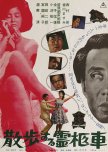
A jealousy and cuckolded husband “kills” his wife and then, in a macabre farce, carries her around in a hearse to extort money from her former lovers, but not everything is as it seems...1964 was a remarkable year, which saw the release of this curious work by Hajime Sato:
It came after the untimely death of the master Ozu (which, incidentally, also coincided with the retirement from the screen of the extraordinary Setsuko Hara) and the release of interesting works that, curiously, also arrived in Italy:
Among the many, Teshigahara’s beautiful “Woman In The Dunes” (often shown on TV) as well as Suzuki's “The Flower And The Angry Waves” and “Gate Of Flesh” (among my favourites by the master), Masumura's ‘Manji’ (another personal favourite of mine), Shindo Kaneto's ‘Onibaba’, as well as works by Imamura, Honda, Shinoda, Naruse (who has been criminally ignored here for decades!) etc.
‘Sanpo Suru Reikyusha’ by Sato, known internationally as ‘The Glamorous Ghost’, also arrives in Italy but is released with a completely different title (a practice that is, alas, widely abused...) and becomes, for some reason, ‘L’ Amore scotta a Yokohama’, something like ‘Love Burns in Yokohama’…
But why, as many have pointed out, is the action set in Tokyo, what does Yokohama have to do with it?
Who knows!
Although difficult to categorise, but well analysed on various websites that have discussed it over the years, the movie can be considered a black comedy with a grotesque atmosphere, with decidedly surreal touches and some concessions to the macabre that place it, with considerable freedom, in the so-called “Ero guro” genre, with all that this entails…
Decidedly ambiguous in structure and morally cruel in its portrayal of the characters—all of whom are deeply unlikeable—the film truly seems like an allegory, or rather, as is often the case in many works from the Land of the Rising Sun, a parable about the destructive power of money which, when all is said and done, always leads to ruin due to greed and cupidity.
One of the film's greatest strengths is its ability to bring out the worst traits in all of its characters, who are largely devoid of humanity and feelings, driven by the murkiest of impulses, greed for wealth, coldfinancial calculation and abuse of power, taken to the extreme.
If the characterisation of the taxi driver husband (Kō Nishimura, with his extraordinary career) is a mediocre figure, lacking in scruples and moral integrity, ready to adapt and exploit the various twists and turns of the situation, he does not present any positive characteristics, his wife (Masumi Harukawa, also a veteran actress) is no less impressive, a treacherous double-crosser who coldly and lucidly exploits her (arguably questionable) attractiveness not for exclusive physical satisfaction, but purely for the desire to get rich...
And the supporting figures who gradually appear throughout the story are no less (obnoxiously) remarkable.
A grotesque comedy of errors, ‘The Glamorous Ghost’ inevitably ends up being compared to ‘The Comedy of Terrors’, one of the last movies by the great Jacques Tourneur, which coincidentally came out just a year earlier. Tourneur’s movie, it must be said, is certainly not unforgettable, revealing its main strength in its excellent and entertaining cast.
This work by Sato, a director perhaps hastily placed in marginal categories of Japanese cinema, on the contrary, thanks to remarkable black and white photography that increases the contrasts between light and shadow, contributing to amplifying the caricatural effect on the characters, his skewed, distorting shots, and moments of amusing surreal comedy (such as the trips in the hearse and the visit to the morgue with all the corpses awaiting burial) is still appreciated today, thanks to its somewhat macabre, undoubtedly unconventional taste, which may not be to everyone's liking, but certainly a faithful reflection of contemporary society, where everything seems to be driven by money and selfishness and where no redemption seems possible, as can also be inferred from the mockingly ironic ending.
7
Was this review helpful to you?
This review may contain spoilers
I'm Never Gonna Die Again
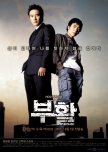
A frankly disappointing and confusing drama, ‘Resurrection’ has the ambition of putting so much -too-much- meat on the fire in the plot, ending up giving an exaggeratedly complex and extremely confusing story; and it's a pity, because the basic assumption, on one of my favourite cinematographic themes, that of the double (but let's not bother Dostoevsky, of course! ), could and should have been exploited much better, instead being reduced to an accumulation of clichés and stereotypes that irregiment the story in a classic makjang scheme that is not even that engaging.The beginning is chaotic, to say the least, with the introduction of so many characters that it is hard to sort out the narrative patterns and the peculiar aspects of the actors on stage; evidently the authors must have realised this too, because at the beginning of the fifth episode, a providential summary of the previous episodes comes to our rescue, clarifying most of the tortuous plot, but beware! we will find ourselves with at least a dozen or more characters involved in what, up to that moment, has turned out to be a barely comprehensible affair...
Trying to sum up, more or less:
A policeman, his vice-presidential twin, the former's fiancée and the latter's almost-wife, aspiring journalist, a senator (father of the journalist but not only ... ) and another business executive (with his rather useless son), and their henchman/gangster, the twin vice-president's family - mother of the twins, stepfather and younger sister - and the policeman's adoptive father, several killers, dead or providentially brought out in the process, just to make even more of a mess, wives or ex-wives, real and alleged crooks, nosy journalists and even several policemen...
At this point, the story, so to speak, tries to stabilise itself for several episodes, which obviously, with the dramatic change of identity of the main character, have an easier time creating the right tension, relying on the gimmicks of the policeman who has to pass himself off as the twin vice-president of the company.
Nothing particularly memorable or innovative, it must be said; the ‘sentimental’ side is much more interesting, with the interchange between the two women in love who develop more than one doubt about the twin's identity, rather than the family aspect, with the anguish and turmoil of the protagonist's mother, which would have deserved more in-depth analysis; but we are nevertheless in the ordinary, the minimum acceptable:
It is the usual theme of revenge for a crime twenty years earlier that will uncover the classic Pandora's box, with a twist, largely phoned in and out of time, and that will take no prisoners...
But then, irreparably, the plot wraps up again, adding more characters to the story and rekindling confusion about it, as well as attempting to unravel it through the contrivance of some object/fetish such as the gaming dices or the bracelet
We are again in a total mess, with tired repetitions of protracted situations (the investigations of the would-be journalist, for instance), daring parental entanglements of the ‘that's the son of that other guy from an extramarital affair’ kind, searches for relatives, corrupt and then repentant cops, and others in a coma, as well as murderous killers who pop up out of nowhere (like the too-often-quoted Park Sangcheol).
It proceeds towards the finale with a sense of weariness and heaviness, a final episode in which we move from an anthology-like incipit of the ridiculous, with an explanation and related listing of names that would need another summary, an explanation so lengthy between the players that it verges on ludicrousness, to a hasty use of cinematic off-screen, hopelessly rushed in closing the stories of some characters who had been crucial up to that point.
Absolutely inexplicable the epilogue after the usual time jump (‘one year later’), ‘Resurrection’ leaves a sense of utter unfinishiness, despite the amount of material at hand, it is saved by some good performances, such as Uhm Tae Woong of course, in the double (or rather triple) part of Seo Ha Eun / Yoo Gang Hyuk / Yoo Shin Hyuk, as well as the beautiful Han Ji Min in the painful role of Seo Eun Ha, as well as Kim Gab Soo, in the role of Senator Lee Tae Jun, father of the journalist;
Kim Kyu-chul's grimacing in the part of Choi Dong Chan is frankly unbearable, while the final question that will remain unanswered is:
What happened to Seo Jae Su, Eun Ha's father and adoptive father of policeman Ha Eun, who at one point in the story simply disappears from the drama!?
6,5 / 10
Was this review helpful to you?
This review may contain spoilers
You Must Be a Witch...
Very high expectations supported by a result that is not entirely satisfying, for this 'Bitter Sweet Hell', a reasonably good but not outstanding drama, capable of starting off in a very solid and engaging manner, but, as frequently happens in contemporary productions, able to end up losing a little focus in the development of the plot.Beyond the personal taste interpretation of the genre (it is definitely bold to consider BSH a generic 'black comedy'), the drama can comfortably be placed in the context of a family-based thriller, accompanied by the now overused theme of revenge linked to past events, where it is precisely the concept of family, in its multiple aspects, that provides the best key to interpretation and analysis.
Beginning as a phenomenological study of a typical upper-class Korean family (I imagine belonging to that famous 1% often depicted in dramas), 'Bitter Sweet Hell' has the merit of highlighting a harsh analysis of the family institution, highlighting through the failure of marriage, the dramatic and in many ways impossible ability concerning the proper management of interpersonal relationships within the same family unit.
That all this originates through the external factor of the criminal element of the plot, the notorious 'Witch', a sort of puppet master, capable of pulling the strings at his own sadistic will, is certainly one of the most interesting aspects in the development of the story.
The perfect, idyllic, but utterly fake and insincere portrayal of the family unit reveals all its fragility when the death of the patriarch (the always excellent Kwon Hae-hyo, also sacrified for plot exigencies), opens the infamous Pandora's box on the private vices and sins of the various family members...
The carnage game that ensues leads Dr. No, an eminent psychiatrist with a TV programme affiliated with her, to vacillate over the truth behind her own father's death, her father-in-law's responsibility and, at the same time, the mysterious disappearance of her own husband, the famous surgeon Choi Jae Jin.
Faced with the collapse of her certainties, purely selfish doubts about her own career, the resulting social status quo, and the safety/protection of her son (holder of an unmentionable secret), Dr No will even have to confront her mother-in-law, the famous mystery novelist Hong Sa Gang ('Cigarette Queen'), a lover of Agatha Christie and not at all resigned to the risk of a veritable media pillory capable of demolishing the few certainties left in the family...
The confrontation/clash between daughter-in-law and mother-in-law gives us the most enjoyable moments of the drama, thanks to the two prima donnas, perfectly placed in their roles; if Kim Hee Sun may seem a little more conservative with an extremely measured style (but she is just great style, as always, even if in the ending she literally loosens the reins as a mother bear protecting her cub) , in the intense performance of the always remarkable Lee Hye Young, we can really appreciate the ultimate feeling of the story, thanks also to a clever use of explicative flashbacks that add meat to the fire, enriching the plot and leading us to understand the sincere love of the novelist for her family, obviously impossible to explain in words, but comprehensible through the pages of books...
The moments in the whole part concerning the search for the husband/son Choi Jae Jin are very well presented, thanks also to the contribution of Park Kang Sung in the role of Ahn Kil Kang, handyman in the service of the novelist and manager of the 'Soft Hands' restaurant; the characterisation of Kim Nam Hee in the role of a genuine pusillanimous, only partly justified by the personal revelation about his origins, is very well done...
Among the drama's negative aspects, which unfortunately affect the final result quite a bit, I have to place the "Wicked" Lee Se Na, played by an inadequate Yeonwoo, in my opinion (it's always a personal thing, specific!) incapable of portraying a memorable villain, commensurate with the story;
if the explanation on the origin of Se Na's evil is decidedly conventional, even less is made clear as to how she could have circuited and manipulated more or less all the men (there is talk of three husbands, several lovers and even some women) in her revenge intentions;
The head tilt and a mocking glance are not enough to define evil, and the last two episodes, with the usual incongruities in the script and the obvious narrative strains, the sudden 'illuminations' capable of giving the drama a decisive turn, suffer greatly from this serious weakness (or casting error, to my way of thinking), dragging the story towards a rather predictable and even not very courageous ending.
Much, much better is the character of Moon Tae Oh (played by Jung Gun Joo) in the role of the main actors' son's tutor; in his case the roots of the evil are fully justified by deriving family faults and therefore deserving of a justified process of recovery, of 'salvation and redemption', unlike Se Na who, perversely guilty, as a pure 'witch' will meet her just fate....
Interesting is the role of Dr Oh Ji Eun (played by Shin So Yool), hopelessly in love, in search of familial acceptance and a victim in spite of herself of adult scheming and insensitivity...
Lee Se Na, Moon Tae Oh and Dr Oh herself represent in different ways three aspects of a family laceration with devastating consequences, irreparable in Se Na's case.
Vice versa, for the main character family, there can be a chance of redemption and new awareness through mutual solidarity, the ability to listen and understand, the principle of 'acceptance'; exemplary from this point of view is the role of the whole family towards the existential condition of their son Do Hyun (portrayed by a sincere and very human Park Jae-chan), and the appeal, albeit painful but necessary, towards memories (through letters, photographs, footage)
The pursuit of dialogue, sitting around the table, even if only to eat together once in a while, may seem a simple or obvious message, but it can be seen as a curative approach... From this point of view, the conclusion, although overly conciliatory, is quite in line with the development.
To sum up, in my personal opinion, 'Bitter Sweet Hell' is a good drama that lacks a bit of solidity in the second half, but is sustained by an almost completely successful cast and that has the virtue of not going on for too long; I would even have appreciated a couple more episodes to highlight the role of the novelist a bit more concretely, especially in her tormented relationship with her husband, but that's OK;
In some sections, I found several points of contact with the contemporaneous 'Hide' (which is however more reliable on the complex) with which, curiously enough, it shares the location of the holiday residence, the scene of adultery in one case and of crimes in the other...
Personal side note: Hong Sa Gang's car is absolutely awesome!
7/10
Was this review helpful to you?
This review may contain spoilers
‘You should have left Hong Kong immediately.... ...What kept you? ...Or who ?’
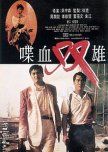
*‘The Killer’ was filmed in 1989 and came just after the great success of the two-hit diptych ‘A Better Tomorrow’. Chow Yun-Fat, who had already starred in the two ‘A Better...’ movies, was again called in as the lead actor. The results were so extraordinary that it was from this film onwards that Woo's name began to travel the world (in every sense of the word).The movie was conceived as a sort of modern remake of ‘Le samouraï’, a famous noir by Jean Pierre Melville, one of Woo's favourite directors, but the Guangzhou director readapted it, according to his precepts, giving us an action movie/noir, capable of merging with the most typical elements of melodrama...All infused with astonishing and spectacular shoot-outs, which, also from a choreographic point of view, will be imitated ad nauseam.
Woo, also a screenwriter, draws truly exemplary characterisations for the two main characters; By setting them against each other and starting from absolutely ‘antithetical’ standpoints (one is the killer, the other the cop) he manages, in a ‘miraculous’ way to make them converge and resemble each other thanks to the typical aspects of his cinematography.
Jeff is indeed a killer, but he is heroic, brave, full of passion, idealistic and sensitive...He has a sense of honour that really doesn't make him resemble an assassin, but rather an ancient knight who accepts his destiny and faces it head-on, without any fear, but rather with a mocking smile on his face; the brotherly, virile friendship and respect that bind him to Sidney is almost poignant, his best friend, also a hitman, physically maimed by a wound but vigorously animated by the same ideals as Jeff.
All fundamental elements in Woo's cinematography.
...And Chow Yun-Fat's performance is truly memorable...
The same rules of honour and moral principles that drive policeman Lee Ying: Lee of course hunts him down, but by some of Jeff's actions, such as the incident with the little girl and the run to the hospital, he is admired, if not actually fascinated, perhaps beginning to perceive the killer's true nature...the two men, moreover, are united by their respective senses of guilt, deriving for both of them from the responsibility of their gestures, which have generated two very serious events.
This common fate, infused with doses of old-fashioned romanticism, a sort of ‘chivalrous code’, a mèlo poetry and that sense of friendship so dear to Woo, triggers an irreversible process that leads all the characters of the movie towards a road of no return, in a sort of almost ‘martyrdom’...and emblematically it is precisely a church that is the place of the showdown.
The extraordinary film direction, as well as the editing, sets a tone of epicness to the entirety, leaving the viewer often open-mouthed, through a series of absolutely breathtaking sequences.
Much has been written about the famous shootouts in John Woo's movies: Choreographed, likened to a kind of a ballet, with unexpected and acrobatic changes of frame...Sudden slowdowns, moments of hiatus that precede extremely violent outbreaks, bodies and bullets leaping and whirling through the air, with the hero on duty moving while handling two guns at the same time (‘a dancer going through the air’ explains Woo), almost ‘in suspension’.
The application of slow motion then reinforces the impact even more, adding depth to the scenes and setting the pace. John Woo is perhaps the only director capable of making even a simple flight of white doves ‘epic’.
Watch ‘The Killer’...and then try to see the Mariachi trilogy by Robert Rodriguez, someone who really has a thing for action movies; Well, you'll notice how much the director of ‘Sin City’ drew from the Asian filmmaker.
Among the film references, I like to point out the boat race during Jeff's last ‘contract’; it has an absolutely Hichcockian ‘construction’, with a rising tension in the style of ‘The Man Who Knew Too Much’…
And there is also a quote from King Vidor's ‘Duel in the Sun’, really poignant...
'The Killer' is one of the high peaks of John Woo's career... it is probably the movie that best defines his cinematic universe and represents one of the most extraordinary modern examples of action movies (but not only).
A fundamental and highly recommended masterpiece.
10/10
-----------------
*An old review of mine from a no more existing forum, here for MDL, the names correspond with the Italian version of the movie
Was this review helpful to you?
This review may contain spoilers
Magnificent Obsession
"Ms. Perfect" is a scintillating melodrama with a classic flavour, able to offer an intricately multifaceted story that, starting from a fairly conventional family drama structure, with the end of a married couple's love affair at its centre and the relative painful disintegration of the domestic unit, gradually evolves into a fascinating and enthralling mystery thriller with an incredible story of mad love at its centre, absolutely indebted to the Hollywood classics of the golden age...Thanks to the chance offered by a singular and apparently perfect woman, a strange rental contract (extremely favourable! ) and a forced and curious cohabitation, accompanied by a heterogeneous group of family members, friends, and real or presumed servants, the focus of the story will develop in the new home of our heroine who, faced with ambiguously hostile characters and situations, gripped by doubts, feelings of guilt (not only her husband's betrayal, but also the uncomfortable presence/figure of her ex-first love) and even erroneous evaluations, will end up feeling threatened in the actual space of her new living location...
Trying to play with cinematic genres, in order to tempt the curious, “Ms. Perfect” seems to be the evolution of the so-called 'gothic movie', in its female variant, starring a woman, in spite of herself, grappling with a marriage affair with disturbing contours. Only in this case, the danger does not come directly from the male counterpart, but from the ambiguous and perturbing co-star, a true modern adaptation of the figure of the 'dark lady', a typical characterisation of the noir genre.
Everything is prodigiously served by a writing script that is never ordinary, capable of re-launching the plot each time with courageous choices, absolutely unsettling in many cases, at the service of a cast of an extraordinary level, able to alternate between comedy and tragedy, charade and drama, in a constant involvement that accompanies us throughout the wonderful twenty episodes, which show no sign of weakness or tiredness...
Intrigues and mysteries, real or presumed ghosts that re-emerge from a past with many interrogative aspects. As in the best tradition of Korean dramas, an underlying ambiguity appears that is able to characterise all the actors of "Ms. Perfect"... No one seems to be immune from guilt, albeit on different levels, and this ambiguity allows us to escape from easy "good/bad" classifications, thanks to a great performance by the whole cast...
The main attraction of this drama rotates around the astonishing performance of the charismatic Cho Yeo Jung, an actress of incredible beauty, capable, thanks to her immense and ambiguous charm, of portraying the role of a foolish woman in love, disposed to do anything to obtain the object of her desire... Absolutely ambiguous and sinister right from the moment she appears on the scene, Eun Hee becomes the true focal point of the narrative, catalysing the attention on her character who will progressively reveal her hidden object, concretely managing to raise the attention also on the omnipresent and obsessive relationship that connects stars and their fans (stalker! ?)
Sacrificial victims of his love madness are the "rival" Jae Bok, played by the also very beautiful Ko So Young (almost a twin sister of Kim Ha Neul!) and her husband, Jung Hee, brilliantly rendered by the excellent Yoon Sang Hyun, in one of the best roles of his remarkable career... In my opinion, it is precisely through the character of Jung Hee, in his progressive personality transformation, in the clash/confrontation with his wife Jae Bok, that some of the most interesting narrative cues emerge, capable of instilling doubts above all of a moral nature, on ambition, guilt and careerism at any cost...
It was said of the overall excellent cast where also the very good Sung Joon/Bong Goo makes his character evolve in a decidedly mature manner, thanks also to the exemplary part played by Im Se Mi/Na Mi who, mainly in the first half of the drama, shows a prominent role in the unravelling of the intrigued plot... I also really appreciated Jae Bok's two funny female friends, Na Hye Ran (played by Kim Jung Nan) and, above all, Kim Won Jae (Jung Soo Young) who could even have been used in more depth, given the psychoanalytic aspect emerging in the development of the storyline.... But, again, bravo to all, adults and children alike
There are many truly fascinating passages, often concentrated inside the vast mansion; the mysterious doors forbidden to all, also a typical noir cliché, almost an update of Hitchcock's "Rebecca" or so many of its epigones; Jae Bok's continuous wandering in the house, often intimidated by the presence of "hostile" figures; the effective use of flash-backs, which, thanks also to the classic repetitions of past traumas, reveal the many dark points of the principal characters... The confrontation between Na Mi and Eun Hee, Eun Hee finding herself alone in the huge house...And then one of my favourite movie tropes: The forced closure in the asylum, as well as the literally " flaming" finale that seems taken from a Roger Corman movie of the Edgar Allan Poe series....
Managing to satisfy so many of my cinematic obsessions, with an intriguing, engaging, well-written, perfectly acted tale, without moments of boredom or the usual lapses into more or less acceptable nonsense, 'Ms. Perfect' is a 'perfectly' successful example of excellent narrative script that meets absolutely exemplary mise-en-scene, creating a very entertaining story
9/10
Was this review helpful to you?
This review may contain spoilers
Love can come at any time in our life
I watched this movie to detox myself a bit from a disappointing drama I ‘ve been watching in the past few days, also recommended by another MDL user, what can I say, really a happy breath of fresh air...It's a really pleasantly well-made romantic comedy that, without saying anything new, joyfully succeeds in engaging the well-prepared viewer for its two-hour duration (which is not particularly heavy at all, however).
It is in the choice of the main players that the movie's success is most evident; telling a love story with two mature characters, wonderfully mature I would say, but at the same time still young in their hearts and at the end of the day simply desperate to have someone at their side to love, like all of us...
The story is of disarming simplicity and the plot mechanics are those well established in the classic Korean rom-com: the main character, with his hilarious facial expressions, lost in his foibles and fixations, with an absolutely absurd and decidedly unhealthy job, the usual circle of colleagues/acquaintances more deranged than him, as well as the bothering element of his brother; on the other side, our beautiful Kim Hee Sun, a messed-up single mother with a teenage daughter, obviously problematic...
Rather than the usual clash-meeting between two completely antithetical entities, the most interesting element is surely the lengthy courteousness on her part, which allows the staging of several rather amusing scenes related to the total clumsiness of our male subject
But it is precisely in these phases of rapprochement of the two lonely souls, in this gradual process towards a state of happiness, that I found myself most satisfied, in that desire to attempt to experience the same joyfully adolescent emotions that can be found in so many dramas or movies, more or less good; that attempt at normality that leads us to think: "Why can't we experience the same joys too!"
Of course, there are the obvious lucky coincidences and even several innocent ingenuities that push the story towards the most obvious ending, thanks also to a supporting cast that is functional to its role, but in the end you are immediately inclined to cheer for the two heroes and therefore we welcome that bit of magical coincidence that leads to the happy end, just to have a Romantic Heart and believe/hope that love can come at any time in our life
The rating is a perhaps generous 7.5/10, but in cases like this it is OK to be kind...
Was this review helpful to you?
This review may contain spoilers
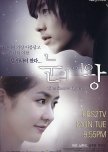
A marvelous story of indissoluble love
A poignant drama, permeated with a deeply felt melancholy that accompanies us from beginning to end, The Snow Queen continues to be, in my opinion, a marvelous story of indissoluble love, capable of transcending any barrier, pushing (in all senses) towards extreme borders (not only figuratively speaking) thanks to the sincere romanticism of a practically perfect script and an excellent direction (the author is the same director of 'Winter Sonata', to be clear)As always, love, chance and destiny are preponderant elements that drive the story forward, but compared to similar cases, one does not turn one's nose up at any inconsistency, illogic or magnanimous demands for complete suspension of disbelief, since everything manages to be coordinated in a balanced and 'realistic' structure that also guarantees a sentimental identification with the beautiful characters of the drama...
The composite screenplay manages to overcome a linear storyline with a concentric structure, full of randomness and coincidences, alternating points of view, even narrative variations on the same theme, as well as subplots and geometrical plotlines that enrich the construction of the story, where even a few symbols or simple objects such as a pager, a music tape and a couple of photographs have the strength to release sincere emotion without trespassing on the pathetic.
It is achieved without falling into the baroque or exaggerated mannerism (typical of many contemporary dramas) that sometimes makes us raise an eyebrow or roll our eyes, thanks to skillful and never ordinary dialogue of obvious literary derivation, capable of arousing equal passion for two apparently antithetical subjects such as mathematics and boxing, and this is also possible thanks to a perfect cast in an absolute state of grace.
Hyun Bin renders his character's torment and remorse very well, with a truly calibrated, touching and involving performance, a prisoner of his own secret and bearer of an inner suffering bordering on self-destruction, almost Catholic in nature, even though the religious references (much more marked in other dramas of the same period) remain confined to a desperate prayer/invocation towards the end of the drama. Yu-ri -very gorgeous! -is absolutely perfect, capable of operating a sort of progressive transformation and dramatic growth that is functional to the narrative development of the story; the bumptious and spoilt little girl of the beginning of the story, ends up evolving and becoming a mature (young) woman, consciously resigned, in spite of herself, to her own fate.
The remaining cast is perfectly integrated in their roles without any pedantic backstory that in this case would frankly be considered pleonastic, with the exception of the excellent portrayal of Tae Woong's mother, who is absolutely decisive in further accentuating the protagonist's torments, and Bo Ra's father, capable of confirming once again that founding principle of dramas whereby the faults of parents end up falling on their children (in fact, he is responsible for the tragic fate of his eldest son)
Much has been written, and rightly so, about the extraordinary venues of the story, and the skillful use of the locations really deserves a separate mention, starting with the extraordinary landscapes in the opening, later reproposed in the last episode, to continue with the gymnasium, a sort of perfect microcosm populated by a group of marginalized people with a warm heart, which restores to us all the sense of sadness that lingers in the (icy!?) heart of the protagonist; Bo Ra's house, almost a gilded prison, up to the basketball court that returns also in the heartbreaking finale...
As is common in other productions, the role of nature is central, both in the snowy sequences and in those where it is the sea that increasingly, almost overwhelmingly, emphasizes the lyricism of the drama; for example, the sequences at the grave of the friend/brother, which personally have always made me think of my favorite Murakami Haruki book, 'Norwegian Wood' ...
Touching and melancholic without ever being intrusive, the soundtrack is the further strength of this extraordinary drama, a kind of contemporary fairy tale that is a truly perfect transposition of Andersen's sadly melancholic universe...
I decided to re-watch this gem a distance of a few years, after, what an irony for a drama-fan such myself! Fate has stripped me, in a short space of time, of some of the most beloved people who have accompanied my life... When one loses, affections, loves, friendships, beyond the pain and inner wounding, one questions oneself and seeks answers as to why things happen...
Just like the characters in the drama, we are constantly asking ourselves many questions, and the reflection on the differences between mathematics, which is always able to provide answers, and life, which acts by chance and very often does not provide answers, is perhaps the best possible metaphor or the perfect theorem to sum up not only this drama, but the lives of many people...
10/10
Was this review helpful to you?

Personally I struggle a bit with the temporal collocation of some events, but no big deal.
In my humble opinion, I love so much the so called " old dramas" there is certainly more courage and more melodramatic strength than the contemporaries, but I also understand that these peculiarities can leave some viewers a bit sceptical,
for what it's worth my personal rating is 8/10
Was this review helpful to you?
This review may contain spoilers
“Being good in business is the most fascinating kind of art.” (Andy Warhol)
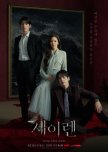
In the world of art, originality is an illusion: what truly matters is the ability to be recognized as such. It is perhaps from this principle—more Warholian than classical—that “Siren’s Kiss” takes shape, a thriller that constantly plays on the boundary between authenticity and representation, between truth and the artificial construction of reality.Conceived as a loose reinterpretation of the Japanese drama “Ice World”, from which it borrows thematic suggestions without ever fully adhering to them, “Siren’s Kiss” moves along more distinctly Korean coordinates, favoring a melodramatic and relational framework over the more elusive and unsettling ambiguity of its counterpart. The result is a layered narrative, rich in twists and shifting perspectives, capable of maintaining tension while occasionally risking dispersion in its attempt to weave together multiple narrative threads.
At the center of the story stands Seol Ah (an excellent Park Min-young, delivering a deeply committed and emotionally demanding performance), a character built on a familiar yet effective archetype: a protagonist shaped by trauma, constantly under suspicion, suspended between guilt and innocence. The drama carefully nurtures this ambiguity for much of its runtime, leading the audience through doubts and misdirection, only to gradually reframe her as a more empathetic and tragic figure. This transition—from potential manipulator to designated victim—marks a crucial turning point, albeit not without some degree of simplification in the latter half of the series.
Alongside her, Woo Seok (Wi Ha-joon, as precise and compelling as ever) embodies an equally classical yet functional role: an investigator burdened by a painful past, initially driven by suspicion and gradually drawn into an emotional dynamic that reshapes his position, eventually taking on almost chivalric traits. Their relationship, while operating within recognizable boundaries, gains credibility through shared pain and a mutual search for redemption.
Particularly noteworthy is the character of President Kim (brilliantly portrayed by Kim Geun-soon), arguably the most symbolically rich figure in the series. Through her, the drama introduces a compelling reflection on the art market, the value of artworks, and the very concept of authenticity. Her “private museum,” composed of hidden and appropriated pieces, becomes a powerful metaphor for art as a privatized commodity—removed from public access and reshaped by power and profit.
It is within this framework that the theme of the “authority of the fake” fully emerges: copies replacing originals, identities overlapping and dissolving, lives manipulated as if they were elements of a larger composition. Beneath the surface, a distinctly Warholian perspective takes shape—one in which serial reproduction challenges the uniqueness of the artwork—reinforcing the drama’s ongoing tension between what is real and what is merely perceived as such.
Even some of the more daring narrative choices—such as the reveal surrounding the CEO (the ambiguous and effective Kim Jung-hyun)—while occasionally forced in execution, still align with this broader discourse on substitution and identity loss, contributing to the thematic depth of the series.
However, the drama ultimately struggles to sustain the pervasive ambiguity that defined its strongest moments. As the story progresses, characters become increasingly delineated, gradually eroding the gray areas that once made the narrative so engaging and unpredictable.
Unfortunately, the finale fails to fully uphold the ambitions built throughout the series. By attributing the entirety of the narrative’s tragedies to a single figure, transformed into the ultimate orchestrator, the story significantly simplifies a structure that had previously thrived on complexity and layered ambiguity.
In doing so, the intricate interplay between truth and representation, between original and copy, is reduced to a more linear explanation—one that provides closure, but at the cost of diminishing the moral and symbolic tension accumulated over time. What initially suggested a broader, systemic corruption involving multiple layers of responsibility ultimately converges into a more contained and reassuring resolution.
The same applies to the characters’ arcs, which lean toward a cathartic and consolatory resolution. While emotionally satisfying on the surface, this choice weakens the unsettling and morally complex undertones that had defined the drama’s most compelling phase.
What remains is the impression of a solid, well-acted series, capable of crafting an engaging and intricate narrative, yet ultimately choosing to retreat into safer territory at the crucial moment, relinquishing the very risk that could have elevated it further.
In light of its conclusion, “Siren’s Kiss” stands as a compelling but only partially fulfilled work—particularly when compared to its Japanese counterpart, which proves more consistent in preserving its ambiguity and resisting more accommodating resolutions.
7/10
Was this review helpful to you?
This review may contain spoilers
Because night time is the right time, to be with the one you love, with the one you love
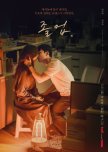
Korean language teacher Seo Hye Jin (a fantastic and stunning Jung Ryeo Won) is the spearhead of the Daechi-chase Academy, a private after-school institute (Hagwon, in fact) in the Gangnam district of Seoul, dedicated to strengthening and improving the academic development of students of various age levels;Entirely dedicated to her work, Hye Jin sees her life take a sensational twist when Lee Joon-ho (Wi Ha Joon, outstanding), her former best pupil, reappears. After giving up his career in a major company, he decides to become a teacher at the same school, with unpredicted consequences...
‘Midnight Romance In Hagwon’ is a beautifully delicate rom-com, capable of treating such a complex and burning theme as the articulated Korean school system, undoubtedly competitive and varied in its labirynthic set of rules, dogmas, social conventions and fierce struggles, all aimed at reaching the top of society itself. The drama, at the same time, is capable of touching us thanks to a captivating love story that escapes the banalities of the most predictable and sugar-coated romance, offering us an adult and decidedly structured relationship, also hindered by social conventions, work principles and even methodological differences.
The Daechi-chase Academy represents a kind of working microcosm where, along with the planned teaching structure, there is also a kind of subterranean ‘internal’ infighting within the Hagwon itself, where ‘there are no friends, everyone is in competition’ (summarised, in one of the clever dialogues, by the metaphor of hyenas and the ‘meal’) and where co-workers are ready to take advantage of any weaknesses of their own in order to advance their careers; certain founding principles of Confucianism are always emphasised, both for the role of teachers and for that of students.
Respect for hierarchy and seniority, the importance of teamwork rather than the individual's path, is portrayed, but almost as an antithesis to this, perfecting education and trying to improve oneself is given a central role, apparently individualistic concept, but accepted, as competition with others, for the best grades and for a job, which is also a better one, is a kind of ‘social lift’ necessary to reach the top of the hierarchical ranks of Korean society itself.
So intense is the competition between the different Hagwons (there are so many of them considering the extent of Seoul and its urban areas) that spy-story techniques to snatch secrets and steal each other's best students often reserve more than a few cheap shots to belittle and discredit the competitors.
In this kind of no-holds-barred law of the jungle, where profit and personal enrichment rule, a kind of feud evolves between the Daechi-chase Academy and the Choiseon Academy, led by the infamous Choi Hyung-sun, known as the White-haired Witch.
In this ill-concealed hypocritical society, closed and dominated by exasperated rhythms and widespread frustrations, both on the teachers‘ and pupils’ side, the figure of Seo Hye Jin -stunningly portrayed by Jung Ryeo Won- ends up being overwhelmed by the uncontainable vitality of Joon-ho (Wi Ha-joon, absolutely perfect in a part one couldn't imagine for anyone else);
The teacher Seo leads a methodical (and boring, it has to be said!) life, consisting of 16 hours of work a day, six days a week, with no traces of private life and no personal relationships, except for a couple of friends -he runs a pub, she is a lawyer-, with practically no relations with family members (there is a hint here and there in conversations with colleagues, but nothing more) and, above all, no sex life;
In the first episodes, we find ourselves following this robotic routine of meetings, scheduling, lectures, insights and sad lonely re-entries into an anonymous house that is almost a ‘non-place’ where Hye-jin seems to return just to sleep, which is a bit of a paradigm shift compared to so many beloved dramas where the house is often the focus of events or narrative plot twists.
It will be Joon-Hoo's unbridled and in some ways brazen audacity that will progressively undermine Hye-jin's convictions; not only the certainties of feelings, and here the noona-romance, as mentioned above, avoids the classic loopholes of the typical rom-com, also giving us a moment of extraordinary and very reserved emotional authenticity, but also -above all!?- the preponderant work vicissitudes, dealt with in some of the drama's topical moments, which offer a confrontation-clash of the highest level, where the dilemma over teaching methodologies instils the seed of doubt in the own Teacher Seo:
Whereas Hye Jin applies an almost mnemonic system where the pupil is directed to learn ‘by memory’ certain mechanisms of comprehension and learning, Joon-ho's style is more ‘ thoughtful’ where there is also a quest to convey passion for the literary subject.
Are the students, almost like machines, to learn and that's all, by memorising passages from books, practising calculating the probability of the questions in the tests, evidently ‘forgetting’ everything immediately after the exams, or are they to become passionate about the subject, perhaps with the opportunity (as in the case of Joon-Ho himself) to become the teachers of tomorrow?
It should not be forgotten that the Hagwons are extremely expensive schools, with families prepared to make considerable sacrifices in order to see a bright future for their children; parents demand the best from teachers and the discourse of ‘experimentation’ cannot prevail over the certainty of academic achievements.
The moment the boiling pot of the ‘clandestine’ relationship is discovered, and professional ethics in the workplace are called into question, the stigmatisation of the two teachers begins, victims not only of the oppressive work rules, but also of those previously mentioned founding principles that foment jealousy, hypocrisy and false respectability, where artfully fuelled slander can disrupt anyone's life...
I have already mentioned Jung Ryeo Won's superlative performance; her characterisation of Teacher Seo is so articulate, she has so many aspects, contradictions, weaknesses, but also resilience against adversity, that it is impossible not to be moved by the portrait of a 34-year-old woman who, confronted with the evidence of changes in her life and work, she finds herself rethinking all her principles and values pursued up to that point; that this sort of emotional switch is triggered by the vitality of the young (6 years younger) Joon-Ho is evidence of great narrative script.
There is, in my opinion, a certain affinity with the same emotional mechanisms of the beautiful ‘Encounter’, where youthful fervour, cheekiness and, let's face it, the right amount of arrogance deriving from one's enthusiastic confidence, prevails over a heavy, boring and, I would emphasise, grey ‘comfort zone’ of frozen maturity...
A great Wi Ha Joon, who is also perfectly mature in a very complex role, able to avoid the risk of falling into easy clichés and boring mannerisms, portrays a splendid character who is not afraid to shout his feelings to the world, not only making a breach in his beloved's heart, but, as a novel knight, defending her with his sword in the hardest moments, especially in the last episodes...
Their private, personal moments are beautiful, underlined by sincerely romantic and moving dialogues, almost ‘literary’ but never pedantic, capable of involving and melting even the least predisposed hearts thanks, it is important to specify, to a nocturnal scenario that often finds the two main characters almost ‘isolated’ from the rest of the world and that, at least for me, recalls certain classics of the past…
It has to be said that among the top-notch cast, I personally did not find the character of Choi Hyung-Sun, the so-called ‘witch’ played by Seo Jung-Yeon so interesting; she seemed a bit too caricatural, almost cartoonesque, a bit like Cruella De Vil, a bit like Miranda Priestly, far too mannered in characterisation...
Much better is Kim Jung-Young in the role of Assistant Director Woo, who is able to make her character grow exponentially with the dramatic progression of the story; she is a decidedly interesting character, fuelled by a resentment that has poisoned her life and who, when confronted with the main characters of the tale, reveals all her mediocrity.
I mention the excellent Kim Song-Il in the role of Professor Pyo Sang-Seob; these are those difficult characters, perhaps considered ‘marginal’ in the economy of the story, but which reveal unexpected qualities even with very few lines; his professional ethics, seemingly old-fashioned and mistreated, more for his attitude or his character disposition than for anything else (once again, appearances are mistaken for certainties), is instead surprisingly re-evaluated in the light of the extraordinary free lesson that the teacher offers his pupils; a truly outstanding piece of acting talent!
Personal curiosity: Between the office and the home of director Kim Hyun-Tak (Kim Jong-Tae), a film lover, one notices the framed posters of various films such as ‘Christmas In August’ and my much-loved ‘The Contact’ (with the goddess Jeon Do Yeon).
Of course, the drama is not completely perfect, in my opinion it gets a little lost in some conclusions that are not quite focused, between a catfight that is perhaps liberating (there is a lot of pent-up anger throughout the drama) but quite exaggerated, a second younger couple of low interest that has more of a function of lightening the narrative tension, and even the role of some students, at the beginning quite highlighted, is a little sidelined;
there is also an invasive use of the music, at the umpteenth ‘Open to page sixty four (don't forget about me)’, a bit like Carla Bruni's obsessive cover of Tammy Wynette in ‘Something In The Rain’, your blood pressure goes up a bit, but whatever, the soundtrack as a whole is pleasant and well structured.
As usual, there seems to be a need to make all the pieces fit together for an ideal closure, but nothing changes the magic of the story, which may not appear immediately engaging (the dialogues are definitely articulated and must be followed with a lot of attention) but which knows how to conquer, thanks to the wonderful work of the two main performers; let yourself be carried away by the emotions and you will be adequately rewarded, this drama will win you over!
8 ½
Was this review helpful to you?

This review may contain spoilers
“And having more ideas, they had more suffering.”
Undoubtedly one of the most interesting contemporary Korean TV series, “The Affair Was Just the Beginning” is a brilliant dark comedy built around an interwoven narrative and a gradual piecing together of the story, in which the chronology and, above all, the way information is revealed are manipulated to make the viewer mentally re-examine what they thought they had already understood.It is a sort of narrative ‘disjunction’ in which it is not necessarily the story itself that is told in a non-linear manner, but rather the information about it that is presented in a disjointed way: the viewer is thus led to form an initial interpretation of the events, only to be forced to re-evaluate it in the light of what is subsequently revealed.
It could therefore be described as a dark comedy of misunderstandings, built around a chain of tragic errors in which the audience gradually ends up knowing more than the characters. And it is this imbalance in information that generates much of the humour: each event provides partial information that leads to an initial interpretation, whilst the addition of new elements retroactively alters its meaning.
The result is a sort of narrative labyrinth constructed through the retrospective repetition of the same time segments, each time expanded by new information and a different point of view.
Beyond the most obvious simplification that might spring to mind — a sort of interlocking, jigsaw-style plot — the narrative structure finds its most compelling element in the randomness with which events end up linking together, transforming more or less significant faults, omissions and poor decisions into a progressive catastrophe. It is the snowball effect that drives the entire story: each character tries to solve their own immediate problem, but in doing so, almost inevitably, creates a much bigger problem for someone else.
It is a narrative structure that, in some respects, may bring to mind Stanley Kubrick’s film “The Killing”, with its constant re-composition of events through different perspectives and temporal segments; the spirit, however, is surprisingly close to that of the Coen brothers, because behind this sophisticated structure there is no all-powerful criminal mastermind orchestrating events, but rather a cast of characters who are convinced, time and again, that they can make up for their mistakes with a slightly bigger one.
Every attempt to evade the consequences of one’s actions thus gives rise to the next consequence, until a single incident turns into an increasingly uncontrollable chain of events. This progressive accumulation of faults, omissions and responsibilities ultimately makes it impossible to draw a clear distinction between the guilty and the innocent: no one is truly innocent, yet the consequences do not necessarily fall on those who bear the greatest responsibility either.
The entire comic and suspenseful dynamic are built on the vast information gap between the characters and the audience itself. We, the viewers, gradually come to possess more pieces of the jigsaw than those on screen, thus witnessing a colossal cover-up which is, in fact, the solution to a problem that the protagonists have failed to grasp.
From case to chaos: blackmail sets off the hunt for money; the hunt for money opens up another abyss; and the discovery of the video’s true content shifts the focus of the story yet again. What appeared to be merely a piece of the puzzle suddenly becomes something else, altering not only the protagonists’ perspective but also that of the viewer, who is almost naturally led to view the adults from a different angle.
And whilst Gyeong-hui finds herself increasingly at the centre of responsibilities that seem to multiply rather than diminish, the relationships between the characters are also constantly shifting: what seemed like an alliance turns into mistrust, what appeared marginal suddenly takes on a different significance, and even the blame seems to be redistributed according to ever-changing perspectives.
It is a most felicitous insight: there are not simply red herrings, but constantly shifting perspectives. Together, the viewer and the characters add a new ‘step’ to the story, only to discover that this new piece also alters the previous ones. An almost labyrinthine deception, in which every new piece of information seems to finally clarify the picture, yet instead alters its focus.
As the system begins to become overwhelmed. The arrival of Na-do finally introduces an external element, almost a disruptive force, a perspective that seems capable of breaking that closed cycle of secrets, omissions and half-truths. Except that even the detective gradually becomes absorbed by the chaos he is supposed to sort out, whilst all the characters converge towards that grotesque ‘all together now’ moment, where the various plotlines cease to run in parallel and begin to collide.
Here, “The Affair Was Just the Beginning” proves itself to be more than just a brilliant dark comedy, revealing itself instead as a drama constructed with almost mechanical precision, in which the complexity never ends up overshadowing the central narrative. The starting point and the ending are part of the same story, and even the chaotic final collapse is not a deviation, but the natural consequence of everything that has gone before.
The series’ modest length certainly helps in this regard: eight episodes, all well under an hour, are enough to develop the vast plot without getting bogged down in digressions or redundant backstory. The pieces fall into place at just the right moment and, just when the puzzle seems impossible to solve, they all surprisingly end up finding their rightful place. It’s a sort of Kubrickian precision applied to a subject matter that is decidedly more chaotic and, above all, far more prone to irony.
Just think of the bunker, which has gradually been transformed into a sort of grotesque burial mound: a concept so absurd that it is irresistibly comic, yet perfectly consistent with the series’ internal logic.
But none of this would be possible without the excellent choice of an absolutely perfect cast; the great chemistry between the actors is evident in every ensemble scene and almost seems to suggest just how much fun they had staging this mad, interlocking game. The dynamics between the characters work precisely because no one tries to steal the limelight from the others: the chaos is collective and is collectively fuelled.
Kim Hye-soo naturally deserves a special mention. It is she, to all intents and purposes, who drives the drama and carries it through the crucial moments with the full range of skills required, displaying impressive naturalness, plenty of self-deprecating humour and a sex appeal that would put many twenty-somethings to shame… Magnetic and simply perfect.
Paradoxical as it may seem, the conclusion is perfectly in keeping with the tone adopted from the outset. The police’s far-fetched theories are by no means a narrative shortcut: they are the final, consistent manifestation of the very same randomness and human stupidity that have governed the entire affair. In a Coen-esque world, even those who are supposed to restore order end up adapting to the chaos.
In the end, what remains above all is that mocking feeling that has accompanied the whole affair; after so much anxiety, so much fear and a web of lies that grew until it became almost bigger than the events themselves, reality seems almost to take pleasure in putting everything back into perspective, according to a logic that completely eludes those who have desperately tried to control it.
If you like, it’s a sort of poetic justice: not a punishment, not redemption, but the irony of having gone all that way only to find oneself, in some way, exactly where one never thought one’d end up. To breathe a sigh of relief, yet without being able to erase what has happened, nor that strange feeling that, for once, coincidence had the last word.
This fairy-tale return to normality therefore has a surreal quality to it: everything seems to be falling back into place, but nothing is really the same as it was before. Ultimately, the affair was really only the beginning: having narrowly escaped danger is not the same as freedom, because perhaps the worst prison is not a jail, but having to carry on living within the gigantic lie that has been constructed.
8 ½
Was this review helpful to you?
This review may contain spoilers
In the shadowplay, acting out your own death, knowing no more
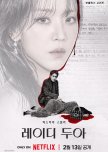
‘The Art of Sarah’ builds its structure around a theme that is, first and foremost, a question about identity. Perhaps it is precisely by starting from the end that we can find the most honest key to understanding this drama: a world dominated by brands, super-luxury, appearances and perceived value, where even a name can become a choice, an invention, a strategy.In this scenario dominated by appearances, Sarah is introduced as an almost mythological figure. Not so much for what she does, but for the way the series observes her: always slightly above the others, more aware, more lucid, as if the system surrounding her were not only a cage, but also a language to be mastered.
This is where the drama builds its most fascinating ambiguity. Is Sarah a victim? Is she a strategist? Is she both? The narrative seems to suggest that, in a world where value is perception, even morality can become a form of representation.
The metaphor of luxury handbags, perfect but exposed because they are “too accurate”, is not a decorative detail: it is the conceptual heart of the drama. Like those seemingly authentic objects, Sarah also oscillates between originality and performance, between authenticity and construction. The audience perceives the tension between what is and what appears to be, and it is here that the moral suspension that accompanies the entire series takes shape.
However, as the story delves deeper into the heart of the matter, that suspension slowly tends to resolve itself, not abruptly, but almost imperceptibly. It is as if, after flirting with the idea of an identity that cannot be reduced to a definition, the series finally chooses to bring it back within a more readable perimeter, without betraying the initial ambiguity and without losing the charm of doubt that Sarah has been able to generate at every step of her journey.
The unveiling, then, seems to take a more cautious trajectory: some elements, perhaps introduced belatedly, give the impression of a functional rather than inevitable relaunch, and the whole tends to come together in a more orderly fashion than might have been expected. This is not inconsistency, but more prosaically a form of narrative caution; after suggesting moral vertigo, the series opts for a controlled landing, which does not cancel out the initial suspension but recomposes it with lightness.
Overall, however, it remains a solid, elegant and coherent production. And above all, she stands out. Shin Hye-sun is magnetic: she combines fragility and calculation with rare naturalness, without ever overdoing it with unnecessary mannerisms. Even when the writing becomes more cautious, her performance continues to suggest something unresolved. She alone makes it drama worth watching.
Lee Joon-hyuk, on the other hand, remains prudently more conventional — perhaps deliberately — and this contrast brings out an interesting element: ambiguity is more fascinating than moral correctness. The morally “dark” character is narratively more vivid than the “righteous” one, and Shin Hye-sun's presence amplifies this tension, making it clear that the true energy of the drama stems from its ability to embody doubt without resolving it.
In the end, ‘The Art of Sarah’ avoids — courageously!? cautiously!? — giving us clear answers, instead creating an open space for reflection, where identity, appearance and morality intertwine without being completely resolved. A drama that knows how to play with doubt, challenging the viewer to question rather than passively observe, and does so with elegance and consistency, without ever betraying its conceptual construction.
For those who love stories that leave a trail of questions rather than certainties — and the inevitable need for a second viewing! — this can be considered a successful narrative experiment: provocative, sophisticated and, above all, capable of making you talk and think, even after the credits roll, and especially after THAT final question...
7/10
Was this review helpful to you?


