

 135
135 431
431 16
16 2
2 6
6 3
3 8
8 10
10 3
3 13
13 1
1 1
1 1
1 1
1 2
2 6
6 8
8 5
5 9
9


Didn't make me wax poetically about it
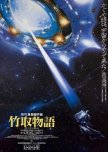
Princess from the Moon told an updated version of the thousand-year-old story, “The Tale of the Bamboo Cutter.” A supernatural “princess”, a sea monster, and UFO should have made for an exciting tale, but connecting to the characters was more difficult than I thought it would be.A mother and father are grieving the loss of their five-year-old daughter when a bright light and explosion near their daughter’s grave draws their attention. The husband runs into the forest, not only concerned about Kaya’s grave but also to put out any fires in the bamboo forest, the source of his income. He finds a small pod that breaks open and reveals a baby, a baby that ages into a five-year-old in seconds. His wife immediately accepts the blue-eyed version of Kaya as a gift from heaven. When Kaya rapidly turns into a young woman, they decide to move away. Their traveling money is aided by the pod which turned out to be pure gold. Soon Kaya’s beauty is the talk of the town and suitors are knocking at the door. What will happen when her people decide it’s time for her to return home?
This story is right up my alley. I love fairytales, fantasy, and kaiju. Not even a guest appearance by Manda could pull me into this one. It didn’t help that the movie was either badly degraded or shot in a gauzy style which distanced me from the story. Instead of giving it an ethereal appearance it was like struggling to see through fog. Kaya came across as detached which didn’t endear me to her. Her love interest was lumped in with two other suitors and an interested emperor. The impossible tasks Kaya assigned them to test their sincerity revealed a lack of integrity in most of the noblemen. “Men trade honesty for an easy life.”
One of my favorite actors, Mifune Toshiro, played the reluctant and then committed father. “Her joy and sorrow are mine now.” Wakao Ayako made the mother’s grief at the loss of a child palpable as well as her joy at heaven providing her another daughter to love. Though beautiful, Sawaguchi Yasuko’s portrayal of Kaya/Princess Kaguya came across as stiff. Despite so much of the story revolving around her, I never emotionally connected with her character. The blind Akeno played by Odaka Megumi gave a more nuanced performance.
Even through the fogged-up lens, the scenery was striking, especially the bamboo forest. The special effects, however, were rudimentary for the most part. The sea dragon did remind me of Manda and with the movie coming from Toho it could have been. The final scenes looked straight out of 1977’s Close Encounters of the Third Kind though I give them props for doing a satisfying job on the space craft. They got their money’s worth as the ship was shown from nearly every angle quite lovingly. Throughout the film the soundtrack was delicate and unobtrusive. Then inexplicably Peter Cetera sang the closing song over the credits. He was everywhere in 1987, also singing the theme song for Karate Kid 2 (1986). Maybe he was in the neighborhood.
Princess from the Moon was a delightful fairytale that missed opportunities to engage this viewer on a deeper level. The second half was stronger than the tepid first half. I did enjoy the concept of a moon maiden growing up with Earthling parents and falling in love with an Earthman. I wouldn’t want to dissuade anyone from watching Princess from the Moon, it’s worth giving a try. For me it faltered on the emotional front for instead of being moved by the tidal tug between celestial homes for Kaya, I found myself reminiscing about Sokka and Zuko’s conversation from The Last Airbender, “My girlfriend turned into the moon.” “That’s rough, buddy.”
28 October 2024
Was this review helpful to you?
Battastically ridiculous!
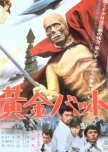
The Golden Bat was a film with aliens, a rogue planet, laser weapons, a spaceship shaped like a shark, and a superhero golden mummy with a serious overbite. The science was laughable. The costumes were dreadful. And this was 70 minutes of silly fun.A secret U.N. space institute has discovered that the planet Icarus is on a collision course with Earth. The rogue planet is being assisted by Nazo “Master of the Universe” who wants to be rid of Earthlings. At the institute, Dr. Pearl is assisted by the studly Dr. Yamatone and Yamatone’s boy wonder, Akira. Pearl has built a laser cannon capable of destroying Icarus but it lacks a rare mineral. Fortunately for Team Earth, one of their spaceships has crashed on an uncharted island. When the team goes to investigate, they come across a sarcophagus with a mummy inside dressed in gold lame. Holy coincidences Batman, the mummy is holding the mineral they need to save the planet! Turns out this risen island is part of Atlantis. The tomb directions read, “Ten millennia from now mankind will face a crisis. Open this sarcophagus and I, the Golden Bat, will awaken from my long sleep to fight by your side. Pour a drop of water on me.” Pearl’s granddaughter obliges and the Golden Bat comes to life. All Emily has to do is call his name and he will appear. Team Earth will need all the help they can get with a planet barreling down on them and Nazo’s minions attacking them from all sides.
If you have ever watched an old live action Saturday morning show for kids, this would be similar---albeit with more dead bodies. Apparently, the Golden Bat is one of the earliest, if not the earliest superhero dating back to 1930. This GB was invulnerable, carried a laser shooting baton, could fly and had a maniacal laugh. The evil Nazo’s costume looked like a big mouse with four eyes and a mechanical claw for one hand. He had three high level minions-Jackal, Keloid, and Piranha. Nazo’s spaceship was a giant drill shaped monstrosity while his cruising around ship was built like a shark. Sonny Chiba played a bearded scientist who spent most of his time shooting his laser handgun at aliens and wondering if his career was what was being destroyed.
The Golden Bat was not a high-quality production and the science was scarily bad. But it was so ridiculous that it was funny. In order to enjoy this movie, you will need an extremely high cheese threshold. Like Icarus high. Or be high. Graded on a curve.
24 October 2024
Was this review helpful to you?
"Behold I will make a havoc in the Heavenly Palace!"
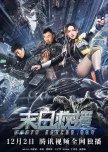
Rescue the Earth aka Earth Rescue Day took the old trope of aliens taking over the Earth and combined it with a little Monkey King magic. The mischievous god never made an appearance but devotee Mo Fei managed to embody some of the simian’s better qualities.The Earth has been devastated and overtaken by an alien called Giant Kun who orbits the sky. Smaller spider-like creatures called Kunzis scavenge the land and anyone who dares to come above ground. Humanity has made their homes safely below ground in modern cities. Mo Fei is a Flyman in his 20’s who goes to the surface to find objects of worth to sell below. He owes his friend, Sha Sha, money. She tags along when he tries to sell items to Boss Zhu who is not happy to see him. Mo Fei and Sha Sha end up on the run from Boss Zhu above ground in their flying vehicles when both are attacked by the Kunzis. Mo Fei rescues Boss Zhu and the civilians find themselves in turn rescued from a herd of Kunzis by the Black Falcon Squad. The squad and Flymen end up on a dangerous mission through Kunzi infested land in order to arm a weapon that might destroy Giant Kun before she reproduces and ends humanity for all time.
Rescue the Earth had some really good creatures. Although Giant Kun looked suspiciously like the Harbulary battery eating Abilisk from Guardians of the Galaxy 2. If spiders make you squeamish the hordes of arachnid inspired Kunzis with long spiky tongues may not be for you. While the creatures were properly creepy, the flying car chases came across as very low quality CGI.
Liu Jian Yu as the Wukong inspired Mo Fei had an impish smile and Monkey King hairdo. There was a nice bit to tie it all together at the end. Wang Zi Jia as his gal pal Sha Sha was the mechanic who had to run around on the snow-covered ground in her Daisy Dukes cut-off jean shorts. The writers worked hard to make the four brave soldiers have their own personalities. Capt. Li had a secret related to Mo Fei that tied him to the young man. Different characters had to make the ultimate sacrifice for the greater good and while it didn’t bring tears, they weren’t complete strangers.
Rescue the Earth had some clunky dialogue and even clunkier science but it did have an interesting premise and characters. The film was thankfully short and kept the action going non-stop. The final solution didn’t make any sense but it was done in Wukong style which made it worthwhile for me. If you can handle cheesy dialogue and don’t mind absurd science it’s a diverting 90 minutes of action and creepy crawlers.
21 October 2024
Triggers-Spiderish creatures
Was this review helpful to you?
The real seafood wars!
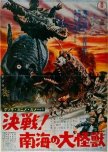
A space probe to Jupiter returned home with glittering aliens who created Seafood Kaiju in order to take over the world in Space Amoeba aka Yog, Monster from Space. An intrepid reporter, a biologist, and a resort developer converge on a pristine island destined to become a luxury resort site. That is, if the native islanders and newly created monsters agree to sign the contracts.Reporter Kudo Taro sees the lost Jupiter probe, Helios 7, parachuting to Earth while he is on an airplane. No one believes him and he is laughed out of the editor’s office. Hoshino Ayako who works for a resort developer asks him to take pictures of a remote island for their project. At first, he’s not interested but then his friend, Dr. Mida Kyoichi tells him he believes monsters might be inhabiting the island. Kudo can smell a buck to be made and agrees. A shady character named Obata tags along on the ship and joins the group even after the monster has already killed a worker on the island. The islanders believe the newcomers are angering Gezora, a giant octopus like creature, but Gezora seems generally pissed off about any two-legged creatures on the island. It’s not long before everyone understands that they are on their own with no way off the island and no way to contact the outside world, with a giant cephalopod out for blood.
This was Honda Ishiro’s first kaiju movie without special effects master Tsuburaya Eiji who died in 1970. Aside from a few random wires through the years, I noticed more in this film than the others combined. Of course, controlling eight legs on land is tough. There were two giant crabs-Ganimes, and a big turtle not named Gamera as well. The overall looks of the kaiju were good for the time period. If you have a bat phobia there were numerous alive and unalive bats in the last third of the film. This film got something right that many of these creature features did not. The monsters showed up early and often instead of being special guest stars in their own movies.
The actors were better than usual, with the exception of the female lead who was never called by name. I kept thinking Kudo would say, “Ayako, stop falling down!” or “Ayako, stop screaming and alerting the monster to our location!” There was never even a proper introduction. The lone island woman, Saki, had her name called out numerous times. Even characters with bit parts had their names vocalized, all but poor Ayako. At least they gave her a name in the cast list. Have I belabored that point? Probably. Lol
Space Amoeba took a different angle on the kaiju genre by having microscopic glittering space aliens take over sea creatures and even humans in their world domination goal. The humans had to survive long enough to work together to discover the aliens’ weakness. They also had a little assist from Mother Nature and a selfless soul. If you enjoy old kaiju films, this is one to try.
19 October 2024
Was this review helpful to you?
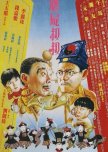
That's not a sword. Now that's a sword!
Lam Ching Ying wasn’t available for this sequel so Mr. Vampire 4 had to find two priests to take his place! Wu Ma joined the hopping fun alongside Anthony Chan’s Four-eyed Taoist. There were jiangshi and one Big Bad vampire for the boys to deal with.Buddhist priest Yi Yu returns home with Ching Ching, a female disciple. Chia Le is a disciple of the Four-eyed Taoist but respects Yi Yu. Chia Le and Ching Ching get off on the wrong foot when Chia Le mistakes her for a boy. Their misunderstanding can’t hold a candle to the childish displays by their elders who torment each other and even have a food fight. The two older men have to set aside their petty rivalry and work together when a vampire is being transported to the capital and breaks out of his traveling coffin during a lightning storm.
Lam Ching Ying’s wise unibrowed character would have had no place in this film. It’s a wonder the vampire was ever subdued with these two frenemies on the job. Wu Ma and Anthony Chan made the most of their roles as they fought each other and then the undead. Ching Ching was a more adept female character than in previous sequels making her a welcome addition. Chin Kar Lok took over his older brother’s (Chin Siu Ho) role as the bumbling Taoist disciple. His kung fu and stunt abilities were fun to watch as he was quite acrobatic. Pauline Wong returned in a guest role as a fox demon who tried to seduce the Four-eyed Taoist. Cheung Wing Cheung played a hopping vampire in Mr. Vampire 2 and played the Big Bad vampire here.
Except for a conga line of hopping vampires who also played limbo, the first 47 minutes was devoted to slapstick comedy with the two competing priests. As someone who has a low tolerance for it, those minutes were slower than a jiangshi hopping through knee deep mud. Once the Big Bad took the stage, the action picked up as well as my interest. There was still plenty of comedy, this was not a scary movie. At one point Four Eyes kept coming out with bigger and bigger swords compared to Yi Yu’s. One thing that did not age well was Yuen Wah’s gay eunuch as the role was played strictly for laughs.
Mr. Vampire 4 was comparable in quality to most of the other sequels in this franchise. The fights were well-choreographed and there were plenty of vampires both of the hopping and non-hopping varieties. Most of all, Wu Ma is always welcome on my screen even if I have to watch him in a food fight. (Graded on a ratings curve)
18 October 2024
Trigger warning: Snakes and one decapitation
Was this review helpful to you?
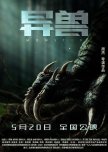
Monstrous and not in the good way
Monsters was a cheap, confusing film which wouldn’t have been a bad thing if it had been funny or scary. Five people ended up in a monster prison that was sealed in four dimensions but wasn’t impregnable. The ancient creators were super geniuses but forgot about solar eclipses which caused the singularity solar space time quantum magnetic black hole multiverse prison to glitch.Long before humans crawled down from the trees, giants ruled the Earth. Everything was hunky dory until an underground explosion spewed up lethal monsters that ate everything in their path. The giants decided to leave Earth but eleven warriors stayed behind and caged the monsters. A gazillion years later Gao Fei and her sidekick Su Jun Bao race to the site where her sister, Gao Wei, disappeared a year earlier during a solar eclipse. As luck would have it another eclipse is about to begin. Fei is ready to jump through the newly formed ripples when Zhang Mu Sheng drops in wielding a knife and attacks Fei. Why you ask? Who knows. Jun Bao is accidentally knocked into the portal. When Mu Sheng refuses to relent Fei bounces both of them through the portal before it closes. An observer, Ayo Sayi, finds her way through the portal as well. Hiding in the deep forest is a monster who has a Black Canary cry that disables its prey before it attacks. As the group wanders through the woods, they keep happening upon other people who look just like them, both living and dead. Fei just wants to survive, find her sister, and get everyone safely home.
The creators failed at world building on multiple levels which dragged this movie down. It could have been a translation problem but the characters’ efforts to explain what was going on were just confusing word salads of scientific terms. It seemed liked the creators used the whole black hole singularity multiverse quantum physics explanation so that they could kill off character without having to sacrifice the main characters. How did beings intelligent enough to build a fourth-dimension prison powered by the sun not take into account solar eclipses? Total solar eclipses happen around every 18 months. And how in the heck would a solar eclipse be any more problematic than nighttime? A solar eclipse doesn’t block the sun for the whole planet. The nocturnal beasts didn’t seem to have any problem coming out in the daytime either.
Along with world building, the characters were a mess. Gao Fei knew her sister disappeared through a mysterious portal. She planned to go through it as well when it appeared again. She brought no food, water, weapon, or backpack. To show she was ready for anything she wore a white sports bra instead of a shirt. The Observer in an elaborate costume and wig was not properly attired for traipsing through the forest and fighting off a monster either, although she at least carried a sword. Mu Sheng went from trying to kill Fei to becoming best buddies with her in whiplash fashion. And poor Jun Bao was given a list of scientific terms to rattle off in no particular order. Most of the characters were knocked unconscious at least once. If they survived their ordeal they all needed to schedule CTscans upon return to their world. Quite honestly, my favorite character and the only one I cared about surviving was Master the dog.
Monsters was primarily a singular monster for most of the movie with the kind of CGI you’d expect from this caliber of film. If you enjoy being confused watching confused characters wandering through a singularity solar space time quantum magnetic black hole multiverse monster prison disguised as a wooded forest, this might be something to check out. I told myself if the writers resisted using the most cliched ending for these cheap monster movies I’d give it a .5 bump. It did not receive a .5 ratings bump.
17 October 2024
Was this review helpful to you?
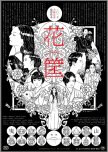
"Art should have no borders"
Hanagatami was a labor of love for Director Obayashi Nobuhiko. He’d conceived the film 40 years before filming it. Right before production he received the news he had stage 4 cancer and he went ahead and began it. This film was surrealistically beautiful, cryptic, and a scathing criticism of the 20th century Japanese war machine.It’s 1941 and seventeen-year-old Toshihiko has returned to Japan from Amsterdam where his mother lives. At his new school he befriends three boys—athletic Ukai, nihilist Kira, and class clown Aso. Toshihiko lives with his aunt and her sister-in-law, the beautiful and dying Mina. The boys are introduced to Mina’s friends, Chitose (Kira’s cousin) and Akine. The youth swim in the ocean, have parties and picnics, attend festivals, and fall in love as befits their age. They also have the sword of war hanging over their heads.
“All you boys will be taken and killed!”
This film set an exhausting pace in the first act. With his extensive use of green screens and special effects some of his choices almost made me dizzy. Toshi was ever exuberant, often to the extreme, which was hard to keep up with. The film eventually settled into a more moderate pace. There were events I wasn’t sure happened or were symbolic. The full moon loomed over the nightly proceedings, bathing everyone in its magical glow. And ghostly military scarecrows came to life and marched while children followed along singing.
“War is hell, but I can’t avoid my own personal hell”
It’s hard for me to call the youth “boys” because in fact the actors were between the ages of 27-42. The girls were closer to their screen ages, most being in their low 20’s. Regardless of their real ages, I had to mentally accept them as teens. They were supposed to be coming of age all the while knowing that they might never make it to manhood. There were homoerotic scenes such as two teens riding a horse naked in the moonlight. And sapphic implied scenes between friends and in-laws. There were plenty of male bare bottoms and women in full nude body suits.
“Seen through the wrong end of a telescope an ordinary scene becomes an ancient history. No, it’s not nostalgia. It’s heartache for all that’s lost.”
Toshi was looking back at his youth in the house his mother and aunt prepared for him. The years had flown by and memory colored in dark nights and filled gaps from old wounds. Friendships were bound by the present and impossible future. Their country had deemed their youth expendable in the name of honor and expansion. There were those who decided if they were being sent to die in a distant land, they could choose a familiar place to end their life. Obayashi drove home every chance he could that Japanese men were born to die in war, a truly useless and tragic thing. At no point was he subtle about his loathing for the 20th century government’s actions and his mourning for the wasted lives and potential. Hanagatami wasn’t an easy film to watch. It was long and maddeningly dream-like. It was also highly creative in showing how teens and their relationships are complex especially when they know they will be forced to grow up and face horrors they can’t escape.
“For Toshihiko, his youth was like a game of hide and seek. It was dark before he knew it and everybody had gone home.”
11 October 2024
Was this review helpful to you?
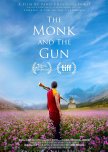
"We were already happy"
In 1999 television and the internet became legal in Bhutan ushering in a new era to the small country sandwiched between China and India. In an even greater societal shakeup in 2006, King Jigme Singye Wangchuck announced his intention to step down and have the country transition to a constitutional monarchy. The people in the village of Ura faced a steep learning curve as they struggled to balance their long-held traditions with the encroaching modernization. And what could be a bigger example of polar opposites colliding than seeing a peaceful monk carrying a gun through fields of flowers in The Monk and the Gun.An election official comes to Ura to register voters and stage a mock election to prepare the people for the real thing. The beloved Buddhist lama hears the news and tells his young monk to bring him two guns. “Things need to be made right.” In a country where many people had never even seen a gun, Tashi had a daunting task. The obedient monk didn’t know why the guns were needed but proceeded to go house to house in search of one. Someone else was also looking for a gun. An American gun dealer and collector, Ron Coleman, along with his guide, Benji, sought to make a deal with a local villager who was in possession of a rare American Civil War rifle.
The election official had her hands full trying to register the villagers as some had no idea when their exact birthdate was. They also weren’t exactly sure what the election was all about and why their king was abdicating. Was all this change really worth it? “Democracy will be the pinnacle of Gross National Happiness.” “We were already happy.” People began fighting about candidates, especially one family where a son-in-law bucked tradition by refusing to back the elder’s choice. The gun collector was led on a merry chase for his prize unaware that the police were chasing him. The collision was priceless.
Brilliant fields of flowers, emerald green hills---the cinematography had a lot to work with and made the most of a beautiful setting. The acting was mostly natural but unexceptional. A wife torn between her husband and mother revealed the conflict between tradition and modernization. All she wanted was for her family to be happy. The tenacious election official was determined to have the villagers prepared for when the real election took place. And the young monk who thought the name of the election was a pig disease just kept putting one foot in front of the other in order to comply with his master. The American was just as clueless about what was going on because despite most of the characters being uninterested in money, both his treasure and significant sums of money kept slipping through his fingers.
The Monk and the Gun was a gentle, humorous, and insightful examination of a society transitioning and wanting the changes to be meaningful and not negatively impact their way of life. The lama stood ready to help the villagers focus on eliminating hatred and conflict as they learned to embrace a say in their own government. People were also beginning to understand that being able to choose didn’t always mean the choices were great. “I can’t believe this idiot represents the ‘freedom and equality party.’” Welcome to democracy.
16 September 2024
Was this review helpful to you?
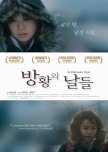
Bittersweet coming of age film
In Between Days was a low budget, independent film that brilliantly portrayed a teenage girl’s awkward friendship with a boy and difficulty in assimilating to her new life in Canada. Loosely based on director Kim So Young’s own experience moving from Busan, Korea to California, USA at the age of 12 and the difficulties she faced trying to fit in. The budget for the film was $60,000 so there were few sets and much of the teens’ conversations took place in the icy winter outdoors, apartments, or buses in Toronto.Aimie and Tran are best friends, but Aimie has developed a serious crush on her buddy. Tran says he just wants to be friends, but by that he seems to mean, friends with benefits. Aimie isn’t comfortable with the sexual experimentation but is also curious about it. Unable to voice their true feelings and wants to each other, they alternately withdraw and show attention to others which only causes more problems for them.
Aimie’s mother works long hours and is emotionally remote from her. The mom has no idea what Aimie is doing or how she is feeling. Aimie’s father left them, and she misses him terribly while also being upset with him. She also misses her extended family, made worse by her mother not being available most of the time as well.
Most of the conversations between Aimie and Tran were in Korean. Whether in English or Korean, Aimie and Tran had trouble communicating with each other and often used jealousy to get the other’s attention or to hurt the other. Teenage years can be awkward and isolating for anyone, but transplanting to a new world only intensified those feelings. Both Aimie and Tran struggled with their emotions, so much was new and they were unsure of how to handle the uncomfortable spaces between them. When she and Tran spent less time together, the frozen winter felt especially cold and lonely.
Director Kim kept the camera tight on Aimie and Tran’s faces, never letting the audience escape the painful, embarrassing, and disconcerting moments. Like most teens grappling and fumbling with unfamiliar emotions and biological urges, they were afraid of being rejected. Both had a sense of needing to belong, made worse by a limited community. Aimie and Tran didn’t want to lose what they had but also maybe wanted something more. This film was the first job for both actors and their performances were natural. Jiseon Kim was able to convey complex emotions quite well. Andy Kang acted like a typical teenage boy unwilling to show his emotions for fear of giving too much away.
In Between Days was a bittersweet coming of age film with all of the euphoria, bumbling efforts, and heartache that entails. Like so many films in this genre, there was no true ending, just a step toward another chapter for a girl seeking to find her place in the world and coming to terms with her own feelings and desires.
19 June 2024
Was this review helpful to you?
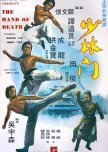
The Manchus decided the Shaolin temples had too much power and too many trained fighters. They found students willing to betray their brothers for money and soon the loyal shaolin students who remained alive were on the run. Commander Shih and his sidekicks Du Qing and Smiling Fox rule their little empire with iron fists or more accurately, Killing Crane fists. Faithful shaolin student Yung Fei has been chosen by the rebels to escort a scholar with a secret list to safety and also to kill Commander Shih. No easy feat, as Shih is protected by 8 Tiger Generals who work as his bodyguards. After failing in his endeavor to kill Shih, Yung Fei convinces two fighters to help him---The Master Sword, a wandering swordsman with a score to settle, and Little Tan, a blacksmith and delivery boy whose brother was killed by Shih and his men. Even with the extra help, it will take a miracle for the men to keep the scholar alive and to take the life of Shih.
Dorian Tan is always fun to watch with his quick, high kicks. His film career ended for the most part around 1985, but he went on to teach Taekwondo in Korea and the United States. This was the fourth film a very young John Woo directed. It was interesting seeing the larger than life director as the fearful scholar depending on others to protect him. Jackie Chan was almost unrecognizable in the role of Little Tan until he started moving and some early Chan mannerisms showed through. James Tien made for a believable villain if not fighter, with poor Sammo wearing prosthetic teeth as his #1. Never one to avoid hitting the ground or anything else, Sammo put his body through the mill during his fight with Dorian in the latter part of the film. Korean actor Kim Ki Ju made for a smarmy and dangerous #2. Yuen Wah played one of the 8 Bodyguards and was unable to hide his quick moves even in this small role. The overall fight choreography for the movie was adequate, oftentimes stilted but avoided kung fu posing. Some fights were better than other, some faster than others. You could tell a number of kicks didn’t really land, but that’s one of the safety concerns with fast, powerful kickers. Ask Jackie Chan about the tooth he lost when filming with “Thunder Leg” Hwang Jang Lee. Even at that, one stunt did go wrong involving a cable with Chan being knocked out.
Like so many kung fu movies filmed in Taiwan and Korea, most of the settings were outdoors in nature. John Woo didn’t break the mold with his story or directing, but as a young director with little experience he did an admirable job of taking a stock story and not overcomplicating it or making it a sieve of plot holes. I only wish they'd sprung for some better wigs. These hairpieces looked like they'd been shoved into a box, stored for ten years, brought out and plopped down on the actors' heads without even brushing them out.
The story was standard. There was a secret list and an almost invincible bad guy. The good guys had to train to improve their skills and weapons or be destroyed. The actors were able to lift the characters slightly above the page, but this was still average at best. The final fight was exciting because by that time, through the little band of fighters’ skills and sacrifices I’d become invested in Shih being taken down…hard. But most of all, I wanted Dorian to flash those legs of his which he kindly obliged to do. As always, graded on a curve.
3 June 2024
Was this review helpful to you?
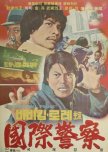
"There's a man who keeps his duty separate from his love at least once a day"
Lo Lieh directed and starred as an agent in Deadly Roulette, a movie about two Interpol agents who sought to bring down a Triad leader who had been killing people using the lethal Finger Bullets style of kung fu. Bobby Kim brought the kicks and lovin’ as the agent whose ex-girlfriend lived in Hong Kong, complicating his actions on the case.Interpol agent Bobby is brought onto a weapons smuggling case in Hong Kong when officers are found dead with finger holes in them. He asks to work with Darion who obligingly signs on. While in Hong Kong he meets up with his ex-flame Kyeong Hee who is still angry about being used in his last investigation and then abandoned. That anger does not stop her from hooking up with him again. As Bobby digs further into the case, he discovers how dangerous the gang is as they supply grenade launchers, missiles, and rifles to terrorists. It doesn’t take long before the agents and officers working on the case ascertain they have a mole in their unit as their every move is preemptively countered.
If you’ve ever wondered what 1970’s Hong Kong looked like, there were many scenes of characters driving around. This was a fairly common practice in movies 50 years ago. The shots established the setting and showed characters’ movement from scene to scene, but it feels dated now days. The music was also classically 1970’s bow chicka bow bow. The Beatles’ song “I'm Happy Just to Dance with You” (1964) was used but I’m betting no royalties were paid. Dog fights were shown in two different scenes early in the film, which was quite disconcerting for me. I’d rather see the men pummel each other instead of innocent animals being abused.
The movie made use of the Interpol trope in order to justify a foreign actor starring in a film set in Hong Kong. I would have preferred Hwang Jang Lee as the Korean agent. Lo Lieh is one of my favorite old kung fu stars and the only reason I watched Deadly Roulette. The film was badly faded and the story had numerous plot holes and inconsistencies. Usually, plot holes weren’t a big issue in these types of films because there were enough fights to distract the viewer. Unfortunately, there weren’t many quality fights and the big finale was a big letdown. South Korean actor Bobby Kim was proficient in taekwondo and it showed with his excellent kicks, even though many of them obviously never landed.
Deadly Roulette had a semblance of a story and was watchable…barely. And watchable only if you enjoy old kung fu films, especially one with a largely Korean cast. As always, I grade these cheap, niche movies before 1990 on a curve.
1 June 2024
Was this review helpful to you?
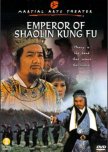
The Snake, the Tiger, the Crane and the Flamingo?
Despite the title of the movie, Emperor of Shaolin Kung Fu, this was Nancy Yen’s movie as the 3rd Princess and sole royal survivor when rebels overthrew the emperor of the Ming Dynasty. Wang Hsieh played the usurper, Li Tzu Cheng, and the target of the princess’ ire and revenge.As Li Tzu Cheng and his army storm the palace, the emperor orders his family to kill themselves. His 3rd daughter argues that her father needs to live to fight another day. In response to her plea, he swipes his sword at her cutting her arm off in the process. 3rd Princess escapes to a Buddhist temple where she heals and regroups. She sets out to bring Li down, finding warriors loyal to the monarchy and traitors along the way.
Nancy Yen was believable as the one-armed princess seeking the death of Li Tzu Cheng (Li Zi Cheng). Unfortunately, 3rd Princess tended to take on Li and his fighters with only one fighter each time she attacked which was always doomed to failure. There was a rather lengthy section of her either acting or having gone mad which dragged on too long. The rebels finally had their chance when Wu Sangui and his army drove Li out. The princess and those loyal to the monarchy confronted the vicious Li Tzu Cheng but only at great cost.
Lo Lieh made an appearance as a wandering warrior who joined her. I’m of the belief Lo makes everything he’s in better, even in a sparkly blue costume. Dean Shek showed up as a deadly scholar. And finally, Carter Wong arrived in the last 30 minutes, as a butcher and fighter devoted to his mother. The fights were okay. Most were sword fights, until Carter’s last fight where he used a variety of styles. Each style had a quick glimpse of the animal the style mimicked. The crane looked suspiciously like a pink flamingo which was hilarious. Wang Hsieh in another of the truly awful wigs he was known for wearing once again played the villain with his typical glee. The sides were badly cropped in the print I saw which cut out much of the action.
Emperor of Shaolin Kung Fu aka The Snake, The Tiger, The Crane aka Lord Chuang, Li Tzu Cheng wasn’t great but was watchable due to the actors involved. Nancy Yen made a fierce, vengeful princess who would ultimately become the legendary One-Armed Nun. She was joined by familiar faces with enough action to keep it from becoming too boring. If you enjoy old kung fu films and don’t mind one that has degraded some, this 1980 Taiwanese flick might be one to try.
23 May 2024
Was this review helpful to you?
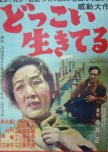
"There's no such thing as easy anywhere these days"
Dokkoi Ikiteru aka I Still Live was a painful look at the most vulnerable in Japan post WWII. Director Imai Tadashi who dove into socially conscious movies after the war, made this film outside of the major studios. I will admit to only grasping the large parts of the film as the only available copy I could find used auto-generated English subtitles which were lacking to say the least. Until such time as someone who watches this who speaks Japanese or there is an adequate translation, I’ll leave a quick review for those who might be interested in this film.The film centers on a Japanese family of four. They initially live in a small shantytown but are forced to move out when it is torn down. The father rises early every morning to apply for day laborer jobs along with crowds of desperate people. It is a daily struggle to earn enough money to eat and supply shelter. Many of the places where the father works amongst the rubble and ruins had been hit hard by the air raids during the war. At one point in time, the mother and two children take the train out of town. At first it looks like the father may find a manufacturing job and his luck will turn for the better, but alas, not in this melodrama. Everything goes from bad to worse, some of the injuries self-inflicted, until he reaches the point when he thinks they would be better off dead. A precipitous action will determine the course he takes.
While this film highlighted a desperate time for many after the war and has value in edification of its historical setting, I found the film to be too deliberately maudlin for me. The music was heavy-handed and overwrought as the little family suffered misfortune after misfortune. Yet the performances were strong and again, it covered an important subject, though at times it did feel more educational in nature. If you enjoy older films and especially ones set in this difficult time in Japan’s recovery, this would be a film to try.
14 May 2024
Was this review helpful to you?
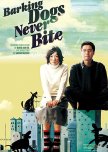
"Nobody in this country follows the rules"
Barking Dogs Never Bite was a dark comedy that darkly commented on social inequalities and inadequacies. While director Bong Joon Ho cast his view on numerous topics, the result was rough and flat instead of subtle and biting. More of a scattershot approach than guided missile.Yoon Joo hears once again why he has been passed over for making professor, made worse by the barking of a dog in the background. He thinks he’s tracked down the culprit, grabs it, and ultimately locks it in a wardrobe in the basement. Hyun Nam works in the building and helps a little girl put up signs for the missing pup. At this point different characters become involved with the four-legged dwellers in the crowded apartment building, most of which have ulterior motives for the pets.
Though the movie clearly stated no animals were harmed during filming, there was some rough treatment. Dog lovers may have trouble with a few of these scenes. The antipathy Yoon Joo felt toward the pampered animals and their doting owners turned out to be more than what he observed. He thought his life was tougher than others, but as it became apparent, his actions led to agonizing pain for the pet owners with devastating consequences for one.
Billed as a dark comedy, I only found two scenes funny and both involved the talented Bae Doo Na. This story played out like a sinister slice of life with few repercussions for bad behavior. Hyun Nam’s unending search for affirmation had its own strange results. I thoroughly enjoyed the close friendship between her and Jang Mi, the complete antithesis of Yoon Joo’s toxic marriage.
The laundry list of social grievances were thrown out on the screen continuously. Suffice to say, the director had complaints he wanted to get off his chest. Class distinctions. People don’t follow the rules. People embezzle money and make shoddy, dangerous buildings. Pregnant employees are treated terribly. School deans have to be bribed for job openings. Humanities professors make the worst husbands. Women with children are vulnerable when husbands leave. For a homeless person being arrested is a blessing because at least there are regular meals. Some drinking culture situations turn deadly. Gender inequalities. Abusive, loveless relationships. Dangerous pesticides thickly sprayed in the air. Exit doors and stairwells blocked by junk creating hazardous situations. People supplementing their diets with dead pets. People fired for caring too much about others. At least later in his career, Bong would grab a singular social criticism by the neck and devour it with satire and venom.
Fans of Bong Joon Ho will most likely see deeper into this film than I did and enjoy it more. I wouldn’t want to deter anyone from trying this film by the famed director. What it boiled down to was Yoon Joo and Hyun Nam were unhappy with their situations and unsure how to make things better or even if they could, given the employment climate and chose inverse approaches. Yoon Joo took the villain role and went to the dark side. Hyun Nam desired to be a hero and though her results weren’t glorious, she and her friend chose to live in the light come what may. The majority of other characters resided somewhere in the gray areas, just trying to make it through their days.
13 May 2024
Was this review helpful to you?
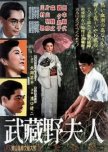
"It's ridiculous!"
Director Mizoguchi Kenji threw me for a loop with The Lady of Musashino. Unhappy marriages, infidelity, and premarital sex abounded in this postwar film. The main couple exemplified the changing lifestyles and social norms being explored as Japan tried to find its footing after everything came tumbling down. Michiko was as traditional in her morals as her husband was laissez faire regarding his.After fleeing Tokyo during the bombing, Michiko and Tadao go to live with her parents. Her family comes from a long line of samurai and the property has been in the family for ages. After her parents die, Michiko inherits it. Three years after the war, her cousin Tsutomu finally arrives home after having spent time in a Singapore POW camp. Tadao is a professor who believes that infidelity is an expression of free will and proceeds to live out that philosophy. He encourages Tsutomu to live in town while attending university so that he can enjoy as much sex as possible. Michiko’s cousin Ono and his wife Tomiko have their own open ideas about marriage fidelity as well. Both Michiko and Tsutomu have a love for Musashino which develops into feelings for each other. Will Michiko’s rigid morality stay in place in the face of handsome Tsutomu’s advances?
Mizoguchi at first seemed to be conveying the idea that women were treated unfairly in marriage and divorce. Tadao was thoroughly reprehensible even as he lauded the new law being passed that would no longer make it a crime for women to commit adultery, men could continue to do whatever they wanted as always. It was difficult to be invested in this story as most of the characters were selfish and unlikeable. Even Michiko’s noble idiocy began to wear thin. Tadao made a mockery of their marriage and her and even tried to leave her homeless yet she still made excuses for him. While it was true that women could become boxed into a corner with few exits, Michiko could only see one due to her narrow views. Like me, love-stricken Tsutomu had trouble understanding her train of thought. When she tried to explain why they couldn’t be together at the moment, “If there are more and more unhappy people, morality will change,” it wasn’t long before Tsutomu replied, “It’s ridiculous!” The moral of the story was pretty convoluted by the end.
What was effective in this film was the camera work. This was a magnificent film to look at even in black and white. Tsumoto’s arrival through the trees and fog was stunning. I would love for it to have been in color in order to bring out all of the hues of the forest and water as Michiko and Tsutomu explored Musashino on several occasions.
Mizoguchi repeatedly stressed how “everyone is running around in a fever with no morals.” The societal anxiety of a postwar Japan was felt in nearly every scene. The decline of traditions represented by the old samurai estate appeared to not only be caused by Western influences but as a reaction to a way of life that led up to the war and during it. Near the end of the war Michiko was given cyanide for the family by the military when she went out to buy their rations. While she thought about taking it, others around her told her how cowardly and ridiculous it was and the same response was given when a family member died “honorably” by taking his life.
The Lady of Musashino was an uneven melodrama and criticism of changing mores. The memory of the “simple, green, beautiful” Musashino that had helped Tsumotu endure while being a prisoner was fading as quickly as the old way of life. Faithful Michiko arduously clung to the traditions of the past and paid a terrible price for her stubborn morality and sense of duty.
29 April 2024
Was this review helpful to you?


