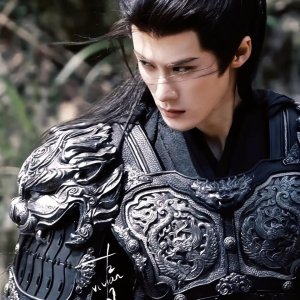
Four more days til season two airs, here's a character analysis of Lord Xiang Liu.An oldie essay, but one of my…
"You either die a hero, or you live long enough to see yourself become the villain."— Harvey Dent, The Dark Knight
When I think about Xiang Liu, I think about this quote from Christopher Nolan’s "The Dark Knight." Xiang Liu maybe an antihero, but unlike Cang Xuan, all of his decisions and actions appear selfish on the surface, yet they actually stem from a place of heroic unselfishness, filial piety, and true love. Everything he does, has done, or will do results in him gaining nothing—no praise, no victory, no glory, and certainly no love. Somehow, he has portrayed heroic traits as well as antiheroic attitudes, transforming himself into a villain in the eyes of the people of Dahuang, and even to some audiences/readers.
Tong Hua put a lot of thought into Xiang Liu. The stream of maybes, I could imagine, as she sat in her place of comfort, sipping tea (or coffee) and pondering the what if’s.
What if a demon with a heart of gold falls in love? Will he become a hero? If so, to whom does he become a hero? Will he confess, hide his love, or demand her love in return? What if this young demon was greatly misunderstood, just learning to be human? Will love transform his demon heart into a human one?
Whatever was Tong Hua’s intention, in the end, she has written one of literature’s most complex antiheroes I’ve ever encountered. In Xiang Liu, we see a character who embodies Nolan's quote, walking the fine line between heroism and villainy, and challenging our understanding of morality and love.
Approaching Xiang Liu with a black and white understanding of Good and Evil, as well as clinging to Christian ideals of Gods and Demons, would hinder a nuanced understanding of his character, as he defies such simplistic categorizations and invites a more profound exploration of moral ambiguity and the depths of his persona. In the world of Dahuang, gods, demons, and humans are intermixed, characterized by the length of their lives and demons' inclination toward more primal, animalistic instincts. Yet, they all share the capacity for both good and evil, showcasing the complex moral spectrum that defines their existence.
Therefore, depending on the fence, and perhaps which side of history, you are standing on, you may see XL as a hero or a villain. He's regarded as a hero by the remnants of Chenrong and deemed worthy as an heroic rival by his opponents (CX even once tried to convince him to come to his aid), while others see him as a villain to be feared. The only person who truly understood this complicated persona was Xiao Yao.
Xiang Liu's character undergoes a remarkable transformation, evolving from a cold-hearted and aloof general into a symbol of the principle of repaying kindness. His journey is a testament to the profound impact of relationships on his character development. Initially, he is driven by the need to repay the kindness of FFB, his adopted father, Jing and Xiao Yao. His heart, once distant and unyielding, gradually softens as he falls deeply in love with XY, an emotion he never expected to encounter.
As Xiang Liu's love for XY grows, so does his determination to honor his fallen soldiers and ensure her peaceful life. He lays intricate plans, demonstrating the lengths he's willing to go to protect her. His heroic journey isn't just one of physical courage on the battlefield but also a transformation of his inner self, driven by love and the desire to secure a future of peace and happiness for XY.
XL has nine lives: one for himself, one for his adoptive father, and six for Xiao Yao—two to save her life, three to last her a lifetime and one for the man she wants to marry. He is willing to die nine times, while continuously crushing his only heart. In a paradoxical blend of antiheroic self-destruction and heroic self-sacrifice, Xiang Liu's demise ultimately ushers in peace to the world of Dahuang, serving as the catalyst to fulfill Cang Xuan's mission for a world where XY can lead a tranquil life with the one who will never abondon her. As he departs this world, leaving behind nothing but the legacy of a villain, to XY, he becomes the irreplaceable loss she'll carry with her always, a poignant tragedy, as she may never come to know the extent of his sacrifice.
Delving into Xiang Liu's sacrifices will invariably prompt a discussion of XY's own battles with selfishness and her inability to overcome the trauma of loneliness and abandonment. These two intertwined narratives illuminate the profound complexities of their relationship and individual character development.
Time and time again, Xiang Liu has demonstrated an unwavering ability to summon strength from the depths of his being to protect Xiao Yao. Regardless of injuries, diminished spiritual power, or even facing formidable armies, he fearlessly charges into battle for what he holds dear, showcasing his profound commitment to what he believes in and loves.
Xiang Liu has impressively prioritized XY while simultaneously balancing his filial devotion to his adopted father and commanding thousands of soldiers on the battlefield. However, within this intricate web of emotions and unspoken affection, they discover themselves entangled in an intense and uncharted emotional terrain. Yet, their relationship bears the strain of unresolved tensions, stemming from XY's self-centered yearning for love and fear of abandonment, and Xiang Liu's ongoing battle with his multitude of responsibilities, all of which contribute to the friction between them.
Adding to the intricacy of their relationship, they are like star-crossed lovers, trapped in the never-ending conflict between the remnants of Xiyan and Chenrong, a war that further complicates their already intricate bond. In their tumultuous journey, Xiang Liu and Xiao Yao have faced countless challenging encounters. Despite the hardships, XY harbors no blame toward XL; however, she finds it incredibly difficult to overcome the emotional scars left by their turbulent moments. Strangely, she manages to let go of the violence inflicted by Cang Xuan, the scars of which heal more readily than the wounds inflicted by the man she loves.
Her inability to let go of the trauma also serves as a barrier to Xiang Liu's approaches. He has faced rejection multiple times by XY and has been deemed unworthy to enter her dreams, a reflection of the lingering wounds in their relationship that both struggle to mend. XL, using these rejections as fuel, inadvertently pushes XY away, inflicting pain on his own heart, all while secretly laying plans for her to find happiness with Jing, despite the turmoil in his own emotions.
Yet, despite the pain, Xiang Liu served as Xiao Yao's mentor and protector, teaching her archery and life lessons during their dates. He encouraged her growth and offered fresh perspectives on life. As a poignant gesture, he gave her a map of the ocean, symbolizing his preparations for a future without him. These actions showcased his deep care for her well-being and left a lasting impact on her life.
"After decades of teaching you archery, you now have the ability to take care of yourself. You don't need your own body to shield someone you treasure when danger is around. You no longer have to endure solitude as your constant companion; you now have the right man to rely on. The sky is vast, and the oceans are deep. You now have a sanctuary to seek, free from the pursuit of others, and a place to call home. Xiao Yao, from now on, I can no longer stand watch to protect you. You have to take care of yourself. Wishing you a lifetime of worry-free happiness." — Xiang Liu
Counting down the days! Five more to go. While we eagerly wait, let's ponder about unspoken love and why it's…
Unspoken love, a sentiment that resides in the depths of human hearts, transcends the boundaries of language and words. It is an emotional experience that navigates the intricate web of cultural values and societal norms, shaping the way love is expressed across generations. The elusive nature of unspoken love beckons us to explore the impact that cultural influences have on the manifestation of affection and how this expression has evolved throughout history.
In "Lost You Forever," the relationship between Xiao Yao and Xiang Liu serves as a mirror of this concept. Within the context of the novel and the drama adaptation, deeply rooted Confucian patriarchal values and norms, where duty and filial obligations take precedence, shape the way their love is expressed. Their tale unfolds not through spoken confessions, kisses, or sweet talk, but through the subtleties of their interactions, reflecting the influence of these cultural values on the art of unspoken love. Tong Hua's use of metaphors and allegories, Chinese poetry and mythology, alongside Zoe Qin's meticulous direction in the drama adaptation, brings their unspoken love to life. Despite the millions of readers and drama watchers who have witnessed the unfolding of the YaoLiu loveline, interpretations have often been met with extreme invalidation.
While 'Lost You Forever' beautifully delves into the intricacies of unspoken love, it is not alone in this exploration within the realm of literature. Countless literary works have ventured into the depths of unspoken affection, revealing the universality of this profound theme. One such example can be found in Charlotte Brontë's 'Jane Eyre,' where the unspoken love between Jane and Mr. Rochester simmers beneath the surface, bound by societal constraints and personal obstacles.
In Chinese cinema, Wong Kar-wai's 'In the Mood for Love' masterfully explores unexpressed emotions within a 1960s Hong Kong setting, as two neighbors bond while suspecting their spouses of infidelity. Wong's cinematography and storytelling evoke a bittersweet sense of yearning, exemplifying how cinema can capture unspoken affection. Similarly, in Ang Lee's 'Crouching Tiger, Hidden Dragon,' Li Mu Bai and Yu Shu Lien's unspoken love, hidden beneath martial arts mastery and societal constraints, is expressed through action rather than words, exemplifying the enduring power of unexpressed affection amidst mesmerizing action sequences.
In the realm of unspoken love, where emotions run deep beneath the surface, one can find rich stories beyond cultural boundaries. If you find yourself intrigued or challenged by the subtleties of unexpressed affection, consider expanding your horizons.
Dive into the world of Asian cinema, where unspoken love is a recurring theme brought to life with exceptional storytelling and visual artistry. Films like 'Ashes of Time,' 'Farewell My Concubine,' 'Afterlife,' 'The Wind Rises,' 'April Snow,' and Haruki Murakami's novel 'Norwegian Wood,' along with its film adaptation, offer unique perspectives on unspoken love. Each of these works weaves its own narrative that invites you to explore the depths of human emotions.
In these cinematic and literary gems, the unspoken love takes center stage, reflecting the universal and timeless nature of this theme. Whether it's the poetic storytelling of Haruki Murakami, the visual elegance of Wong Kar Wai, or the exploration of emotions that words cannot manifest, these creations offer a glimpse into the unspoken language of the heart. By immersing yourself in these narratives, you may uncover the beauty and complexity of unspoken affection, gaining a deeper understanding of how it resonates across cultures and eras, ultimately enriching your appreciation for complex human emotions.
I just finished reading the novel after starting it yesterday even though I originally planned to read the S2…
The only thing you need to know is that the story starts with XY and ends with XL. It's not a coincidence. Everything is is just noise. 🥰♥️ Awe. You should have kept your comment. I was gonna reply.
Six days until we meet Xiang Liu. Let's devlve into why Xiang Liu is a tragic character? 👇👇👇
Although he is not considered a male lead in terms of the amount of words Tong Hua has dedicated to him, in her novel, Xiang Liu is remembered as if he is one. This is because his character and his side story are rooted in Aristotle's definition of a tragedy.
Aristotle believed a tragic plot needed to have three main elements: Hamartia, anagnorisis, and peripeteia—all of which lead to a profound experience of catharsis. Hamartia are Xiang Liu's flaws, anagnorisis is the moment he realizes something in himself and spurs a change, and peripeteia is the moment his is unable to reverse his fate. In peripeteia, we witness his moment of suffering.
There are few novel readers who have been left quite frankly depressed after learning of Xiang Liu's fate and the choices that lead to his untimely end. Some of us have dubbed it "Xiang Liu Depression" because the thought that we couldn't save him from the world of DaHuang and mostly from himself has caused this extraordinary pain. For me, it was as if I was the one to have lost a lover.
With season two, I am forecasting another long year of Xiang Liu Depression.
Oh no is it getting heated and intense again? I don’t want to read them hahaha. I share the same sentiments,…
Most XL fans accept that XY loves Jing too, and many of us understand her ending with Jing. Some of us think XY doesn't deserve XL because she has a lot of work to do on herself, and XL deserves peace. Others believe XY needs to love herself first.
The problem is the people who have made it their life's mission to say XY doesn't love XL and that the YaoLiu love line is unrequited. They refuse to see that YaoLiu is a star-crossed, unspoken love with an obvious intent on TH's part. They throw their opinions out there, and when they are met with strong opposition from XL fans who have read the novel and watched the drama over and over again, digging into the Chinese antiquity that TH has written into her novel, and cannot counter the overwhelming evidence, they throw insults and then dismiss the argument altogether while doubling down that their interpretation is the absolute truth.
The character Jing doesn't appeal to many staunch CX and XL fans because his character is frustratingly flat, making it hard to discuss without comparing him to CX or XL. So, I guess Jing fans can get frustrated. He can't even be compared to other characters in c-drama land; even sweet characters like Jing found in modern K-dramas eventually experience character growth.
This scene represents how XY has been waiting and waiting and waiting, that somehow deep inside, she had been…
Argh, the agonizing heartstrings tugging of waiting and not getting an answer. This is one of those few moments I sympathize with XY and feel sorry for her.
She stands to lose more if she follows him, so he wouldn't ever force her to choose. So he just took himself out of the equation... but even so, it didn't stop him from hoping.
She hoped he would put her first, and unbeknownst to her, he did. He put her wishes before his own and made sure she got what she wanted. If XL putting her wishes before his own desires isn't putting her first, then I don't know what is.
The way she cared for him... the only one she would lie for and kill for.
I'm a big fan of all these characters - ALL of them. I may not in real life associate with any of them (heck,…
True... I've always tried my best to engage and have met plenty of Jing fans who are honest about their experience with LYF. We cry and laugh about all the characters, and express our nuanced issues with all of them.
I understand XY's character very much, despite her flaws overshadowing her achievements for me. This is a fantasy, after all, and to have a character who can be anyone choose to compromise is a letdown for me. That being said, it doesn't mean that I'm going to go around insulting someone who finds her character admirable.
My views just happen to lean towards XL and the unspoken, star-crossed love of YaoLiu because it is the most poetic, and it speaks volumes to me through the film composition, cinematography, and TH poetry and prose.
What’s irritating is that people need to remember TH or the actors' opinions about the work shouldn't be taken as the law or the only true way to interpret a piece of literary masterpiece like LYF. Works of art are meant for open interpretation, and artists and writers throw their hearts out there, knowing very well that the test of time may change the work itself.
Just don't make it a mission to invalidate other people's experiences by dictating that their interpretation is the only way to understand the novel and its characters.
Do you really want to talk about Xiang Liu? So let's talk about Jing, who manipulated XY into waiting for him…
Adding to this list: Emasculated male figure Nine tails maiden troupe (if the script was flipped, these same women would be raging of how stupid she is) Damsel in distress Plot device
You're awkwardly biased, I'm watching because of all the four characters that brought the story alive. If you…
Somewhere between the TH prequel where XL was the main character and LYF, TH found writing about XL’s transformation through XY's eyes more interesting. Thus, in the end, we ended up with what we have.
LYF, story structure-wise, is a mash-up of Scarlet Heart and Once Promised. XY is basically the main character in Scarlet Heart but is determined to be everything opposite of her mother, Aheng, who is the main character of Once Promised. XL, character-wise, is built like TH's most beloved other male characters, specifically Chi Chen, XY's dad. So you see, even though XL has the least words dedicated to him, he always was the male lead in theory.
The story of LYF started with XL in theory and ended in the Epilogue.
In adapting the story, TH wrote it in a linear fashion, probably to help with world-building for those who are not familiar with the novel. But the novel starts with XY and ends with XL.
If that is the case, why do we see evidence of the bugs creating backlash and hurting Xiangliu who have to suppress…
I not going to answer your questions because my brain cells are too precious. But I'll leave this conversation here: Jing is a unique plot device in placed to run parallel to the Lovers Bugs. Whether it was intentional or not, it does create alot of open-ended circumstances. My interpretation is no more right or wrong than yours. But there is no friends in the word lovers. K, bye.
When I think about Xiang Liu, I think about this quote from Christopher Nolan’s "The Dark Knight." Xiang Liu maybe an antihero, but unlike Cang Xuan, all of his decisions and actions appear selfish on the surface, yet they actually stem from a place of heroic unselfishness, filial piety, and true love. Everything he does, has done, or will do results in him gaining nothing—no praise, no victory, no glory, and certainly no love. Somehow, he has portrayed heroic traits as well as antiheroic attitudes, transforming himself into a villain in the eyes of the people of Dahuang, and even to some audiences/readers.
Tong Hua put a lot of thought into Xiang Liu. The stream of maybes, I could imagine, as she sat in her place of comfort, sipping tea (or coffee) and pondering the what if’s.
What if a demon with a heart of gold falls in love? Will he become a hero? If so, to whom does he become a hero? Will he confess, hide his love, or demand her love in return? What if this young demon was greatly misunderstood, just learning to be human? Will love transform his demon heart into a human one?
Whatever was Tong Hua’s intention, in the end, she has written one of literature’s most complex antiheroes I’ve ever encountered. In Xiang Liu, we see a character who embodies Nolan's quote, walking the fine line between heroism and villainy, and challenging our understanding of morality and love.
Approaching Xiang Liu with a black and white understanding of Good and Evil, as well as clinging to Christian ideals of Gods and Demons, would hinder a nuanced understanding of his character, as he defies such simplistic categorizations and invites a more profound exploration of moral ambiguity and the depths of his persona. In the world of Dahuang, gods, demons, and humans are intermixed, characterized by the length of their lives and demons' inclination toward more primal, animalistic instincts. Yet, they all share the capacity for both good and evil, showcasing the complex moral spectrum that defines their existence.
Therefore, depending on the fence, and perhaps which side of history, you are standing on, you may see XL as a hero or a villain. He's regarded as a hero by the remnants of Chenrong and deemed worthy as an heroic rival by his opponents (CX even once tried to convince him to come to his aid), while others see him as a villain to be feared. The only person who truly understood this complicated persona was Xiao Yao.
Xiang Liu's character undergoes a remarkable transformation, evolving from a cold-hearted and aloof general into a symbol of the principle of repaying kindness. His journey is a testament to the profound impact of relationships on his character development. Initially, he is driven by the need to repay the kindness of FFB, his adopted father, Jing and Xiao Yao. His heart, once distant and unyielding, gradually softens as he falls deeply in love with XY, an emotion he never expected to encounter.
As Xiang Liu's love for XY grows, so does his determination to honor his fallen soldiers and ensure her peaceful life. He lays intricate plans, demonstrating the lengths he's willing to go to protect her. His heroic journey isn't just one of physical courage on the battlefield but also a transformation of his inner self, driven by love and the desire to secure a future of peace and happiness for XY.
XL has nine lives: one for himself, one for his adoptive father, and six for Xiao Yao—two to save her life, three to last her a lifetime and one for the man she wants to marry. He is willing to die nine times, while continuously crushing his only heart. In a paradoxical blend of antiheroic self-destruction and heroic self-sacrifice, Xiang Liu's demise ultimately ushers in peace to the world of Dahuang, serving as the catalyst to fulfill Cang Xuan's mission for a world where XY can lead a tranquil life with the one who will never abondon her. As he departs this world, leaving behind nothing but the legacy of a villain, to XY, he becomes the irreplaceable loss she'll carry with her always, a poignant tragedy, as she may never come to know the extent of his sacrifice.
Delving into Xiang Liu's sacrifices will invariably prompt a discussion of XY's own battles with selfishness and her inability to overcome the trauma of loneliness and abandonment. These two intertwined narratives illuminate the profound complexities of their relationship and individual character development.
Time and time again, Xiang Liu has demonstrated an unwavering ability to summon strength from the depths of his being to protect Xiao Yao. Regardless of injuries, diminished spiritual power, or even facing formidable armies, he fearlessly charges into battle for what he holds dear, showcasing his profound commitment to what he believes in and loves.
Xiang Liu has impressively prioritized XY while simultaneously balancing his filial devotion to his adopted father and commanding thousands of soldiers on the battlefield. However, within this intricate web of emotions and unspoken affection, they discover themselves entangled in an intense and uncharted emotional terrain. Yet, their relationship bears the strain of unresolved tensions, stemming from XY's self-centered yearning for love and fear of abandonment, and Xiang Liu's ongoing battle with his multitude of responsibilities, all of which contribute to the friction between them.
Adding to the intricacy of their relationship, they are like star-crossed lovers, trapped in the never-ending conflict between the remnants of Xiyan and Chenrong, a war that further complicates their already intricate bond. In their tumultuous journey, Xiang Liu and Xiao Yao have faced countless challenging encounters. Despite the hardships, XY harbors no blame toward XL; however, she finds it incredibly difficult to overcome the emotional scars left by their turbulent moments. Strangely, she manages to let go of the violence inflicted by Cang Xuan, the scars of which heal more readily than the wounds inflicted by the man she loves.
Her inability to let go of the trauma also serves as a barrier to Xiang Liu's approaches. He has faced rejection multiple times by XY and has been deemed unworthy to enter her dreams, a reflection of the lingering wounds in their relationship that both struggle to mend. XL, using these rejections as fuel, inadvertently pushes XY away, inflicting pain on his own heart, all while secretly laying plans for her to find happiness with Jing, despite the turmoil in his own emotions.
Yet, despite the pain, Xiang Liu served as Xiao Yao's mentor and protector, teaching her archery and life lessons during their dates. He encouraged her growth and offered fresh perspectives on life. As a poignant gesture, he gave her a map of the ocean, symbolizing his preparations for a future without him. These actions showcased his deep care for her well-being and left a lasting impact on her life.
"After decades of teaching you archery, you now have the ability to take care of yourself. You don't need your own body to shield someone you treasure when danger is around. You no longer have to endure solitude as your constant companion; you now have the right man to rely on. The sky is vast, and the oceans are deep. You now have a sanctuary to seek, free from the pursuit of others, and a place to call home. Xiao Yao, from now on, I can no longer stand watch to protect you. You have to take care of yourself. Wishing you a lifetime of worry-free happiness." — Xiang Liu
An oldie essay, but one of my favorites. 👇👇👇
In "Lost You Forever," the relationship between Xiao Yao and Xiang Liu serves as a mirror of this concept. Within the context of the novel and the drama adaptation, deeply rooted Confucian patriarchal values and norms, where duty and filial obligations take precedence, shape the way their love is expressed. Their tale unfolds not through spoken confessions, kisses, or sweet talk, but through the subtleties of their interactions, reflecting the influence of these cultural values on the art of unspoken love. Tong Hua's use of metaphors and allegories, Chinese poetry and mythology, alongside Zoe Qin's meticulous direction in the drama adaptation, brings their unspoken love to life. Despite the millions of readers and drama watchers who have witnessed the unfolding of the YaoLiu loveline, interpretations have often been met with extreme invalidation.
While 'Lost You Forever' beautifully delves into the intricacies of unspoken love, it is not alone in this exploration within the realm of literature. Countless literary works have ventured into the depths of unspoken affection, revealing the universality of this profound theme. One such example can be found in Charlotte Brontë's 'Jane Eyre,' where the unspoken love between Jane and Mr. Rochester simmers beneath the surface, bound by societal constraints and personal obstacles.
In Chinese cinema, Wong Kar-wai's 'In the Mood for Love' masterfully explores unexpressed emotions within a 1960s Hong Kong setting, as two neighbors bond while suspecting their spouses of infidelity. Wong's cinematography and storytelling evoke a bittersweet sense of yearning, exemplifying how cinema can capture unspoken affection. Similarly, in Ang Lee's 'Crouching Tiger, Hidden Dragon,' Li Mu Bai and Yu Shu Lien's unspoken love, hidden beneath martial arts mastery and societal constraints, is expressed through action rather than words, exemplifying the enduring power of unexpressed affection amidst mesmerizing action sequences.
In the realm of unspoken love, where emotions run deep beneath the surface, one can find rich stories beyond cultural boundaries. If you find yourself intrigued or challenged by the subtleties of unexpressed affection, consider expanding your horizons.
Dive into the world of Asian cinema, where unspoken love is a recurring theme brought to life with exceptional storytelling and visual artistry. Films like 'Ashes of Time,' 'Farewell My Concubine,' 'Afterlife,' 'The Wind Rises,' 'April Snow,' and Haruki Murakami's novel 'Norwegian Wood,' along with its film adaptation, offer unique perspectives on unspoken love. Each of these works weaves its own narrative that invites you to explore the depths of human emotions.
In these cinematic and literary gems, the unspoken love takes center stage, reflecting the universal and timeless nature of this theme. Whether it's the poetic storytelling of Haruki Murakami, the visual elegance of Wong Kar Wai, or the exploration of emotions that words cannot manifest, these creations offer a glimpse into the unspoken language of the heart. By immersing yourself in these narratives, you may uncover the beauty and complexity of unspoken affection, gaining a deeper understanding of how it resonates across cultures and eras, ultimately enriching your appreciation for complex human emotions.
The fanfics does refer to events in Lost You Forever, so read at your discretion. Happy reading, peeps.
Aristotle believed a tragic plot needed to have three main elements: Hamartia, anagnorisis, and peripeteia—all of which lead to a profound experience of catharsis. Hamartia are Xiang Liu's flaws, anagnorisis is the moment he realizes something in himself and spurs a change, and peripeteia is the moment his is unable to reverse his fate. In peripeteia, we witness his moment of suffering.
There are few novel readers who have been left quite frankly depressed after learning of Xiang Liu's fate and the choices that lead to his untimely end. Some of us have dubbed it "Xiang Liu Depression" because the thought that we couldn't save him from the world of DaHuang and mostly from himself has caused this extraordinary pain. For me, it was as if I was the one to have lost a lover.
With season two, I am forecasting another long year of Xiang Liu Depression.
😳🥰💋
The problem is the people who have made it their life's mission to say XY doesn't love XL and that the YaoLiu love line is unrequited. They refuse to see that YaoLiu is a star-crossed, unspoken love with an obvious intent on TH's part. They throw their opinions out there, and when they are met with strong opposition from XL fans who have read the novel and watched the drama over and over again, digging into the Chinese antiquity that TH has written into her novel, and cannot counter the overwhelming evidence, they throw insults and then dismiss the argument altogether while doubling down that their interpretation is the absolute truth.
The character Jing doesn't appeal to many staunch CX and XL fans because his character is frustratingly flat, making it hard to discuss without comparing him to CX or XL. So, I guess Jing fans can get frustrated. He can't even be compared to other characters in c-drama land; even sweet characters like Jing found in modern K-dramas eventually experience character growth.
She stands to lose more if she follows him, so he wouldn't ever force her to choose. So he just took himself out of the equation... but even so, it didn't stop him from hoping.
She hoped he would put her first, and unbeknownst to her, he did. He put her wishes before his own and made sure she got what she wanted. If XL putting her wishes before his own desires isn't putting her first, then I don't know what is.
The way she cared for him... the only one she would lie for and kill for.
I understand XY's character very much, despite her flaws overshadowing her achievements for me. This is a fantasy, after all, and to have a character who can be anyone choose to compromise is a letdown for me. That being said, it doesn't mean that I'm going to go around insulting someone who finds her character admirable.
My views just happen to lean towards XL and the unspoken, star-crossed love of YaoLiu because it is the most poetic, and it speaks volumes to me through the film composition, cinematography, and TH poetry and prose.
What’s irritating is that people need to remember TH or the actors' opinions about the work shouldn't be taken as the law or the only true way to interpret a piece of literary masterpiece like LYF. Works of art are meant for open interpretation, and artists and writers throw their hearts out there, knowing very well that the test of time may change the work itself.
Just don't make it a mission to invalidate other people's experiences by dictating that their interpretation is the only way to understand the novel and its characters.
Emasculated male figure
Nine tails maiden troupe (if the script was flipped, these same women would be raging of how stupid she is)
Damsel in distress
Plot device
LYF, story structure-wise, is a mash-up of Scarlet Heart and Once Promised. XY is basically the main character in Scarlet Heart but is determined to be everything opposite of her mother, Aheng, who is the main character of Once Promised. XL, character-wise, is built like TH's most beloved other male characters, specifically Chi Chen, XY's dad. So you see, even though XL has the least words dedicated to him, he always was the male lead in theory.
The story of LYF started with XL in theory and ended in the Epilogue.
In adapting the story, TH wrote it in a linear fashion, probably to help with world-building for those who are not familiar with the novel. But the novel starts with XY and ends with XL.