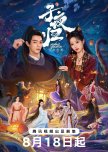
main leads are male lead Mei Zhuyu, a Taoist practioner, no longer with the temple (in the novel) and the female…
half demon. in this drama, it's not a world setting of good versus evil. like you don't think oh demon is bad, Wu Zhen is half demon, a cat spirit, can turn into a cat, and, in the novel, she's actually very kind, and won't let anyone bully Mei Zhuyu. There's a lot of shape shifting with spirits.
Novel readers: is cat lord and snake lord both the main leads? Im now watching it. The pilot episode is good so…
main leads are male lead Mei Zhuyu, a Taoist practioner, no longer with the temple (in the novel) and the female lead is Wu Zhen, Cat Lord, half demon with cat spirit, goes to brothels in day, peace keeping at night. Snake Lord is a main character, or second female lead. She is a fox spirit and helps Cat Lord to keep peace in Demon city.
Last time I checked there's a xianxia element in the tag.. Is it not xianxia? Or am I just daydreaming? Lol Tysmm!!
Moonlit Reunion is definitely not xianxia as there are no immortals or god realm. There are only two realms, humans and demons (spirits). It's been broadly label as wuxia.
Mei is a righteous Taoist walking alone through a world of shadowsānot to conquer it, but to keep it from falling apart. In the novel, there is no plot. In the trailer, I saw him investigating his parents' death. In the novel, he does practice his sword, but he only uses talismans. Mei grew up in the temple and became a powerful Taoist. There are sects and he is in the Daoist sect, but he acts alone, not part of a sect, unless the drama changes it so he returns to sect, but I don't think so. He works in the imperial ministry by day and at night, he really acting alone to fight demons only to keep peace, not to eliminate them. There is no good versus evil. Wu Zhen herself and her deputies are spirits or demons, and they are not part of some sect either. They're just being task with keeping the peace in demon city. The ideological core isnāt classic xia chivalryāitās duty, balance, and containment.
Mei is not a xia, because heās not driven by a chivalric code to fight injustice. Heās not part of jianghu, because he doesnāt live in that chaotic martial world of rival sects and wandering swordsmen. Heās not wuxia, because wuxia is defined by those two things: the code of xia and the world of jianghu. I see Mei as a solitary Taoist with a secret life, walking the line between duty and grief, peace and shadow.
This focus on balance over conquest or justice sets Moonlit Reunion apart from the heroic archetypes of wuxia or xianxia. If the novelās essence is preserved, Meiās solitary nature and lack of jianghu ties would likely remain central. The ideological coreāduty, balance, containmentāsuggests a narrative more aligned with philosophical or spiritual traditions than martial heroism.
I guess you could call it Subverted Supernatural Wuxia, meaning it turns traditional wuxia troupe upside down
Itās still martial arts ā through talismans, but not to fight for glory, and itās still spiritual tradition But it flips the usual wuxia tropes: No sect loyalty (unless the drama changes it) No flashy cultivation (he's already the most powerful Taoist) No grand duels or honor-bound rivalries Instead: A righteous man investigating his parentsā mysterious death (from the trailer, not the novel) A world haunted by subtle supernatural forces A story thatās quiet, personal, and emotionally driven
What makes Moonlit Reunion so special. It is folklore rather than mythology or divine fantasy. Grounded in the Human-Spirit Connection No Celestial Hierarchies: Unlike mythologies that revolve around gods and heavenly realms, this story stays rooted in the earthly and ethereal. Spirits as Neighbors: The demons and spirits arenāt distant or omnipotentātheyāre part of the landscape, sometimes protectors, sometimes tricksters, always complex. Folklore with Nuance Moral Complexity: Good and evil arenāt defined by species or power, but by actions and intentions. Thatās classic folkloreāwhere a fox spirit might be a villain in one tale and a hero in another. Rare and Refreshing: Most stories with supernatural elements lean into divine spectacle. Moonlit Reunion chooses intimacy, mystery, and emotional depth.
In the novel, Cat Lord (Wu Zhen) and Snake Lord (Liu Tai Zhen) maintained order in the East and West supernatural markets (I think in a trailer they called it shadow market?) or demon city. The two markets of East and West under the night are worlds that belong to inhuman things, and ordinary people cannot see them, nor can they enter these two demon cities." In the novel, Cat Lord and Snake Lord each have two deputies. Cat Lord's assistants are Hu Zhu (fox spirit) and Wordless Book or a book spirit... I think it might be Wu ZhiShu? and for Snake Lord's two deputies, in the cast, I only see one of them, Ling Xiao (wisteria spirit).
They spent something like 28 straight days filming at night and by night, I mean they worked during their normal sleeping hours and slept during their normal working hours. It was not easy at first to stay awake, imagine after a month, they had to switch back to normal hours. I'm sure there was a few days of transition, probably a lot of yawning.
yes.. and that's what I'm looking for in Moonlit Reunion... more of that "haunting" feeling Xu Kai said the director keep playing this really eerie BGM when he was inside this dark space with only a candle - it harkened him back to GE
Wonder if this gonna be like 'fahai' monk in legend of white snake šLike all demons must be exterminated, or…
Moonlit Reunion skips the tired āpriests vs. demonsā and good-vs-evil tropes. Rooted in Taoist philosophy, it follows Wu Zhen (a half-demon) and Mei Zhu Yu (a Taoist priest) as they team up to maintain spiritual balance, confront specific threats, and fall in love. Instead of demon-hunting, itās about coexistence, compassion, and romanceānot a black-and-white battle between good and evil.
Philosophy TLOWS Buddhist morality, MR Taoist harmony and balance Tone TLOWS Tragic and dramatic, MR Romantic, whimsical, and warm Human-Spirit Relations TLOWS Forbidden and punished, MR Cooperative and protective Religious Figure TLOWS Fa Hai (rigid, antagonistic), MR Mei Zhu Yu (compassionate, Taoist) Female Lead TLOWS Bai Suzhen (spirit seeking love), MR Wu Zhen (half demon governing demon city) Ending TLOWS Often bittersweet or tragic MR Focuses on love and daily joy
it's ok, I don't' really care about 27.9K vs 28K. or whatever, not even ratings... ABAY was a huge hit, more than people realized.
Mei is a righteous Taoist walking alone through a world of shadowsānot to conquer it, but to keep it from falling apart. In the novel, there is no plot. In the trailer, I saw him investigating his parents' death. In the novel, he does practice his sword, but he only uses talismans. Mei grew up in the temple and became a powerful Taoist. There are sects and he is in the Daoist sect, but he acts alone, not part of a sect, unless the drama changes it so he returns to sect, but I don't think so. He works in the imperial ministry by day and at night, he really acting alone to fight demons only to keep peace, not to eliminate them. There is no good versus evil. Wu Zhen herself and her deputies are spirits or demons, and they are not part of some sect either. They're just being task with keeping the peace in demon city. The ideological core isnāt classic xia chivalryāitās duty, balance, and containment.
Mei is not a xia, because heās not driven by a chivalric code to fight injustice. Heās not part of jianghu, because he doesnāt live in that chaotic martial world of rival sects and wandering swordsmen. Heās not wuxia, because wuxia is defined by those two things: the code of xia and the world of jianghu. I see Mei as a solitary Taoist with a secret life, walking the line between duty and grief, peace and shadow.
This focus on balance over conquest or justice sets Moonlit Reunion apart from the heroic archetypes of wuxia or xianxia. If the novelās essence is preserved, Meiās solitary nature and lack of jianghu ties would likely remain central. The ideological coreāduty, balance, containmentāsuggests a narrative more aligned with philosophical or spiritual traditions than martial heroism.
I guess you could call it Subverted Supernatural Wuxia, meaning it turns traditional wuxia troupe upside down
Itās still martial arts ā through talismans, but not to fight for glory, and itās still spiritual tradition
But it flips the usual wuxia tropes:
No sect loyalty (unless the drama changes it)
No flashy cultivation (he's already the most powerful Taoist)
No grand duels or honor-bound rivalries
Instead:
A righteous man investigating his parentsā mysterious death (from the trailer, not the novel)
A world haunted by subtle supernatural forces
A story thatās quiet, personal, and emotionally driven
Grounded in the Human-Spirit Connection
No Celestial Hierarchies: Unlike mythologies that revolve around gods and heavenly realms, this story stays rooted in the earthly and ethereal.
Spirits as Neighbors: The demons and spirits arenāt distant or omnipotentātheyāre part of the landscape, sometimes protectors, sometimes tricksters, always complex.
Folklore with Nuance
Moral Complexity: Good and evil arenāt defined by species or power, but by actions and intentions. Thatās classic folkloreāwhere a fox spirit might be a villain in one tale and a hero in another.
Rare and Refreshing: Most stories with supernatural elements lean into divine spectacle. Moonlit Reunion chooses intimacy, mystery, and emotional depth.
In the novel, Cat Lord and Snake Lord each have two deputies. Cat Lord's assistants are Hu Zhu (fox spirit) and Wordless Book or a book spirit... I think it might be Wu ZhiShu? and for Snake Lord's two deputies, in the cast, I only see one of them, Ling Xiao (wisteria spirit).
They spent something like 28 straight days filming at night and by night, I mean they worked during their normal sleeping hours and slept during their normal working hours. It was not easy at first to stay awake, imagine after a month, they had to switch back to normal hours. I'm sure there was a few days of transition, probably a lot of yawning.
Xu Kai said the director keep playing this really eerie BGM when he was inside this dark space with only a candle - it harkened him back to GE
https://www.viki.com/tv/41179c-moonlit-reunion
Philosophy TLOWS Buddhist morality, MR Taoist harmony and balance
Tone TLOWS Tragic and dramatic, MR Romantic, whimsical, and warm
Human-Spirit Relations TLOWS Forbidden and punished, MR Cooperative and protective
Religious Figure TLOWS Fa Hai (rigid, antagonistic), MR Mei Zhu Yu (compassionate, Taoist)
Female Lead TLOWS Bai Suzhen (spirit seeking love), MR Wu Zhen (half demon governing demon city)
Ending TLOWS Often bittersweet or tragic MR Focuses on love and daily joy