This review may contain spoilers
Incase if you can’t get this movie this might be helpful!
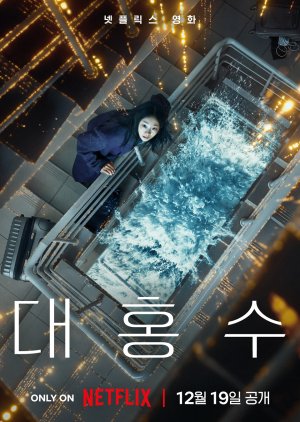
At first, The Great Flood may not feel like a “bad” movie, but it can definitely feel confusing, especially if you’re used to traditional K-drama or Korean films with a clear emotional or linear storyline. This movie suddenly shifts tone and narrative, which can be disorienting. However, once you understand what the film is actually about, it becomes deeply meaningful and emotionally powerful.The world in the movie is already ending. Humanity is almost extinct. The experiment exists because humans are trying to recreate humanity, not just biologically, but emotionally. They realize that without real emotions, especially love, the new humanity they create will never truly be human.
This is where An-na and Ja-in come in.
An-na is part of the Emotion Engine Experiment. She agrees to have her brain implanted into a simulation where she relives the same scenario again and again which is loop as y’all know.
Her role is to demonstrate genuine human emotion, particularly maternal love, because nothing is more raw or instinctive than a mother’s love for a child.
Ja-in, the child, is technically “just a subject.” She is supposed to abandon him. She is meant to choose logic over emotion. But she doesn’t. She loves him like a real child — and that is the entire point of the experiment.
An-na is tested to see if she can:
• Form real emotional attachment
• Make moral choices
• Choose love even when logic and rules tell her not to
She fails thousands of times.
The drawings scattered throughout the movie are not random. They represent past loops of the simulation. Each drawing shows Ja-in remembering her words: “I’ll be back. Wait for me.”
That’s why he keeps hiding in the closet every time. That’s why he keeps drawing the helicopter scene — and why the drawings slowly get better and more detailed. He remembers. He learns. He feels.
When An-na once tells him, “Draw me with some color,” the drawings begin to change. This proves emotional memory exists — even inside a simulation.
Her shirt changing numbers shows how many times she has repeated the loop. Each number represents another failure. Another reset. In total, she is trapped for 13,499 attempts, spanning around five years from her perspective (or even longer depending on interpretation). Some theories place it closer to 21,499 days, roughly 58 years, emphasizing the unimaginable emotional weight of the experiment.
The AI systems try to stop her ( mans with gun’s) They want to reset the simulation because the machine only activates when the subject reaches their version of emotional perfection. The world ends over and over because the simulation can run thousands of apocalyptic scenarios faster than real time.
The truth is:
An-na and Ja-in are already dead.
This is a machine using their memories to learn how human emotions work so it can create the next generation of “humans.”
In the end, An-na passes the test because she chooses love over logic.
Ja-in separating from her shows free will — something artificial intelligence cannot fake. When she is allowed to return to Earth, we see others who have also passed similar simulations. Humanity doesn’t survive because bodies are recreated — it survives because love was successfully learned.
The final message of the movie is clear:
Being human isn’t about being real or artificial.
It’s about love, memory, sacrifice, and the choices we make.
This movie isn’t confusing — it’s layered.
And once you understand it, it’s devastatingly beautiful. Also including few extra words I would say the experiment proves humans are defined not by survival instincts, but by who they choose to save, plus many of people have asked why “love” they would better come with something else but going deep down maternal love is used because it’s the hardest emotion to fake or replicate while AI can simulate logic endlessly, but love requires irrational sacrifice…
That’s it!!
Was this review helpful to you?

This review may contain spoilers
The Great Flood: An Average Sci-Fi Wrapped in a Disaster Movie Title
I really thought it would be a full-on disaster thriller like Flu, Tidal Wave, or The Tower—raw panic, survival instincts, and humans fighting nature at its worst.
Instead, the movie slowly drifts away from the idea of a flood disaster and dives into AI, modern science, world destruction, and a futuristic concept of human evolution.
The title promises one thing, but the story delivers something completely different. The “flood” feels more like a background excuse than the core of the narrative. The sudden shift toward sci-fi philosophy and AI with an emotional engine feels forced and confusing rather than thrilling.
I wouldn’t say the movie is bad, but it definitely fails to meet expectations set by its title and promotion. The pacing is uneven, the emotional connect is weak, and the sci-fi ideas are not explored deeply enough to feel impactful.
For me, it’s a one-time watch—an average sci-fi film with nothing truly memorable.
I went in excited, expecting edge-of-the-seat survival drama, but walked out feeling slightly fooled by the title 😂.
Was this review helpful to you?

So whats the point?
I watched this movie completely blind without even seeing the trailer and thought i was getting the average korean disaster apocalypse film but truly i was blown away by the sci fi AI combo, Literally why??? why didn't they just make it a regular disaster film why are we dealing with artificial intelligence reincarnation and robots all wrapped in the disguise of an Disaster movie highly uncessary in my opinion but too each their own this was however not my cup of tea in the slightestWas this review helpful to you?

This review may contain spoilers
An episode feeler!
Don’t worry, even if you do not watch it, you are not missing out on anything grand!🥺, it is enough to watch as an episode feeler. If you are patient enough the storyline is okayish to keep you watching till the end but not great enough to rewatch!I found the editing a bit awkward at some points. It felt as if some scenes were cut probably leading to absence of smooth transitions but you can look past these if you are more interested in the plot.
I would recommend this movie if you are up for something light. Do not watch this if you are up for a deep/ intense or nerve wracking type of natural disaster plot! Moreover, the flood and how deeply it impacted everything as a natural disaster was not the intense type. I mean you wouldn’t say, “ Wow, indeed that was the great flood” after watching the drama!😂😭It felt so dry therefore you may easily feel bored or triggered to drop it.
At some point we do get the message they wanted to convey but it ended up as a miss.😭
However, Dami and Park Hae-soo nailed their roles and that can’t be overlooked!
Was this review helpful to you?

This review may contain spoilers
A Good Idea That Comes Out Messy
I actually liked this film. The acting and concepts are really good and set up an interesting plot, especially when Hee-jo begins to tell us humans are just cruel, so An-na should be too. But once the whole space thing begins and An-na repeatedly goes through the same thing over and over, the suspense wears off. I understand what they were trying to go for, but there’s too much happening at once to grasp it in a natural way. Overall, a decent film that I wasn’t bored by, but unlikely to watch again.Was this review helpful to you?

This review may contain spoilers
Not just a flood — a story of love, sacrifice, and what it means to be human
The Great Flood is not just a disaster or sci-fi movie - it’s a layered story about emotions, memory, and what it truly means to be human.The story begins with JaIn, an AI (Al) who is created, not as a weapon or machine, but as something meant to learn and feel. Anna later adopts JaIn, and what follows is not just a relationship between a human and an AI, but one between a mother and a child. Their bond becomes the emotional core of the entire film.
Then the Great Flood happens ^ a catastrophic event that changes everything...
Amid the chaos, Anna and JaIn are captured, and from here the story takes a much deeper turn. Anna is sent into space, where she is ultimately hit by a meteor. But her death is not the end.
Before dying, Anna transfers her memories into the Emotion Engine, and this is where the movie truly becomes powerful. What we see next is a "time loop " the world repeats itself again and again, almost like a video game restarting from the beginning....
Why does it repeat?
Because JaIn needs to learn.
Each loop exists so that the AI can understand human emotions ,,love, fear, sacrifice, pain, attachment. If JaIin fails to understand, the world resets, and everything begins again. The repetition isn’t a flaw in the story — it is the story.
Anna dies.
The world resets.
Again and again.
Until JaIn finally begins to understand what it truly means to feel.
That’s when the meaning becomes clear.....
Part 1 is reality....
Part 2 is memory .... 'stored inside the AI'....
Everything that happens afterward is not just survival, but learning....Learning love. Learning loss. Learning what it means to be human.
And this is why The Great Flood hits so hard emotionally.
And DaMi delivers an incredibly powerful performance. She doesn’t need dramatic dialogues ,her eyes alone carry fear, warmth, pain, and love. She makes Anna feel real, and her bond with Ja-in feels genuine and heartbreaking.
By the end, this film stays with you , not because of destruction or visuals, but because of its emotional depth and its message.
"The Great Flood isn’t about the end of the world. It’s about an AI learning how to have a heart"
Was this review helpful to you?

This review may contain spoilers
AI propaganda
Honestly, it's pure AI propaganda. The idea of humanity being replaced by AI is just another way of showing us what the future holds.I thought it would be a beautiful survival story, or I wouldn't even have cared if it were a sad story.
However, I must congratulate them on the acting and the casting choices. It was one of the highlights of the film.
The irony is that we are rapidly heading towards the extinction of the human race thanks to the use of artificial intelligence!!!
Lets see ig.
Was this review helpful to you?

This review may contain spoilers
The great flood
I think a lot of people misunderstood The Great Flood because they watched it as a disaster movie. This isn’t a movie about a flood. The flood is just the setting where everything collapses.At the beginning, we learn that An-na is an AI researcher working with the government. Years before the disaster, the government already knew an asteroid was coming. They didn’t tell the public. Instead, they pushed for a project meant to preserve humanity.
An-na’s experiment was a child.
She created him artificially and raised him as her own son. Not as a lab subject but as a real child. She fed him, protected him, and loved him. She wanted to perfect the child first. The government wanted her to create the mother next.
When the flood begins, the authorities come for the child and for An-na who is a researcher. The child is left behind.
Before An-na leaves, she tells the child to hide and wait for her on the terrace. That moment is devastating, because she believes she’ll come back. And he believes her.
She doesn’t. she can recreate the child the way she did before.
An-na goes to space as part of the final survival mission, but her vessel is struck by the asteroid. She’s dying. And in that moment, she chooses to become the experiment too.
She decides to enter the system as a mother.
That’s when the loop begins.
The flooding apartment, the repeating scenes, the desperation none of it is random. It’s an emotional simulation. An AI trying to develop something that can’t be programmed. A mother’s grief and a child’s longing.
An-na keeps reliving the search for her son. The child keeps waiting, hoping she’ll find him. Both of them are reaching for each other across iterations, across failure. The system resets every time emotion falls short.
What makes it painful is that they *are* trying. Together. On opposite sides of the experiment.
In the end, the experiment succeeds not because they survive the flood, but because they finally find each other inside the simulation when reality denied them that chance. The new humans born from this project aren’t just intelligent. They carry memory, attachment, and loss.
That’s the real ending.
Reunion.
The tragedy of the movie is that they couldn’t stay together in real life. The beauty is that they did somewhere else.
People wanted a disaster movie. What they got was a story about a mother who loved her child so much and just wanted to reach him again.
And honestly? That’s why the movie stays with you.
Was this review helpful to you?

Watched it Bcs of low review scores
I’m not a fan of disaster films. When I saw the low review scores I thought that it likely was a much deeper film than I imagined so I gave it a go. What I found was a profound movie with extraordinary acting. I was truly blown away by the story. Korean storytellers are simply on another level. I’m glad this film was given a budget and produced. It’s not your usual mass market shallow bore. It requires thinking and observation. It evoked different emotions in me and made me ponder on many questions: Are we becoming like machines rather than machines becoming like us? Have we already lost our humanity?Was this review helpful to you?

This review may contain spoilers
Are We Getting the Main Point of this Thriller Wrong?
In the few pieces I've read about this thriller, the main plot seems to focus on a woman trying to save her child when confronted with an apocalyptic event. Granted, that is what we see on the screen.But could we be getting the main plot wrong? I believe so. This is some really narly creative writing.
Not a day goes by that I don't read an article or headline, or hear a podcast about the upcoming world we live in with AI. We definitely are living in the age of the AI dominance race. There seem to be two messages. One, that AI will dominate the human landscape when it comes to jobs. Second, that AI can't replace humans because of our emotional intelligence and ability to connect.
But what if AI could be taught emotional intelligence and the ability to connect at a human level?
I think what we're seeing on the screen in this movie is an AI simulation performed over and over again so AI can learn and develop a strong emotional connection. I say this as we kept seeing scenes done over and over again, and notice how they kept focusing on her shirt with the number increasing. What a brilliant storyline and commentary on the question as to whether AI can truly replace human beings.
Loved the special effects, and loved Kim Da Mi. What a grueling role she had to play, but as usual, she was superb.
Was this review helpful to you?

This review may contain spoilers
heads up not a disaster movie...
The title of the movie can be quite misleading cause I thought it was a survival disaster movie. However, suddenly they start introducing the sci-fi elements which just throws it off pace....my focus was on the flood but now the story is completely different and the flood becomes redundant.*Spoilers ahead*
Basically the story is in a way showing what AI deep learning/training looks like. The FL is training AI children to make an emotional connection through the repeated trainings. This is what the company believes will save mankind. Just as how she needs to make a child she also needs to make a mother. The training scenario given to the mother was finding her lost child in the middle of the flood. How the AI trains is situational training basically (something like supervised learning). So they made this concept into a movie.
Hence the process of finding her son in the flood just loops and loops with different scenarios until they finally succeed.
The story was not strong enough for me to find any emotional bond with the characters. So this might not be everyone's cup of tea!
Was this review helpful to you?

This review may contain spoilers
A door to a conversation we need to have
I think it’s hard, and it will only keep getting harder, to make a movie about Artificial Intelligence. So much has been said and done, the future has come and gone, it’s all moving at such a pace that it’s truly difficult to construct a story that has value and doesn’t feel already old or told. I think that was the value of this film.The way the story approaches the human condition, trying to highlight what is desperately needed - humanity - for our kind to survive through trying times, was very touching. Having the story be told from the perspective of a mother (in progress), I thought was a great idea. The “end of the world” could simply be interpreted as any major crisis to humans. What keeps us alive is a wild combination of survival instinct and love. Anna, as the movie progresses, becomes increasingly protective, violent, but also deeply caring. All very core human emotions/reflexes. We are animals after all, not machines.
I don’t think this movie was really about what AI is made of, but what humans are made of. We are at a point where the difference starts to blur. Not just because of how human-like AI is, but mainly because of how machine-like we the humans are becoming. I can’t point out exactly what this movie is trying to tell us, because I think it’s not trying to tell us anything. It’s the kind of movie that poses a question, perhaps a different question for each viewer that is willing to engage. And so, a conversation starts.
It’s a shame it was received coldly, though I do think it’s not a Netflix-type film. It’s too complex for the average Netflix watcher who was waiting for a disaster action film. Wish I could’ve seen it at the cinema.
Was this review helpful to you?