This review may contain spoilers
korea if they had the rules of america
this story is basically two men who had rough childhoods and want to have a battle with their guns.moon-baek with the blue eye did something to me.
the main guy for the gang (jeong-man) was so sexy when we say his tattoos same with moon-baek
the reporter was so god dang annoying i was so thankful he had gotten shot in the end.
the nurse that was getting bullied had every right to shoot the people who were harassing her. but she didn’t.
i honestly rooted for most of the bad guys
extra points for moon-baek being sexy
Was this review helpful to you?

This review may contain spoilers
First episode, the only female characters : a nurse is insulted, a woman hangs herself, a technician narrowly avoids being sexually assaulted (saved by a man), a girlfriend in the middle of lovemaking is shot with a machine gun.And it doesn't get any better after that. It's just guys, real tough guys, because we're real virile males, yeah.
Yet another series glorifying the police (and their video surveillance service, apparently ?). In fact, we are told that bureaucracy prevents brave cops from saving lives. And journalists ? they do nothing but annoy the police who protect us at the risk of their lives. If that's true, it's very serious !
There are lots of little visual effects that fuel a dynamic montage, even if the plot doesn't advance much. (The villain's motivations... a bit light, shall we say) For example : the strategy of showing the same scene from a different angle from one episode to the next, classic and effective. It's not necessarily the most subtle approach, but the extreme situations that follow one another without any downtime, the villain who is having a good time, and people's cowardice in the face of harassment make this series compelling. Simple but engaging.
To be honest, I watched it to unwind after When Life Gives You Tangerine.
Was this review helpful to you?
This review may contain spoilers
“Dark, intense, unforgettable,Pure psychological chaos"....
⚠️ SPOILERS AHEAD ⚠️
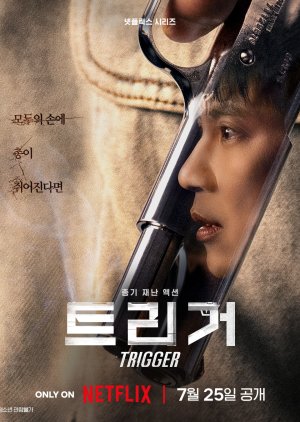
Trigger starts like a normal action thriller about illegal guns entering South Korea, but by the end it becomes a deep psychological drama about fear, anger, and human nature.
The drama constantly asks one question: “If ordinary people suddenly had access to guns, what would happen to society?”
Lee Do represents hope and humanity, while Moon Baek represents chaos and distrust in people. Throughout the series, we see how fear slowly changes normal citizens into violent people. The gun itself was never the real villain — human emotions were.
Episode 10 explains the entire meaning of the drama. Moon Baek’s final plan was to create complete panic by distributing guns publicly and proving that humans naturally choose violence. He wanted Lee Do to kill him, because that would prove his ideology correct and push society deeper into chaos. But Lee Do makes the opposite choice. Instead of revenge, he chooses to save a child. That single decision becomes the emotional core of the ending. The crowd slowly realizes that violence only creates more violence. This is why many citizens voluntarily return their guns afterward.
The acting was one of the strongest parts of the drama. The emotional tension, facial expressions, and psychological breakdowns felt realistic. The action scenes were intense without feeling overdone, and the dark atmosphere stayed consistent until the final episode.
However, the ending can feel confusing on first watch because the drama becomes very symbolic instead of directly explaining everything. Some side characters also deserved more development.
The final hospital scene with the blonde woman carrying a gun clearly hints that the illegal gun organization still exists, meaning the story is far from over. It feels less like a complete ending and more like the beginning of a bigger conflict, possibly setting up Season 2.
Overall, Trigger is not just an action K-drama. It is a social commentary about how fragile society becomes when fear controls people. Dark, intense, emotional, and thought-provoking from beginning to end.
Was this review helpful to you?

This review may contain spoilers
Good series but WHY would you rush the ending?
I watched Trigger last year, and i really liked it at least till the episode 6 and there's a lot to talk about here.Trigger started great, the first 6 episodes were intriguing, it's a story about what if the weak, the bullied, the one with life struggles decided to pull the trigger, and there's someone who's ready to give them that option, to get revenge basically. The concept itself isn't new but it was well executed here because it's realistic and you find yourself relating to the victims and their struggles.
The acting is awesome as well as the action, hand to hand and shooting is well done, i enjoyed it. I would've give it 8 or even 9 if the serie kept the same momentum but it didn't because.. Everything stared to feel off after episode 6, it started to feel rushed, no tension, and the absent of police (counter power) just made it worse.
Hear me out, you've got a very dangerous arm dealer walking around Korea, killing people and giving them a reason to avenge by sending them free guns, instead of using all the govs power to stop it (like calling for literally the army to help), they just relied on the regular cops and special forces that done absolutely nothing. This took away any sense of tension and emergency.
Moon baik ending was just badly executed too, i probably understand why they did that but i hated it.
Now apparently there will be a Season 2 but I don't personally feel like i need to watch it and I probably won't.
So: 1-6 Ep = 8.5/10 1-10 Ep = 7/10.
Was this review helpful to you?

A Great Watch
Trigger started strong. The actor playing the villain was the star of the show for me. The concept behind normal people pulling the trigger felt interesting to me. The ending, though, felt a bit illogical, but it was what a drama should promote, obviously. Violence should not be promoted irrespective of logic. The story was tight and thrilling for me. I liked the atmosphere that the drama managed to create. Overall, it was a very nice drama.Was this review helpful to you?

This review may contain spoilers
amazing.. just felt a bit rushed
tbh ive got mixed about this ..the concept is actually really interesting .. imagining a world where guns start becoming common in Korea and how society reacts to that shift and that alone makes it stand out and keeps you curious.
acting wise.. literal top tier
Kim nam gil was amazing as expected and honestly the antagonist Moon Baek also surprised me a lot... both performances carried the drama amazingly.. but the main issue for me was the pacing... it felt like the story starts off smooth and structured… but towards the end everything suddenly speeds up
the ending especially felt a bit rushed... lot of major events happen back to back.. and the resolution comes way quicker than i expected... felt like the story had more to say but wrapped early
some parts like the final chaos and aftermath were intense and strong visually but the transition from mass chaos to that resolution felt a bit abrupt
still.. there are good emotional moments.. especially around the main detective’s storyline and how he handles the situation involving the child... that part gives the drama a bit of heart n closure
overall the idea is strong the acting is excellent but the execution towards the end couldve been more balanced
Was this review helpful to you?

Very strong opening
I really liked this!! I loved the concept a lot! This had a very strong open as well that drew you in instantly. It's quite intense and deals with a subject that can be triggering (no pun intended lol) so just be aware of that. I loved the characters a lot too, especially Lee Do and Moon Baek! Highly recommend!Was this review helpful to you?

Unconvinced by the writing but properly subjugated by Kim Young Kwang's character
This drama focus on an interesting question : what would happen if illegal guns were spreading in South Korea, one of the nation with the lowest gun per habitant rate ? I was pretty intrigued at first but at the end I found myself quite unconvinced in the hypothesis offered by the showrunner on how the situation would unfold in terms of collective impact. I think the writing did a great job when focusing on individuals in circumstances in which they would be brought to litteraly push the trigger of a gun obtained illegaly. However, the big picture for the overall country felt definitely less believable to me. The plot armor of the hero, who was really strong and smart, was also a bit too thick for my taste.The acting was overall good for the main characters. Kim Na Gil was solid even if I wish he had a role that allowed him to emote more because he was quite "stone"-faced all along the series. Kim Young Kwang was incredible in this : all his scenes (except the ones in English which were unfortunately quite a fail), all his attitudes and costumes were just chef's kiss. He gives a lot of charming vibes and craziness to the overall series. The filmmaking was excellent with some very powerful imagery. The tension and urgency were palpable, making the series quite thrilling.
I would recommend this to people that are looking for a thriller exploring a very interesting hypothesis regarding the impact of guns on a population with very low firearms usage. The deep diving on the psychology of targeted specific people (when in possession of an illegal gun) was really frightening and captivating at the beginning. Unfortunately the way it devolved into a larger scheme was much more doubtful.
Was this review helpful to you?
it wasn't bad
The main idea is interesting - what would happen if everyone owned a gun? Would anarchy arise? How would the order of society change?Both main actors gave an excellent performance.
There was no shortage of surprises and turning points.
I forgive a few illogical moments considering the idea of the series.
Overall, a good action drama with good actors, 10 episodes were just right.
Was this review helpful to you?

Good story, low on action
There is a story—yes, —but the action stumbles, never quite catching fire. The dorm and high school scenes spark brief excitement, yet much of the rest, though vital to the plot, drifts into monotony.> Kwang glows on screen, magnetic and perfectly cast. Lee Do, brought to life by Kim Nam Gil, charges through the raid scene with vigor and charm, a rare burst of energy in a subdued landscape.
> The ending is a letdown. The idea was Worthy. But in the end, it’s Kwang who steals the spotlight and leaves a lasting impression 🫠
Was this review helpful to you?

This review may contain spoilers
Loved it to the moon and baek
Sorry, I had to use that phrase 🤭 But jokes aside, Trigger was a really pleasant addition to my list. The story itself isn’t super unique, but the main characters are what made this drama so good.Honestly, the moment I saw that Kim Youngkwang had the villain role, I knew I had to watch it. And oh lord, he delivered!!! I don’t think anyone else could’ve portrayed Moon Baek better. He was so damn charming and had this Joker-like aura that instantly captivated me. At first, he was such a pookie that I thought, “Okay… how is this man gonna turn into a villain?” But the transition was so smooth. He’s definitely one of those relatable villains you can’t fully hate, because you can see where they’re coming from.
Abandoned as a baby, victim of human trafficking, tortured, even losing an eye in the process… Then an American gang dealing in weapons took him in, saw his “villain potential,” and gave him the opportunity to return to Korea, the country that had failed him. I’m not exactly sure if he was a narcissist or a sociopath, but his vision that “free weapons would let people take justice into their own hands” was chilling yet oddly logical from his perspective.
On the other hand, we have Lee Do who also had a brutal past, but chose the opposite path. And don’t we all love a capable cop who knows exactly what he’s doing? It was inspiring and heartwarming to see how much he genuinely cared about people.
Still, despite these two amazing characters, the drama felt incomplete. There was so much more that could’ve been told and shown. I’d happily watch a sequel, though I’m not sure if Moon Baek even survived. Honestly, even without a sequel, the drama could’ve been longer. At least 12 episodes would’ve given it more room to breathe.
Some moments didn’t make much sense to me. Like… how would a country like South Korea let millions of firearms be distributed like bread every day? How did Moon Baek just stroll around freely, even shooting Lee Do in the middle of a city square without anyone stopping him? There were a few of those head-scratch moments, you know what I mean.
But overall, the drama was engaging, had me seated the whole time, and was perfect for binge-watching with its 10 episodes averaging about 40 minutes each.
The core question it raises is compelling: Would you want guns to be legal? And if they were, would you want to own one?
Was this review helpful to you?
Was this review helpful to you?