I FOUND MY KDRAMA OF THE YEAR!
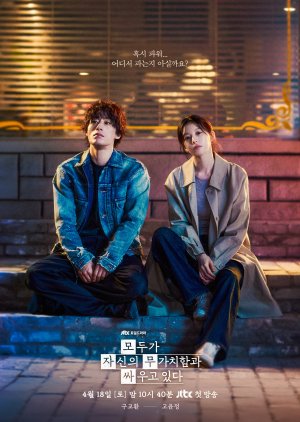
From the writer behind "My Mister" and "My Liberation Notes," "We Are All Trying Here" dives headfirst into the cutthroat world of the film industry. The story centers on a man in his forties, an aspiring director yearning for his big break. His journey intersects with a stressed and anxious producer, and together with a diverse group of individuals, they embark on a quest to overcome their feelings of worthlessness and carve out their own place in the world. This drama is a slice-of-life, character-driven narrative that unflinchingly portrays the pain, struggle, jealousy, and anxiety that accompany the pursuit of dreams in the face of relentless setbacks.
The characters are a masterclass in moral ambiguity, driven by a complex mix of desire, greed, hardship, and a deep-seated need to be seen. They exist not in black and white, but in the nuanced shades of grey, their actions often questionable yet undeniably understandable. The pilot episodes are nothing short of cinematic brilliance, immersive and akin to a feature-length film. This emotional rollercoaster is elevated by phenomenal performances, thought-provoking dialogue that lingers long after the credits roll, and a brilliant introduction that leaves you eagerly anticipating the rest of the journey.
Koo Kyo Hwan leads the charge as Hwang Dong Man, a character who is likely to stay with viewers for a long time. He's a complex, broken man grappling with anxiety, masking his struggles with a smile and a talkative facade. Watching others progress while he remains stagnant fuels his negativity and jealousy, shaping his actions. While he may be difficult to fully comprehend, he's a character you'll find yourself rooting for, like they said in the show he's a man with a thousand doors open, his character has a lot you will find yourself critiquing but slot you will find yourself loving, he's not the best but definitely not the worst and he's human. Koo Kyo Hwan's nuanced and raw performance breathes life into every emotion.
Alongside him, Go Youn Jung shines as Eun Ah, a producer whose anxiety manifests as nosebleeds. She navigates each day with an unsettling lack of warmth in her eyes. Go Youn Jung's portrayal of Eun Ah, a character who communicates more through subtle gestures and impactful eye acting than words, is exceptional.
These two eventually become two broken people that seek warmth, recognition and strength from one another, through late night walks, eating together sharing pain, they bond.
The cast also includes Oh Jung Se as Park Gyeongse, a director struggling with his writing despite a successful debut, and Kang Mal Geum as Ko Hyejin, a hardworking producer. Park Hae Joon plays Hwang Jinman, the male lead's brother and a former poet grappling with grief, while Han Suhwa portrays the actress Jang Miran.
With such a large cast, one might expect the narrative to be driven solely by them, but "We Are All Trying Here" showcases a group of relentless individuals working together with an amazing show and script, delivering nuanced, real, and relatable acting that touches the soul. The writer allows each character to shine, both individually and as part of the ensemble, offering viewers diverse personalities to connect with.
"We Are All Trying Here" is a rare gem that sweeps you away with its storytelling, characterization, and direction. As the director noted, this drama is for those who appreciate a journey, focusing not on success but on battling internal failures and worthlessness, finding the strength to persevere, and acknowledging shared hardships. It offers comfort in the knowledge that we are not alone in our struggles. This is a show that stays with you, and I highly recommend it!
Was this review helpful to you?
Best kdrama
Honestly this is the best kdrama I ve seen in a whileThe last time a drama made me fell so many emotion was… maybe Mr plankton or when life gives u tangerines
This tho it’s so good the characters look like they are alive and everything has this vintage vibe that makes it look so cool
I feel like the mc is really similar to me so maybe that’s why I’m liking this so much but I strongly recommend this to alle the people who want to feel different emotion again
So go watch it now
Was this review helpful to you?
Art, Failure, and the Small Death of Other People’s Success
We Are All Trying Here is one of the best K-dramas I’ve seen in a long time. Not because it’s “important” or relentlessly realistic, but because it feels so alive and so aware of itself at the same time.The acting is incredible across the board, but especially Dong-man. It’s one of those performances where after a while it stops feeling like acting at all. He never drops character for even a second. There’s no visible effort, no actorly “look how damaged and chaotic I am” energy. He just completely inhabits the role. And considering how difficult the character is — funny, pathetic, intelligent, cruel, charismatic, self-deluding, deeply wounded — it would have been so easy to tip into caricature. But he never does. Dong-man always feels like a real person rather than a type.
The female lead is equally good. She feels fully real in herself rather than just existing to soften or redeem him. Even small reactions and silences in this drama feel inhabited.
It’s also beautifully shot, but in a very self-aware way. The drama constantly points at cinematic language while using it — the strident guitar cue, the “heroine takes control of her life” moment, the artistic suffering, the dramatic framing — and then fully commits to it anyway. It almost feels like a drama about dramas sometimes, or filmmaking talking about filmmaking while it’s happening. It absolutely knows how good it is.
Normally that kind of thing would annoy me or create distance, but here it somehow works because the self-awareness becomes part of the pleasure. We’re engaged rather than fully immersed. The drama stands slightly outside itself, watching itself perform, while still managing to move me emotionally.
Some people will probably call it bleak because the themes are harsh: abandonment, suicide, alienation, shame, failure, loneliness. But it never feels completely heavy to me. Partly because of the humour, partly because of the self-awareness, but mostly because there’s something fundamentally redemptive underneath it all.
There are really two redemptive movements happening throughout the story. One is potential slowly ripening — potential in talent, creativity, relationships, forgiveness, growth. The drama is very interested in the possibility that people can still become more than the worst thing they’ve done or the life they currently seem trapped inside.
The other is recognition. People slowly start understanding themselves more clearly. Motivations get named. Defences get exposed. Characters are constantly acting and reflecting at the same time. The drama understands how much cruelty comes from fear, humiliation and hurt rather than simple evil. People become monstrous one moment and deeply sympathetic the next.
It’s also one of the sharpest portrayals of jealousy I’ve seen. Not cartoon jealousy, but the painful ordinary kind — the small part of us that wants our friends to succeed, but not quite more than us. The film industry becomes a perfect setting for this because success is so unstable and comparative. People love each other, admire each other, resent each other and compete with each other all at once.
That’s probably what I find most moving about it. Nobody is flattened into hero or villain. Everyone is trying, failing, hurting each other, performing versions of themselves, wanting to be seen, and still reaching toward connection anyway.
Was this review helpful to you?

 1
1 1
1 1
1This Drama Understands The Parts Of People They Never Talk About
I honestly don’t think this drama is meant to be “easy” to watch.It’s uncomfortable sometimes. Frustrating too. There were moments where I wanted certain characters to stop hurting themselves, stop pretending they were okay, stop carrying everything alone. But I think that’s exactly what makes this drama feel so real to me.
None of these characters feel perfectly written just to be liked by the audience. They feel human.
Hwang Dong-man especially stayed with me throughout the drama. A lot of people might see him as bitter, insecure or difficult sometimes, but honestly… I never saw him as a bad person. I saw someone who spent years trying to move forward while constantly feeling left behind.
Watching everyone around him become successful while he remains stuck slowly destroys his confidence, and the saddest part is that he’s painfully aware of it himself. The way he talks too much sometimes, gets defensive, criticizes others or tries to make himself look stronger than he feels inside ,,none of it looked like arrogance to me. It looked like frustration. Like exhaustion. Like someone trying very hard not to disappear emotionally.
At the same time, there were moments where Dong-man frustrated me deeply too. Sometimes he lives more inside his imagination than reality itself, constantly holding onto versions of life that no longer exist. There’s this strange disconnect in him where he keeps chasing emotional comfort in memories, old expectations and fantasies because reality feels too painful to fully accept. And honestly, that made his character even sadder to me. Not because he was “crazy” or mentally unstable, but because he felt like someone emotionally stuck between who he wanted to become and who life slowly forced him to be.
And honestly, I hated how some of his friends treated him sometimes.
It felt like they only remembered him when they needed something, but emotionally he was always left alone with his struggles. That kind of friendship hurts in a very quiet way because you slowly realize you are present for people who are never truly present for you.
This drama captures that feeling so well.
The loneliness of being surrounded by people yet still feeling emotionally unsupported. The exhaustion of maintaining relationships that start feeling one-sided over time. The sadness of realizing that not everyone who stays in your life truly understands you.
And maybe that’s why Dong-man hurt me so much as a character. Because beneath all his flaws, he was still trying. Still hoping. Still wanting to matter to someone.
And then there’s Eun-ah.
She was honestly the character I related to the most sometimes. There’s something painfully familiar about the way she carries herself. She looks calm and composed on the outside, but internally she feels emotionally exhausted all the time. The way she quietly keeps things inside, overthinks, silently endures emotions instead of expressing them immediately… it felt too real at times.
What I admired about her is that the drama never tries to make her unrealistically “strong.” She feels emotionally fragile in such a natural human way. Sometimes she withdraws, sometimes she avoids difficult emotions, sometimes she looks like she’s carrying years of emotional tiredness behind simple expressions. And somehow that made her even more relatable to me.
What I loved most about her relationship with Dong-man is that they understood each other beyond words sometimes. Their connection never felt overly dramatic or unrealistic to me. It felt like two emotionally tired people finding comfort in someone who could see through the version they showed the world.
And maybe that’s what made their relationship feel beautiful.
Not because they “fixed” each other, but because they understood the loneliness inside each other.
But honestly, what makes this drama truly special is that it’s not only about one person’s pain. Every character here feels like they are fighting their own quiet battle with life. Some hide it behind success, some behind humor, some behind silence, some behind relationships that are already emotionally falling apart.
That’s why the story feels so emotionally heavy sometimes. Nobody here feels completely okay. Everyone is trying to survive life in their own imperfect way.
This drama really captures the quiet loneliness of trying your best and still feeling lost sometimes.
The fear of wasting your life.
The exhaustion of comparing yourself to others.
The pressure of pretending you’re okay while silently questioning yourself every day.
What makes this drama special to me is that it never tries to force artificial positivity onto these emotions. It simply lets them exist honestly.
And somehow, that honesty makes everything hit even harder.
Because while watching this drama, I didn’t just feel like I was watching fictional characters.
I felt like I was watching emotions most of us quietly carry in real life.
Was this review helpful to you?

This review may contain spoilers
an exceptional performance and writing
this has to be one of the greatest k dramas to ever exist,the story telling is well written and makes the characters feel so relatable,GYJ has delivered a masterpiece performance along with the rest of the cast,this k drama should have the highest ratings but a lot of people don’t understand emotional intelligence and story telling,they rather have a perfect crown type of show wealthy people who are obnoxious and annoying but because there ML actor and FL actress are very pretty people and super famous they watch a shallow mindless useless story instead of this well crafted drama where it shows the real world not a fake dream,I get some people want to escape there real life but this story tells so much more and makes it a well written masterpiece.Was this review helpful to you?

Ditch the victim consciousness and own the narrative
This is going to be a very personal review about a drama that I both enjoyed and needed to dive into and explain to myself. I love Park Hae Young’s work, it always leaves a long tail. Weeks, months, years after watching them I am still thinking, wtf was that drama about. And each time you revisit the memory of it, you come out with something new. A lot of things in this drama resonated with me as I have had to go through the process of remaking the narrative. So this time, I want to unpack a few thoughts about it immediately after finishing it.The opening is typical. The characters irritate you, and you wonder if you can make it out of first base. Then the last scene of the first episode just opens it up and you realise, yes, I sort of know where we are going here. I’ll stick with it.
There is a reason it was set in the film industry. The setting is a metaphor for the stories that we tell ourselves and the difficulty that we have both bringing stories into the real world and also believing in the stories that we create.
The perspective of the drama is about the disconnect between what we feel and how we interpret our feelings, the narrative that we place those emotions in. The stories that we tell ourselves about ourselves and our experiences. The characters are written with that very rare trait of self observance and introspection. They often speak unreal lines, but you go along with it because it’s like an inner voice explaining what’s happening on an emotional level. The use of emotion watches (watches that identify what your are feeling) was a clever device to allow this to be understood and make it credible.
It is also a love story, but we only glimpse the intimacies of that through voice-overs and the odd scene where Dong Man and Eun A make a connection. This must have been a very deliberate choice. Perhaps Park Hae Young did not want the drama and the focus to be highjacked by the “romance” label, or whether she just wanted that emotion to be unspoken. At one point there is a conversation about love not being one of the emotions displayed on the watch, as it is not a raw emotion. So she follows that through by showing how the characters react to each other in a kaleidoscope of different ways that constitute care, closeness and empathy.
As always with her writing, every character has a carefully curated arc and a totally filled out personality. They are larger than life, wearing their inner lives like an outer visible skin. You may not like every character, or even any of them. But the magic of Park Hae Young is that she has the ability to connect you to them. To enable you to see their vulnerabilities in a way that evokes compassion rather than dismissal.
The drama explores how most of the characters’ narratives involve the demonisation of others. The shifting of the responsibility for their misery onto something or someone else and labelling the other as the perpetrator and themselves as the victim. In doing so they cling to the situation or other person as justification for their emotions. This results in trying to manipulate and control the other to fit the self-made narrative. When this manipulation synchs from both sides, such as Dong Man and Gyeong Se, this becomes a co-dependant relationship of mutually assured destruction.
In fact the true narrative, revealed by the correct identification of emotions, is about each person alone. There is short key scene late in the drama where a counsellor explains that once you can correctly identify an emotion, put the correct description to it, you can begin to see the sometimes hidden narrative that lies behind it and change it to something positive. The other situation/person was/is only the catalyst. Each character creates their own storyline, and now lives it, believing that taking revenge, or running away, or indulging someone will in some way free them from the pain. But only the character alone can change it. The path to fulfilment lies in being able to be free themselves from the notion that the fault /responsibility lies elsewhere or with others.
The genius of Park Hae Young is to craft a story of complex and tangled relationships that brings these truths to life. The actors really bring themselves to the table and invest everything. There was not a weak performance amongst the leads. But personally, I fell for Kang Mal Geum as Ko Hye Jin. Whenever I see Go Youn Jung, I feel that her eyes are like black wells that plumb the hidden depths, and here the cinematographer and director did a wonderful job of capturing that ability. Koo Kyo Hwan courageously put everything he had into Dong Man and exploded onto the screen. His total commitment and exposure hit me like a train. It was an all or nothing performance and a less confident portrayal would have been catastrophic for the whole drama.
Overall, another stunning offering.
Was this review helpful to you?
What was that final episode?
The story was revolving around feelings and how to understand/deal with them, and the show does a great job at that. But, it felt like they realized they had to wrap everything up with only 20 minutes left. After all the build up we barely see Dongman shooting the movie and what happened to Eun A? The relationship with her mother? What happened to her movie? Is all left unknown. The revelation to her step sister has no consequences and Dongman almost had more romantic chemistry with the other director than with her in the end :/Was this review helpful to you?

This review may contain spoilers
Maybe I shouldn't be awful to people because one day I might need them to be nice to me.
This drama frustrated me more than it impressed me, and honestly, that's the main reason it got a 6 instead of a lower score.My biggest issue with the series was the complete lack of character development. The entire story revolves around people in their forties dealing with regret, failure, insecurity, and lost dreams, yet by the end it felt like most of them were still stuck in the exact same place emotionally.
Dong-man was the character that tested my patience the most. For twenty years he failed to debut as a film director, and instead of processing those feelings in a healthy way, he spent most of the drama criticizing other people's success. He constantly talked down on movies, celebrated failures, and acted bitter whenever someone else achieved something.
Now, I understand where that bitterness came from. Watching your peers succeed while you remain stuck in the same place for decades would make anyone feel insecure. But understanding a character's behavior doesn't automatically make that behavior acceptable.
What annoyed me was how little accountability the story expected from him. This man would attend his friend's movie premiere and still find ways to talk trash. These weren't random acquaintances either. This was the same friend group he had spent twenty years with. At some point I stopped feeling bad for him and started wondering why they were still putting up with him.
The friend group wasn't perfect either. Some of them looked down on him and treated him like the group's punching bag. But unlike Dong-man, they still supported him and continued showing up for him. If they were truly as petty as he was, they would've dropped him years ago.
The funniest part is that Dong-man's big realization comes only after his own script finally gets approved and he gets the chance to direct a film. Suddenly he experiences the same fears every creator faces: anxiety, pressure, and the possibility of failure. Suddenly he wants to apologize and make peace with people. Suddenly he realizes how difficult it is to put your work out into the world.
And all I could think was: *"So you understand now because you're the one standing in the arena?"*
Not because you finally understands that other people worked hard for their success.
Not because you realize you've been unfair.
But because now you hope people will be kinder to you than you were to them.
That entire realization felt incredibly self-centered.
The ending was also rushed. The drama spent episode after episode building emotional conflicts, only to wrap everything up so quickly that it didn't feel satisfying. For a story that wanted to be realistic and character-driven, it needed a stronger payoff.
That said, I didn't hate the drama. It had some genuinely good dialogue and explored themes like loneliness, insecurity, failure, and the fear of being left behind in life. A lot of the struggles felt real, even when the characters were driving me insane.
Overall, this drama had interesting ideas and realistic themes, but it desperately needed stronger character growth. I spent twelve episodes waiting for people to learn from their mistakes, and by the end it felt like I had learned more than they did.
Was this review helpful to you?

Great acting, torturous watch
Watching this drama felt like torture.Getting through the first few episodes was genuinely painful because the male lead's character was completely unlikeable. I kept waiting for him to grow on me, but it just didn't happen. If you manage to push through that rough start, the drama does get a little better and becomes more watchable—but honestly? It was still too much for me.
The thought of sitting through another 8 long episodes? No. Just no.
What made it even harder was watching the female lead struggle and not being able to fight back. It was frustrating rather than engaging. By the end, I started skipping scenes just to get through it.
The acting was great—I can't fault the performances. But great acting alone couldn't save this one for me. I just couldn't force myself to finish it.
Verdict: Great cast, unbearable watch. Only for those with a lot of patience.
Was this review helpful to you?

Not Made for Hype, but for Warmth
Park Hae Young has made a name for herself with her former kdramas, but We Are All Trying Here is much different than her 2 past slice of life works.Our lead, Hwang Dong Man, is the antithesis of a KDrama male lead. He is a known loser, he acts deranged, he is down for majority of the drama, and he can get on your nerves. But that is what makes him HUMAN. At the end, this story is about humans. messy humans, depressed humans. And this story is about WRITING. Why do writers exist? Why does film exist? And why should it be protected? The drama is the writer herself asking her industry these questions to remind themselves of the power of arts. Poetry, film, love, that is what makes us human.
The slight romance between Eun Ah and Dong Man is lovely. Together, these two lonely people heal one another, and even those around them. But the real love story is between Dong Man and Gyeong Se; our two parallel male leads, each so imperfect and messed up, but their bond and hatred and love defines every episode of the drama. Jin Man ended up being my favorite character however with an utterly outstanding performance. Tbh every performance is incredible in this drama. Koo Kyo Hwan is a maestro of acting.
This is not a drama you binge watch. It is not a drama you watch for OTP heart fluttering scenes. It is one you must digest slowly, and think about the dialogue deeply. If you want to sit down and watch worthless people find some worth in this world of ours, this is a must watch. PHY has done it again.
Was this review helpful to you?

Despite Its Flaws, “It’s Art” (PSY)
When I started watching We Are All Trying Here, I was reminded of Fabrice Luchini speaking about the sense of uselessness described by Blaise Pascal, one of the greatest French thinkers of the 17th century. In Pascal’s work, there is this deep recognition of existential emptiness that emerges when a person is confronted with their own insignificance. From there comes a constant need for distraction, recognition, and self-expression: because the moment one is no longer occupied, the feeling of being useless returns. Behind this drama, we find screenwriter Park Hae-young, known for Another Miss Oh, but especially for My Mister and My Liberation Notes. I felt this series revisited a familiar pairing she seems particularly fond of: a young, strikingly beautiful woman contrasted with an older man, marked by life’s hardships (after IU and Kim Ji-won, we now have Go Youn-jung’s almost “madonna-like” figure). However, the narrative suffers from certain clumsiness, due to poorly introduced or sometimes simply omitted elements. Once again, this is a psychological and sociological study of characters, all of whom carry—or continue to carry—a burden. That said, this is not a 100% tragedy: the series also allows for lighter, even comedic moments. Because this work is not intended solely for neurotics or pessimists; it also shows that beyond suffering, there is always a small opening toward light and healing.The story revolves around a group of friends gathered in the “Eight Club”: screenwriters, directors, producers—everyone works in the film industry. Some have succeeded, while others have had a much harder path. Hwang Dong-man (Koo Kyo-hwan), in his forties, is the only one who has achieved nothing in twenty years. He is a dreamer, shaped by life’s vicissitudes, often appearing lazy and detached. He frequently comes across as a victim, a role he unconsciously nurtures. To avoid sinking into the feeling of uselessness, he clings to anything available—whether in real life or in the films he watches as a form of escape. He lives in a small apartment he shares with his older brother, Hwang Jin-man (Park Hae-joon), a once-renowned poet now physically and mentally broken, surviving through menial jobs. They are painful to watch, both in deep emotional distress. On the other side, Byeon Eun-a (Go Youn-jung) works at a production company. Her job is to read scripts, revise them, and approve them. Her life is shaped by emotional emptiness, rooted in a complete lack of maternal connection after being abandoned at age nine. She drowns her melancholy in work. Her anxiety manifests physically through frequent nosebleeds whenever she feels threatened. Knowing each other professionally and also through an academic program, Dong-man and Eun-a gradually grow closer, helping each other confront their emotional states and the contempt they face from others.
This drama feels like it closes a trilogy about mental alienation and the paths toward healing. After the extreme poverty and responsibility awakening of My Mister, and the rural monotony, alcoholism, and existential suffocation of My Liberation Notes, We Are All Trying Here explores abandonment and existential emptiness. These are anti-heroes who feel they have missed their lives due to external circumstances, but also because of their own choices. However, this is not about excusing them—the story avoids self-pity. It is once again a slice-of-life narrative from the writer. Yet while I was moved by My Mister and disappointed by My Liberation Notes, here it is more the casting than the writing that holds the series together, despite a sometimes chaotic structure that loses track of its own narrative threads. The story of Jin-man and Mi-ran, in particular, feels underdeveloped. As viewers, we are often left to fill in the gaps ourselves, which creates a frustrating sense of incompleteness. Only toward the very end do we finally receive, almost in thriller fashion, a late explanation of Jin-man’s traumatic past—feeling almost like a patch added after the fact.
So what is We Are All Trying Here to me? It is a mirror of life itself, a gallery of portraits in which each character must face their own demons: they feel they have failed or missed their lives because, while others moved forward, they stagnated—missing what mattered due to professional or personal missteps. External events have amplified this sense of injustice. Dong-man and Byeon Eun-a have both suffered life’s blows. But while the former is partly responsible for his situation due to arrogance and minimal effort, Eun-a carries a melancholy that is not of her own making. She was built alone, without emotional support; the love of a surrogate grandmother is not enough to fill that void. The common point between these two broken beings is that they are constantly humiliated by their respective nemeses: for Dong-man, Park Gyeong-se (Oh Jung-se), a failed director sustained only by his wife Ko Hye-jin (Kang Mal-geum); for Eun-a, her boss Choi Dong-hyeon (Choi Won-young), who reduces her to a convenient scapegoat. Without spoiling anything, Eun-a must eventually confront her mother for the first time since her abandonment—much like Luke confronting his father in Star Wars to break free and become whole. These confrontations between the two women are beautifully written and mark a major turning point in her character. As for Dong-man, he becomes the man he always wanted to be by overcoming his emotional excess and impulsive behavior.
The series’ greatest strengths lie in its finely written dialogue and outstanding cast: nothing is said without purpose. Coming straight from the disappointing Perfect Crown, this felt like a punch in the face—in the best possible way. Koo Kyo-hwan is given full space to showcase his talent in this deeply human and sincere fable. I have nothing against Go Youn-jung, but like Kim Ji-won, her physical presence sometimes overshadows her acting. Once Jang Mi-ran (Han Sun-hwa) enters the story, she partially eclipses her. I also grow tired of the overly pitiful “Calimero-like” expressions and somewhat stereotyped acting style. However, the casting overall is handled very well. The introduction of veteran actors like Bae Jong-ok and Sung Dong-il in the second half adds real energy to the drama. The direction is solid, as is the cinematography, with visual metaphors that are both explicit and effective. Unfortunately, while the series opens many narrative doors, some arcs remain unresolved or underdeveloped, seemingly due to convenience rather than intention. Why does no journalist investigate Oh Jeong-hui’s past? And why introduce Jin-man’s backstory if it ultimately leads nowhere? This sense of incompleteness is frustrating. A few clichés are also easily forgettable.
“Everyone Is Fighting Against Their Own Sense of Worthlessness”: this is the real title of the drama, and it captures its essence perfectly. It reflects the internal struggle we all face simply to continue existing—not merely to avoid being forgotten, two very different things. I agree with Moon Yeong, who notes in her review how misleading Netflix’s chosen title is, as it feels hollow and disconnected from the work’s true meaning. This drama shows that resilience leads to healing—partial or complete—through mutual emotional support that is tangible and lasting. The series is not at all miserabilist; quite the opposite. It is a psychological study of a slice of life that is corrosive, sincere, and deeply moving. It becomes a true emotional rollercoaster, even if it is imperfect. The narrative suffers from uneven pacing and occasionally unnecessary scenes; there was clearly room for refinement. The OST is sublime and poetic, enhancing the visuals and occasionally bringing tears. And Koo Kyo-hwan, like a storm, carries everything in his path. Fortunately, the final four episodes are particularly strong, culminating in a hopeful horizon. The most memorable moment comes in Jin-man’s monologue to Dong-man—a powerful, poetic speech that encapsulates the soul of the story. This earns the drama a bonus point in my view. A deeply humane work, never truly tragic, but rather an ode to reconciliation with oneself and to life itself, expressed with humility.
Was this review helpful to you?
This review may contain spoilers
Maybe not for me
A lot of this show involves sitting in a certain level of misery which made it hard to watch when there was little relief. Dong Man’s “craziness” is meant to at times offer some comedic lightness but I found it very awkward and cringe. I mostly enjoyed his interactions in Eun-A but also found their relationship hard to believe and confusing. There were some parts of the story that didn’t quite feel finished (whatever happened to Knock Knock Knock?) or rushed/odd at the end (DM struggling to maintain control of the set so the solution is a fist fight?). I was surprised everyone was so happy for Dong Man after all he’s said over the years about their own work.I can understand why others liked the story, and in a way I did too. It was new and not your typical drama, but I think this was just not quite my style.
Was this review helpful to you?